AP Biology
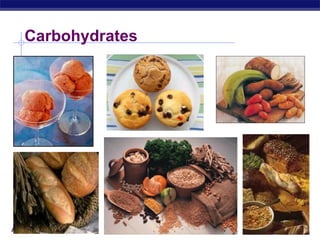
Carbohydrates
AP Biology 2006-2007
OH
OH
H
H
HO
CH2OH
H
H
H
OH
O
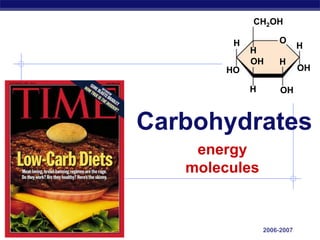
Carbohydrates
energy
molecules
AP Biology
Carbohydrates
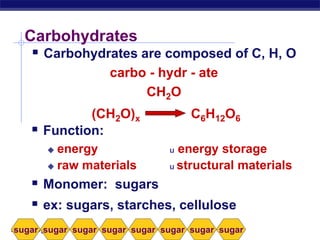
 Carbohydrates are composed of C, H, O
carbo - hydr - ate
CH2O
(CH2O)x C6H12O6
 Function:
 energy u energy storage
 raw materials u structural materials
 Monomer: sugars
 ex: sugars, starches, cellulose
sugar sugar sugar sugar sugar sugar sugarsugar
C6H12O6(CH2O)x
AP Biology
Sugars
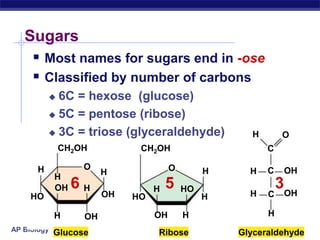
 Most names for sugars end in -ose
 Classified by number of carbons
 6C = hexose (glucose)
 5C = pentose (ribose)
 3C = triose (glyceraldehyde)
OH
OH
H
H
HO
CH2OH
H
H
H
OH
O
Glucose
H
OH
HO
O H
H
HO
H
Ribose
CH2OH
Glyceraldehyde
H
H
H
H
OH
OH
O
C
C
C
6 5 3
AP Biology
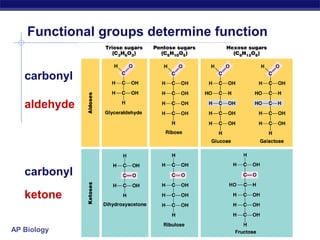
Functional groups determine function
carbonyl
ketone
aldehyde
carbonyl
AP Biology
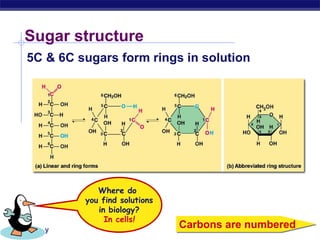
Sugar structure
5C & 6C sugars form rings in solution
Carbons are numbered
Where do
you find solutions
in biology?
In cells!
AP Biology
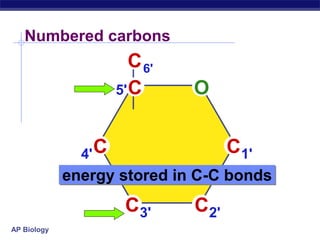
Numbered carbons
C
CC
C
C
C
1'
2'3'
4'
5'
6'
O
energy stored in C-C bonds
AP Biology
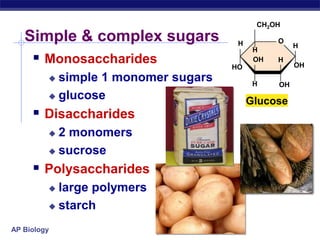
Simple & complex sugars
 Monosaccharides
 simple 1 monomer sugars
 glucose
 Disaccharides
 2 monomers
 sucrose
 Polysaccharides
 large polymers
 starch
OH
OH
H
H
HO
CH2OH
H
H
H
OH
O
Glucose
AP Biology
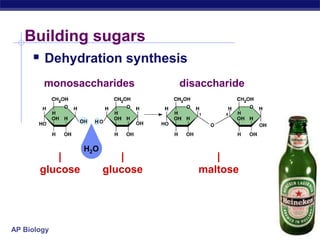
Building sugars
 Dehydration synthesis
|
glucose
|
glucose
monosaccharides disaccharide
|
maltose
H2O
AP Biology
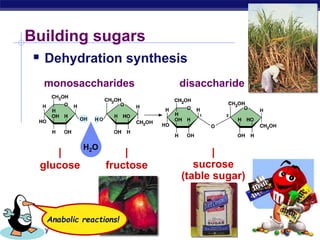
Building sugars
 Dehydration synthesis
|
fructose
|
glucose
monosaccharides
|
sucrose
(table sugar)
disaccharide
Anabolic reactions!
H2O
AP Biology
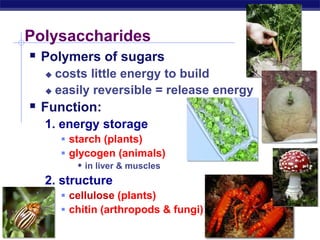
Polysaccharides
 Polymers of sugars
 costs little energy to build
 easily reversible = release energy
 Function:
1. energy storage
 starch (plants)
 glycogen (animals)
 in liver & muscles
2. structure
 cellulose (plants)
 chitin (arthropods & fungi)
AP Biology
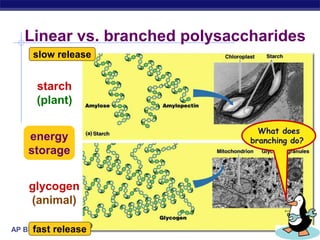
Linear vs. branched polysaccharides
starch
(plant)
glycogen
(animal)
energy
storage
What does
branching do?
slow release
fast release
AP Biology
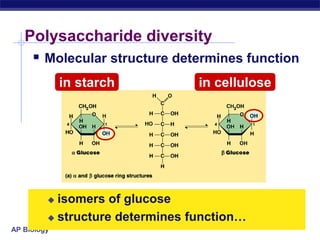
Polysaccharide diversity
 Molecular structure determines function
 isomers of glucose
 structure determines function…
in starch in cellulose
AP Biology
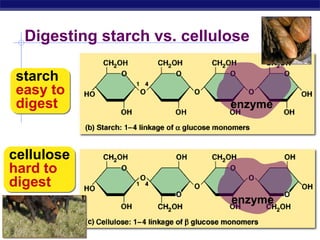
Digesting starch vs. cellulose
starch
easy to
digest enzyme
enzyme
cellulose
hard to
digest
AP Biology
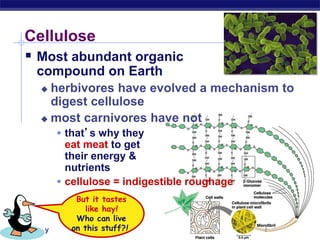
Cellulose
 Most abundant organic
compound on Earth
 herbivores have evolved a mechanism to
digest cellulose
 most carnivores have not
 that’s why they
eat meat to get
their energy &
nutrients
 cellulose = indigestible roughage
But it tastes
like hay!
Who can live
on this stuff?!
Regents Biology
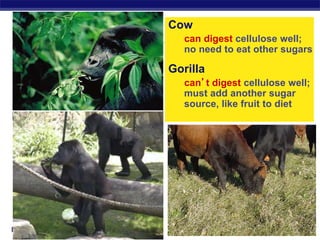
Cow
can digest cellulose well;
no need to eat other sugars
Gorilla
can’t digest cellulose well;
must add another sugar
source, like fruit to diet
Regents Biology
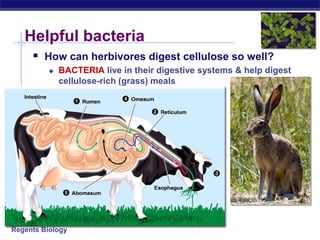
Helpful bacteria
 How can herbivores digest cellulose so well?
 BACTERIA live in their digestive systems & help digest
cellulose-rich (grass) meals
Regents Biology 2006-2007
Let’s build some
Carbohydrates!
EAT
X

Carbohydrates