AP Biology
Carbohydrates
AP Biology 2006-2007
OH
OH
H
H
HO
CH2OH
H
H
H
OH
O
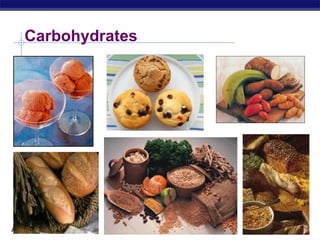
Carbohydrates
energy
molecules
AP Biology
Carbohydrates
 Carbohydrates are composed of C, H, O
carbo - hydr - ate
CH2O
(CH2O)x C6H12O6
 Function:
 energy  energy storage
 raw materials  structural
materials
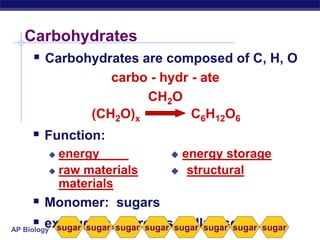
 Monomer: sugars
 ex: sugars, starches, cellulose
sugar sugar sugar sugar sugar sugar sugar
sugar
C6H12O6
(CH2O)x
AP Biology
Sugars
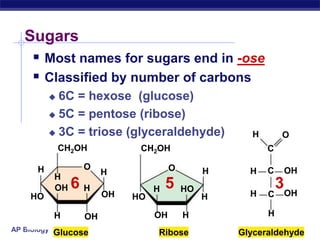
 Most names for sugars end in -ose
 Classified by number of carbons
 6C = hexose (glucose)
 5C = pentose (ribose)
 3C = triose (glyceraldehyde)
OH
OH
H
H
HO
CH2OH
H
H
H
OH
O
Glucose
H
OH
HO
O H
H
HO
H
Ribose
CH2OH
Glyceraldehyde
H
H
H
H
OH
OH
O
C
C
C
6 5 3
AP Biology
Functional groups determine function
carbonyl
ketone
aldehyde
carbonyl
AP Biology
Sugar structure
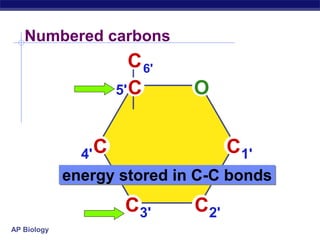
5C & 6C sugars form rings in solution
Carbons are numbered
Where do
you find solutions
in biology?
In cells!
AP Biology
Numbered carbons
C
C
C
C
C
C
1'
2'
3'
4'
5'
6'
O
energy stored in C-C bonds
AP Biology
QuickTime™ and a
TIFF (Uncompressed) decompressor
are needed to see this picture.
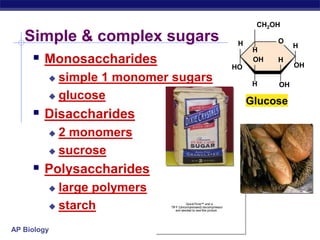
Simple & complex sugars
 Monosaccharides
 simple 1 monomer sugars
 glucose
 Disaccharides
 2 monomers
 sucrose
 Polysaccharides
 large polymers
 starch
OH
OH
H
H
HO
CH2OH
H
H
H
OH
O
Glucose
AP Biology
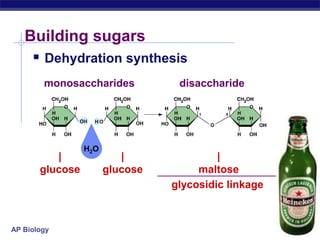
Building sugars
 Dehydration synthesis
glycosidic linkage
|
glucose
|
glucose
monosaccharides disaccharide
|
maltose
H2O
AP Biology
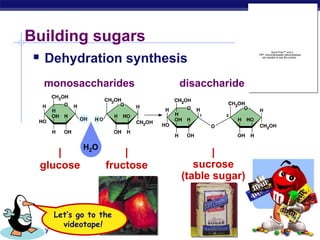
Building sugars
 Dehydration synthesis
|
fructose
|
glucose
monosaccharides
|
sucrose
(table sugar)
disaccharide
Let’s go to the
videotape!
H2O
QuickTime™ and a
TIFF (Uncompressed) decompressor
are needed to see this picture.
AP Biology
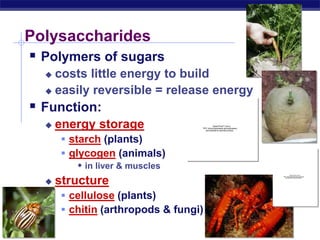
Polysaccharides
 Polymers of sugars
 costs little energy to build
 easily reversible = release energy
 Function:
 energy storage
 starch (plants)
 glycogen (animals)
 in liver & muscles
 structure
 cellulose (plants)
 chitin (arthropods & fungi)
QuickTime™ and a
TIFF (Uncompressed) decompressor
are needed to see this picture.
QuickTime™ and a
TIFF (Uncompressed) decompressor
are needed to see this picture.
AP Biology
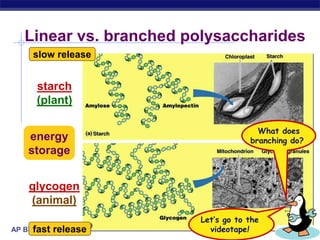
Linear vs. branched polysaccharides
starch
(plant)
glycogen
(animal)
energy
storage
What does
branching do?
Let’s go to the
videotape!
slow release
fast release
AP Biology
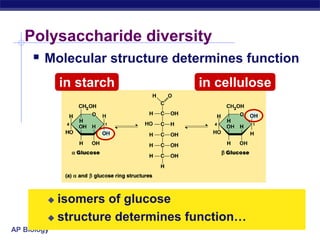
Polysaccharide diversity
 Molecular structure determines function
 isomers of glucose
 structure determines function…
in starch in cellulose
AP Biology
Digesting starch vs. cellulose
starch
easy to
digest enzyme
enzyme
cellulose
hard to
digest
AP Biology
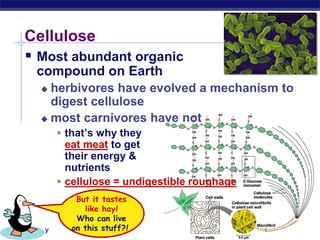
Cellulose
 Most abundant organic
compound on Earth
 herbivores have evolved a mechanism to
digest cellulose
 most carnivores have not
 that’s why they
eat meat to get
their energy &
nutrients
 cellulose = undigestible roughage
But it tastes
like hay!
Who can live
on this stuff?!
Regents Biology
Cow
can digest cellulose well;
no need to eat other sugars
Gorilla
can’t digest cellulose well;
must add another sugar
source, like fruit to diet
Regents Biology
Q
u
i
c
k
T
i
m
e
™
a
n
d
a
T
I
F
F
(
U
n
c
o
m
p
r
e
s
s
e
d
)
d
e
c
o
m
p
r
e
s
s
o
r
a
r
e
n
e
e
d
e
d
t
o
s
e
e
t
h
i
s
p
i
c
t
u
r
e
.
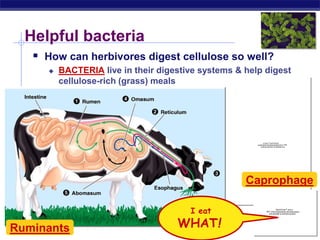
Helpful bacteria
 How can herbivores digest cellulose so well?
 BACTERIA live in their digestive systems & help digest
cellulose-rich (grass) meals
Ruminants
QuickTime™ and a
TIFF (Uncompressed) decompressor
are needed to see this picture.
Tell me about
the rabbits,
again, George!
I eat
WHAT!
Caprophage
Regents Biology 2006-2007
Let’s build some
Carbohydrates!
EAT
X

ch_5_carbohydrates.ppt