The unbroken chain of life 
http://www.flickr.com/photos/euthman/216030298/
Processes needed for the spontaneous origin of life on Earth 
1) The non-living synthesis of simple organic molecules 
• Obviously if nothing was alive yet then the source of these molecules had to be abiotic 
• We can presume that the early Earth had all of the base elements and compounds required 
• They were somehow combined to make simple organic compounds 
• Maybe the organic compounds were generated here, maybe they were extra-terrestrial! 
2) The assembly of these molecules into polymers 
• It makes sense, to make the larger molecules necessary for life, the simple organic 
compounds would have to polymerise 
3) The origin of self-replicating molecules made inheritance possible 
• DNA can’t self replicate, it needs protein enzymes 
• However some RNA can self-replicate, it can catalyse 
the formation of copies of itself. 
• The 64 RNA codons for amino acids is the same in nearly 
All forms of life on earth with some variation. 
4) The packaging of these molecules into membranes 
with internal chemistry different from their 
surroundings 
• The formation of closed membranes an important step 
• Closed membrane vesicles can form spontaneously 
from lipids. 
• This allowed differentiation between the internal and external environments 
http://exploringorigins.org/resources.html
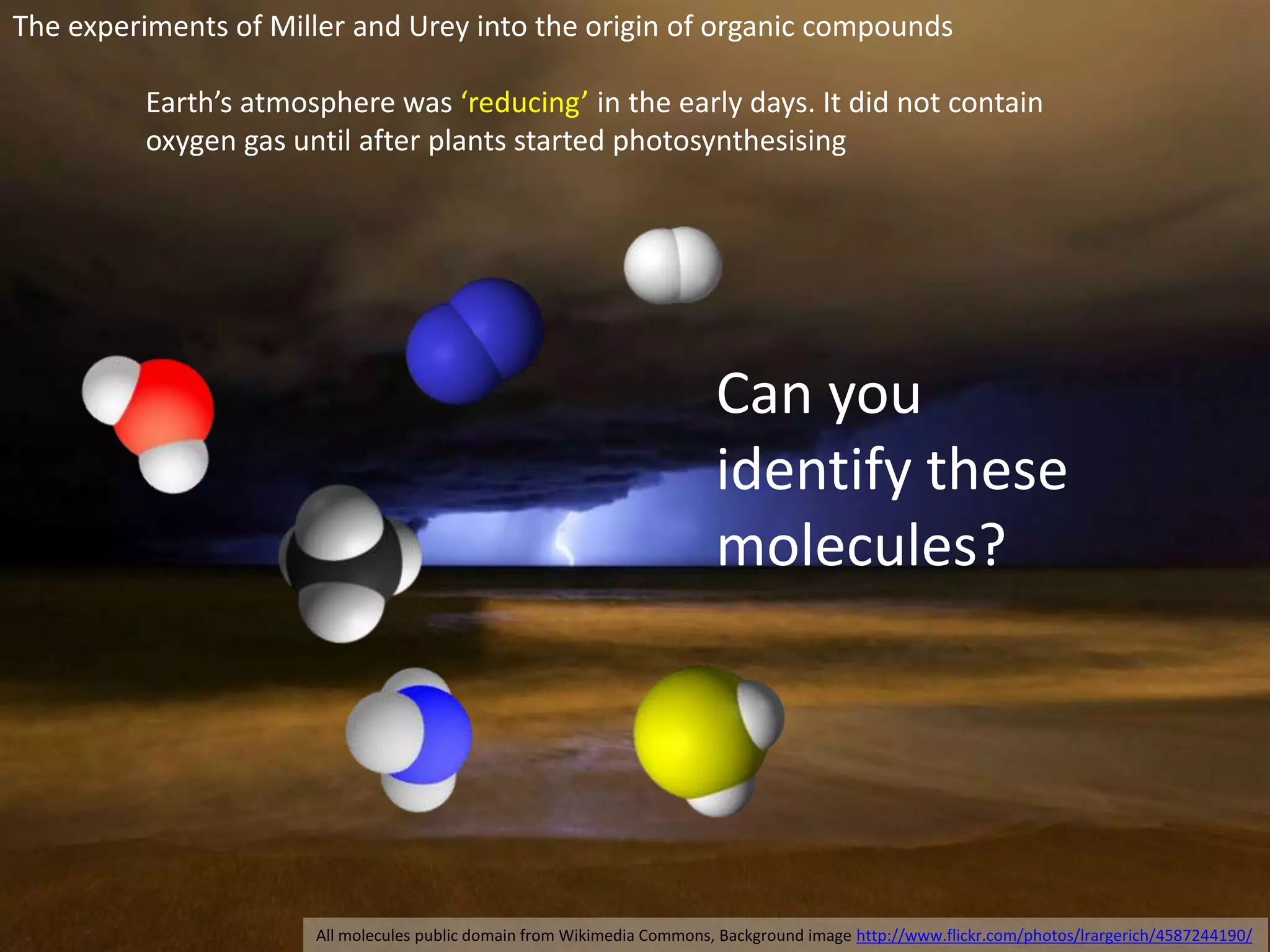
The experiments of Miller and Urey into the origin of organic compounds 
Earth’s atmosphere was ‘reducing’ in the early days. It did not contain 
oxygen gas until after plants started photosynthesising 
Can you 
identify these 
molecules? 
All molecules public domain from Wikimedia Commons, Background image http://www.flickr.com/photos/lrargerich/4587244190/
The experiments of Miller and Urey into the origin of organic compounds 
Earth’s atmosphere was ‘reducing’ in the early days. It did not contain 
oxygen gas until after plants started photosynthesising 
The atmosphere contained: 
Hydrogen 
Nitrogen 
Water vapour 
Methane 
Ammonia 
Hydrogen sulfide 
The gases came from 
abundant volcanic activity 
All molecules public domain from Wikimedia Commons, Background image http://www.flickr.com/photos/lrargerich/4587244190/
These monomers mixed in the ‘primeval soup’, shallow oceans laden with chemicals 
where it is thought that they reacted to form biological molecules 
Miller and Urey tried to recreate these conditions in the lab in 1953 
They were trying to demonstrate ‘chemical evolution’, the formation of more complex 
molecules from simpler stock in the primeval soup 
They combined the molecules from the previous page in a closed glass vessel 
(simulated atmosphere), they heated the water (simulated volcanic activity) and 
sparked electricity through the gases (simulated lightning) 
http://www.flickr.com/photos/afeman/663646181/
Carny http://upload.wikimedia.org/wikipedia/commons/5/59/MUexperiment.png
After a week they found: 
Thirteen of the twenty naturally occurring amino acids 
Around 15% of the carbon was now in 
organic compounds
D.1.3 State that comets may have delivered organic compounds to Earth 
Panspermia is the hypothesis 
that life on Earth originated 
from material delivered by a 
comet, either in the form of 
amino acids or as hardy 
bacteria 
Existing bacteria and archaebacteria have been found in odd 
and extreme environments on Earth: 
In hot springs, kilometres deep in the crust and even 
embedded in ice cores from deep inside Antarctica 
Space is so 
empty, yet full 
of the 
potential for 
life 
It is feasible that they could survive on or in a comet
Cosmic radiation could provide 
the energy for reactions that lead 
to the formation of complex 
organic molecules 
Analysis of the spectra of light 
coming from the comets reveals 
the presence of hydrocarbons, 
amino acids and peptides 
The bombardment of 
Earth by comets 4 
billion years ago 
could have ‘kick 
started’ chemical 
evolution
D.1.3 Discuss possible locations where conditions could have allowed the synthesis of 
organic compounds 
Problem: The water in the Miller Urey experiment 
tends to hydrolyse any polymers as they form and 
prevents their formation. The conditions in the 
ocean not ideal for polymerisation 
Solution: “black smokers”, hydrothermal vents where 
superheated steam escapes from within the crust. 
The outflow is full of dissolved sulfides that crystallise around 
the vent and may be a suitable environment for the formation 
and concentration of complex biological compounds
Volcanoes may also have played a part: 
Gases from above hot lava lakes have been found to 
contain a higher than average level of fixed nitrogen Nitrogen fixation is the 
formation of ammonia (NH4) 
from nitrogen gas (N2). 
The Haber process is a 
modern industrial way to fix 
nitrogen and it requires high 
pressures (200 atm) and high 
temperatures (400 °C) 
Volcanoes and geysers 
may have provided a suitable 
location for the formation of 
biological compounds 
The hypothesis that life originated 
on Earth is called abiogenesis 
(ab bio genesis) 
(aboriginal – life – creation) 
http://www.flickr.com/photos/storm-crypt/3043902298/
The hypothesis that life came an extraterrestrial source: 
As previously mentioned, organic molecules are out there 
Mars is smaller than Earth and therefore cooled down more 
quickly, life could have begun there while Earth was still scorching 
Meteorites and comets impacting on mars could have thrown up debris with 
early life attached, this could then have crashed on Earth. 
Meteorites of Mars origin have been found in Antarctica 
There is no evidence that life has been transferred in this way. Every now and then 
there is a news story about “Fossils found in Mars meteorite” 
but so far this has not been confirmed 
The extraterrestrial hypothesis still doesn’t address how life formed, 
just how it could move around the galaxy 
http://images.cdn.fotopedia.com/flickr-2406913018-hd.jpg
D.1.5 Outline Two properties of RNA that would have allowed it to play a role in the origin of life 
RNAs can store, transmit and replicate genetic Information 
Ribozymes are RNA molecules that can catalyse reactions 
(Hey! You told us that all enzymes are proteins! Liar!) 
Some can polymerise nucleotides using ATP 
Some can break chemical bonds, including peptide bonds 
Ribosomes are themselves Ribozymes (huh?). 
The part that catalyses the peptide bonds is RNA, the protein part of a ribosome 
seems to have a purely structural function 
Evolution by natural selection requires variation and heritability. RNA possesses these traits 
http://genetics.mgh.harvard.edu/szostakweb/exploringOriginsDownloads/centralDogma.jpg
D.1.6 State that living cells may have been preceded by protobionts, 
with an internal chemical environment different from their surroundings 
(Proto = first, or precursor) 
Coacervates are droplets of polymeric molecules. 
Coacervates containing enzyes can absorb 
and concentrate substrate molecules 
and then release the products to 
their surrounds 
If they absorb a lot of material they 
can divide into two smaller 
coacervate droplets 
This is not true reproduction though 
so they are not alive. 
An illustration of a protocell, 
composed of a fatty acid membrane 
encapsulating RNA ribozymes. 
http://exploringorigins.org/protocells.html
• Protobionts may have arisen from coacervates. 
• Coacervates containing RNA may have started synthesising proteins 
• Enzyme controlled binary fission may have arisen. 
• The first true cells probably heterotrophic (maybe getting energy from 
sulfur chemistry) and anaerobic (there was no free oxygen) 
Microspheres: are another candidate 
for a structure that might have given 
rise to protobionts. 
They form when amino acids are 
heated and polymerise to form 
simple proteins (thermal proteins) 
http://www.daviddarling.info/encyclopedia/M/microsphere.html 
One milligram of 
thermal proteins can 
make 100 million 
microspheres! 
They divide like coacervates 
and can catalyse some reactions
The contribution of prokaryotes to the creation of an oxygen-rich atmosphere 
Remember: there was little free oxygen in the early 
atmosphere 
Small amounts were made by UV light splitting water 
vapour in the atmosphere 
After about 2 billion years of prokaryote life (2 billion years ago) there 
was an Earth changing event: a form of chlorophyll appeared in 
bacteria that allowed oxygenic photosynthesis 
The increase in Oxygen led to: 
• The breakdown of the chemicals in the ‘chemical soup’ to carbon dioxide 
The oxygen concentration rose to 0.45% of the atmosphere 
Not much compared to today’s 21%, but it coincides with the rise of the Eukaryotes 
COINCIDENCE? Probably not. 
and oxidised sediments 
• The formation of the ozone layer, which blocked out UV and stopped the 
production of more of the ‘soupy’ molecules
D.1.8 Discuss the endosymbiotic theory for the origin of eukaryotes 
Endosymbiosis is the theory 
that chloroplasts and 
mitochondria were once free-living 
prokaryotes that were 
engulfed by larger prokaryotes 
and survived to evolve into the 
modern organelles 
Evidence in support: 
1. Mitochondria and Chloroplasts have their 
own DNA that is more like bacterial DNA 
than what is found in the nucleus 
2. The structure and biochemistry of 
chloroplasts is similar to cyanobacteria 
3. New organelles are made by a process that 
resembles binary fission 
4. Both organelles have a double membrane 
which resembles the structure of 
prokaryotic cells 
5. Their ribosomes resemble those of bacteria 
(70S) 
6. DNA analysis suggests that some DNA in 
plant nuclei was previously in the 
chloroplast 
7. Some proteins coded for in the nucleus are 
transported to the organelles. The 
organelles have lost the DNA to make it 
themselves.
Further information:

Origin of life

  • 1.
    The unbroken chainof life http://www.flickr.com/photos/euthman/216030298/
  • 2.
    Processes needed forthe spontaneous origin of life on Earth 1) The non-living synthesis of simple organic molecules • Obviously if nothing was alive yet then the source of these molecules had to be abiotic • We can presume that the early Earth had all of the base elements and compounds required • They were somehow combined to make simple organic compounds • Maybe the organic compounds were generated here, maybe they were extra-terrestrial! 2) The assembly of these molecules into polymers • It makes sense, to make the larger molecules necessary for life, the simple organic compounds would have to polymerise 3) The origin of self-replicating molecules made inheritance possible • DNA can’t self replicate, it needs protein enzymes • However some RNA can self-replicate, it can catalyse the formation of copies of itself. • The 64 RNA codons for amino acids is the same in nearly All forms of life on earth with some variation. 4) The packaging of these molecules into membranes with internal chemistry different from their surroundings • The formation of closed membranes an important step • Closed membrane vesicles can form spontaneously from lipids. • This allowed differentiation between the internal and external environments http://exploringorigins.org/resources.html
  • 3.
    The experiments ofMiller and Urey into the origin of organic compounds Earth’s atmosphere was ‘reducing’ in the early days. It did not contain oxygen gas until after plants started photosynthesising Can you identify these molecules? All molecules public domain from Wikimedia Commons, Background image http://www.flickr.com/photos/lrargerich/4587244190/
  • 4.
    The experiments ofMiller and Urey into the origin of organic compounds Earth’s atmosphere was ‘reducing’ in the early days. It did not contain oxygen gas until after plants started photosynthesising The atmosphere contained: Hydrogen Nitrogen Water vapour Methane Ammonia Hydrogen sulfide The gases came from abundant volcanic activity All molecules public domain from Wikimedia Commons, Background image http://www.flickr.com/photos/lrargerich/4587244190/
  • 5.
    These monomers mixedin the ‘primeval soup’, shallow oceans laden with chemicals where it is thought that they reacted to form biological molecules Miller and Urey tried to recreate these conditions in the lab in 1953 They were trying to demonstrate ‘chemical evolution’, the formation of more complex molecules from simpler stock in the primeval soup They combined the molecules from the previous page in a closed glass vessel (simulated atmosphere), they heated the water (simulated volcanic activity) and sparked electricity through the gases (simulated lightning) http://www.flickr.com/photos/afeman/663646181/
  • 6.
  • 7.
    After a weekthey found: Thirteen of the twenty naturally occurring amino acids Around 15% of the carbon was now in organic compounds
  • 8.
    D.1.3 State thatcomets may have delivered organic compounds to Earth Panspermia is the hypothesis that life on Earth originated from material delivered by a comet, either in the form of amino acids or as hardy bacteria Existing bacteria and archaebacteria have been found in odd and extreme environments on Earth: In hot springs, kilometres deep in the crust and even embedded in ice cores from deep inside Antarctica Space is so empty, yet full of the potential for life It is feasible that they could survive on or in a comet
  • 9.
    Cosmic radiation couldprovide the energy for reactions that lead to the formation of complex organic molecules Analysis of the spectra of light coming from the comets reveals the presence of hydrocarbons, amino acids and peptides The bombardment of Earth by comets 4 billion years ago could have ‘kick started’ chemical evolution
  • 10.
    D.1.3 Discuss possiblelocations where conditions could have allowed the synthesis of organic compounds Problem: The water in the Miller Urey experiment tends to hydrolyse any polymers as they form and prevents their formation. The conditions in the ocean not ideal for polymerisation Solution: “black smokers”, hydrothermal vents where superheated steam escapes from within the crust. The outflow is full of dissolved sulfides that crystallise around the vent and may be a suitable environment for the formation and concentration of complex biological compounds
  • 11.
    Volcanoes may alsohave played a part: Gases from above hot lava lakes have been found to contain a higher than average level of fixed nitrogen Nitrogen fixation is the formation of ammonia (NH4) from nitrogen gas (N2). The Haber process is a modern industrial way to fix nitrogen and it requires high pressures (200 atm) and high temperatures (400 °C) Volcanoes and geysers may have provided a suitable location for the formation of biological compounds The hypothesis that life originated on Earth is called abiogenesis (ab bio genesis) (aboriginal – life – creation) http://www.flickr.com/photos/storm-crypt/3043902298/
  • 12.
    The hypothesis thatlife came an extraterrestrial source: As previously mentioned, organic molecules are out there Mars is smaller than Earth and therefore cooled down more quickly, life could have begun there while Earth was still scorching Meteorites and comets impacting on mars could have thrown up debris with early life attached, this could then have crashed on Earth. Meteorites of Mars origin have been found in Antarctica There is no evidence that life has been transferred in this way. Every now and then there is a news story about “Fossils found in Mars meteorite” but so far this has not been confirmed The extraterrestrial hypothesis still doesn’t address how life formed, just how it could move around the galaxy http://images.cdn.fotopedia.com/flickr-2406913018-hd.jpg
  • 13.
    D.1.5 Outline Twoproperties of RNA that would have allowed it to play a role in the origin of life RNAs can store, transmit and replicate genetic Information Ribozymes are RNA molecules that can catalyse reactions (Hey! You told us that all enzymes are proteins! Liar!) Some can polymerise nucleotides using ATP Some can break chemical bonds, including peptide bonds Ribosomes are themselves Ribozymes (huh?). The part that catalyses the peptide bonds is RNA, the protein part of a ribosome seems to have a purely structural function Evolution by natural selection requires variation and heritability. RNA possesses these traits http://genetics.mgh.harvard.edu/szostakweb/exploringOriginsDownloads/centralDogma.jpg
  • 14.
    D.1.6 State thatliving cells may have been preceded by protobionts, with an internal chemical environment different from their surroundings (Proto = first, or precursor) Coacervates are droplets of polymeric molecules. Coacervates containing enzyes can absorb and concentrate substrate molecules and then release the products to their surrounds If they absorb a lot of material they can divide into two smaller coacervate droplets This is not true reproduction though so they are not alive. An illustration of a protocell, composed of a fatty acid membrane encapsulating RNA ribozymes. http://exploringorigins.org/protocells.html
  • 15.
    • Protobionts mayhave arisen from coacervates. • Coacervates containing RNA may have started synthesising proteins • Enzyme controlled binary fission may have arisen. • The first true cells probably heterotrophic (maybe getting energy from sulfur chemistry) and anaerobic (there was no free oxygen) Microspheres: are another candidate for a structure that might have given rise to protobionts. They form when amino acids are heated and polymerise to form simple proteins (thermal proteins) http://www.daviddarling.info/encyclopedia/M/microsphere.html One milligram of thermal proteins can make 100 million microspheres! They divide like coacervates and can catalyse some reactions
  • 16.
    The contribution ofprokaryotes to the creation of an oxygen-rich atmosphere Remember: there was little free oxygen in the early atmosphere Small amounts were made by UV light splitting water vapour in the atmosphere After about 2 billion years of prokaryote life (2 billion years ago) there was an Earth changing event: a form of chlorophyll appeared in bacteria that allowed oxygenic photosynthesis The increase in Oxygen led to: • The breakdown of the chemicals in the ‘chemical soup’ to carbon dioxide The oxygen concentration rose to 0.45% of the atmosphere Not much compared to today’s 21%, but it coincides with the rise of the Eukaryotes COINCIDENCE? Probably not. and oxidised sediments • The formation of the ozone layer, which blocked out UV and stopped the production of more of the ‘soupy’ molecules
  • 17.
    D.1.8 Discuss theendosymbiotic theory for the origin of eukaryotes Endosymbiosis is the theory that chloroplasts and mitochondria were once free-living prokaryotes that were engulfed by larger prokaryotes and survived to evolve into the modern organelles Evidence in support: 1. Mitochondria and Chloroplasts have their own DNA that is more like bacterial DNA than what is found in the nucleus 2. The structure and biochemistry of chloroplasts is similar to cyanobacteria 3. New organelles are made by a process that resembles binary fission 4. Both organelles have a double membrane which resembles the structure of prokaryotic cells 5. Their ribosomes resemble those of bacteria (70S) 6. DNA analysis suggests that some DNA in plant nuclei was previously in the chloroplast 7. Some proteins coded for in the nucleus are transported to the organelles. The organelles have lost the DNA to make it themselves.
  • 18.