CARBOHYDRATE
Carbohydrates, as the name implies, are composed mainly of carbon, hydrogen
and oxygen with the latter two elements in the ratio of 2 to 1 as in water. These
compounds may be represented by the general formula Cx(H2O)y, where x and y may
be same or different. For example, we can write glucose C6H12O6, as C6(H2O)6, and
sucrose C12H22O11, as C12(H2O)11.
Structurally, carbohydrates are polyfunctional compounds. They contain two types of
functional groups, the hydroxyl group and the carbonyl group.
Carbohydrates are
 polyhydroxy aldehydes
 polyhydroxy ketones or
 compounds that can be hydrolyzed to them
CLASSIFICATION OF CARBOHYDRATE
Based on Hydrolysis
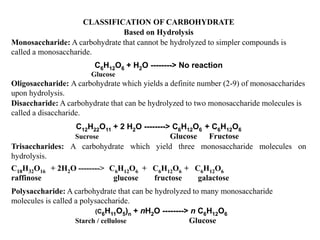
Monosaccharide: A carbohydrate that cannot be hydrolyzed to simpler compounds is
called a monosaccharide.
C6H12O6 + H2O --------> No reaction
Glucose
Oligosaccharide: A carbohydrate which yields a definite number (2-9) of monosaccharides
upon hydrolysis.
Disaccharide: A carbohydrate that can be hydrolyzed to two monosaccharide molecules is
called a disaccharide.
C12H22O11 + 2 H2O --------> C6H12O6 + C6H12O6
Sucrose Glucose Fructose
Trisaccharides: A carbohydrate which yield three monosaccharide molecules on
hydrolysis.
C18H32O16 + 2H2O --------> C6H12O6 + C6H12O6 + C6H12O6
raffinose glucose fructose galactose
Polysaccharide: A carbohydrate that can be hydrolyzed to many monosaccharide
molecules is called a polysaccharide.
(C6H11O5)n + nH2O --------> n C6H12O6
Starch / cellulose Glucose
Classification of monosaccharide:
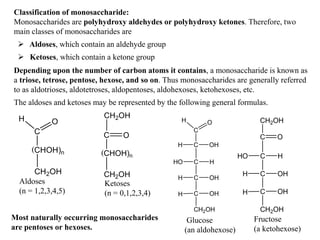
Monosaccharides are polyhydroxy aldehydes or polyhydroxy ketones. Therefore, two
main classes of monosaccharides are
 Aldoses, which contain an aldehyde group
 Ketoses, which contain a ketone group
Depending upon the number of carbon atoms it contains, a monosaccharide is known as
a triose, tetrose, pentose, hexose, and so on. Thus monosaccharides are generally referred
to as aldotrioses, aldotetroses, aldopentoses, aldohexoses, ketohexoses, etc.
The aldoses and ketoses may be represented by the following general formulas.
C
O
H
CHOH)n
CH2OH
(
C O
CH2OH
CHOH)n
CH2OH
(
Aldoses
(n = 1,2,3,4,5)
Ketoses
(n = 0,1,2,3,4)
Most naturally occurring monosaccharides
are pentoses or hexoses.
C
O
H
C
C
H OH
C
C
CH2OH
HO H
H OH
H OH
CH2OH
C
C
C
C
CH2OH
HO H
H OH
H OH
O
Glucose
(an aldohexose)
Fructose
(a ketohexose)
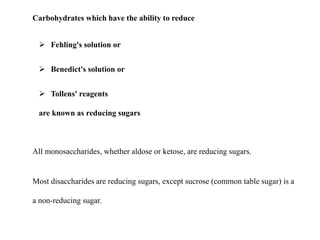
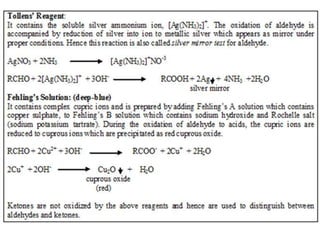
Carbohydrates which have the ability to reduce
 Fehling's solution or
 Benedict's solution or
 Tollens' reagents
are known as reducing sugars
All monosaccharides, whether aldose or ketose, are reducing sugars.
Most disaccharides are reducing sugars, except sucrose (common table sugar) is a
a non-reducing sugar.
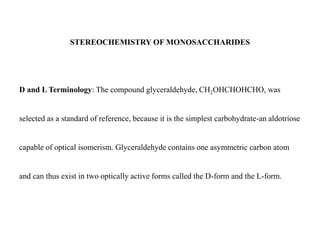
STEREOCHEMISTRY OF MONOSACCHARIDES
D and L Terminology: The compound glyceraldehyde, CH2OHCHOHCHO, was
selected as a standard of reference, because it is the simplest carbohydrate-an aldotriose
capable of optical isomerism. Glyceraldehyde contains one asymmetric carbon atom
and can thus exist in two optically active forms called the D-form and the L-form.
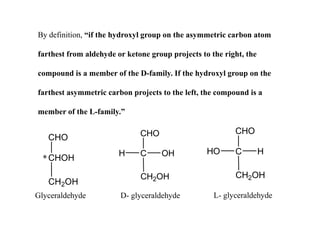
By definition, “if the hydroxyl group on the asymmetric carbon atom
farthest from aldehyde or ketone group projects to the right, the
compound is a member of the D-family. If the hydroxyl group on the
farthest asymmetric carbon projects to the left, the compound is a
member of the L-family.”
CHO
CHOH
CH2OH
*
CHO
C
CH2OH
OH
H
CHO
C
CH2OH
H
HO
Glyceraldehyde D- glyceraldehyde L- glyceraldehyde
Optical activity: An optically active compound is one that rotates the plane polarized
light to the right or to the left. If a compound rotates the plane-polarized light to the right,
it is said to be dextrorotatory (Latin, dexter, right). This is indicated in the name of the
compound by the prefix sign (+).
On the other hand, if the compound rotates the plane-polarized light to the left,, the
compound is said to be laevorotatory (Latin, laeveus, left). The prefix sign (-) is used to
designate a laevorotatory compound.
D(+)-glyceraldehyde
(rotates plane-polarized
light to the right)
L(-)-glyceraldehyde
(rotates plane-polarized
light to the left)
CHO
C
CH2OH
H
HO
CHO
C
CH2OH
OH
H
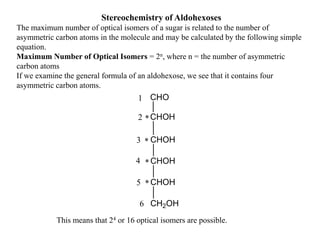
Stereochemistry of Aldohexoses
The maximum number of optical isomers of a sugar is related to the number of
asymmetric carbon atoms in the molecule and may be calculated by the following simple
equation.
Maximum Number of Optical Isomers = 2n, where n = the number of asymmetric
carbon atoms
If we examine the general formula of an aldohexose, we see that it contains four
asymmetric carbon atoms.
CHO
CHOH
CHOH
CHOH
CHOH
CH2OH
1
2
3
4
5
6
*
*
*
*
This means that 24 or 16 optical isomers are possible.
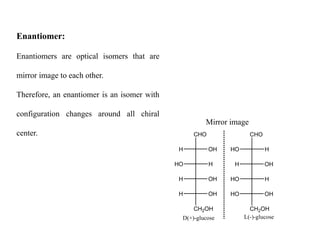
CHO
OH
H
H
HO
OH
H
OH
H
CH2OH
D(+)-glucose
CHO
H
HO
OH
H
H
HO
OH
HO
CH2OH
L(-)-glucose
Enantiomer:
Enantiomers are optical isomers that are
mirror image to each other.
Therefore, an enantiomer is an isomer with
configuration changes around all chiral
center.
Mirror image
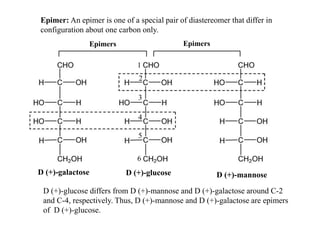
Epimer: An epimer is one of a special pair of diastereomer that differ in
configuration about one carbon only.
D (+)-glucose differs from D (+)-mannose and D (+)-galactose around C-2
and C-4, respectively. Thus, D (+)-mannose and D (+)-galactose are epimers
of D (+)-glucose.
Epimers Epimers
1
2
3
4
5
6
D (+)-glucose
D (+)-galactose D (+)-mannose
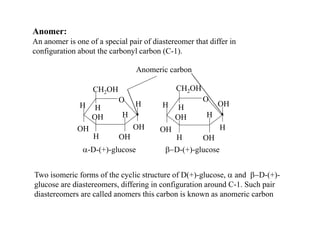
Anomer:
An anomer is one of a special pair of diastereomer that differ in
configuration about the carbonyl carbon (C-1).
Two isomeric forms of the cyclic structure of D(+)-glucose, a and b-D-(+)-
glucose are diastereomers, differing in configuration around C-1. Such pair
diastereomers are called anomers this carbon is known as anomeric carbon
O
H
OH
OH
H H H
OH
OH
H
CH2OH
O
H
OH
OH
H H
H
OH
OH
H
CH2OH
a-D-(+)-glucose b-D-(+)-glucose
Anomeric carbon
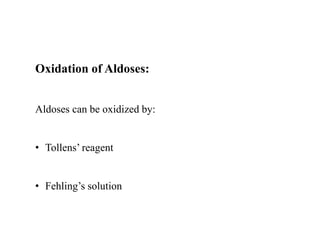
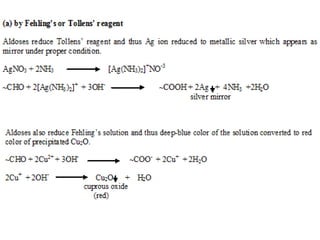
Oxidation of Aldoses:
Aldoses can be oxidized by:
• Tollens’ reagent
• Fehling’s solution
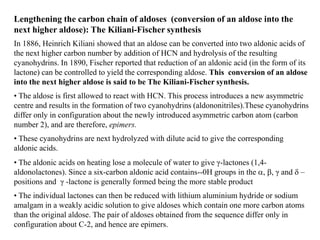
Lengthening the carbon chain of aldoses (conversion of an aldose into the
next higher aldose): The Kiliani-Fischer synthesis
In 1886, Heinrich Kiliani showed that an aldose can be converted into two aldonic acids of
the next higher carbon number by addition of HCN and hydrolysis of the resulting
cyanohydrins. In 1890, Fischer reported that reduction of an aldonic acid (in the form of its
lactone) can be controlled to yield the corresponding aldose. This conversion of an aldose
into the next higher aldose is said to be The Kiliani-Fischer synthesis.
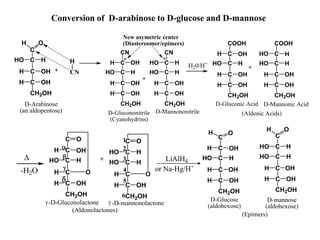
• The aldose is first allowed to react with HCN. This process introduces a new asymmetric
centre and results in the formation of two cyanohydrins (aldononitriles).These cyanohydrins
differ only in configuration about the newly introduced asymmetric carbon atom (carbon
number 2), and are therefore, epimers.
• These cyanohydrins are next hydrolyzed with dilute acid to give the corresponding
aldonic acids.
• The aldonic acids on heating lose a molecule of water to give γ-lactones (1,4-
aldonolactones). Since a six-carbon aldonic acid contains--0H groups in the a, b, γ and d –
positions and γ -lactone is generally formed being the more stable product
• The individual lactones can then be reduced with lithium aluminium hydride or sodium
amalgam in a weakly acidic solution to give aldoses which contain one more carbon atoms
than the original aldose. The pair of aldoses obtained from the sequence differ only in
configuration about C-2, and hence are epimers.
C
O
H
C
C
HO H
C
CH2OH
H OH
H OH
+ CN
H
D-Arabinose
(an aldopentose)
C
CN
C
C
HO H
C
CH2OH
H OH
H OH
OH
H * C
CN
C
C
HO H
C
CH2OH
H OH
H OH
H
HO
*
New asymetric center
(Diastereomer/epimers)
+
D-Glucononitrile
(Cyanohydrins)
D-Mannononitrile
C
COOH
C
C
HO H
C
CH2OH
H OH
H OH
OH
H C
COOH
C
C
HO H
C
CH2OH
H OH
H OH
H
HO
+
D-Gluconic Acid D-Mannonic Acid
(Aldonic Acids)
C
C
C
C
HO H
C
CH2OH
H OH
H OH
OH
H
O
H
C
C
C
C
HO H
C
CH2OH
H OH
H OH
H
HO
O
H
D-Glucose
(aldohexose)
D-mannose
(aldohexose)
(Epimers)
H20/H+

-H2O
C
C
C
C
HO H
C
CH2OH
H O
H OH
OH
H
+
O
a
b

C
C
C
C
HO H
C
CH2OH
H O
H OH
H
HO
O
1
2
3
4
5
6
-D-Gluconolactone -D-mannonolactone
 
(Aldonolactones)
LiAlH4
or Na-Hg/H+
Conversion of D-arabinose to D-glucose and D-mannose
d
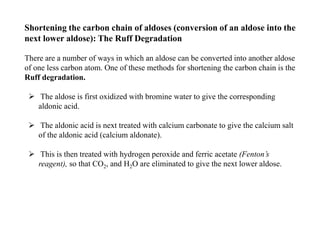
Shortening the carbon chain of aldoses (conversion of an aldose into the
next lower aldose): The Ruff Degradation
There are a number of ways in which an aldose can be converted into another aldose
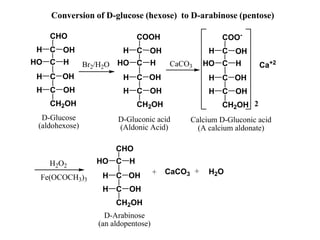
of one less carbon atom. One of these methods for shortening the carbon chain is the
Ruff degradation.
 The aldose is first oxidized with bromine water to give the corresponding
aldonic acid.
 The aldonic acid is next treated with calcium carbonate to give the calcium salt
of the aldonic acid (calcium aldonate).
 This is then treated with hydrogen peroxide and ferric acetate (Fenton’s
reagent), so that CO2, and H2O are eliminated to give the next lower aldose.
C
CHO
C
C
HO H
C
CH2OH
H OH
H OH
OH
H
D-Glucose
(aldohexose)
C
COOH
C
C
HO H
C
CH2OH
H OH
H OH
OH
H
D-Gluconic acid
(Aldonic Acid)
C
COO-
C
C
HO H
C
CH2OH
H OH
H OH
OH
H
Calcium D-Gluconic acid
(A calcium aldonate)
Ca+2
CHO
C
C
HO H
C
CH2OH
H OH
H OH
+ CaCO3 + H2O
H2O2
Fe(OCOCH3)3
D-Arabinose
(an aldopentose)
Br2/H2O CaCO3
2
Conversion of D-glucose (hexose) to D-arabinose (pentose)
Carbohydrate.ppt
Carbohydrate.ppt
Carbohydrate.ppt
Carbohydrate.ppt
Carbohydrate.ppt
Carbohydrate.ppt

Carbohydrate.ppt

  • 1.
    CARBOHYDRATE Carbohydrates, as thename implies, are composed mainly of carbon, hydrogen and oxygen with the latter two elements in the ratio of 2 to 1 as in water. These compounds may be represented by the general formula Cx(H2O)y, where x and y may be same or different. For example, we can write glucose C6H12O6, as C6(H2O)6, and sucrose C12H22O11, as C12(H2O)11. Structurally, carbohydrates are polyfunctional compounds. They contain two types of functional groups, the hydroxyl group and the carbonyl group. Carbohydrates are  polyhydroxy aldehydes  polyhydroxy ketones or  compounds that can be hydrolyzed to them
  • 2.
    CLASSIFICATION OF CARBOHYDRATE Basedon Hydrolysis Monosaccharide: A carbohydrate that cannot be hydrolyzed to simpler compounds is called a monosaccharide. C6H12O6 + H2O --------> No reaction Glucose Oligosaccharide: A carbohydrate which yields a definite number (2-9) of monosaccharides upon hydrolysis. Disaccharide: A carbohydrate that can be hydrolyzed to two monosaccharide molecules is called a disaccharide. C12H22O11 + 2 H2O --------> C6H12O6 + C6H12O6 Sucrose Glucose Fructose Trisaccharides: A carbohydrate which yield three monosaccharide molecules on hydrolysis. C18H32O16 + 2H2O --------> C6H12O6 + C6H12O6 + C6H12O6 raffinose glucose fructose galactose Polysaccharide: A carbohydrate that can be hydrolyzed to many monosaccharide molecules is called a polysaccharide. (C6H11O5)n + nH2O --------> n C6H12O6 Starch / cellulose Glucose
  • 3.
    Classification of monosaccharide: Monosaccharidesare polyhydroxy aldehydes or polyhydroxy ketones. Therefore, two main classes of monosaccharides are  Aldoses, which contain an aldehyde group  Ketoses, which contain a ketone group Depending upon the number of carbon atoms it contains, a monosaccharide is known as a triose, tetrose, pentose, hexose, and so on. Thus monosaccharides are generally referred to as aldotrioses, aldotetroses, aldopentoses, aldohexoses, ketohexoses, etc. The aldoses and ketoses may be represented by the following general formulas. C O H CHOH)n CH2OH ( C O CH2OH CHOH)n CH2OH ( Aldoses (n = 1,2,3,4,5) Ketoses (n = 0,1,2,3,4) Most naturally occurring monosaccharides are pentoses or hexoses. C O H C C H OH C C CH2OH HO H H OH H OH CH2OH C C C C CH2OH HO H H OH H OH O Glucose (an aldohexose) Fructose (a ketohexose)
  • 4.
    Carbohydrates which havethe ability to reduce  Fehling's solution or  Benedict's solution or  Tollens' reagents are known as reducing sugars All monosaccharides, whether aldose or ketose, are reducing sugars. Most disaccharides are reducing sugars, except sucrose (common table sugar) is a a non-reducing sugar.
  • 5.
    STEREOCHEMISTRY OF MONOSACCHARIDES Dand L Terminology: The compound glyceraldehyde, CH2OHCHOHCHO, was selected as a standard of reference, because it is the simplest carbohydrate-an aldotriose capable of optical isomerism. Glyceraldehyde contains one asymmetric carbon atom and can thus exist in two optically active forms called the D-form and the L-form.
  • 6.
    By definition, “ifthe hydroxyl group on the asymmetric carbon atom farthest from aldehyde or ketone group projects to the right, the compound is a member of the D-family. If the hydroxyl group on the farthest asymmetric carbon projects to the left, the compound is a member of the L-family.” CHO CHOH CH2OH * CHO C CH2OH OH H CHO C CH2OH H HO Glyceraldehyde D- glyceraldehyde L- glyceraldehyde
  • 7.
    Optical activity: Anoptically active compound is one that rotates the plane polarized light to the right or to the left. If a compound rotates the plane-polarized light to the right, it is said to be dextrorotatory (Latin, dexter, right). This is indicated in the name of the compound by the prefix sign (+). On the other hand, if the compound rotates the plane-polarized light to the left,, the compound is said to be laevorotatory (Latin, laeveus, left). The prefix sign (-) is used to designate a laevorotatory compound. D(+)-glyceraldehyde (rotates plane-polarized light to the right) L(-)-glyceraldehyde (rotates plane-polarized light to the left) CHO C CH2OH H HO CHO C CH2OH OH H
  • 8.
    Stereochemistry of Aldohexoses Themaximum number of optical isomers of a sugar is related to the number of asymmetric carbon atoms in the molecule and may be calculated by the following simple equation. Maximum Number of Optical Isomers = 2n, where n = the number of asymmetric carbon atoms If we examine the general formula of an aldohexose, we see that it contains four asymmetric carbon atoms. CHO CHOH CHOH CHOH CHOH CH2OH 1 2 3 4 5 6 * * * * This means that 24 or 16 optical isomers are possible.
  • 9.
    CHO OH H H HO OH H OH H CH2OH D(+)-glucose CHO H HO OH H H HO OH HO CH2OH L(-)-glucose Enantiomer: Enantiomers are opticalisomers that are mirror image to each other. Therefore, an enantiomer is an isomer with configuration changes around all chiral center. Mirror image
  • 10.
    Epimer: An epimeris one of a special pair of diastereomer that differ in configuration about one carbon only. D (+)-glucose differs from D (+)-mannose and D (+)-galactose around C-2 and C-4, respectively. Thus, D (+)-mannose and D (+)-galactose are epimers of D (+)-glucose. Epimers Epimers 1 2 3 4 5 6 D (+)-glucose D (+)-galactose D (+)-mannose
  • 11.
    Anomer: An anomer isone of a special pair of diastereomer that differ in configuration about the carbonyl carbon (C-1). Two isomeric forms of the cyclic structure of D(+)-glucose, a and b-D-(+)- glucose are diastereomers, differing in configuration around C-1. Such pair diastereomers are called anomers this carbon is known as anomeric carbon O H OH OH H H H OH OH H CH2OH O H OH OH H H H OH OH H CH2OH a-D-(+)-glucose b-D-(+)-glucose Anomeric carbon
  • 12.
    Oxidation of Aldoses: Aldosescan be oxidized by: • Tollens’ reagent • Fehling’s solution
  • 15.
    Lengthening the carbonchain of aldoses (conversion of an aldose into the next higher aldose): The Kiliani-Fischer synthesis In 1886, Heinrich Kiliani showed that an aldose can be converted into two aldonic acids of the next higher carbon number by addition of HCN and hydrolysis of the resulting cyanohydrins. In 1890, Fischer reported that reduction of an aldonic acid (in the form of its lactone) can be controlled to yield the corresponding aldose. This conversion of an aldose into the next higher aldose is said to be The Kiliani-Fischer synthesis. • The aldose is first allowed to react with HCN. This process introduces a new asymmetric centre and results in the formation of two cyanohydrins (aldononitriles).These cyanohydrins differ only in configuration about the newly introduced asymmetric carbon atom (carbon number 2), and are therefore, epimers. • These cyanohydrins are next hydrolyzed with dilute acid to give the corresponding aldonic acids. • The aldonic acids on heating lose a molecule of water to give γ-lactones (1,4- aldonolactones). Since a six-carbon aldonic acid contains--0H groups in the a, b, γ and d – positions and γ -lactone is generally formed being the more stable product • The individual lactones can then be reduced with lithium aluminium hydride or sodium amalgam in a weakly acidic solution to give aldoses which contain one more carbon atoms than the original aldose. The pair of aldoses obtained from the sequence differ only in configuration about C-2, and hence are epimers.
  • 16.
    C O H C C HO H C CH2OH H OH HOH + CN H D-Arabinose (an aldopentose) C CN C C HO H C CH2OH H OH H OH OH H * C CN C C HO H C CH2OH H OH H OH H HO * New asymetric center (Diastereomer/epimers) + D-Glucononitrile (Cyanohydrins) D-Mannononitrile C COOH C C HO H C CH2OH H OH H OH OH H C COOH C C HO H C CH2OH H OH H OH H HO + D-Gluconic Acid D-Mannonic Acid (Aldonic Acids) C C C C HO H C CH2OH H OH H OH OH H O H C C C C HO H C CH2OH H OH H OH H HO O H D-Glucose (aldohexose) D-mannose (aldohexose) (Epimers) H20/H+  -H2O C C C C HO H C CH2OH H O H OH OH H + O a b  C C C C HO H C CH2OH H O H OH H HO O 1 2 3 4 5 6 -D-Gluconolactone -D-mannonolactone   (Aldonolactones) LiAlH4 or Na-Hg/H+ Conversion of D-arabinose to D-glucose and D-mannose d
  • 17.
    Shortening the carbonchain of aldoses (conversion of an aldose into the next lower aldose): The Ruff Degradation There are a number of ways in which an aldose can be converted into another aldose of one less carbon atom. One of these methods for shortening the carbon chain is the Ruff degradation.  The aldose is first oxidized with bromine water to give the corresponding aldonic acid.  The aldonic acid is next treated with calcium carbonate to give the calcium salt of the aldonic acid (calcium aldonate).  This is then treated with hydrogen peroxide and ferric acetate (Fenton’s reagent), so that CO2, and H2O are eliminated to give the next lower aldose.
  • 18.
    C CHO C C HO H C CH2OH H OH HOH OH H D-Glucose (aldohexose) C COOH C C HO H C CH2OH H OH H OH OH H D-Gluconic acid (Aldonic Acid) C COO- C C HO H C CH2OH H OH H OH OH H Calcium D-Gluconic acid (A calcium aldonate) Ca+2 CHO C C HO H C CH2OH H OH H OH + CaCO3 + H2O H2O2 Fe(OCOCH3)3 D-Arabinose (an aldopentose) Br2/H2O CaCO3 2 Conversion of D-glucose (hexose) to D-arabinose (pentose)