Try it!
Warm-Up
Try it!
Warm-Up
Try it!
Warm-Up
13 letters
Try it!
Warm-Up
8 letters
Try it!
Warm-Up
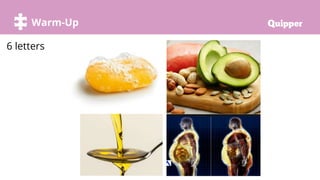
6 letters
Try it!
Warm-Up
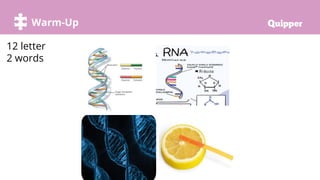
12 letter
2 words
Try it!
Warm-Up
Lesson 21.1
Carbohydrates
Learning Competency
Recognize the major categories of biomolecules such
as carbohydrates, lipids, proteins, and nucleic acids
(S10MT-IVc-d-22).
At the end of this lesson, the given DepEd learning
competency should be met by the students.
Learning Objectives
At the end of this lesson, the learner should be able to
do the following:
● Recognize carbohydrates as one of the major
categories of biomolecules.
● Explain the functions of carbohydrates in the
processes of life.
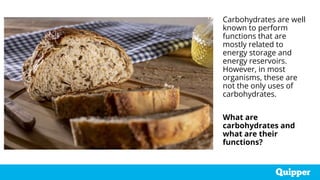
Carbohydrates are well
known to perform
functions that are
mostly related to
energy storage and
energy reservoirs.
However, in most
organisms, these are
not the only uses of
carbohydrates.
What are
carbohydrates and
what are their
functions?
Learn about It
Learn about It
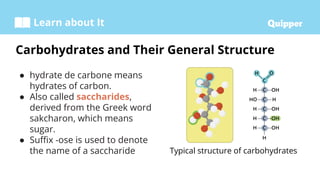
● hydrate de carbone means
hydrates of carbon.
● Also called saccharides,
derived from the Greek word
sakcharon, which means
sugar.
● Suffix -ose is used to denote
the name of a saccharide
Carbohydrates and Their General Structure
Typical structure of carbohydrates
Learn about It
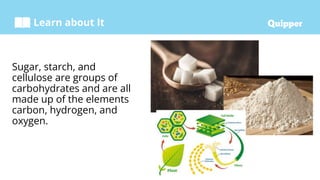
Sugar, starch, and
cellulose are groups of
carbohydrates and are all
made up of the elements
carbon, hydrogen, and
oxygen.
Learn about It
● Carbohydrates are
molecules that are
composed of carbon,
hydrogen, and oxygen.
They have the general
formula CnH2nOn.
Carbohydrates and Their General Structure
Typical structure of carbohydrates
Learn about It
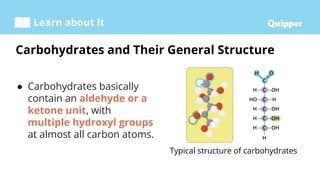
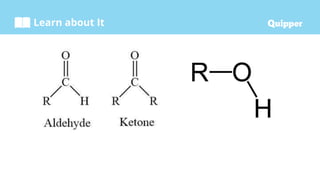
● Carbohydrates basically
contain an aldehyde or a
ketone unit, with
multiple hydroxyl groups
at almost all carbon atoms.
Carbohydrates and Their General Structure
Typical structure of carbohydrates
Learn about It
Learn about It
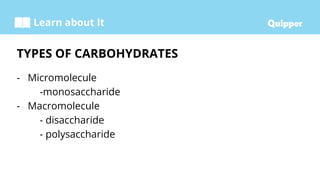
- Micromolecule
-monosaccharide
- Macromolecule
- disaccharide
- polysaccharide
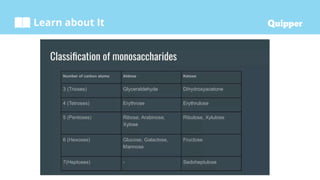
TYPES OF CARBOHYDRATES
Learn about It
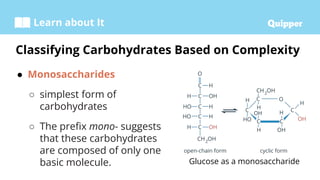
● Monosaccharides
○ simplest form of
carbohydrates
○ The prefix mono- suggests
that these carbohydrates
are composed of only one
basic molecule.
Classifying Carbohydrates Based on Complexity
Glucose as a monosaccharide
Learn about It
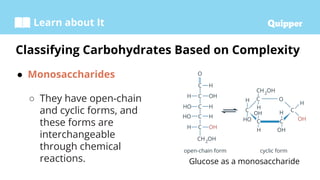
● Monosaccharides
○ They have open-chain
and cyclic forms, and
these forms are
interchangeable
through chemical
reactions.
Classifying Carbohydrates Based on Complexity
Glucose as a monosaccharide
Learn about It
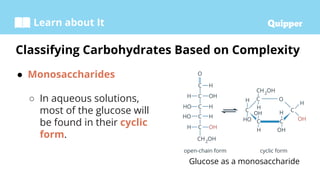
● Monosaccharides
○ In aqueous solutions,
most of the glucose will
be found in their cyclic
form.
Classifying Carbohydrates Based on Complexity
Glucose as a monosaccharide
Learn about It
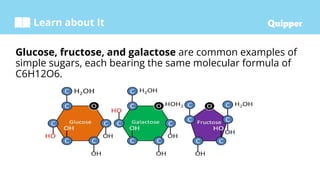
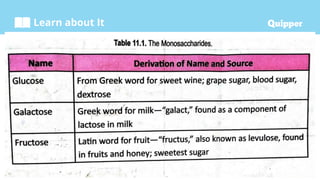
Glucose, fructose, and galactose are common examples of
simple sugars, each bearing the same molecular formula of
C6H12O6.
Learn about It
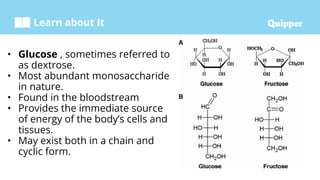
• Glucose , sometimes referred to
as dextrose.
• Most abundant monosaccharide
in nature.
• Found in the bloodstream
• Provides the immediate source
of energy of the body’s cells and
tissues.
• May exist both in a chain and
cyclic form.
Learn about It
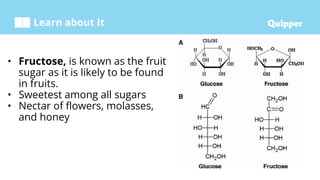
• Fructose, is known as the fruit
sugar as it is likely to be found
in fruits.
• Sweetest among all sugars
• Nectar of flowers, molasses,
and honey
Learn about It
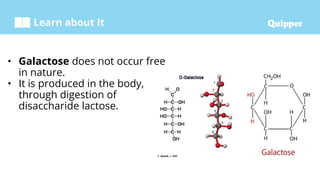
• Galactose does not occur free
in nature.
• It is produced in the body,
through digestion of
disaccharide lactose.
Learn about It
Learn about It
Learn about It
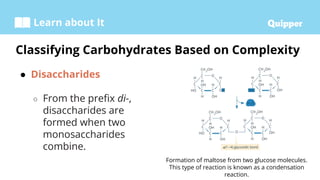
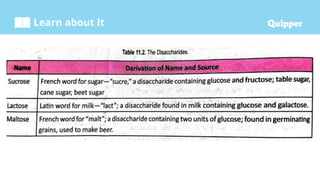
● Disaccharides
○ From the prefix di-,
disaccharides are
formed when two
monosaccharides
combine.
Classifying Carbohydrates Based on Complexity
Formation of maltose from two glucose molecules.
This type of reaction is known as a condensation
reaction.
Learn about It
● Disaccharides
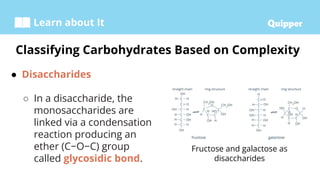
○ In a disaccharide, the
monosaccharides are
linked via a condensation
reaction producing an
ether (C−O−C) group
called glycosidic bond.
Classifying Carbohydrates Based on Complexity
Fructose and galactose as
disaccharides
Learn about It
Learn about It
Learn about It
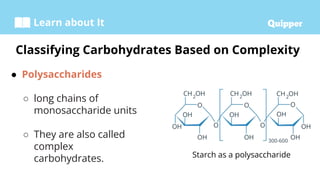
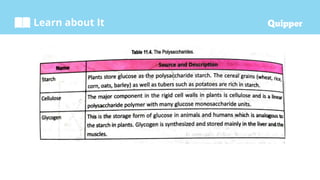
● Polysaccharides
○ long chains of
monosaccharide units
○ They are also called
complex
carbohydrates.
Classifying Carbohydrates Based on Complexity
Starch as a polysaccharide
Learn about It
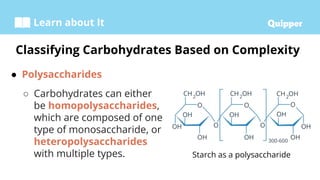
● Polysaccharides
○ Carbohydrates can either
be homopolysaccharides,
which are composed of one
type of monosaccharide, or
heteropolysaccharides
with multiple types.
Classifying Carbohydrates Based on Complexity
Starch as a polysaccharide
Learn about It
Learn about It
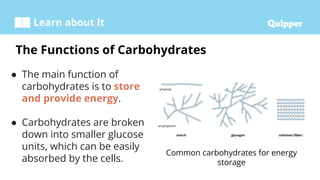
● The main function of
carbohydrates is to store
and provide energy.
● Carbohydrates are broken
down into smaller glucose
units, which can be easily
absorbed by the cells.
The Functions of Carbohydrates
Common carbohydrates for energy
storage
Learn about It
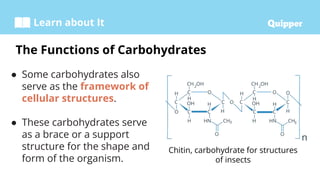
● Some carbohydrates also
serve as the framework of
cellular structures.
● These carbohydrates serve
as a brace or a support
structure for the shape and
form of the organism.
The Functions of Carbohydrates
Chitin, carbohydrate for structures
of insects
Learn about It
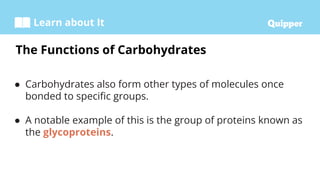
● Carbohydrates also form other types of molecules once
bonded to specific groups.
● A notable example of this is the group of proteins known as
the glycoproteins.
The Functions of Carbohydrates
Key Points
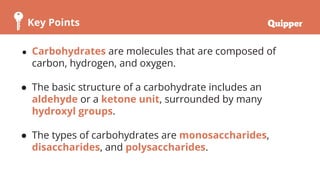
● Carbohydrates are molecules that are composed of
carbon, hydrogen, and oxygen.
● The basic structure of a carbohydrate includes an
aldehyde or a ketone unit, surrounded by many
hydroxyl groups.
● The types of carbohydrates are monosaccharides,
disaccharides, and polysaccharides.
Check Your Understanding
Identify the terms being described by each of the
statements below.
1. These carbohydrates are also known as simple sugars.
2. These carbohydrates are made up of several simple sugars
linked together. They are also called complex carbohydrates.
3. These proteins known to have carbohydrate moieties.
Bibliography
Boyer, Rodney. 2006. Concepts in Biochemistry Third Edition. Danvers: John Wiley & Sons Inc.
Carberry, Claudia. “How to Make Homemade Whey Protein.” wikiHow. Accessed June 7, 2022.
https://www.wikihow.com/Make-Homemade-Whey-Protein.
Krempels, Dana. “The Plant Cell is Special.” Department of Biology, University of Miami. Accessed August
17, 2016. http://www.bio.miami.edu/dana/226/226F07_3print.html.
Lehninger, Albert L., Nelson, David L., Cox, Michael M. 2013. Principles of Biochemistry, 6th Edition. W.H.
Freeman and Company.
Martin, Laura J. “Antibody.” Medline Plus. Accessed August 17, 2016.
https://medlineplus.gov/ency/article/002223.htm.
Bibliography
Moyna, Guillermo. “Nucleotides and Nucleic Acids.” The Moyna Group. Accessed August 18, 2016.
http://tonga.usp.edu/gmoyna/biochem341/dec6.html.
Reusch, William. “Peptides & Proteins.” Natural Product Chemistry. Accessed August 18, 2016.
https://www2.chemistry.msu.edu/faculty/reusch/virttxtjml/protein2.htm.
Voet, Donald, Voet, Judith G., Pratt, Charlotte W. 2016. Fundamentals of Biochemistry: Life at the Molecular
Level, 5th Edition. John Wiley & Sons, Inc.
“What is the Biuret Test for Proteins?” Brilliant Biology Student. Accessed June 7, 2022.
http://brilliantbiologystudent.weebly.com/biuret-test-for-protein.html.

Carbohydrates.pptx

  • 1.
  • 2.
  • 3.
  • 4.
  • 5.
  • 6.
  • 7.
  • 8.
  • 9.
    Learning Competency Recognize themajor categories of biomolecules such as carbohydrates, lipids, proteins, and nucleic acids (S10MT-IVc-d-22). At the end of this lesson, the given DepEd learning competency should be met by the students.
  • 10.
    Learning Objectives At theend of this lesson, the learner should be able to do the following: ● Recognize carbohydrates as one of the major categories of biomolecules. ● Explain the functions of carbohydrates in the processes of life.
  • 11.
    Carbohydrates are well knownto perform functions that are mostly related to energy storage and energy reservoirs. However, in most organisms, these are not the only uses of carbohydrates. What are carbohydrates and what are their functions?
  • 12.
  • 13.
    Learn about It ●hydrate de carbone means hydrates of carbon. ● Also called saccharides, derived from the Greek word sakcharon, which means sugar. ● Suffix -ose is used to denote the name of a saccharide Carbohydrates and Their General Structure Typical structure of carbohydrates
  • 14.
    Learn about It Sugar,starch, and cellulose are groups of carbohydrates and are all made up of the elements carbon, hydrogen, and oxygen.
  • 15.
    Learn about It ●Carbohydrates are molecules that are composed of carbon, hydrogen, and oxygen. They have the general formula CnH2nOn. Carbohydrates and Their General Structure Typical structure of carbohydrates
  • 16.
    Learn about It ●Carbohydrates basically contain an aldehyde or a ketone unit, with multiple hydroxyl groups at almost all carbon atoms. Carbohydrates and Their General Structure Typical structure of carbohydrates
  • 17.
  • 18.
    Learn about It -Micromolecule -monosaccharide - Macromolecule - disaccharide - polysaccharide TYPES OF CARBOHYDRATES
  • 19.
    Learn about It ●Monosaccharides ○ simplest form of carbohydrates ○ The prefix mono- suggests that these carbohydrates are composed of only one basic molecule. Classifying Carbohydrates Based on Complexity Glucose as a monosaccharide
  • 20.
    Learn about It ●Monosaccharides ○ They have open-chain and cyclic forms, and these forms are interchangeable through chemical reactions. Classifying Carbohydrates Based on Complexity Glucose as a monosaccharide
  • 21.
    Learn about It ●Monosaccharides ○ In aqueous solutions, most of the glucose will be found in their cyclic form. Classifying Carbohydrates Based on Complexity Glucose as a monosaccharide
  • 22.
    Learn about It Glucose,fructose, and galactose are common examples of simple sugars, each bearing the same molecular formula of C6H12O6.
  • 23.
    Learn about It •Glucose , sometimes referred to as dextrose. • Most abundant monosaccharide in nature. • Found in the bloodstream • Provides the immediate source of energy of the body’s cells and tissues. • May exist both in a chain and cyclic form.
  • 24.
    Learn about It •Fructose, is known as the fruit sugar as it is likely to be found in fruits. • Sweetest among all sugars • Nectar of flowers, molasses, and honey
  • 25.
    Learn about It •Galactose does not occur free in nature. • It is produced in the body, through digestion of disaccharide lactose.
  • 26.
  • 27.
  • 28.
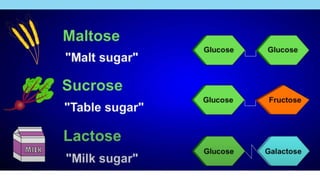
    Learn about It ●Disaccharides ○ From the prefix di-, disaccharides are formed when two monosaccharides combine. Classifying Carbohydrates Based on Complexity Formation of maltose from two glucose molecules. This type of reaction is known as a condensation reaction.
  • 29.
    Learn about It ●Disaccharides ○ In a disaccharide, the monosaccharides are linked via a condensation reaction producing an ether (C−O−C) group called glycosidic bond. Classifying Carbohydrates Based on Complexity Fructose and galactose as disaccharides
  • 30.
  • 31.
  • 32.
    Learn about It ●Polysaccharides ○ long chains of monosaccharide units ○ They are also called complex carbohydrates. Classifying Carbohydrates Based on Complexity Starch as a polysaccharide
  • 33.
    Learn about It ●Polysaccharides ○ Carbohydrates can either be homopolysaccharides, which are composed of one type of monosaccharide, or heteropolysaccharides with multiple types. Classifying Carbohydrates Based on Complexity Starch as a polysaccharide
  • 34.
  • 35.
    Learn about It ●The main function of carbohydrates is to store and provide energy. ● Carbohydrates are broken down into smaller glucose units, which can be easily absorbed by the cells. The Functions of Carbohydrates Common carbohydrates for energy storage
  • 36.
    Learn about It ●Some carbohydrates also serve as the framework of cellular structures. ● These carbohydrates serve as a brace or a support structure for the shape and form of the organism. The Functions of Carbohydrates Chitin, carbohydrate for structures of insects
  • 37.
    Learn about It ●Carbohydrates also form other types of molecules once bonded to specific groups. ● A notable example of this is the group of proteins known as the glycoproteins. The Functions of Carbohydrates
  • 38.
    Key Points ● Carbohydratesare molecules that are composed of carbon, hydrogen, and oxygen. ● The basic structure of a carbohydrate includes an aldehyde or a ketone unit, surrounded by many hydroxyl groups. ● The types of carbohydrates are monosaccharides, disaccharides, and polysaccharides.
  • 39.
    Check Your Understanding Identifythe terms being described by each of the statements below. 1. These carbohydrates are also known as simple sugars. 2. These carbohydrates are made up of several simple sugars linked together. They are also called complex carbohydrates. 3. These proteins known to have carbohydrate moieties.
  • 40.
    Bibliography Boyer, Rodney. 2006.Concepts in Biochemistry Third Edition. Danvers: John Wiley & Sons Inc. Carberry, Claudia. “How to Make Homemade Whey Protein.” wikiHow. Accessed June 7, 2022. https://www.wikihow.com/Make-Homemade-Whey-Protein. Krempels, Dana. “The Plant Cell is Special.” Department of Biology, University of Miami. Accessed August 17, 2016. http://www.bio.miami.edu/dana/226/226F07_3print.html. Lehninger, Albert L., Nelson, David L., Cox, Michael M. 2013. Principles of Biochemistry, 6th Edition. W.H. Freeman and Company. Martin, Laura J. “Antibody.” Medline Plus. Accessed August 17, 2016. https://medlineplus.gov/ency/article/002223.htm.
  • 41.
    Bibliography Moyna, Guillermo. “Nucleotidesand Nucleic Acids.” The Moyna Group. Accessed August 18, 2016. http://tonga.usp.edu/gmoyna/biochem341/dec6.html. Reusch, William. “Peptides & Proteins.” Natural Product Chemistry. Accessed August 18, 2016. https://www2.chemistry.msu.edu/faculty/reusch/virttxtjml/protein2.htm. Voet, Donald, Voet, Judith G., Pratt, Charlotte W. 2016. Fundamentals of Biochemistry: Life at the Molecular Level, 5th Edition. John Wiley & Sons, Inc. “What is the Biuret Test for Proteins?” Brilliant Biology Student. Accessed June 7, 2022. http://brilliantbiologystudent.weebly.com/biuret-test-for-protein.html.