What is Whiplash Injury ?
A neck injury that can occur when the head suddenly moves backward
and then forward.
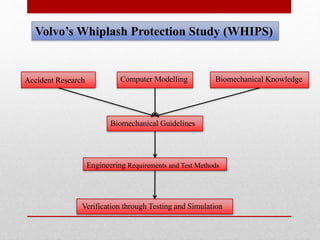
Accident Research Computer Modelling Biomechanical Knowledge
Biomechanical Guidelines
Engineering Requirements and Test Methods
Verification through Testing and Simulation
Volvo’s Whiplash Protection Study (WHIPS)
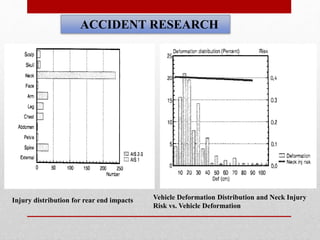
Injury distribution for rear end impacts
ACCIDENT RESEARCH
Vehicle Deformation Distribution and Neck Injury
Risk vs. Vehicle Deformation
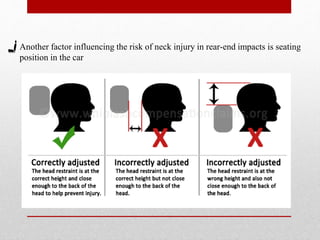
Another factor influencing the risk of neck injury in rear-end impacts is seating
position in the car
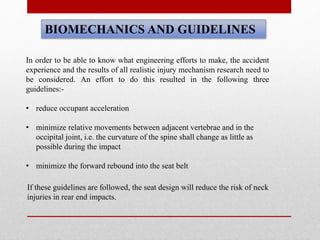
BIOMECHANICS AND GUIDELINES
In order to be able to know what engineering efforts to make, the accident
experience and the results of all realistic injury mechanism research need to
be considered. An effort to do this resulted in the following three
guidelines:-
• reduce occupant acceleration
• minimize relative movements between adjacent vertebrae and in the
occipital joint, i.e. the curvature of the spine shall change as little as
possible during the impact
• minimize the forward rebound into the seat belt
If these guidelines are followed, the seat design will reduce the risk of neck
injuries in rear end impacts.
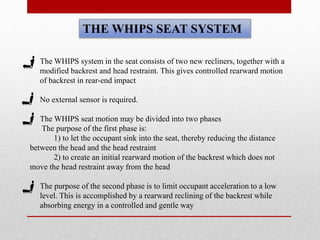
THE WHIPS SEAT SYSTEM
• The WHIPS system in the seat consists of two new recliners, together with a
modified backrest and head restraint. This gives controlled rearward motion
of backrest in rear-end impact
• No external sensor is required.
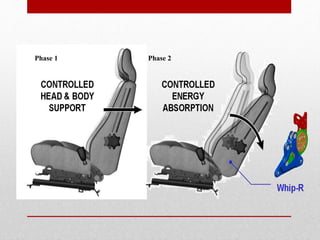
• The WHIPS seat motion may be divided into two phases
The purpose of the first phase is:
1) to let the occupant sink into the seat, thereby reducing the distance
between the head and the head restraint
2) to create an initial rearward motion of the backrest which does not
move the head restraint away from the head
• The purpose of the second phase is to limit occupant acceleration to a low
level. This is accomplished by a rearward reclining of the backrest while
absorbing energy in a controlled and gentle way
Phase 1 Phase 2
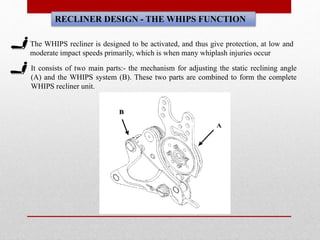
It consists of two main parts:- the mechanism for adjusting the static reclining angle
(A) and the WHIPS system (B). These two parts are combined to form the complete
WHIPS recliner unit.
The WHIPS recliner is designed to be activated, and thus give protection, at low and
moderate impact speeds primarily, which is when many whiplash injuries occur
RECLINER DESIGN - THE WHIPS FUNCTION
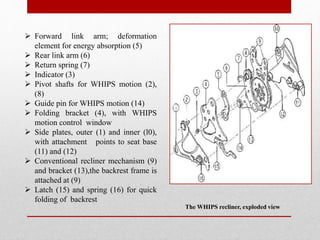
 Forward link arm; deformation
element for energy absorption (5)
 Rear link arm (6)
 Return spring (7)
 Indicator (3)
 Pivot shafts for WHIPS motion (2),
(8)
 Guide pin for WHIPS motion (14)
 Folding bracket (4), with WHIPS
motion control window
 Side plates, outer (1) and inner (l0),
with attachment points to seat base
(11) and (12)
 Conventional recliner mechanism (9)
and bracket (13),the backrest frame is
attached at (9)
 Latch (15) and spring (16) for quick
folding of backrest
The WHIPS recliner, exploded view
MOTION OF THE RECLINER
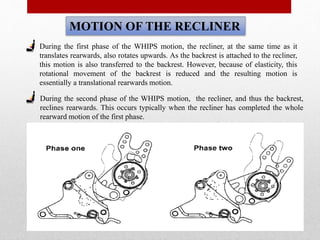
During the first phase of the WHIPS motion, the recliner, at the same time as it
translates rearwards, also rotates upwards. As the backrest is attached to the recliner,
this motion is also transferred to the backrest. However, because of elasticity, this
rotational movement of the backrest is reduced and the resulting motion is
essentially a translational rearwards motion.
During the second phase of the WHIPS motion, the recliner, and thus the backrest,
reclines rearwards. This occurs typically when the recliner has completed the whole
rearward motion of the first phase.
TESTING
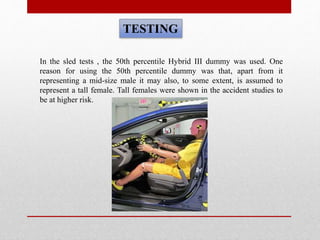
In the sled tests , the 50th percentile Hybrid III dummy was used. One
reason for using the 50th percentile dummy was that, apart from it
representing a mid-size male it may also, to some extent, is assumed to
represent a tall female. Tall females were shown in the accident studies to
be at higher risk.
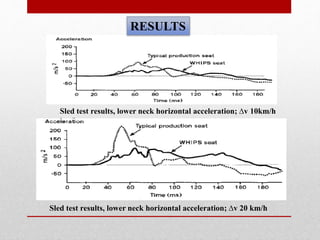
Sled test results, lower neck horizontal acceleration; ∆v 10km/h
km/h
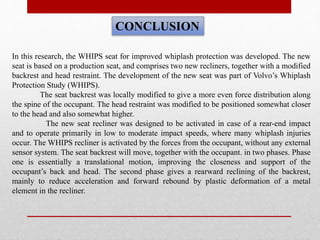
RESULTS
Sled test results, lower neck horizontal acceleration; ∆v 20 km/h
CONCLUSION
In this research, the WHIPS seat for improved whiplash protection was developed. The new
seat is based on a production seat, and comprises two new recliners, together with a modified
backrest and head restraint. The development of the new seat was part of Volvo’s Whiplash
Protection Study (WHIPS).
The seat backrest was locally modified to give a more even force distribution along
the spine of the occupant. The head restraint was modified to be positioned somewhat closer
to the head and also somewhat higher.
The new seat recliner was designed to be activated in case of a rear-end impact
and to operate primarily in low to moderate impact speeds, where many whiplash injuries
occur. The WHIPS recliner is activated by the forces from the occupant, without any external
sensor system. The seat backrest will move, together with the occupant. in two phases. Phase
one is essentially a translational motion, improving the closeness and support of the
occupant’s back and head. The second phase gives a rearward reclining of the backrest,
mainly to reduce acceleration and forward rebound by plastic deformation of a metal
element in the recliner.
REFERENCES
 AAAM (Association for the Advancement of Automotive Medicine); The Abbreviated
Injury Scale, 1990 Revision; AAAM, Des Plaines, IL, USA; 1990.
 Aldman B, A Protective Seat for Children - Experiments with a Safety Seat ,for
Children between One and Six. Proc. of 8”’ Stapp Car Crash Conference, Detroit,
1964, pp 320-328.
 Aldman 9, An Analytical Approach to the Impact Biomechanics of the Head and Neck
Injury;. Proc. of 30” Annual AAAM Conference. Motreal, Quebec, 1986: pp 439-454.
 Bostram , Svensson M Y, Aldman9, Hansson H A, Holand Y, LBvsund P, Seeman T,
Suneson A, Saljs A, ijrtengren T, A New Neck Injury Criterion Candidate - Based on
Injury Findings in the ‘Cervical Ganglia after Experimental Neck Extension Trauma.
Proc. of IRCOBI Conference on Biomechanics of Impacts, Dublin, Ireland, 1996: pp
123- 136.
 Lovsund P, Nygren A, Salen B, Tingvall C; Neck Injuries in Rear End Collisions
among Front and Rear Seat Occupants:Proc. of IRCOBI Conference on the
Biomechanics of Impacts, Bergisch Gladbach, Germany, 1988: pp. 3 19-326
Whiplash Protection System

Whiplash Protection System

  • 2.
    What is WhiplashInjury ? A neck injury that can occur when the head suddenly moves backward and then forward.
  • 3.
    Accident Research ComputerModelling Biomechanical Knowledge Biomechanical Guidelines Engineering Requirements and Test Methods Verification through Testing and Simulation Volvo’s Whiplash Protection Study (WHIPS)
  • 4.
    Injury distribution forrear end impacts ACCIDENT RESEARCH Vehicle Deformation Distribution and Neck Injury Risk vs. Vehicle Deformation
  • 5.
    Another factor influencingthe risk of neck injury in rear-end impacts is seating position in the car
  • 6.
    BIOMECHANICS AND GUIDELINES Inorder to be able to know what engineering efforts to make, the accident experience and the results of all realistic injury mechanism research need to be considered. An effort to do this resulted in the following three guidelines:- • reduce occupant acceleration • minimize relative movements between adjacent vertebrae and in the occipital joint, i.e. the curvature of the spine shall change as little as possible during the impact • minimize the forward rebound into the seat belt If these guidelines are followed, the seat design will reduce the risk of neck injuries in rear end impacts.
  • 7.
    THE WHIPS SEATSYSTEM • The WHIPS system in the seat consists of two new recliners, together with a modified backrest and head restraint. This gives controlled rearward motion of backrest in rear-end impact • No external sensor is required. • The WHIPS seat motion may be divided into two phases The purpose of the first phase is: 1) to let the occupant sink into the seat, thereby reducing the distance between the head and the head restraint 2) to create an initial rearward motion of the backrest which does not move the head restraint away from the head • The purpose of the second phase is to limit occupant acceleration to a low level. This is accomplished by a rearward reclining of the backrest while absorbing energy in a controlled and gentle way
  • 8.
  • 9.
    It consists oftwo main parts:- the mechanism for adjusting the static reclining angle (A) and the WHIPS system (B). These two parts are combined to form the complete WHIPS recliner unit. The WHIPS recliner is designed to be activated, and thus give protection, at low and moderate impact speeds primarily, which is when many whiplash injuries occur RECLINER DESIGN - THE WHIPS FUNCTION
  • 10.
     Forward linkarm; deformation element for energy absorption (5)  Rear link arm (6)  Return spring (7)  Indicator (3)  Pivot shafts for WHIPS motion (2), (8)  Guide pin for WHIPS motion (14)  Folding bracket (4), with WHIPS motion control window  Side plates, outer (1) and inner (l0), with attachment points to seat base (11) and (12)  Conventional recliner mechanism (9) and bracket (13),the backrest frame is attached at (9)  Latch (15) and spring (16) for quick folding of backrest The WHIPS recliner, exploded view
  • 11.
    MOTION OF THERECLINER During the first phase of the WHIPS motion, the recliner, at the same time as it translates rearwards, also rotates upwards. As the backrest is attached to the recliner, this motion is also transferred to the backrest. However, because of elasticity, this rotational movement of the backrest is reduced and the resulting motion is essentially a translational rearwards motion. During the second phase of the WHIPS motion, the recliner, and thus the backrest, reclines rearwards. This occurs typically when the recliner has completed the whole rearward motion of the first phase.
  • 12.
    TESTING In the sledtests , the 50th percentile Hybrid III dummy was used. One reason for using the 50th percentile dummy was that, apart from it representing a mid-size male it may also, to some extent, is assumed to represent a tall female. Tall females were shown in the accident studies to be at higher risk.
  • 13.
    Sled test results,lower neck horizontal acceleration; ∆v 10km/h km/h RESULTS Sled test results, lower neck horizontal acceleration; ∆v 20 km/h
  • 14.
    CONCLUSION In this research,the WHIPS seat for improved whiplash protection was developed. The new seat is based on a production seat, and comprises two new recliners, together with a modified backrest and head restraint. The development of the new seat was part of Volvo’s Whiplash Protection Study (WHIPS). The seat backrest was locally modified to give a more even force distribution along the spine of the occupant. The head restraint was modified to be positioned somewhat closer to the head and also somewhat higher. The new seat recliner was designed to be activated in case of a rear-end impact and to operate primarily in low to moderate impact speeds, where many whiplash injuries occur. The WHIPS recliner is activated by the forces from the occupant, without any external sensor system. The seat backrest will move, together with the occupant. in two phases. Phase one is essentially a translational motion, improving the closeness and support of the occupant’s back and head. The second phase gives a rearward reclining of the backrest, mainly to reduce acceleration and forward rebound by plastic deformation of a metal element in the recliner.
  • 15.
    REFERENCES  AAAM (Associationfor the Advancement of Automotive Medicine); The Abbreviated Injury Scale, 1990 Revision; AAAM, Des Plaines, IL, USA; 1990.  Aldman B, A Protective Seat for Children - Experiments with a Safety Seat ,for Children between One and Six. Proc. of 8”’ Stapp Car Crash Conference, Detroit, 1964, pp 320-328.  Aldman 9, An Analytical Approach to the Impact Biomechanics of the Head and Neck Injury;. Proc. of 30” Annual AAAM Conference. Motreal, Quebec, 1986: pp 439-454.  Bostram , Svensson M Y, Aldman9, Hansson H A, Holand Y, LBvsund P, Seeman T, Suneson A, Saljs A, ijrtengren T, A New Neck Injury Criterion Candidate - Based on Injury Findings in the ‘Cervical Ganglia after Experimental Neck Extension Trauma. Proc. of IRCOBI Conference on Biomechanics of Impacts, Dublin, Ireland, 1996: pp 123- 136.  Lovsund P, Nygren A, Salen B, Tingvall C; Neck Injuries in Rear End Collisions among Front and Rear Seat Occupants:Proc. of IRCOBI Conference on the Biomechanics of Impacts, Bergisch Gladbach, Germany, 1988: pp. 3 19-326