Welcome To The
Muzette Charles
mcharles2@pace.edu
Certified Associate Project Management
CAPM® Exam Prep – Week 1
Why take the CAPM® ?
 Regardless of your career stage, the Certified Associate in Project Management
(CAPM)® is an asset that will distinguish you in the job market and enhance your
credibility and effectiveness working on — or with — project teams.
 Project management is a rapidly growing profession. Through 2020, 1.57 million
new jobs will be created each year and qualified practitioners are in demand.
With the CAPM, you’ll be on the fast track to opportunity.
 If you’d like to manage larger projects and gain more responsibility or add project
management skills into your current role, then the Certified Associate in Project
Management (CAPM) is right for you.
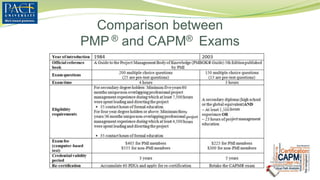
Comparison between
PMP ® and CAPM® Exams
Tricks of the Trade
Studying for the CAPM® Exam
Chapter 1
 Pass the exam on your first try
 Learn, not just memorize
 Shorten your study time
 Determine the gaps in your knowledge
 Gain insider tips on the exam
 Make sense of the topics on the exam
 Apply to Project Management Institute - PMI
 Authorization Notice to make appointment to take exam
 Designated Computerized Testing Sites
 One year from date of Authorization Notice to pass exam
 Can take exam up to 3x within that one year
 If you fail all 3x times, must wait one year to reapply
Tricks of the Trade
Studying for the CAPM® Exam
Chapter 1
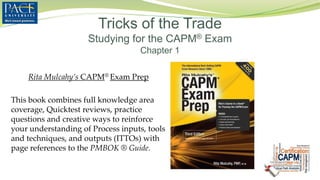
Rita Mulcahy’s CAPM® Exam Prep
This book combines full knowledge area
coverage, Quicktest reviews, practice
questions and creative ways to reinforce
your understanding of Process inputs, tools
and techniques, and outputs (ITTOs) with
page references to the PMBOK ® Guide.
Tricks of the Trade
Studying for the CAPM® Exam
Chapter 1
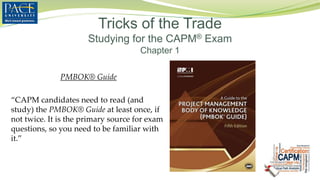
PMBOK® Guide
“CAPM candidates need to read (and
study) the PMBOK® Guide at least once, if
not twice. It is the primary source for exam
questions, so you need to be familiar with
it.”
Tricks of the Trade
Studying for the CAPM® Exam
Chapter 1
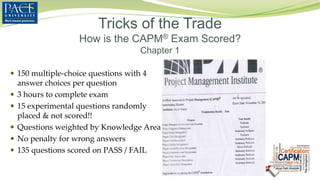
 150 multiple-choice questions with 4
answer choices per question
 3 hours to complete exam
 15 experimental questions randomly
placed & not scored!!
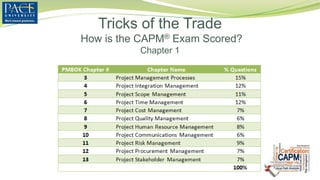
 Questions weighted by Knowledge Area
 No penalty for wrong answers
 135 questions scored on PASS / FAIL
Tricks of the Trade
How is the CAPM® Exam Scored?
Chapter 1
Tricks of the Trade
How is the CAPM® Exam Scored?
Chapter 1
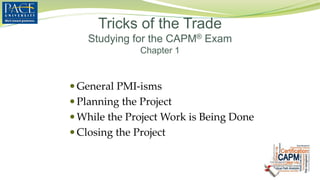
 General PMI-isms
 Planning the Project
 While the Project Work is Being Done
 Closing the Project
Tricks of the Trade
Studying for the CAPM® Exam
Chapter 1
 Project
 Project Management
 Program
 Portfolio
 Operations vs. Projects
 Enterprise Environment Factors
 Organizational Process Assets
 Work Performance Data, Information &
Reports
 Organizational Structure: Functional,
Projectized, Matrix
 Project Life Cycle: Predictive, Iterative,
Adaptive
 Project Management Process
 Project Management Office (PMO)
 Stakeholders
 Constraints
Project Management Framework
QUICKTEST – Chapter 2
What is a Project?
“A project is a temporary endeavor undertaken to create a unique
product, service or result. The temporary nature of projects
indicates that a project has a definite beginning and end. The end
is reached when the project’s objectives have been achieved or
when the project is terminated because its objectives will not or
cannot be met or when the need for the project no longer exists.”
Project Management Framework
Chapter 2
Project Managers
 “… keep the team focused on the business value the project is providing. By constantly
helping each team member to understand how his or her work impacts the project’s
value, the PM makes sure that everyone on the team makes the best decisions to keep the
project on track.”
 Interpersonal Skills
 Leadership
 Motivation
 Team Building & Trust Building
 Influencing
 Coaching
 Conflict Management
 Political & Cultural Awareness
Project Management Framework
Chapter 2
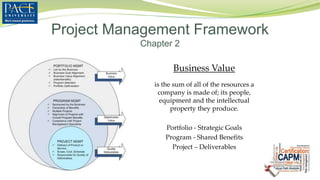
Business Value
is the sum of all of the resources a
company is made of; its people,
equipment and the intellectual
property they produce.
Portfolio - Strategic Goals
Program - Shared Benefits
Project – Deliverables
Project Management Framework
Chapter 2
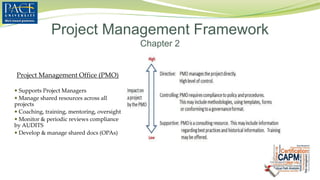
Project Management Office (PMO)
 Supports Project Managers
 Manage shared resources across all
projects
 Coaching, training, mentoring, oversight
 Monitor & periodic reviews compliance
by AUDITS
 Develop & manage shared docs (OPAs)
Project Management Framework
Chapter 2
OPERATIONS vs.
 Work is REPEATABLE &
ONGOING to produce goods or
services in support of the
business/organization.
 Supports the day-to-day business to
achieve the company’s strategic goals.
 Ex: production, accounting,
software support, maintenance,
manufacturing
PROJECTS
 Gathers a team together to do
TEMPORARY work to create a
UNIQUE RESULT and is
PROGRESSIVELY ELABORATED that
ends when the project is closed
 Produces a product that is handed off
to operations
 Require PM activities & skill sets
 Are not always successful
Project Management Framework
Chapter 2
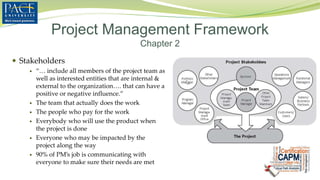
 Stakeholders
 “… include all members of the project team as
well as interested entities that are internal &
external to the organization…. that can have a
positive or negative influence.”
 The team that actually does the work
 The people who pay for the work
 Everybody who will use the product when
the project is done
 Everyone who may be impacted by the
project along the way
 90% of PM’s job is communicating with
everyone to make sure their needs are met
Project Management Framework
Chapter 2
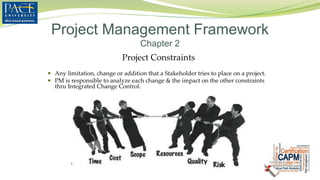
Project Constraints
 Any limitation, change or addition that a Stakeholder tries to place on a project.
 PM is responsible to analyze each change & the impact on the other constraints
thru Integrated Change Control.
Project Management Framework
Chapter 2
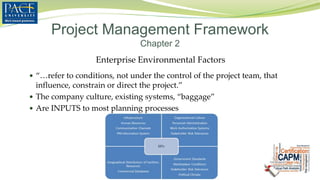
Enterprise Environmental Factors
 “…refer to conditions, not under the control of the project team, that
influence, constrain or direct the project.”
 The company culture, existing systems, “baggage”
 Are INPUTS to most planning processes
Project Management Framework
Chapter 2
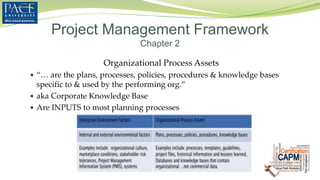
Organizational Process Assets
 “… are the plans, processes, policies, procedures & knowledge bases
specific to & used by the performing org.”
 aka Corporate Knowledge Base
 Are INPUTS to most planning processes
Project Management Framework
Chapter 2
Project Information
 Work Performance Data – raw observations & measurements
 % completion
 Start & finish dates of activities
 Actual costs & durations
 # of change requests
 Work Performance Information – data collected from control processes analyzed & integrated
 Status of deliverables
 Forecasted estimates to completion
 Work Performance Reports – information compiled into Project Docs to generate decisions, raise issues,
actions or awareness
 Project Status Reports
 Memos
 eDashboards, KPIs, etc
Project Management Framework
Chapter 2
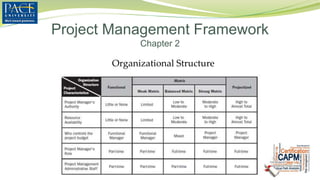
Organizational Structure
 Functional
 Most common, grouped by function/department – Acctg, Mktg,
 PM has no direct reports & Team members work in a “Silo”
 Matrix
 Maximizes strength of both functional & projectized structures
BALANCED - PM shares authority with Func. Mgr & Team members have “Two Bosses”
WEAK MATRIX
 Expeditor – Cannot make/enforce decisions, is a Staff Asst/Communications Coord.
 Coordinator – Has some authority to make decisions & reports to a higher level Mgr
 Projectized
 PM controls the project & Team members have “No Home”
Project Management Framework
Chapter 2
Organizational Structure
Project Management Framework
Chapter 2
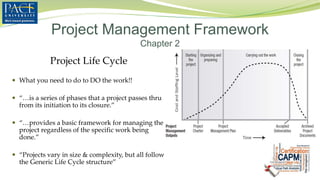
Project Life Cycle
 What you need to do to DO the work!!
 “…is a series of phases that a project passes thru
from its initiation to its closure.”
 “…provides a basic framework for managing the
project regardless of the specific work being
done.”
 “Projects vary in size & complexity, but all follow
the Generic Life Cycle structure”
Project Management Framework
Chapter 2
Project Life Cycle
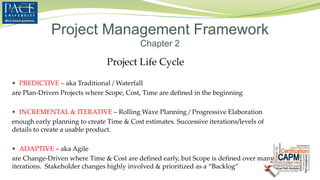
 PREDICTIVE – aka Traditional / Waterfall
are Plan-Driven Projects where Scope, Cost, Time are defined in the beginning
 INCREMENTAL & ITERATIVE – Rolling Wave Planning / Progressive Elaboration
enough early planning to create Time & Cost estimates. Successive iterations/levels of
details to create a usable product.
 ADAPTIVE – aka Agile
are Change-Driven where Time & Cost are defined early, but Scope is defined over many
iterations. Stakeholder changes highly involved & prioritized as a “Backlog”
Project Management Framework
Chapter 2
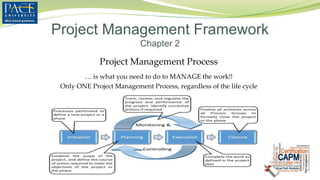
Project Management Process
… is what you need to do to MANAGE the work!!
Only ONE Project Management Process, regardless of the life cycle
Project Management Framework
Chapter 2
Project Management Process
The Goal…
- Deliver the product on time
- Within budget
- Fulfill the customer’s needs & expectations
- Maintain a happy & well-functioning team
Project Management Framework
Chapter 2
Project Managers
 use Process Groups to coordinate the effective flow of a project
from its start to its close using ITTOs & Knowledge Areas.
 in collaboration with the project team are ALWAYS responsible for
planning & developing a successful Project Management Process
 actively manages each of these interactions to meet the Sponsor,
Customer & Stakeholder requirements
Project Management Processes
Chapter 3
PROCESS
 “is a set of interrelated actions & activities performed to create a specific product, service or
result.”
 Project Management has 47 processes
PROCESS GROUPS
 organize the process functions by their Actions
 are the project activities broken down into 5 steps
KNOWLEDGE AREAS
 organizes the process functions by their Subject Matter
 are the process elements broken down into 10 areas
 ARE NOT LINEAR !!!
ITTOs
 “each process is linked & characterized by its INPUTS, TOOLS, TECHNIQUES & OUTPUTS.”
 Inputs – information used in the project ex. EEF, OPAs, Charter, etc
 Outputs – documents, deliverables, decisions
 Tools &Techniques – used to do the work ex. Meetings, Expert, Audits
Project Management Processes
Chapter 3
PHASES
 “a set of processes that are ITERATED several times to achieve the required
outcome.”
 each Phase of the project goes thru all of the 5 Process Groups
Sequential Relationship
 Phases of the project that happen one after another
 Teams work together on each phase
Overlapping Relationship
 Phases of the project deliver results independently
 Teams work on different parts of the project
 Complicated to manage due to increased risk & rework
Project Management Processes
Chapter 3
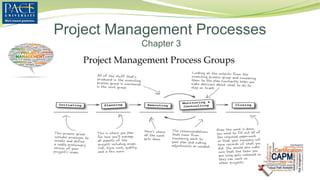
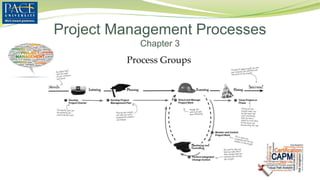
Project Management Process Groups
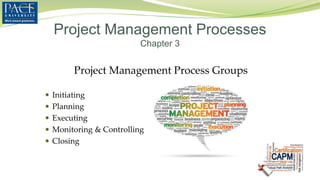
 Initiating
 Planning
 Executing
 Monitoring & Controlling
 Closing
Project Management Processes
Chapter 3
Project Management Processes
Chapter 3
Project Management Process Groups
INITIATING Process Group
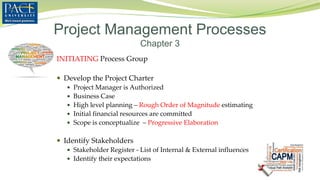
 Develop the Project Charter
 Project Manager is Authorized
 Business Case
 High level planning – Rough Order of Magnitude estimating
 Initial financial resources are committed
 Scope is conceptualize – Progressive Elaboration
 Identify Stakeholders
 Stakeholder Register - List of Internal & External influences
 Identify their expectations
Project Management Processes
Chapter 3
PLANNING Process Group
“… 24 processes used in the strategy to develop a course of action or path to
successfully complete the project or phase. A well managed plan saves
resources, time & money and gets the Stakeholder’s buy-in & engagement.”
Iterative – each planning process may use the results of the previous process that
may affect or change the plan
 Project Management Plan
 Is an Output that guides the Execution & Control of the project
 Project Documents
 Are Outputs detailing each of the Knowledge Areas
Project Management Processes
Chapter 3
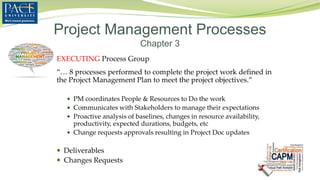
EXECUTING Process Group
“… 8 processes performed to complete the project work defined in
the Project Management Plan to meet the project objectives.”
 PM coordinates People & Resources to Do the work
 Communicates with Stakeholders to manage their expectations
 Proactive analysis of baselines, changes in resource availability,
productivity, expected durations, budgets, etc
 Change requests approvals resulting in Project Doc updates
 Deliverables
 Changes Requests
Project Management Processes
Chapter 3
MONITORING & CONTROLLING Process Group
“… 11 processes required to track & review the progress & performance
of the project. ”
 Key benefit is that project performance is measured & analyzed at
regular intervals to identify variances from the project management plan
 Identifies any areas in which changes to the plan are required
 Recommending corrective or preventive action in anticipating problems
 Approved Change Requests
Project Management Processes
Chapter 3
CLOSING Process Group
“… 2 processes performed to formally complete the project or contract obligations.”
 Obtain acceptance by the Customer or Sponsor to formally Close
 Conduct post-project review
 Document Lessons Learned & update OPAs
 Archive project docs as historical data
 Close out procurement activities to terminate agreements
 Perform team members’ assessments & release project resources
 Close Project
 Close Procurements
 Celebrate Your Success!!!
Project Management Processes
Chapter 3
Project Management Processes
Chapter 3
Process Groups
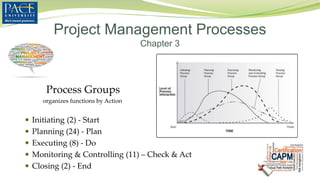
Process Groups
organizes functions by Action
 Initiating (2) - Start
 Planning (24) - Plan
 Executing (8) - Do
 Monitoring & Controlling (11) – Check & Act
 Closing (2) - End
Project Management Processes
Chapter 3
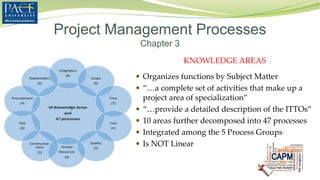
KNOWLEDGE AREAS
Project Management Processes
Chapter 3
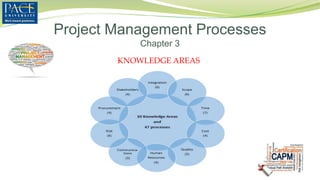
KNOWLEDGE AREAS
 Organizes functions by Subject Matter
 “…a complete set of activities that make up a
project area of specialization”
 “…provide a detailed description of the ITTOs”
 10 areas further decomposed into 47 processes
 Integrated among the 5 Process Groups
 Is NOT Linear
Project Management Processes
Chapter 3
Project Management Processes
Chapter 3
Group Exercise – The Shuffle Game
CAPM Exam Prep
Quiz 1
• Review of Project Framework, Processes & Integration Management
• Review 5 Process Groups & 10 Knowledge Areas
• Identify each of the Processes by their Process Group

CAPM Chapters 1-3

  • 1.
    Welcome To The MuzetteCharles mcharles2@pace.edu Certified Associate Project Management CAPM® Exam Prep – Week 1
  • 2.
    Why take theCAPM® ?
  • 3.
    Why take theCAPM® ?  Regardless of your career stage, the Certified Associate in Project Management (CAPM)® is an asset that will distinguish you in the job market and enhance your credibility and effectiveness working on — or with — project teams.  Project management is a rapidly growing profession. Through 2020, 1.57 million new jobs will be created each year and qualified practitioners are in demand. With the CAPM, you’ll be on the fast track to opportunity.  If you’d like to manage larger projects and gain more responsibility or add project management skills into your current role, then the Certified Associate in Project Management (CAPM) is right for you.
  • 4.
    Comparison between PMP ®and CAPM® Exams
  • 5.
    Tricks of theTrade Studying for the CAPM® Exam Chapter 1  Pass the exam on your first try  Learn, not just memorize  Shorten your study time  Determine the gaps in your knowledge  Gain insider tips on the exam  Make sense of the topics on the exam
  • 6.
     Apply toProject Management Institute - PMI  Authorization Notice to make appointment to take exam  Designated Computerized Testing Sites  One year from date of Authorization Notice to pass exam  Can take exam up to 3x within that one year  If you fail all 3x times, must wait one year to reapply Tricks of the Trade Studying for the CAPM® Exam Chapter 1
  • 7.
    Rita Mulcahy’s CAPM®Exam Prep This book combines full knowledge area coverage, Quicktest reviews, practice questions and creative ways to reinforce your understanding of Process inputs, tools and techniques, and outputs (ITTOs) with page references to the PMBOK ® Guide. Tricks of the Trade Studying for the CAPM® Exam Chapter 1
  • 8.
    PMBOK® Guide “CAPM candidatesneed to read (and study) the PMBOK® Guide at least once, if not twice. It is the primary source for exam questions, so you need to be familiar with it.” Tricks of the Trade Studying for the CAPM® Exam Chapter 1
  • 9.
     150 multiple-choicequestions with 4 answer choices per question  3 hours to complete exam  15 experimental questions randomly placed & not scored!!  Questions weighted by Knowledge Area  No penalty for wrong answers  135 questions scored on PASS / FAIL Tricks of the Trade How is the CAPM® Exam Scored? Chapter 1
  • 10.
    Tricks of theTrade How is the CAPM® Exam Scored? Chapter 1
  • 11.
     General PMI-isms Planning the Project  While the Project Work is Being Done  Closing the Project Tricks of the Trade Studying for the CAPM® Exam Chapter 1
  • 12.
     Project  ProjectManagement  Program  Portfolio  Operations vs. Projects  Enterprise Environment Factors  Organizational Process Assets  Work Performance Data, Information & Reports  Organizational Structure: Functional, Projectized, Matrix  Project Life Cycle: Predictive, Iterative, Adaptive  Project Management Process  Project Management Office (PMO)  Stakeholders  Constraints Project Management Framework QUICKTEST – Chapter 2
  • 13.
    What is aProject? “A project is a temporary endeavor undertaken to create a unique product, service or result. The temporary nature of projects indicates that a project has a definite beginning and end. The end is reached when the project’s objectives have been achieved or when the project is terminated because its objectives will not or cannot be met or when the need for the project no longer exists.” Project Management Framework Chapter 2
  • 14.
    Project Managers  “…keep the team focused on the business value the project is providing. By constantly helping each team member to understand how his or her work impacts the project’s value, the PM makes sure that everyone on the team makes the best decisions to keep the project on track.”  Interpersonal Skills  Leadership  Motivation  Team Building & Trust Building  Influencing  Coaching  Conflict Management  Political & Cultural Awareness Project Management Framework Chapter 2
  • 15.
    Business Value is thesum of all of the resources a company is made of; its people, equipment and the intellectual property they produce. Portfolio - Strategic Goals Program - Shared Benefits Project – Deliverables Project Management Framework Chapter 2
  • 16.
    Project Management Office(PMO)  Supports Project Managers  Manage shared resources across all projects  Coaching, training, mentoring, oversight  Monitor & periodic reviews compliance by AUDITS  Develop & manage shared docs (OPAs) Project Management Framework Chapter 2
  • 17.
    OPERATIONS vs.  Workis REPEATABLE & ONGOING to produce goods or services in support of the business/organization.  Supports the day-to-day business to achieve the company’s strategic goals.  Ex: production, accounting, software support, maintenance, manufacturing PROJECTS  Gathers a team together to do TEMPORARY work to create a UNIQUE RESULT and is PROGRESSIVELY ELABORATED that ends when the project is closed  Produces a product that is handed off to operations  Require PM activities & skill sets  Are not always successful Project Management Framework Chapter 2
  • 18.
     Stakeholders  “…include all members of the project team as well as interested entities that are internal & external to the organization…. that can have a positive or negative influence.”  The team that actually does the work  The people who pay for the work  Everybody who will use the product when the project is done  Everyone who may be impacted by the project along the way  90% of PM’s job is communicating with everyone to make sure their needs are met Project Management Framework Chapter 2
  • 19.
    Project Constraints  Anylimitation, change or addition that a Stakeholder tries to place on a project.  PM is responsible to analyze each change & the impact on the other constraints thru Integrated Change Control. Project Management Framework Chapter 2
  • 20.
    Enterprise Environmental Factors “…refer to conditions, not under the control of the project team, that influence, constrain or direct the project.”  The company culture, existing systems, “baggage”  Are INPUTS to most planning processes Project Management Framework Chapter 2
  • 21.
    Organizational Process Assets “… are the plans, processes, policies, procedures & knowledge bases specific to & used by the performing org.”  aka Corporate Knowledge Base  Are INPUTS to most planning processes Project Management Framework Chapter 2
  • 22.
    Project Information  WorkPerformance Data – raw observations & measurements  % completion  Start & finish dates of activities  Actual costs & durations  # of change requests  Work Performance Information – data collected from control processes analyzed & integrated  Status of deliverables  Forecasted estimates to completion  Work Performance Reports – information compiled into Project Docs to generate decisions, raise issues, actions or awareness  Project Status Reports  Memos  eDashboards, KPIs, etc Project Management Framework Chapter 2
  • 23.
    Organizational Structure  Functional Most common, grouped by function/department – Acctg, Mktg,  PM has no direct reports & Team members work in a “Silo”  Matrix  Maximizes strength of both functional & projectized structures BALANCED - PM shares authority with Func. Mgr & Team members have “Two Bosses” WEAK MATRIX  Expeditor – Cannot make/enforce decisions, is a Staff Asst/Communications Coord.  Coordinator – Has some authority to make decisions & reports to a higher level Mgr  Projectized  PM controls the project & Team members have “No Home” Project Management Framework Chapter 2
  • 24.
  • 25.
    Project Life Cycle What you need to do to DO the work!!  “…is a series of phases that a project passes thru from its initiation to its closure.”  “…provides a basic framework for managing the project regardless of the specific work being done.”  “Projects vary in size & complexity, but all follow the Generic Life Cycle structure” Project Management Framework Chapter 2
  • 26.
    Project Life Cycle PREDICTIVE – aka Traditional / Waterfall are Plan-Driven Projects where Scope, Cost, Time are defined in the beginning  INCREMENTAL & ITERATIVE – Rolling Wave Planning / Progressive Elaboration enough early planning to create Time & Cost estimates. Successive iterations/levels of details to create a usable product.  ADAPTIVE – aka Agile are Change-Driven where Time & Cost are defined early, but Scope is defined over many iterations. Stakeholder changes highly involved & prioritized as a “Backlog” Project Management Framework Chapter 2
  • 27.
    Project Management Process …is what you need to do to MANAGE the work!! Only ONE Project Management Process, regardless of the life cycle Project Management Framework Chapter 2
  • 28.
    Project Management Process TheGoal… - Deliver the product on time - Within budget - Fulfill the customer’s needs & expectations - Maintain a happy & well-functioning team Project Management Framework Chapter 2
  • 29.
    Project Managers  useProcess Groups to coordinate the effective flow of a project from its start to its close using ITTOs & Knowledge Areas.  in collaboration with the project team are ALWAYS responsible for planning & developing a successful Project Management Process  actively manages each of these interactions to meet the Sponsor, Customer & Stakeholder requirements Project Management Processes Chapter 3
  • 30.
    PROCESS  “is aset of interrelated actions & activities performed to create a specific product, service or result.”  Project Management has 47 processes PROCESS GROUPS  organize the process functions by their Actions  are the project activities broken down into 5 steps KNOWLEDGE AREAS  organizes the process functions by their Subject Matter  are the process elements broken down into 10 areas  ARE NOT LINEAR !!! ITTOs  “each process is linked & characterized by its INPUTS, TOOLS, TECHNIQUES & OUTPUTS.”  Inputs – information used in the project ex. EEF, OPAs, Charter, etc  Outputs – documents, deliverables, decisions  Tools &Techniques – used to do the work ex. Meetings, Expert, Audits Project Management Processes Chapter 3
  • 31.
    PHASES  “a setof processes that are ITERATED several times to achieve the required outcome.”  each Phase of the project goes thru all of the 5 Process Groups Sequential Relationship  Phases of the project that happen one after another  Teams work together on each phase Overlapping Relationship  Phases of the project deliver results independently  Teams work on different parts of the project  Complicated to manage due to increased risk & rework Project Management Processes Chapter 3
  • 32.
    Project Management ProcessGroups  Initiating  Planning  Executing  Monitoring & Controlling  Closing Project Management Processes Chapter 3
  • 33.
    Project Management Processes Chapter3 Project Management Process Groups
  • 34.
    INITIATING Process Group Develop the Project Charter  Project Manager is Authorized  Business Case  High level planning – Rough Order of Magnitude estimating  Initial financial resources are committed  Scope is conceptualize – Progressive Elaboration  Identify Stakeholders  Stakeholder Register - List of Internal & External influences  Identify their expectations Project Management Processes Chapter 3
  • 35.
    PLANNING Process Group “…24 processes used in the strategy to develop a course of action or path to successfully complete the project or phase. A well managed plan saves resources, time & money and gets the Stakeholder’s buy-in & engagement.” Iterative – each planning process may use the results of the previous process that may affect or change the plan  Project Management Plan  Is an Output that guides the Execution & Control of the project  Project Documents  Are Outputs detailing each of the Knowledge Areas Project Management Processes Chapter 3
  • 36.
    EXECUTING Process Group “…8 processes performed to complete the project work defined in the Project Management Plan to meet the project objectives.”  PM coordinates People & Resources to Do the work  Communicates with Stakeholders to manage their expectations  Proactive analysis of baselines, changes in resource availability, productivity, expected durations, budgets, etc  Change requests approvals resulting in Project Doc updates  Deliverables  Changes Requests Project Management Processes Chapter 3
  • 37.
    MONITORING & CONTROLLINGProcess Group “… 11 processes required to track & review the progress & performance of the project. ”  Key benefit is that project performance is measured & analyzed at regular intervals to identify variances from the project management plan  Identifies any areas in which changes to the plan are required  Recommending corrective or preventive action in anticipating problems  Approved Change Requests Project Management Processes Chapter 3
  • 38.
    CLOSING Process Group “…2 processes performed to formally complete the project or contract obligations.”  Obtain acceptance by the Customer or Sponsor to formally Close  Conduct post-project review  Document Lessons Learned & update OPAs  Archive project docs as historical data  Close out procurement activities to terminate agreements  Perform team members’ assessments & release project resources  Close Project  Close Procurements  Celebrate Your Success!!! Project Management Processes Chapter 3
  • 39.
  • 40.
    Process Groups organizes functionsby Action  Initiating (2) - Start  Planning (24) - Plan  Executing (8) - Do  Monitoring & Controlling (11) – Check & Act  Closing (2) - End Project Management Processes Chapter 3
  • 41.
  • 42.
    KNOWLEDGE AREAS  Organizesfunctions by Subject Matter  “…a complete set of activities that make up a project area of specialization”  “…provide a detailed description of the ITTOs”  10 areas further decomposed into 47 processes  Integrated among the 5 Process Groups  Is NOT Linear Project Management Processes Chapter 3
  • 43.
    Project Management Processes Chapter3 Group Exercise – The Shuffle Game
  • 44.
    CAPM Exam Prep Quiz1 • Review of Project Framework, Processes & Integration Management • Review 5 Process Groups & 10 Knowledge Areas • Identify each of the Processes by their Process Group

Editor's Notes

  • #19 The Sponsor, Seller, Business Partner who provides training Consumers Users, Organ. Groups, Functional Mgr
  • #20 Time: durations, dependencies, critical path Cost: $, budget, profits Scope: Proj size, goals Resources: Ppl, Equip, Material Customer satisfaction
  • #22 Pg 20: Lessons learned: What was right or wrong about how we completed the work to produce the product? How did we do w/the WBS creation, risk planning…? How did we do with communications leadership as a PM?
  • #23 Pg 21: DATA; an activity took 10 hrs & was completed on July 21. INFO; how does data compare to the project plan of 12hrs & 7/22? REPORT: status reports
  • #24 Pg 22: Functional think Silo , Projectized Teams – PM choose Team Mbrs & releases them when Project is Closed
  • #25 Pg 22: Functional think Silo , Projectized think “no home”
  • #26 Don’t confuse with Product Life Cycle…. From its conception to its withdrawal from the marketplace
  • #27 Iterations aka Phases means Executing 1 Phase while Planning another… Can be OVERLAPPING or SEQUENTIAL
  • #30 Processes are either: Operational Process & a Project Management Process
  • #32 Processes are either: Operational Process & a Project Management Process
  • #34 Formally starts a New project or Phase, PM named early so he/she assists in Proj. Charter / High-level planning estimating to see if the proj can be dlvrd by the time & wi/budget that’s requested… basically does the project have a chance to be successful b4 $ & resources are committed?
  • #35 Formally starts a New project or Phase, PM named early so he/she assists in Proj. Charter / High-level planning estimating to see if the proj can be dlvrd by the time & wi/budget that’s requested… basically does the project have a chance to be successful b4 $ & resources are committed?
  • #36 This is where the PM walks thru the project & gets organized BEFORE actual work begins
  • #40 Formally starts a New project or Phase, PM named early so he/she assists in Proj. Charter / High-level planning estimating to see if the proj can be dlvrd by the time & wi/budget that’s requested… basically does the project have a chance to be successful b4 $ & resources are committed?
  • #41 Organizes functions by Action
  • #42 Int: coordinating all of the work so that it happens correctly
  • #43 Int: coordinating all of the work so that it happens correctly
  • #44 Formally starts a New project or Phase, PM named early so he/she assists in Proj. Charter / High-level planning estimating to see if the proj can be dlvrd by the time & wi/budget that’s requested… basically does the project have a chance to be successful b4 $ & resources are committed?