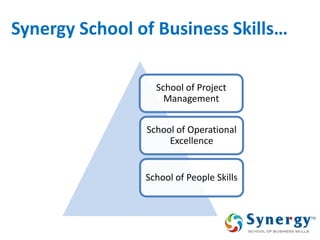

Synergy School of Business Skills… 
School of Project Management 
School of Operational Excellence 
School of People Skills
World’s leading PM Tools
Who is PMI® ? 
Project Management Institute. 
Established in 1969 
Global Organization Headquartered in Newtown Square, Pennsylvania USA 
Codified best practices in Project Management as PMBOK® guide
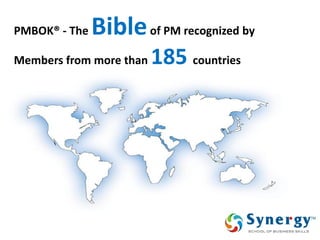
PMBOK® - The Bible of PM recognized by Members from more than 185 countries
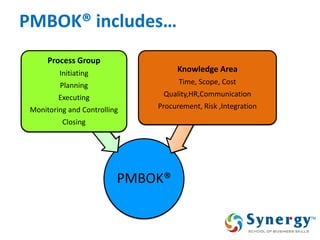
PMBOK® includes… 
PMBOK® 
Process Group 
Initiating 
Planning 
Executing 
Monitoring and Controlling 
Closing 
Knowledge Area 
Time, Scope, Cost 
Quality,HR,Communication 
Procurement, Risk ,Integration
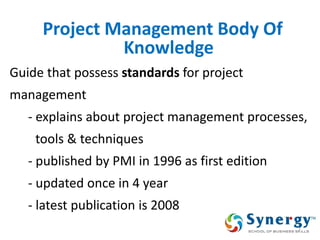
Project Management Body Of Knowledge 
Guide that possess standards for project 
management 
- explains about project management processes, 
tools & techniques 
- published by PMI in 1996 as first edition 
- updated once in 4 year 
- latest publication is 2008 
7
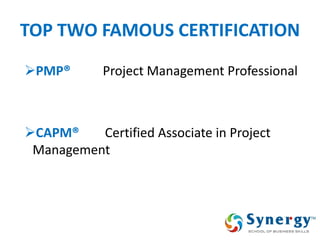
TOP TWO FAMOUS CERTIFICATION 
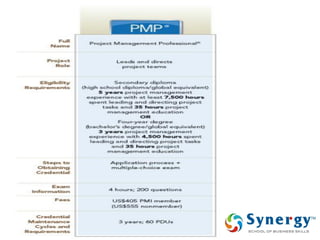
PMP® Project Management Professional 
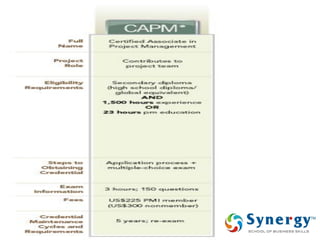
CAPM® Certified Associate in Project Management
PROJECT MANAGEMENT FRAMEWORK
12 
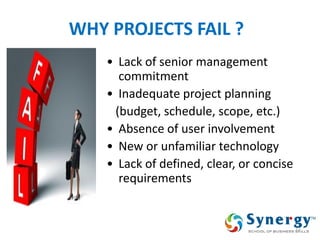
WHY PROJECTS FAIL ? 
•Lack of senior management commitment 
•Inadequate project planning 
(budget, schedule, scope, etc.) 
•Absence of user involvement 
•New or unfamiliar technology 
•Lack of defined, clear, or concise requirements
13 
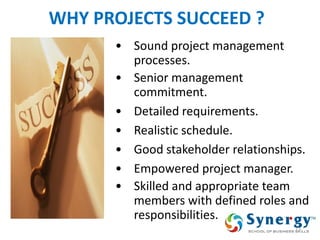
WHY PROJECTS SUCCEED ? 
•Sound project management processes. 
•Senior management commitment. 
•Detailed requirements. 
•Realistic schedule. 
•Good stakeholder relationships. 
•Empowered project manager. 
•Skilled and appropriate team members with defined roles and responsibilities.
What is a Project? 
Temporary 
Unique products or services or result 
A Project is a temporary endeavor undertaken to create a unique product , services or results
What is Project Management ? 
Application of 
Knowledge 
Skills 
Tools and Techniques 
Project Management is the application of 
knowledge, skills, tools and techniques to 
project activities to meet project 
requirements. 
15
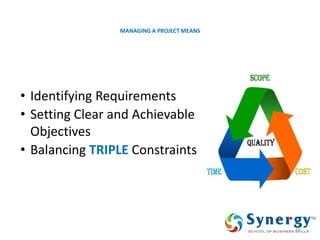
•Identifying Requirements 
•Setting Clear and Achievable Objectives 
•Balancing TRIPLE Constraints 
16 
MANAGING A PROJECT MEANS
PROGRAM 
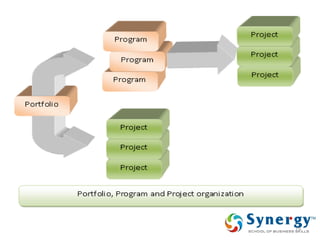
A Program is a group of related projects managed 
in a coordinated way to obtain benefits and control 
not available from managing them individually. 
Program management focuses on 
interdependencies of projects and describes the 
best approach to achieving program objectives
PORTFOLIO 
A Portfolio is a collection of projects or programs 
and other work that are grouped together to 
facilitate effective management of the work to 
meet strategic business objectives. 
Portfolio management is an approach to 
centralized management of collection of 
programs, portfolios and other work, to achieve 
organizational goals.
19
Why Projects are undertaken? 
Market demand 
Organizational need 
Customer request 
Technological advancement 
Legal requirement 
20
PMO 
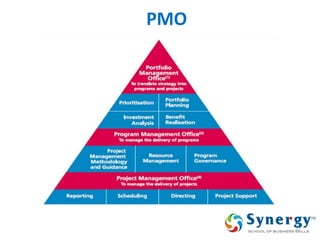
The PMO is the source of documentation, guidance and metrics on the practice of project management and execution. 
In some organizations this is known as the Project Management Office or Program Management Office or Portfolio Management Office .
PMO 
22
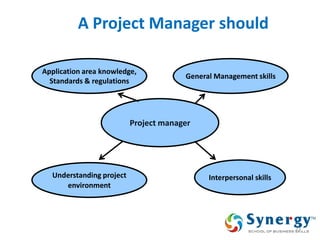
A Project Manager should 
23 
Project manager 
Application area knowledge, 
Standards & regulations 
General Management skills 
Interpersonal skills 
Understanding project 
environment
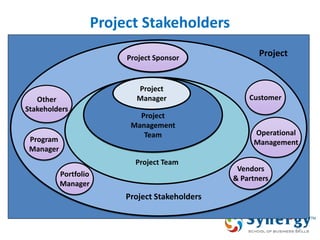
Project Stakeholders 
24 
Project Stakeholders are individuals and organizations who are actively involved in the project, or whose interests may be positively or negatively affected as a result of project execution or successful completion. 
Identify Stakeholders 
Determine requirements and Expectations 
Influences 
•Positive 
•Negative
Project Stakeholders 
25 
Project Team 
Project 
Management 
Team 
Project 
Manager 
Project Sponsor 
Project 
Project Stakeholders 
Customer 
Operational 
Management 
Vendors 
& Partners 
Other 
Stakeholders 
Program 
Manager 
Portfolio 
Manager
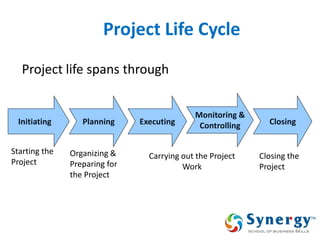
Project Life Cycle 
Project life spans through 
27 
Initiating 
Planning 
Executing 
Monitoring & 
Controlling 
Closing 
Starting the Project 
Organizing & Preparing for the Project 
Carrying out the Project Work 
Closing the Project
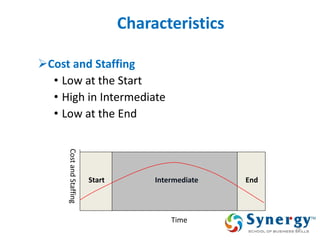
Characteristics 
Cost and Staffing 
•Low at the Start 
•High in Intermediate 
•Low at the End 
28 
Start 
Intermediate 
End 
Time
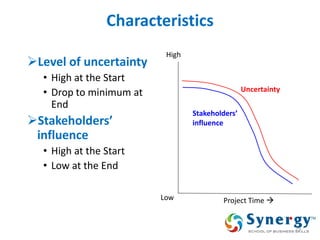
Characteristics 
Level of uncertainty 
•High at the Start 
•Drop to minimum at End 
Stakeholders’ influence 
•High at the Start 
•Low at the End 
29 
High 
Low 
Project Time  
Stakeholders’ 
influence 
Uncertainty
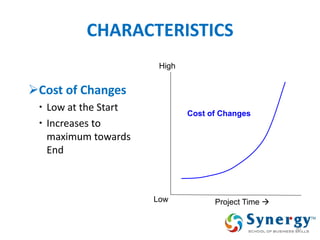
Cost of Changes 
Low at the Start 
Increases to maximum towards End 
30 
High 
Low 
Project Time  
Cost of Changes 
CHARACTERISTICS
31 
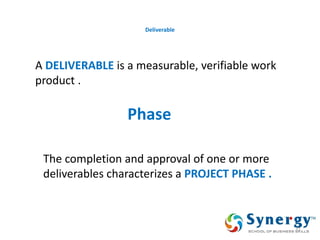
A DELIVERABLE is a measurable, verifiable work product . 
The completion and approval of one or more deliverables characterizes a PROJECT PHASE . 
Phase 
Deliverable
Project Phase Characteristics 
1.Phases are sequential 
2.Work differs from one to another 
3.End of each phase, a deliverable is produced 
4.Phase end deliverables are reviewed whether to continue or to abort the phase / project 
32
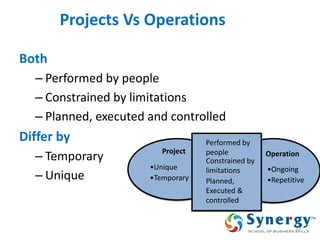
Projects Vs Operations 
Both 
–Performed by people 
–Constrained by limitations 
–Planned, executed and controlled 
Differ by 
–Temporary 
–Unique 
33 
Project 
Operation 
Performed by 
people 
Constrained by 
limitations 
Planned, 
Executed & 
controlled 
•Unique 
•Temporary 
•Ongoing 
•Repetitive
Organizational Culture 
Organizational culture will have a direct 
influence on the success of the project 
Organizational culture includes: 
Values 
Organizational policies and procedures 
View of authority relationships 
Work ethic and work hours 
34
Influence of Organization 
Types of Organization 
Functional 
Matrix 
•Weak 
•Balanced 
•Strong 
Projectized 
35
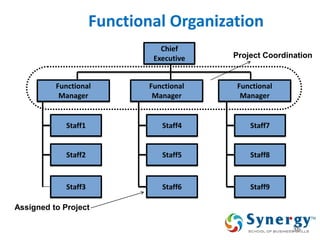
Functional Organization 
36 
Project Coordination 
Assigned to Project 
Chief 
Executive 
Staff1 
Staff2 
Staff3 
Staff4 
Staff5 
Staff6 
Staff7 
Staff8 
Staff9 
Functional 
Manager 
Functional 
Manager 
Functional 
Manager
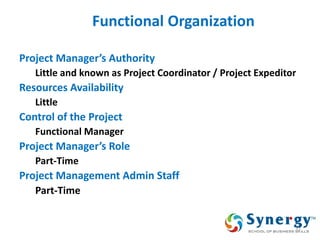
Functional Organization 
Project Manager’s Authority 
Little and known as Project Coordinator / Project Expeditor 
Resources Availability 
Little 
Control of the Project 
Functional Manager 
Project Manager’s Role 
Part-Time 
Project Management Admin Staff 
Part-Time 
37
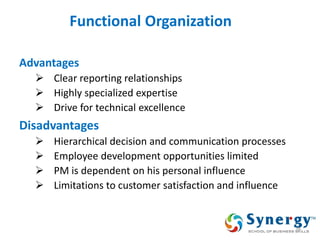
Functional Organization 
Advantages 
Clear reporting relationships 
Highly specialized expertise 
Drive for technical excellence 
Disadvantages 
Hierarchical decision and communication processes 
Employee development opportunities limited 
PM is dependent on his personal influence 
Limitations to customer satisfaction and influence 
38
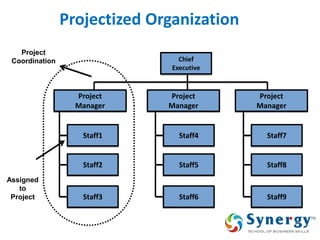
Projectized Organization 
39 
Chief 
Executive 
Staff1 
Staff2 
Staff3 
Staff4 
Staff5 
Staff6 
Staff7 
Staff8 
Staff9 
Project 
Manager 
Project 
Manager 
Project 
Manager 
Project 
Coordination 
Assigned to 
Project
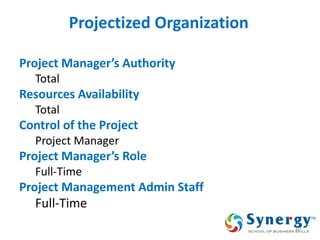
Projectized Organization 
Project Manager’s Authority 
Total 
Resources Availability 
Total 
Control of the Project 
Project Manager 
Project Manager’s Role 
Full-Time 
Project Management Admin Staff 
Full-Time 
40
Projectized Organization 
Advantages 
Clear accountability 
Decision making 
Customer relationships 
Disadvantages 
Focus on technical competence reduced 
Project Manager may be technical/non-technical 
Project team is dissolved at the completion of the project 
41
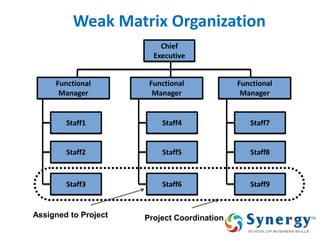
Weak Matrix Organization 
42 
Chief 
Executive 
Staff1 
Staff2 
Staff3 
Staff4 
Staff5 
Staff6 
Staff7 
Staff8 
Staff9 
Functional 
Manager 
Functional 
Manager 
Functional 
Manager 
Project Coordination 
Assigned to Project
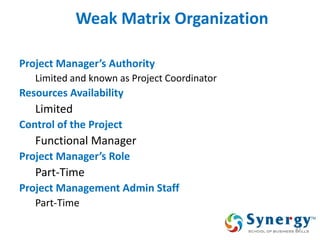
Weak Matrix Organization 
Project Manager’s Authority 
Limited and known as Project Coordinator 
Resources Availability 
Limited 
Control of the Project 
Functional Manager 
Project Manager’s Role 
Part-Time 
Project Management Admin Staff 
Part-Time 
43
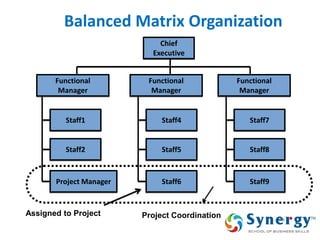
Balanced Matrix Organization 
44 
Chief 
Executive 
Staff1 
Staff2 
Project Manager 
Staff4 
Staff5 
Staff6 
Staff7 
Staff8 
Staff9 
Functional 
Manager 
Functional 
Manager 
Functional 
Manager 
Project Coordination 
Assigned to Project
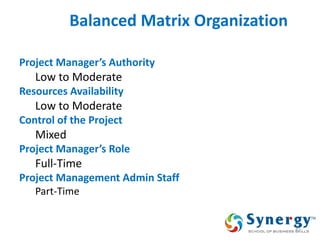
Balanced Matrix Organization 
Project Manager’s Authority 
Low to Moderate 
Resources Availability 
Low to Moderate 
Control of the Project 
Mixed 
Project Manager’s Role 
Full-Time 
Project Management Admin Staff 
Part-Time 
45
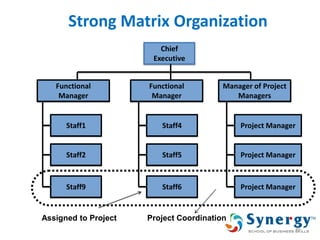
Strong Matrix Organization 
46 
Chief 
Executive 
Staff1 
Staff2 
Project Manager 
Staff4 
Staff5 
Staff6 
Staff9 
Functional 
Manager 
Functional 
Manager 
Manager of Project 
Managers 
Project Coordination 
Assigned to Project 
Project Manager 
Project Manager
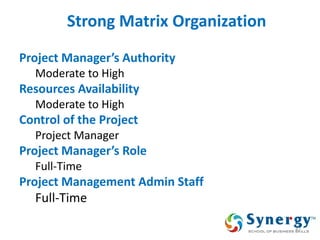
Strong Matrix Organization 
Project Manager’s Authority 
Moderate to High 
Resources Availability 
Moderate to High 
Control of the Project 
Project Manager 
Project Manager’s Role 
Full-Time 
Project Management Admin Staff 
Full-Time 
47
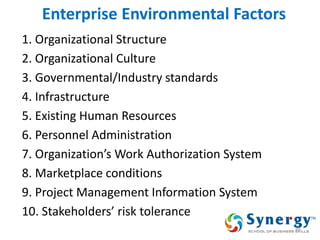
Enterprise Environmental Factors 
1. Organizational Structure 
2. Organizational Culture 
3. Governmental/Industry standards 
4. Infrastructure 
5. Existing Human Resources 
6. Personnel Administration 
7. Organization’s Work Authorization System 
8. Marketplace conditions 
9. Project Management Information System 
10. Stakeholders’ risk tolerance 
48
Organizational Process Assets 
1. Organizational processes, standards & procedures 
2. Templates 
3. Organizational communications requirements 
4. Financial controls procedures 
5. Issues and Defect Management procedures 
6. Change control procedures 
7. Risk Control procedures 
8. Procedures approving and issuing work authorizations 
9. Organizational knowledge base 
49
Introduction to Project Management 
To Sum up… 
We know what Project is 
We know what Project Management is 
We know what a Program and Program Management is 
We know what Portfolio and Portfolio Management is 
We know why projects are undertaken 
We know what Project Management Office is 
50
Introduction to Project Management 
To Sum up … 
We know w hat are qualifies of a good Project Manager 
We know what Project Life Cycle is 
We know the characteristics of Project Life Cycle 
We know characteristics of Project Phase 
We know differences between a Project and an Operation 
51
Introduction to Project Management 
To Sum up … 
We know to identify Project Stakeholders 
We know different types of organizations and their influences on the project 
We know what Enterprise Environmental Factors are 
We know what Organizational Process Assets are 
52
Project Planning and Management

Project Planning and Management

  • 2.
    Synergy School ofBusiness Skills… School of Project Management School of Operational Excellence School of People Skills
  • 3.
  • 4.
    Who is PMI®? Project Management Institute. Established in 1969 Global Organization Headquartered in Newtown Square, Pennsylvania USA Codified best practices in Project Management as PMBOK® guide
  • 5.
    PMBOK® - TheBible of PM recognized by Members from more than 185 countries
  • 6.
    PMBOK® includes… PMBOK® Process Group Initiating Planning Executing Monitoring and Controlling Closing Knowledge Area Time, Scope, Cost Quality,HR,Communication Procurement, Risk ,Integration
  • 7.
    Project Management BodyOf Knowledge Guide that possess standards for project management - explains about project management processes, tools & techniques - published by PMI in 1996 as first edition - updated once in 4 year - latest publication is 2008 7
  • 8.
    TOP TWO FAMOUSCERTIFICATION PMP® Project Management Professional CAPM® Certified Associate in Project Management
  • 11.
  • 12.
    12 WHY PROJECTSFAIL ? •Lack of senior management commitment •Inadequate project planning (budget, schedule, scope, etc.) •Absence of user involvement •New or unfamiliar technology •Lack of defined, clear, or concise requirements
  • 13.
    13 WHY PROJECTSSUCCEED ? •Sound project management processes. •Senior management commitment. •Detailed requirements. •Realistic schedule. •Good stakeholder relationships. •Empowered project manager. •Skilled and appropriate team members with defined roles and responsibilities.
  • 14.
    What is aProject? Temporary Unique products or services or result A Project is a temporary endeavor undertaken to create a unique product , services or results
  • 15.
    What is ProjectManagement ? Application of Knowledge Skills Tools and Techniques Project Management is the application of knowledge, skills, tools and techniques to project activities to meet project requirements. 15
  • 16.
    •Identifying Requirements •SettingClear and Achievable Objectives •Balancing TRIPLE Constraints 16 MANAGING A PROJECT MEANS
  • 17.
    PROGRAM A Programis a group of related projects managed in a coordinated way to obtain benefits and control not available from managing them individually. Program management focuses on interdependencies of projects and describes the best approach to achieving program objectives
  • 18.
    PORTFOLIO A Portfoliois a collection of projects or programs and other work that are grouped together to facilitate effective management of the work to meet strategic business objectives. Portfolio management is an approach to centralized management of collection of programs, portfolios and other work, to achieve organizational goals.
  • 19.
  • 20.
    Why Projects areundertaken? Market demand Organizational need Customer request Technological advancement Legal requirement 20
  • 21.
    PMO The PMOis the source of documentation, guidance and metrics on the practice of project management and execution. In some organizations this is known as the Project Management Office or Program Management Office or Portfolio Management Office .
  • 22.
  • 23.
    A Project Managershould 23 Project manager Application area knowledge, Standards & regulations General Management skills Interpersonal skills Understanding project environment
  • 24.
    Project Stakeholders 24 Project Stakeholders are individuals and organizations who are actively involved in the project, or whose interests may be positively or negatively affected as a result of project execution or successful completion. Identify Stakeholders Determine requirements and Expectations Influences •Positive •Negative
  • 25.
    Project Stakeholders 25 Project Team Project Management Team Project Manager Project Sponsor Project Project Stakeholders Customer Operational Management Vendors & Partners Other Stakeholders Program Manager Portfolio Manager
  • 27.
    Project Life Cycle Project life spans through 27 Initiating Planning Executing Monitoring & Controlling Closing Starting the Project Organizing & Preparing for the Project Carrying out the Project Work Closing the Project
  • 28.
    Characteristics Cost andStaffing •Low at the Start •High in Intermediate •Low at the End 28 Start Intermediate End Time
  • 29.
    Characteristics Level ofuncertainty •High at the Start •Drop to minimum at End Stakeholders’ influence •High at the Start •Low at the End 29 High Low Project Time  Stakeholders’ influence Uncertainty
  • 30.
    Cost of Changes Low at the Start Increases to maximum towards End 30 High Low Project Time  Cost of Changes CHARACTERISTICS
  • 31.
    31 A DELIVERABLEis a measurable, verifiable work product . The completion and approval of one or more deliverables characterizes a PROJECT PHASE . Phase Deliverable
  • 32.
    Project Phase Characteristics 1.Phases are sequential 2.Work differs from one to another 3.End of each phase, a deliverable is produced 4.Phase end deliverables are reviewed whether to continue or to abort the phase / project 32
  • 33.
    Projects Vs Operations Both –Performed by people –Constrained by limitations –Planned, executed and controlled Differ by –Temporary –Unique 33 Project Operation Performed by people Constrained by limitations Planned, Executed & controlled •Unique •Temporary •Ongoing •Repetitive
  • 34.
    Organizational Culture Organizationalculture will have a direct influence on the success of the project Organizational culture includes: Values Organizational policies and procedures View of authority relationships Work ethic and work hours 34
  • 35.
    Influence of Organization Types of Organization Functional Matrix •Weak •Balanced •Strong Projectized 35
  • 36.
    Functional Organization 36 Project Coordination Assigned to Project Chief Executive Staff1 Staff2 Staff3 Staff4 Staff5 Staff6 Staff7 Staff8 Staff9 Functional Manager Functional Manager Functional Manager
  • 37.
    Functional Organization ProjectManager’s Authority Little and known as Project Coordinator / Project Expeditor Resources Availability Little Control of the Project Functional Manager Project Manager’s Role Part-Time Project Management Admin Staff Part-Time 37
  • 38.
    Functional Organization Advantages Clear reporting relationships Highly specialized expertise Drive for technical excellence Disadvantages Hierarchical decision and communication processes Employee development opportunities limited PM is dependent on his personal influence Limitations to customer satisfaction and influence 38
  • 39.
    Projectized Organization 39 Chief Executive Staff1 Staff2 Staff3 Staff4 Staff5 Staff6 Staff7 Staff8 Staff9 Project Manager Project Manager Project Manager Project Coordination Assigned to Project
  • 40.
    Projectized Organization ProjectManager’s Authority Total Resources Availability Total Control of the Project Project Manager Project Manager’s Role Full-Time Project Management Admin Staff Full-Time 40
  • 41.
    Projectized Organization Advantages Clear accountability Decision making Customer relationships Disadvantages Focus on technical competence reduced Project Manager may be technical/non-technical Project team is dissolved at the completion of the project 41
  • 42.
    Weak Matrix Organization 42 Chief Executive Staff1 Staff2 Staff3 Staff4 Staff5 Staff6 Staff7 Staff8 Staff9 Functional Manager Functional Manager Functional Manager Project Coordination Assigned to Project
  • 43.
    Weak Matrix Organization Project Manager’s Authority Limited and known as Project Coordinator Resources Availability Limited Control of the Project Functional Manager Project Manager’s Role Part-Time Project Management Admin Staff Part-Time 43
  • 44.
    Balanced Matrix Organization 44 Chief Executive Staff1 Staff2 Project Manager Staff4 Staff5 Staff6 Staff7 Staff8 Staff9 Functional Manager Functional Manager Functional Manager Project Coordination Assigned to Project
  • 45.
    Balanced Matrix Organization Project Manager’s Authority Low to Moderate Resources Availability Low to Moderate Control of the Project Mixed Project Manager’s Role Full-Time Project Management Admin Staff Part-Time 45
  • 46.
    Strong Matrix Organization 46 Chief Executive Staff1 Staff2 Project Manager Staff4 Staff5 Staff6 Staff9 Functional Manager Functional Manager Manager of Project Managers Project Coordination Assigned to Project Project Manager Project Manager
  • 47.
    Strong Matrix Organization Project Manager’s Authority Moderate to High Resources Availability Moderate to High Control of the Project Project Manager Project Manager’s Role Full-Time Project Management Admin Staff Full-Time 47
  • 48.
    Enterprise Environmental Factors 1. Organizational Structure 2. Organizational Culture 3. Governmental/Industry standards 4. Infrastructure 5. Existing Human Resources 6. Personnel Administration 7. Organization’s Work Authorization System 8. Marketplace conditions 9. Project Management Information System 10. Stakeholders’ risk tolerance 48
  • 49.
    Organizational Process Assets 1. Organizational processes, standards & procedures 2. Templates 3. Organizational communications requirements 4. Financial controls procedures 5. Issues and Defect Management procedures 6. Change control procedures 7. Risk Control procedures 8. Procedures approving and issuing work authorizations 9. Organizational knowledge base 49
  • 50.
    Introduction to ProjectManagement To Sum up… We know what Project is We know what Project Management is We know what a Program and Program Management is We know what Portfolio and Portfolio Management is We know why projects are undertaken We know what Project Management Office is 50
  • 51.
    Introduction to ProjectManagement To Sum up … We know w hat are qualifies of a good Project Manager We know what Project Life Cycle is We know the characteristics of Project Life Cycle We know characteristics of Project Phase We know differences between a Project and an Operation 51
  • 52.
    Introduction to ProjectManagement To Sum up … We know to identify Project Stakeholders We know different types of organizations and their influences on the project We know what Enterprise Environmental Factors are We know what Organizational Process Assets are 52