PMP Preparation Course
The Project Management framework
Eng.Akram Alnajjar , PgMP , PMP , PSP
www.pmhouse.org
 My name is Mohamed Seleam
 Certified Project Management Professional PMP by PMI / USA
 Postgraduate Diploma for business administration Suis Canal University 1991
 BSC , Business Administration 1989
 PM consultant and owner of an Import firm
 Currently working as lecturer for Arab Academy , ITI, PMI Mena Chapter PM
information house, IPA, Orascom, Brisk
 more than fifteen years of experience in the field of project management and
marketing .
 very aware of today's complex business environment with firms of different types
and sizes and with people of different cultures.
Who am I?
Participant Introductions
ü
ü
Name
ü
ü
Organization
Role in organization
Why do you attend this course?
What is your expectations ?
Ground Rules To Enhance Performance
Start on time to End on time
Mobile Phone Silent Please
Questions after Permeation
RATHOLE TO CONCENTRATE
Presents 100 % to get your certificate
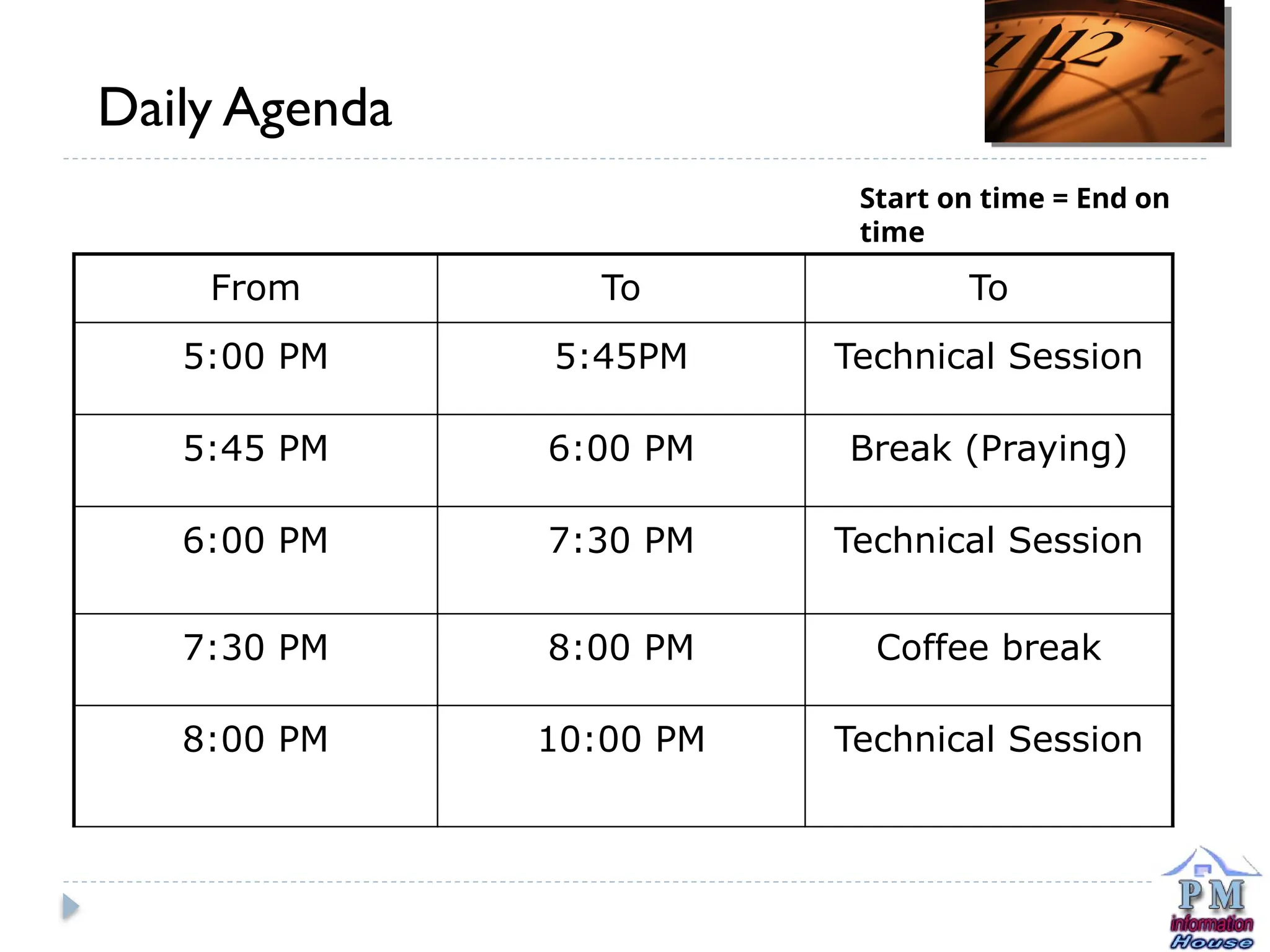
From To To
5:00 PM 5:45PM Technical Session
5:45 PM 6:00 PM Break (Praying)
6:00 PM 7:30 PM Technical Session
7:30 PM 8:00 PM Coffee break
8:00 PM 10:00 PM Technical Session
Daily Agenda
Start on time = End on
time
Section I - Project
Framework Management
 PMP Certifications and
Requirements
 Chapter 1 – Introduction
 Chapter 2 –Project Life
Cycle and Organization
 Chapter 3 –Project
Management Process
Interactions
Exam (I)
15 Min 
Chapter 1 -
Introduction
 Purpose of the PMBOK®
Guide
 What is a Project?
 What is Project management?
 Relationships Among Project
Management
 Program Management ,
Operations Management
 Role of Project Manager
 ProjectsVs. Operational Work
 Enterprise Environmental
Factors
Purpose of this PMBOK® Guide
 The primary purpose of the PMBOK® Guide is to
identify that Subset of the Project Management Body
of Knowledge that is generally recognized as good
practice.
 Provides common terminology
What is a Project
 A project is a temporary endeavor
undertaken to create a unique product
service, or result.
•Temporary Has a definite beginning and end, not an
on-going effort.
Ceases when objectives have been attained.
Team disbanded upon completion.
•Unique The product or service is different in
some way from other products or services.
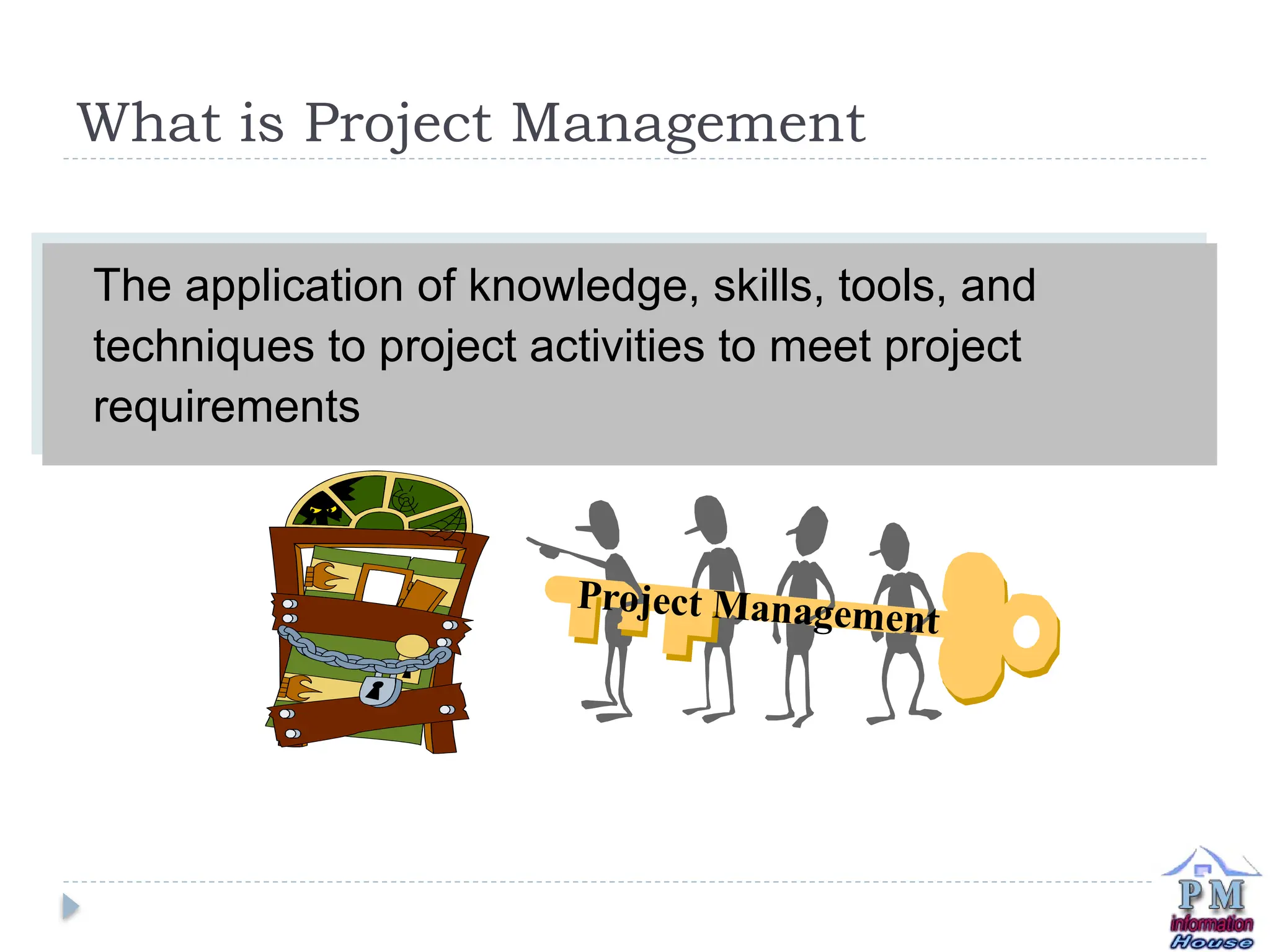
What is Project Management
The application of knowledge, skills, tools, and
techniques to project activities to meet project
requirements
Project Management
Project constraints
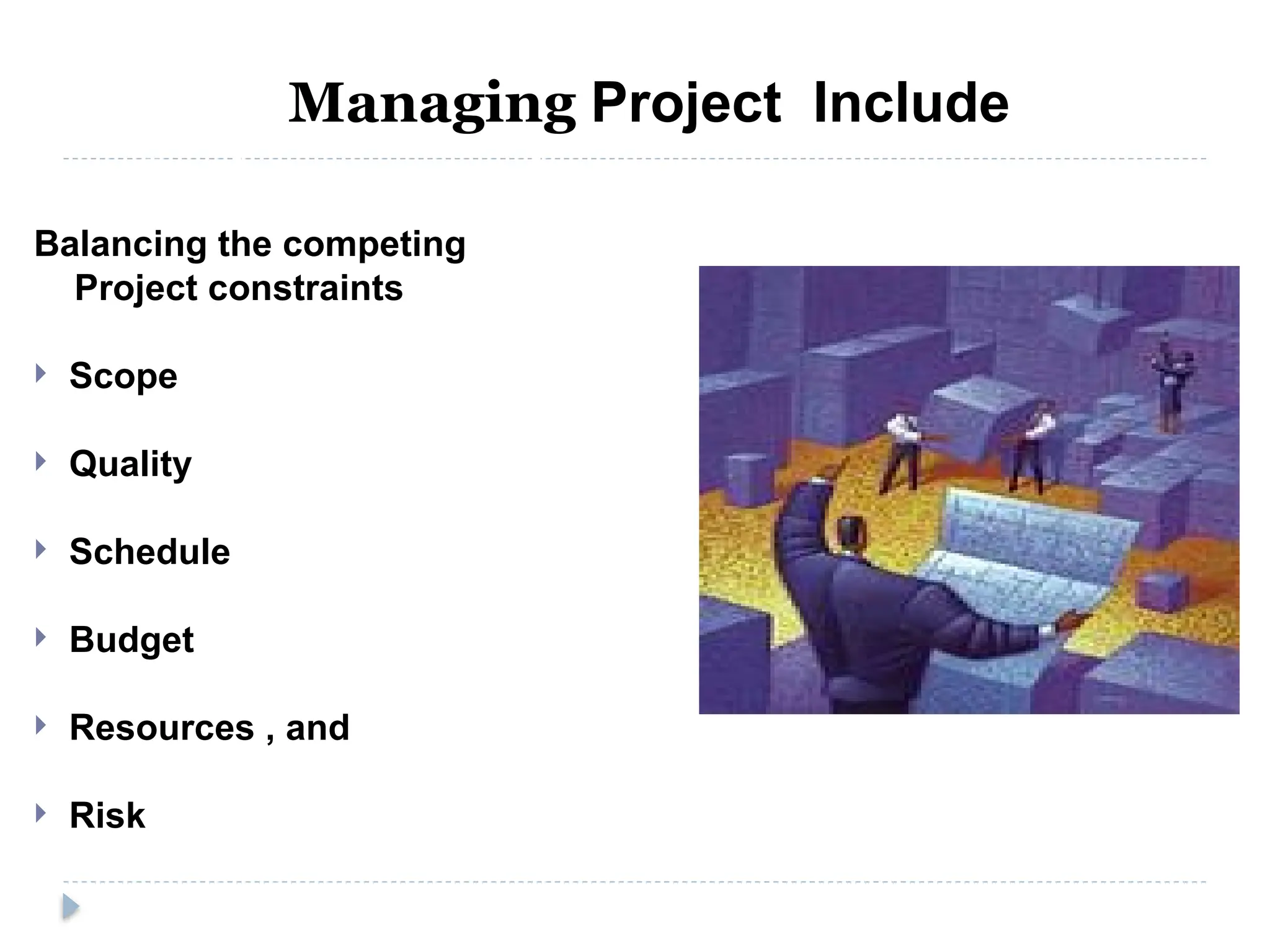
Balancing the competing
Project constraints
 Scope
 Quality
 Schedule
 Budget
 Resources , and
 Risk
Managing Project Include
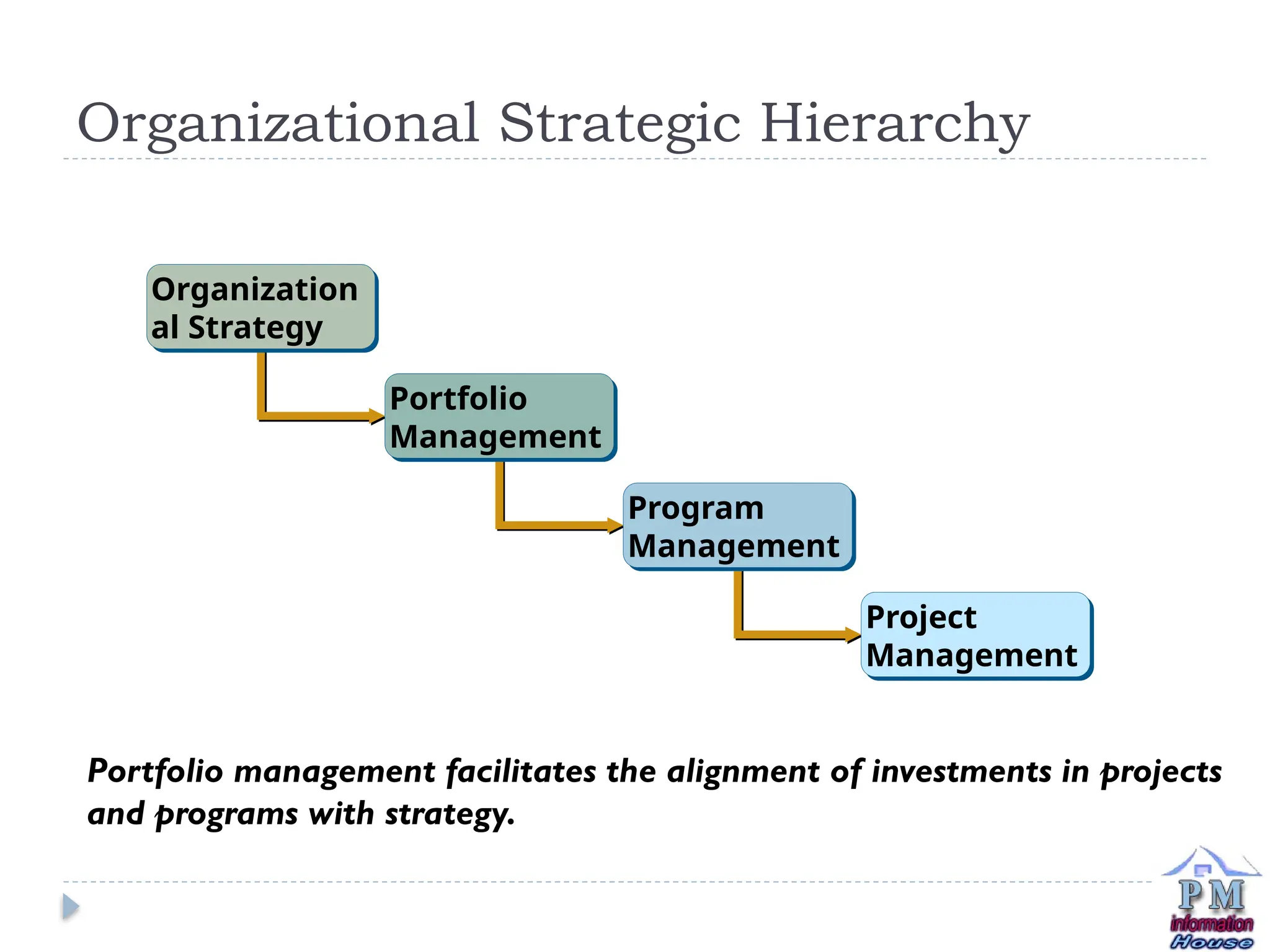
Organizational Strategic Hierarchy
Organization
al Strategy
Portfolio
Management
Program
Management
Project
Management
Portfolio management facilitates the alignment of investments in projects
and programs with strategy.
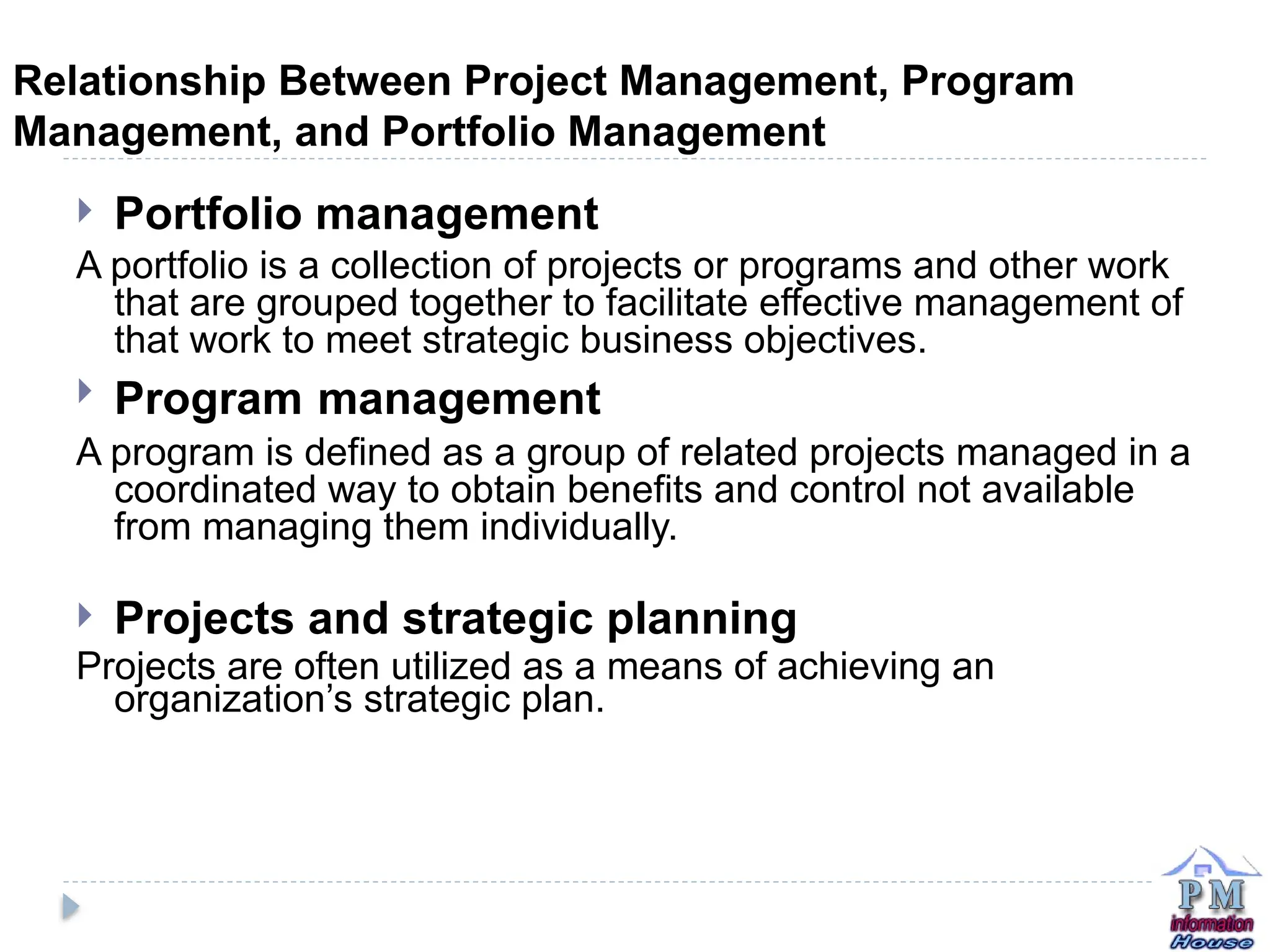
Relationship Between Project Management, Program
Management, and Portfolio Management
 Portfolio management
A portfolio is a collection of projects or programs and other work
that are grouped together to facilitate effective management of
that work to meet strategic business objectives.
 Program management
A program is defined as a group of related projects managed in a
coordinated way to obtain benefits and control not available
from managing them individually.
 Projects and strategic planning
Projects are often utilized as a means of achieving an
organization’s strategic plan.
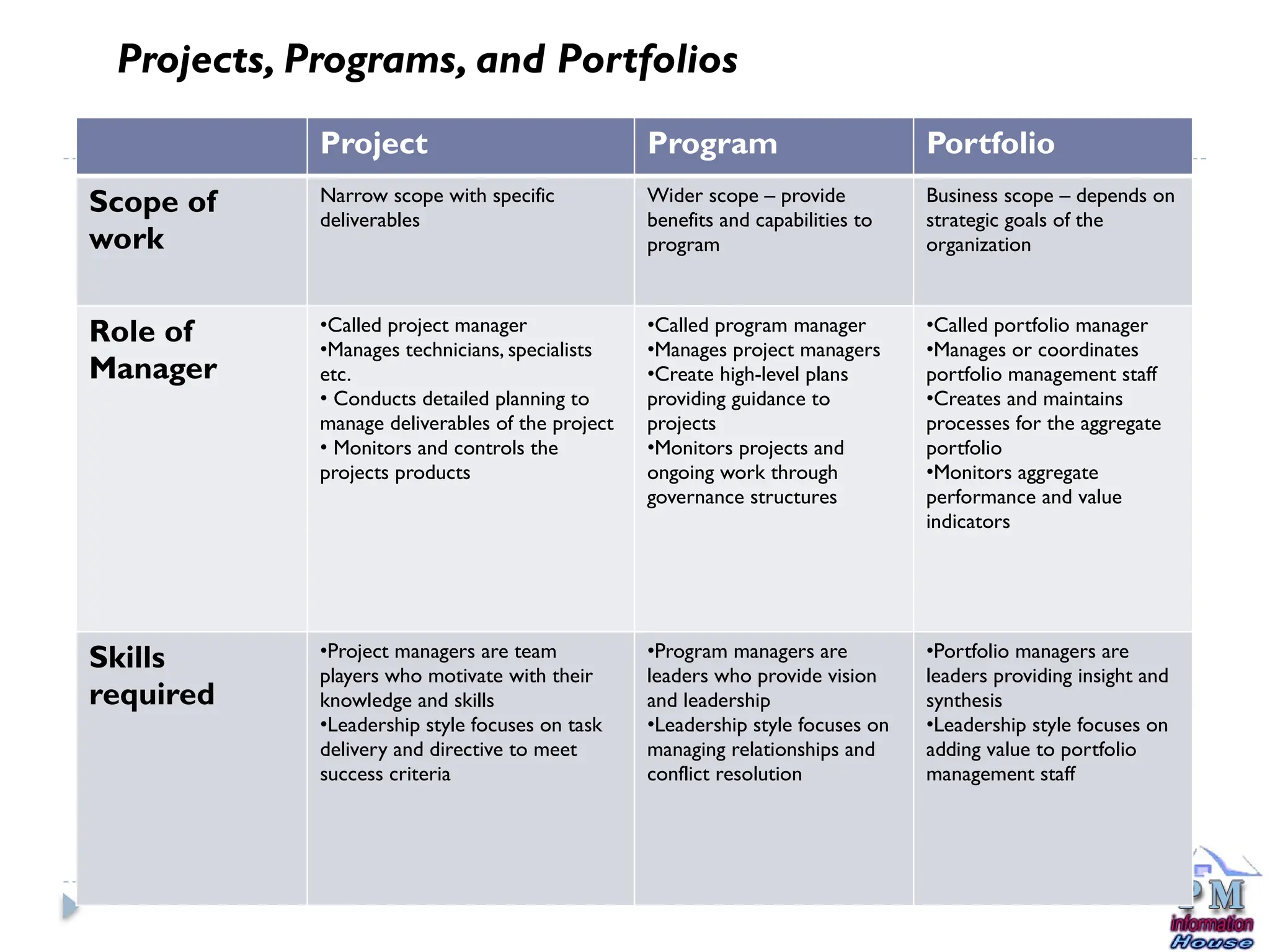
Project Program Portfolio
Scope of
work
Narrow scope with specific
deliverables
Wider scope – provide
benefits and capabilities to
program
Business scope – depends on
strategic goals of the
organization
Role of
Manager
•Called project manager
•Manages technicians, specialists
etc.
• Conducts detailed planning to
manage deliverables of the project
• Monitors and controls the
projects products
•Called program manager
•Manages project managers
•Create high-level plans
providing guidance to
projects
•Monitors projects and
ongoing work through
governance structures
•Called portfolio manager
•Manages or coordinates
portfolio management staff
•Creates and maintains
processes for the aggregate
portfolio
•Monitors aggregate
performance and value
indicators
Skills
required
•Project managers are team
players who motivate with their
knowledge and skills
•Leadership style focuses on task
delivery and directive to meet
success criteria
•Program managers are
leaders who provide vision
and leadership
•Leadership style focuses on
managing relationships and
conflict resolution
•Portfolio managers are
leaders providing insight and
synthesis
•Leadership style focuses on
adding value to portfolio
management staff
Projects, Programs, and Portfolios
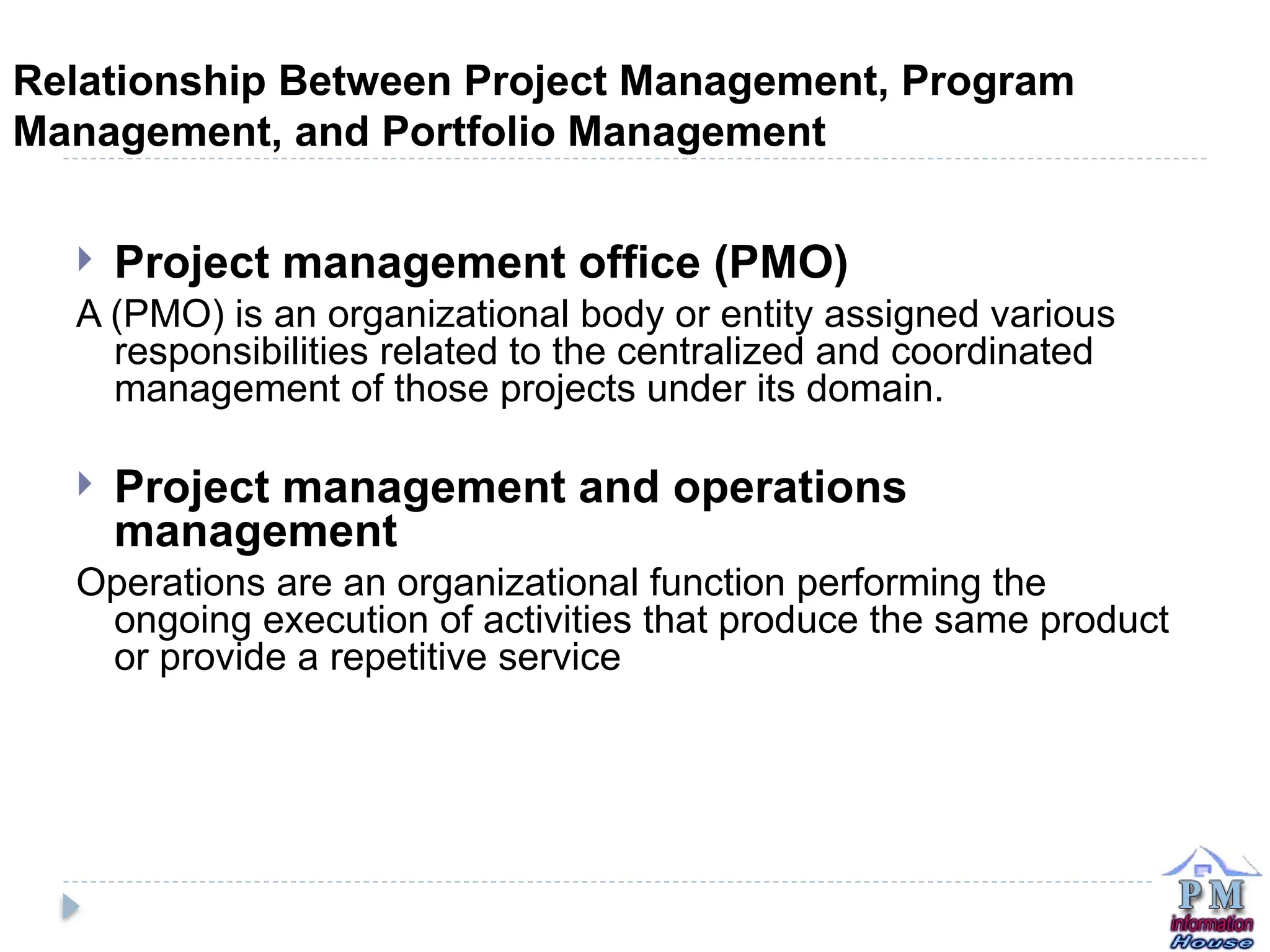
Relationship Between Project Management, Program
Management, and Portfolio Management
 Project management office (PMO)
A (PMO) is an organizational body or entity assigned various
responsibilities related to the centralized and coordinated
management of those projects under its domain.
 Project management and operations
management
Operations are an organizational function performing the
ongoing execution of activities that produce the same product
or provide a repetitive service
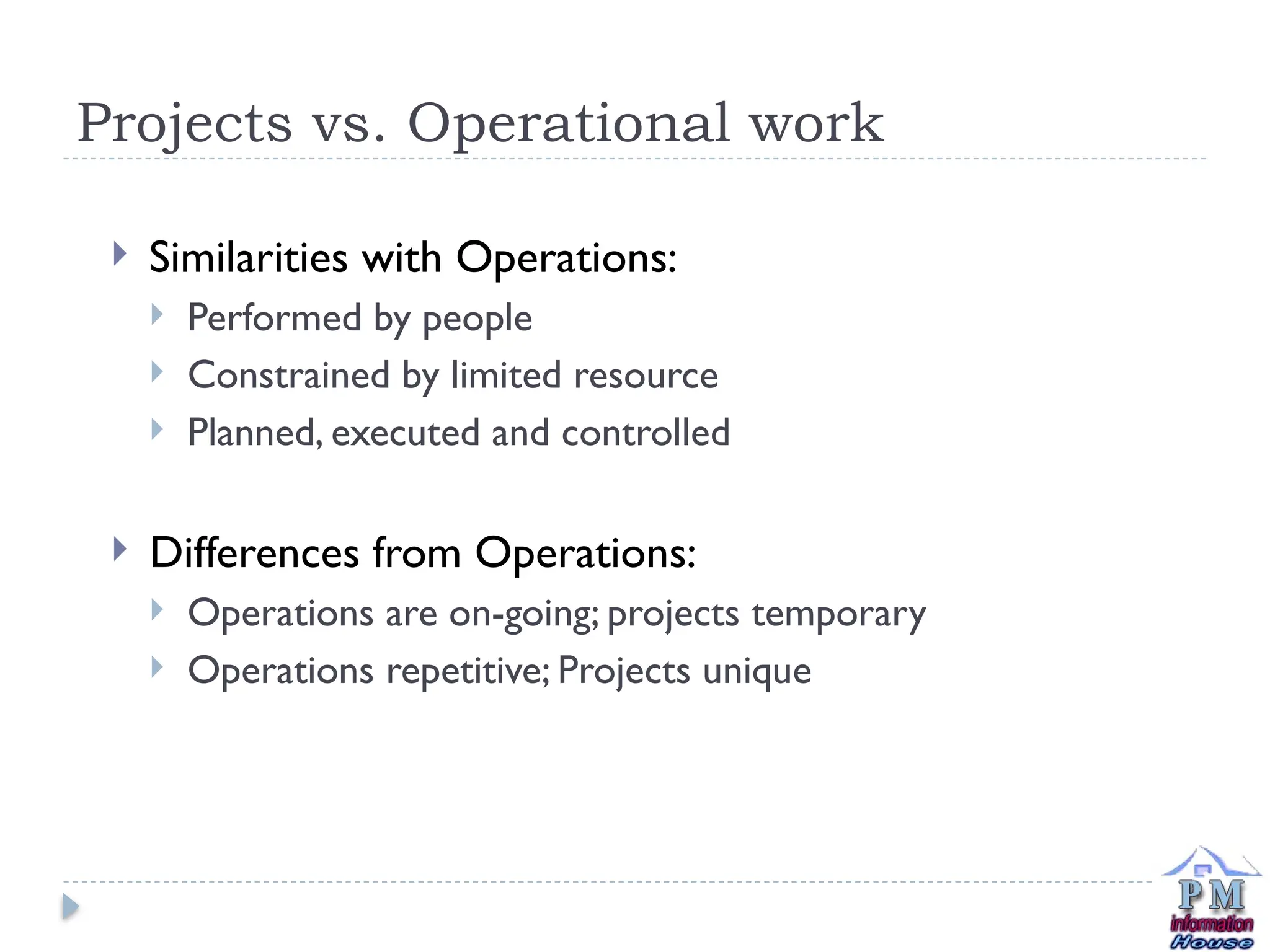
Projects vs. Operational work
 Similarities with Operations:
 Performed by people
 Constrained by limited resource
 Planned, executed and controlled
 Differences from Operations:
 Operations are on-going; projects temporary
 Operations repetitive; Projects unique
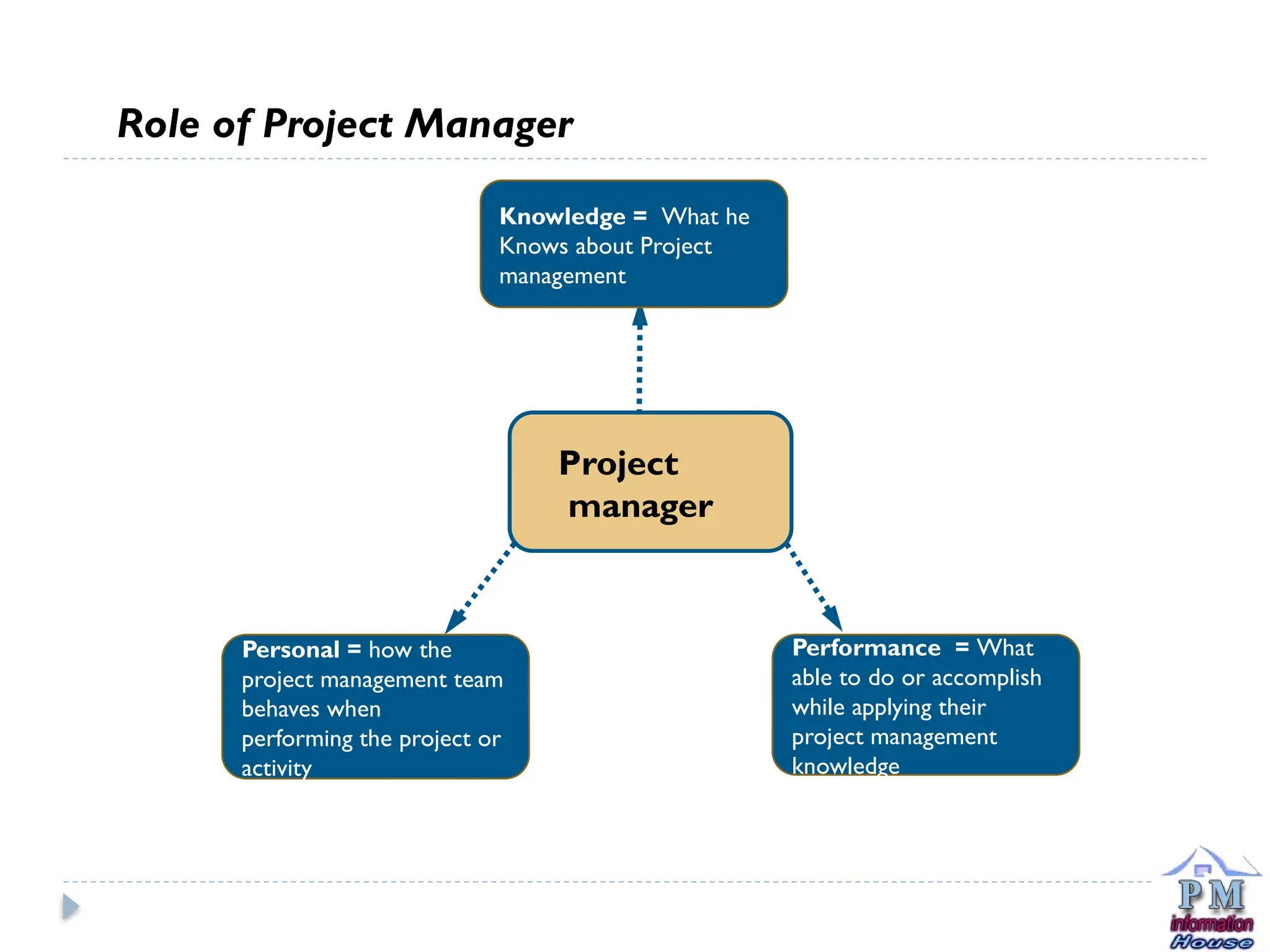
Personal = how the
project management team
behaves when
performing the project or
activity
Knowledge = What he
Knows about Project
management
Performance = What
able to do or accomplish
while applying their
project management
knowledge
Project
manager
Role of Project Manager
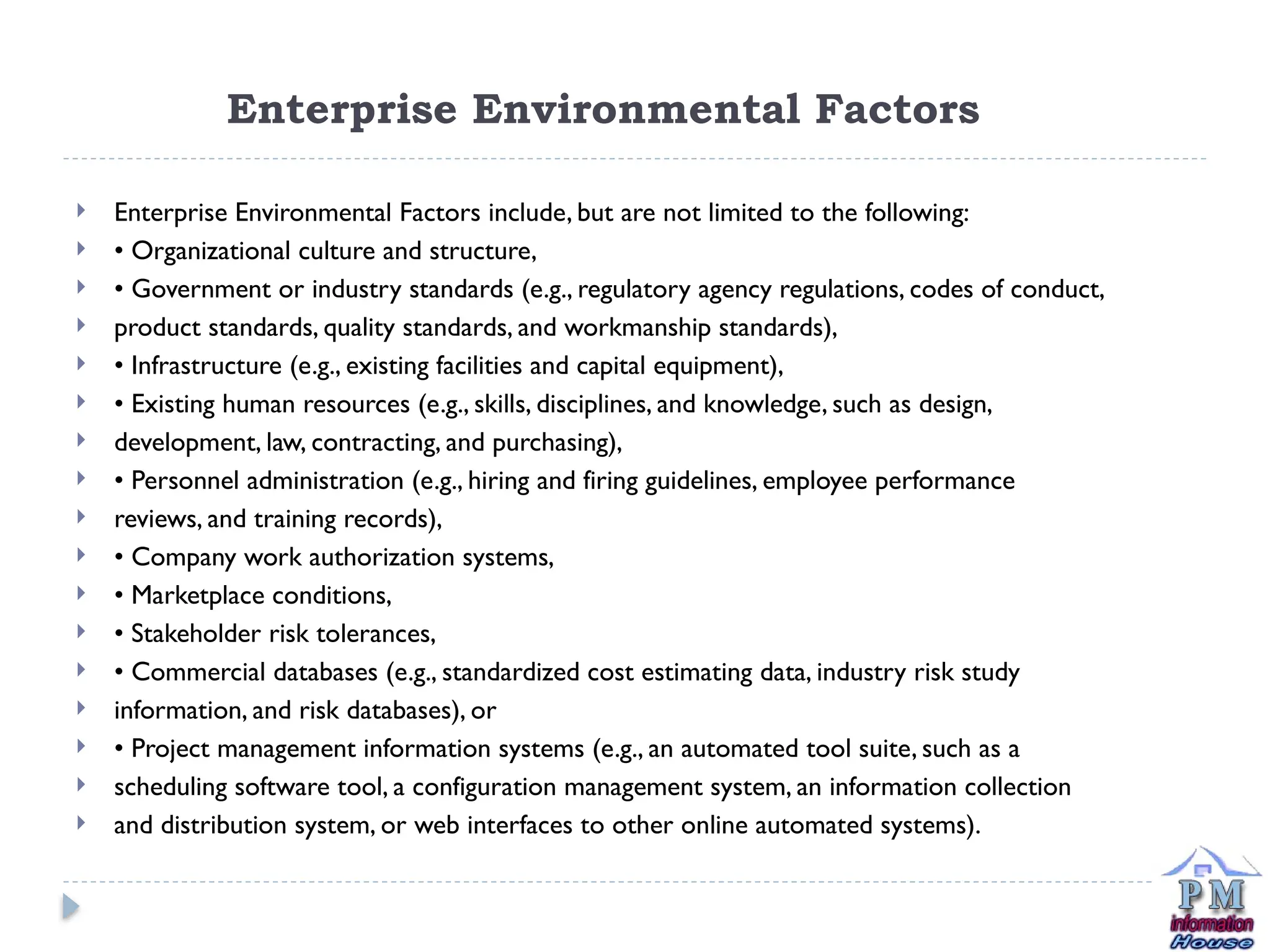
Enterprise Environmental Factors
 Enterprise Environmental Factors include, but are not limited to the following:
 • Organizational culture and structure,
 • Government or industry standards (e.g., regulatory agency regulations, codes of conduct,
 product standards, quality standards, and workmanship standards),
 • Infrastructure (e.g., existing facilities and capital equipment),
 • Existing human resources (e.g., skills, disciplines, and knowledge, such as design,
 development, law, contracting, and purchasing),
 • Personnel administration (e.g., hiring and firing guidelines, employee performance
 reviews, and training records),
 • Company work authorization systems,
 • Marketplace conditions,
 • Stakeholder risk tolerances,
 • Commercial databases (e.g., standardized cost estimating data, industry risk study
 information, and risk databases), or
 • Project management information systems (e.g., an automated tool suite, such as a
 scheduling software tool, a configuration management system, an information collection
 and distribution system, or web interfaces to other online automated systems).
QUESTIONS?
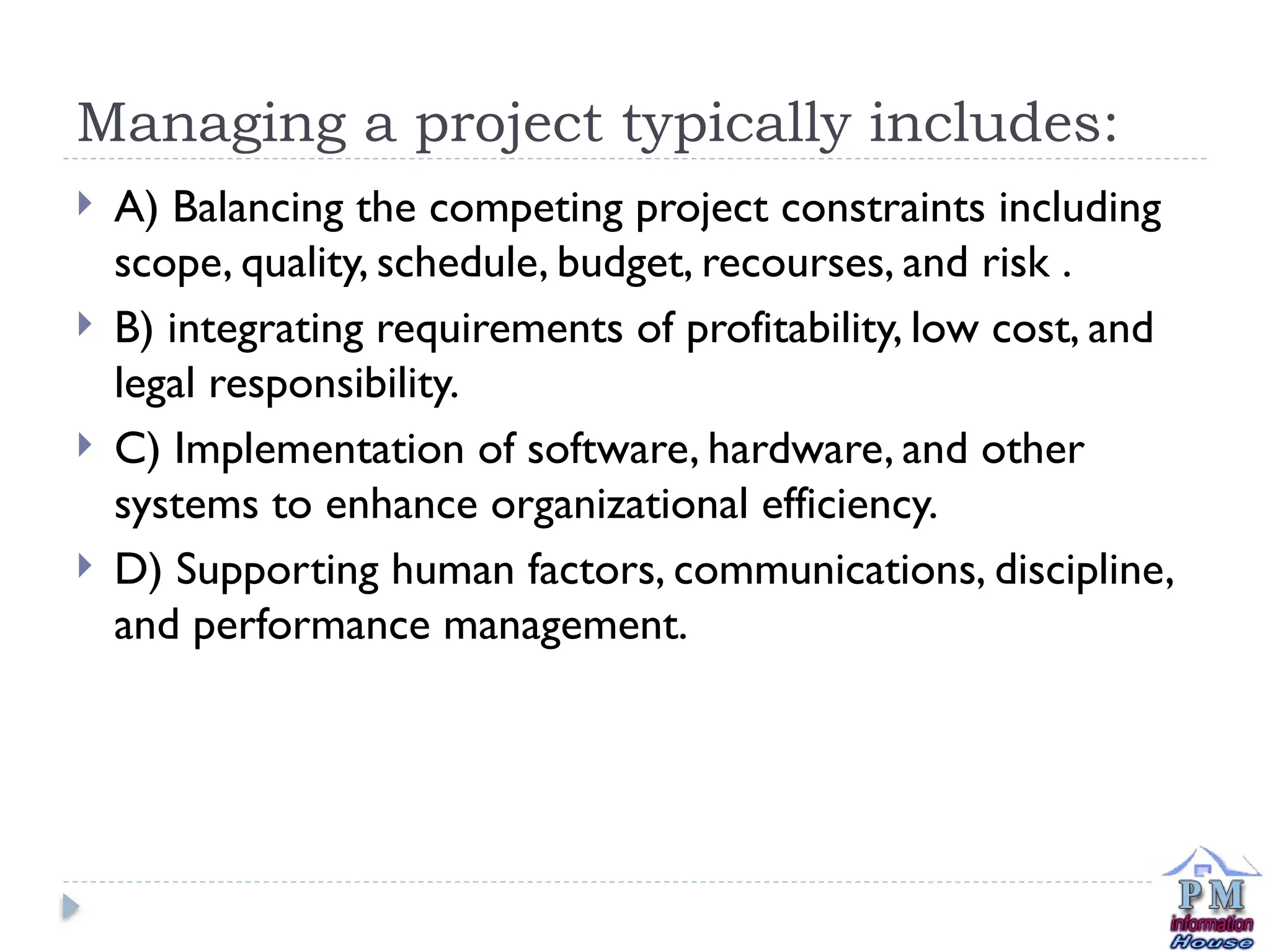
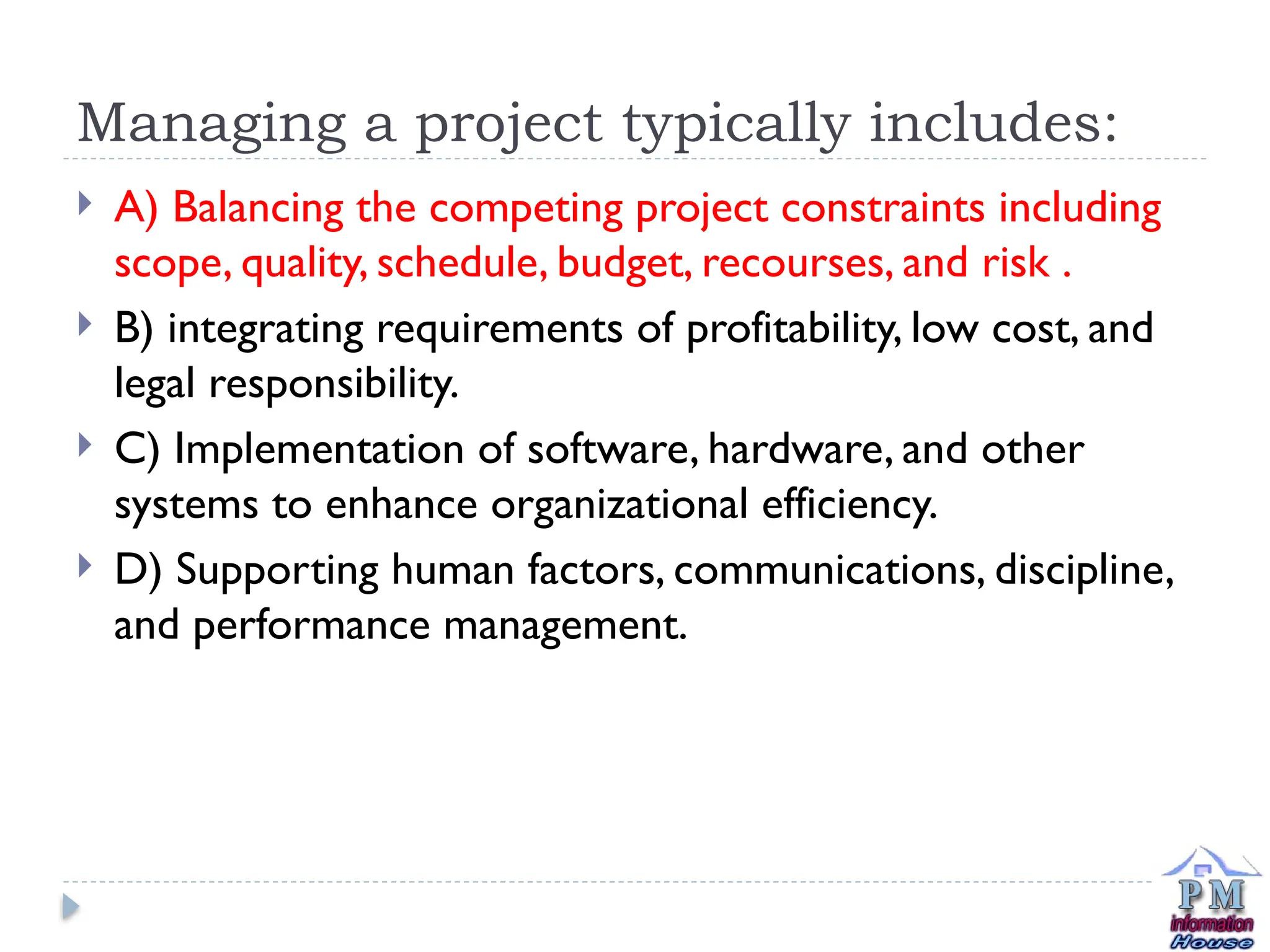
Managing a project typically includes:
 A) Balancing the competing project constraints including
scope, quality, schedule, budget, recourses, and risk .
 B) integrating requirements of profitability, low cost, and
legal responsibility.
 C) Implementation of software, hardware, and other
systems to enhance organizational efficiency.
 D) Supporting human factors, communications, discipline,
and performance management.
Managing a project typically includes:
 A) Balancing the competing project constraints including
scope, quality, schedule, budget, recourses, and risk .
 B) integrating requirements of profitability, low cost, and
legal responsibility.
 C) Implementation of software, hardware, and other
systems to enhance organizational efficiency.
 D) Supporting human factors, communications, discipline,
and performance management.
Portfolio management refers to:
 A) Managing various contents of project file.
 B) Managing the levels of financial authority to facilitate
project decision making.
 C) Identifying, prioritizing, authorizing, managing, and
controlling projects, programs, and other related work, to
achieve specific strategic business objectives.
 D) Applying recourses-leveling heuristics across all the
organization’s projects to achieve the organization’s
strategic objectives.
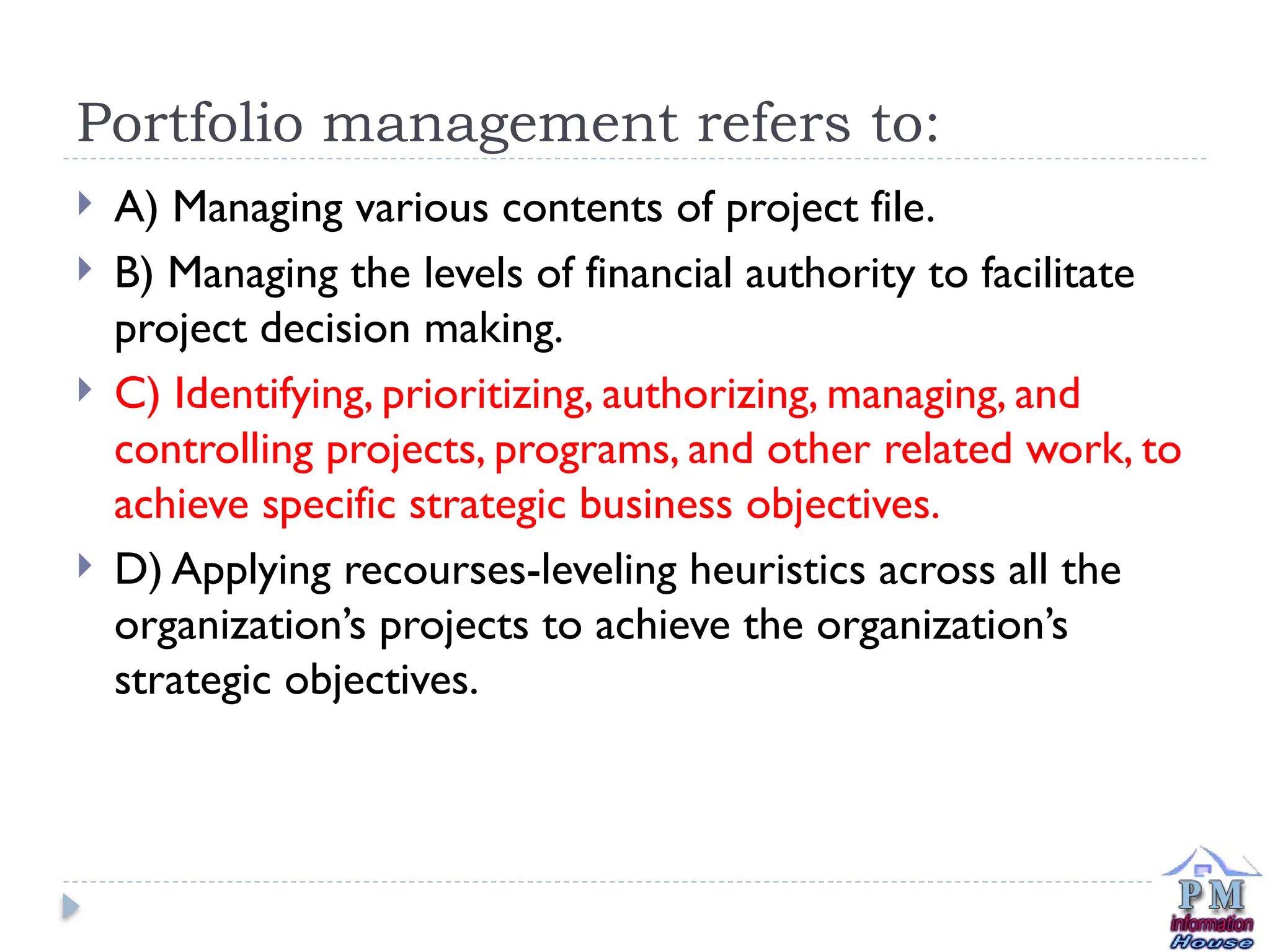
Portfolio management refers to:
 A) Managing various contents of project file.
 B) Managing the levels of financial authority to facilitate
project decision making.
 C) Identifying, prioritizing, authorizing, managing, and
controlling projects, programs, and other related work, to
achieve specific strategic business objectives.
 D) Applying recourses-leveling heuristics across all the
organization’s projects to achieve the organization’s
strategic objectives.
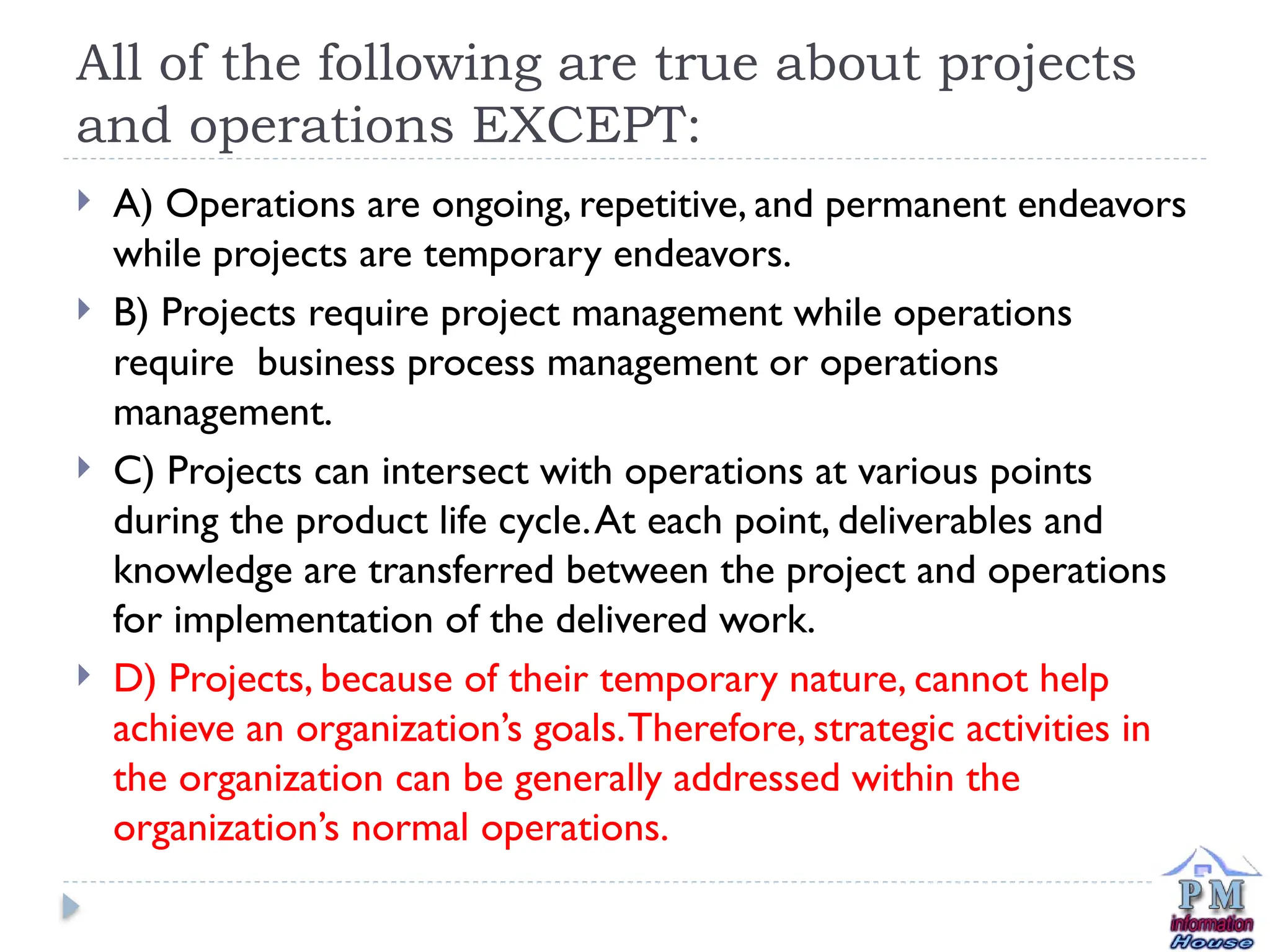
All of the following are true about projects
and operations EXCEPT:
 A) Operations are ongoing, repetitive, and permanent endeavors
while projects are temporary endeavors.
 B) Projects require project management while operations
require business process management or operations
management.
 C) Projects can intersect with operations at various points
during the product life cycle.At each point, deliverables and
knowledge are transferred between the project and operations
for implementation of the delivered work.
 D) Projects, because of their temporary nature, cannot help
achieve an organization’s goals.Therefore, strategic activities in
the organization can be generally addressed within the
organization’s normal operations.
All of the following are true about projects
and operations EXCEPT:
 A) Operations are ongoing, repetitive, and permanent endeavors
while projects are temporary endeavors.
 B) Projects require project management while operations
require business process management or operations
management.
 C) Projects can intersect with operations at various points
during the product life cycle.At each point, deliverables and
knowledge are transferred between the project and operations
for implementation of the delivered work.
 D) Projects, because of their temporary nature, cannot help
achieve an organization’s goals.Therefore, strategic activities in
the organization can be generally addressed within the
organization’s normal operations.
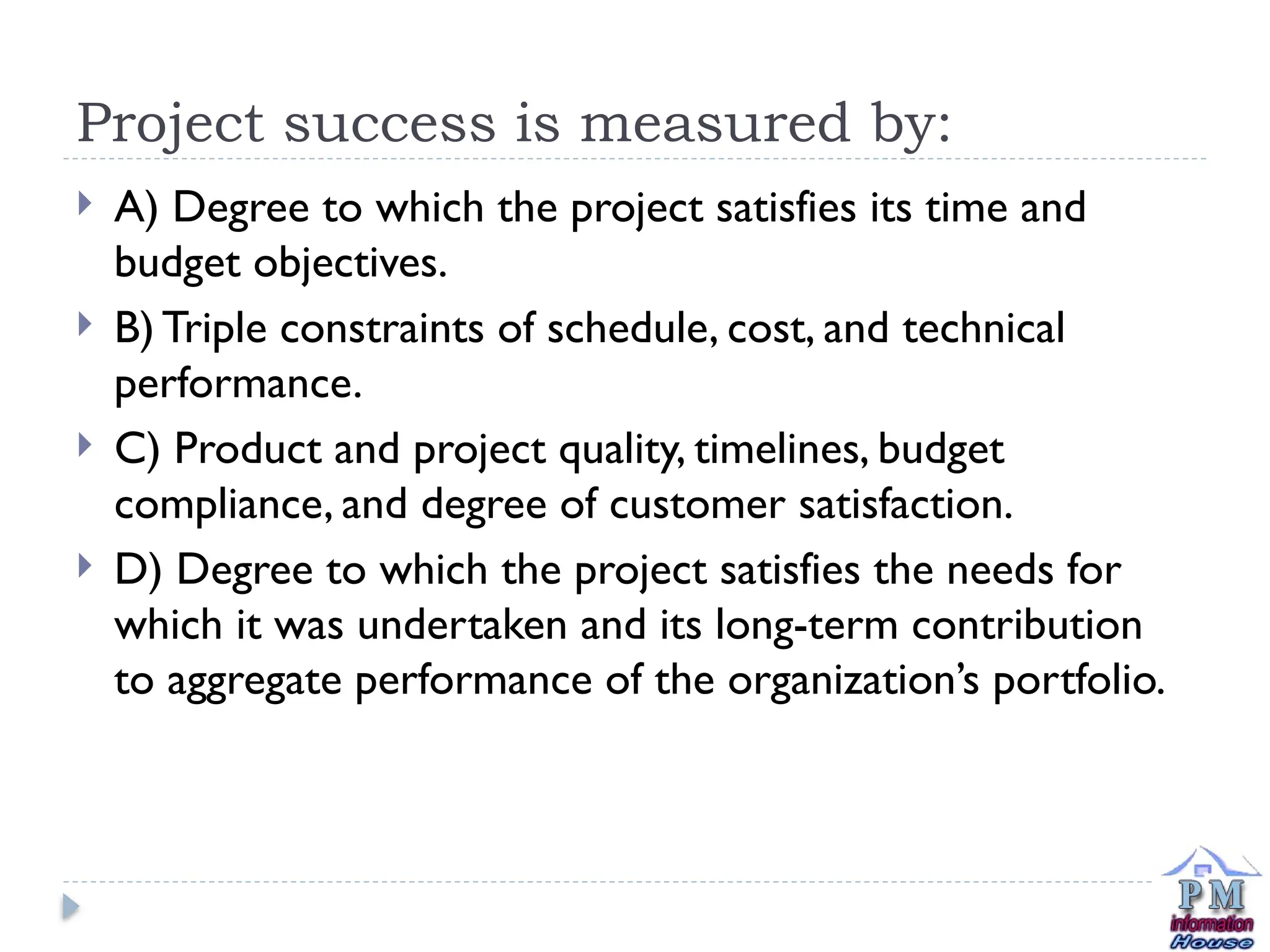
Project success is measured by:
 A) Degree to which the project satisfies its time and
budget objectives.
 B) Triple constraints of schedule, cost, and technical
performance.
 C) Product and project quality, timelines, budget
compliance, and degree of customer satisfaction.
 D) Degree to which the project satisfies the needs for
which it was undertaken and its long-term contribution
to aggregate performance of the organization’s portfolio.
Project success is measured by:
 A) Degree to which the project satisfies its time and
budget objectives.
 B) Triple constraints of schedule, cost, and technical
performance.
 C) Product and project quality, timelines, budget
compliance, and degree of customer satisfaction.
 D) Degree to which the project satisfies the needs for
which it was undertaken and its long-term contribution
to aggregate performance of the organization’s portfolio.
The PMBOK guide is the standard for:
 A ) Managing all projects all of the time across all
industries.
 B ) Managing all projects all of the time across some types
of industries.
 C ) Managing most projects most of the time across many
types of industries.
 D ) Managing some projects some of the time across few
types of industries .
The PMBOK guide is the standard for:
 A ) Managing all projects all of the time across all
industries.
 B ) Managing all projects all of the time across some types
of industries.
 C ) Managing most projects most of the time across many
types of industries.
 D ) Managing some projects some of the time across few
types of industries .
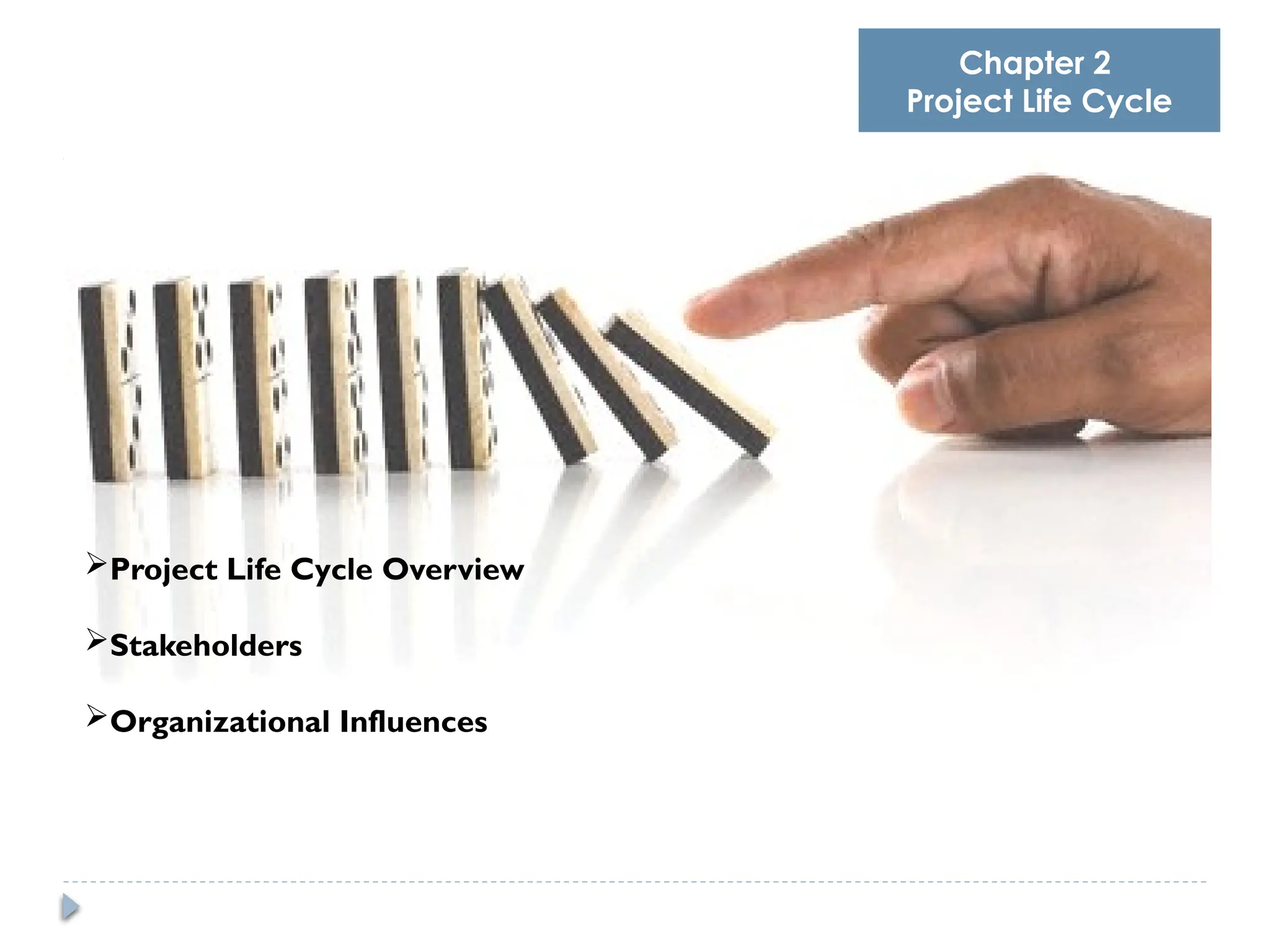
Project Life Cycle Overview
Stakeholders
Organizational Influences
Chapter 2
Project Life Cycle
The project life cycle Overview
a project life cycle is a collection of generally sequential
and sometimes overlapping project phases whose
name and number are determined by the
management and control needs of the organization or
organizations involved in the project, the nature of the
project itself, and its area of application.
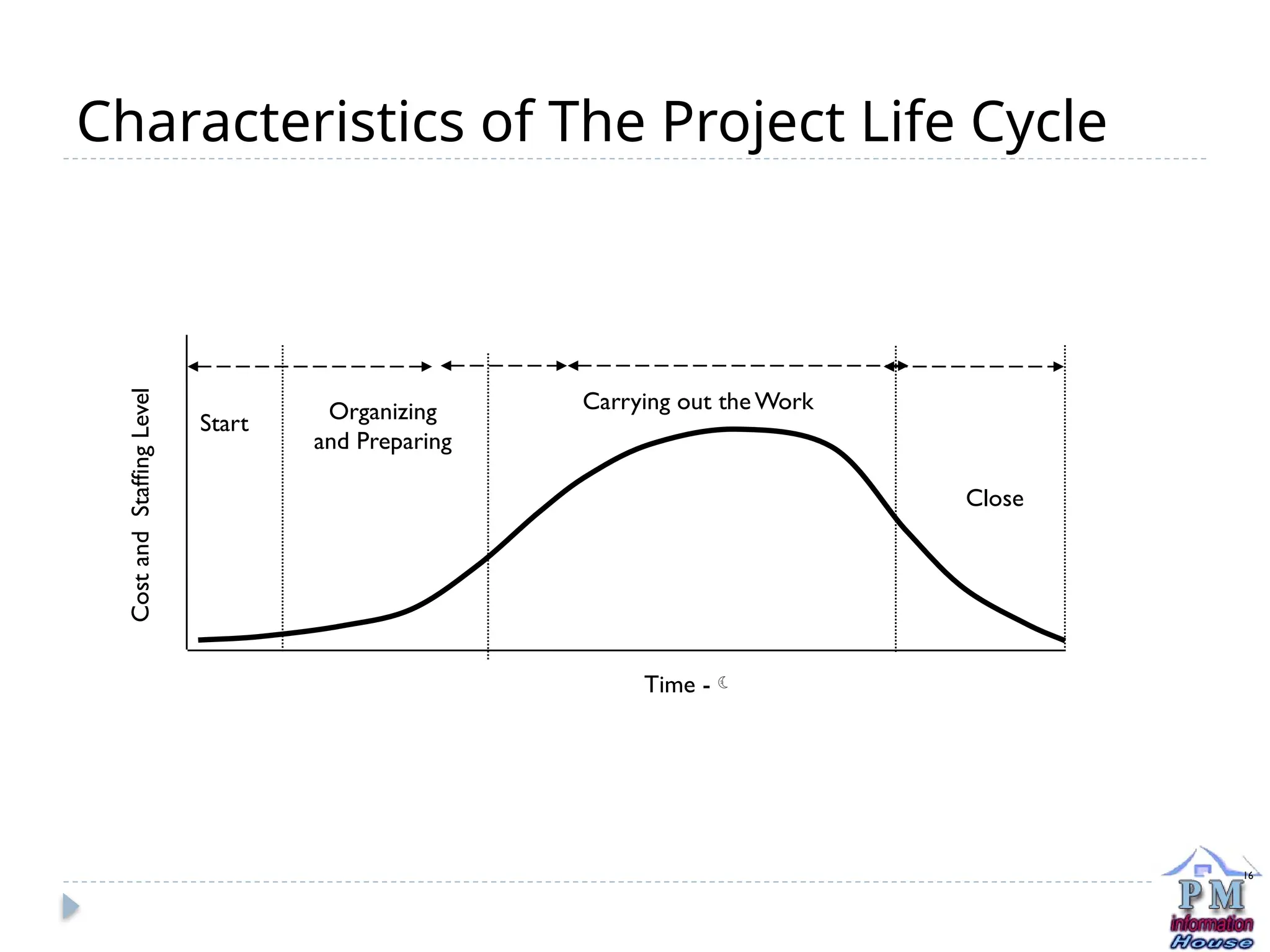
Start Organizing
and Preparing
Carrying out theWork
Close
Cost
and
Staffing
Level
Time -
Characteristics of The Project Life Cycle
16
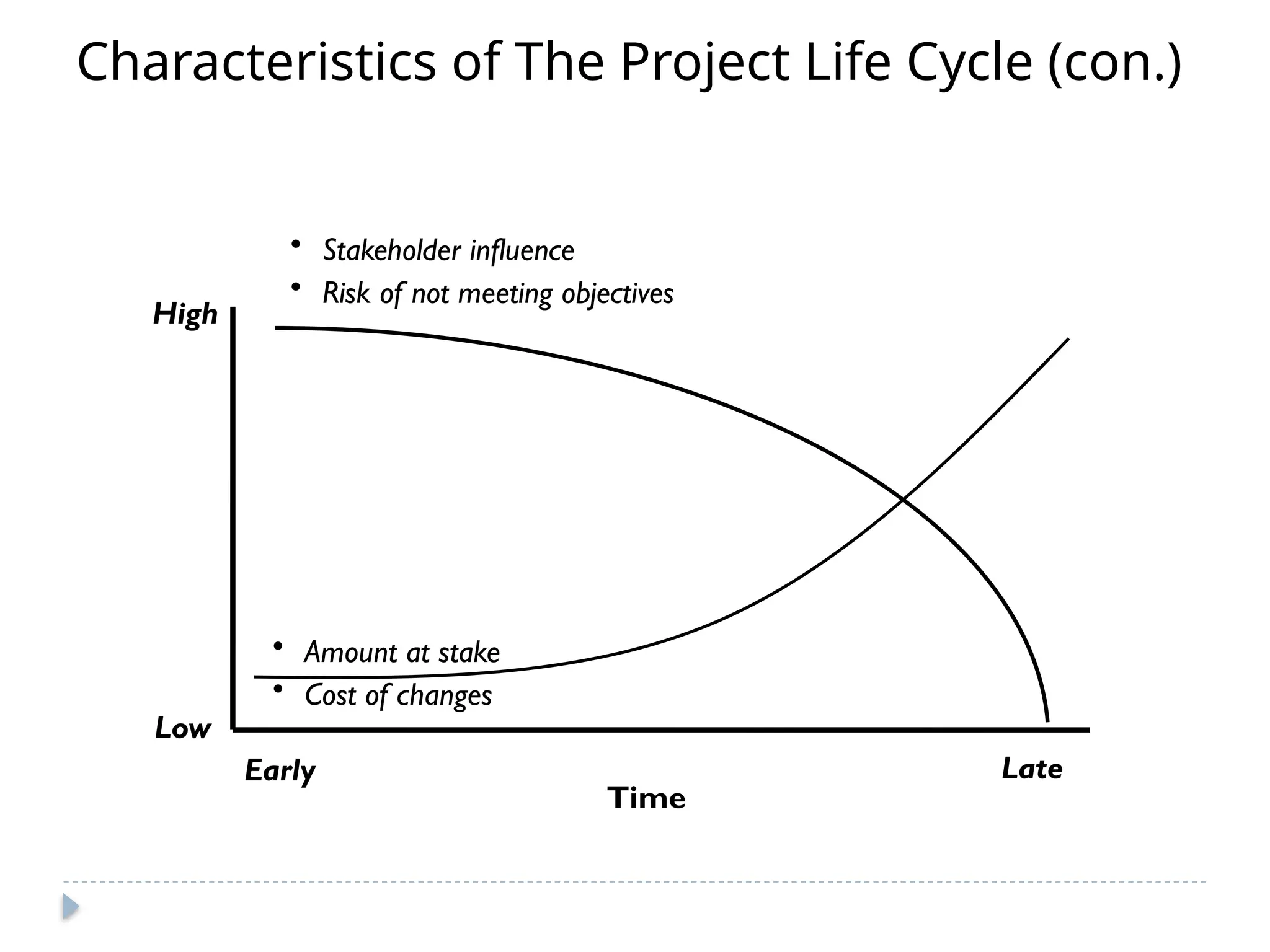
Time
Low
High
• Stakeholder influence
• Risk of not meeting objectives
• Amount at stake
• Cost of changes
Early Late
Characteristics of The Project Life Cycle (con.)
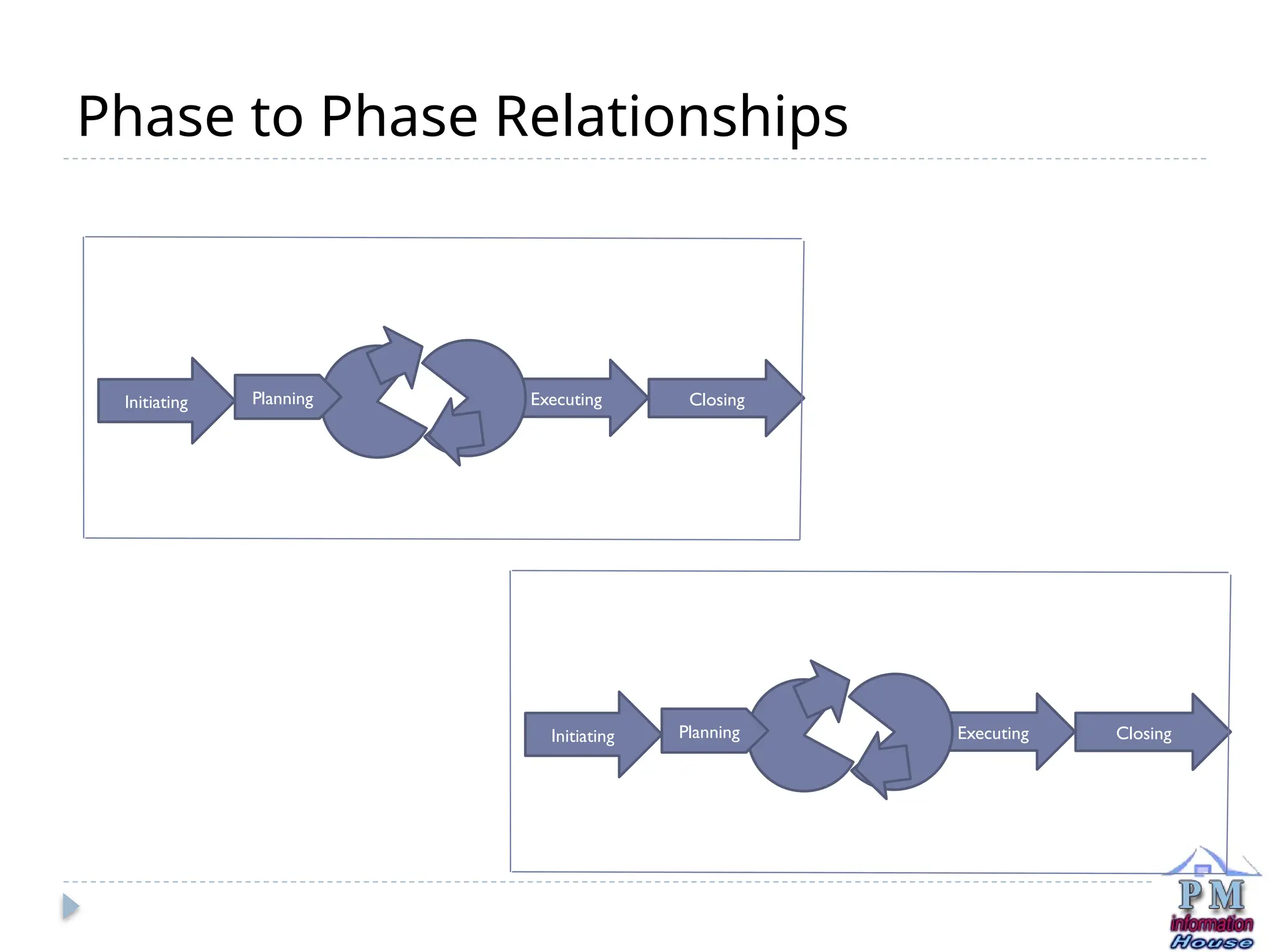
Phase to Phase Relationships
Initiating Planning Executing Closing
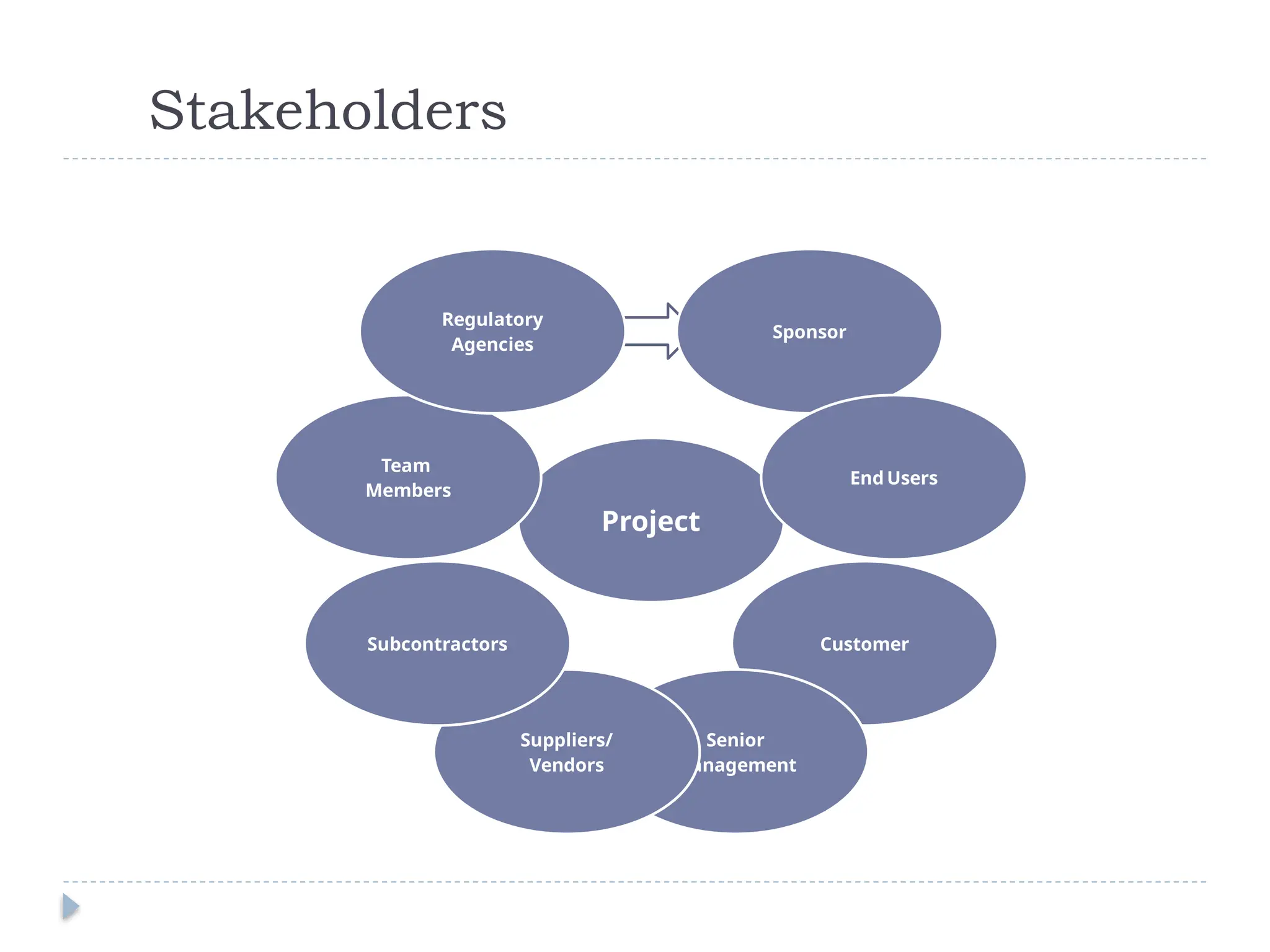
Stakeholders
Project
Sponsor
End Users
Customer
Senior
Management
Suppliers/
Vendors
Subcontractors
Team
Members
Regulatory
Agencies
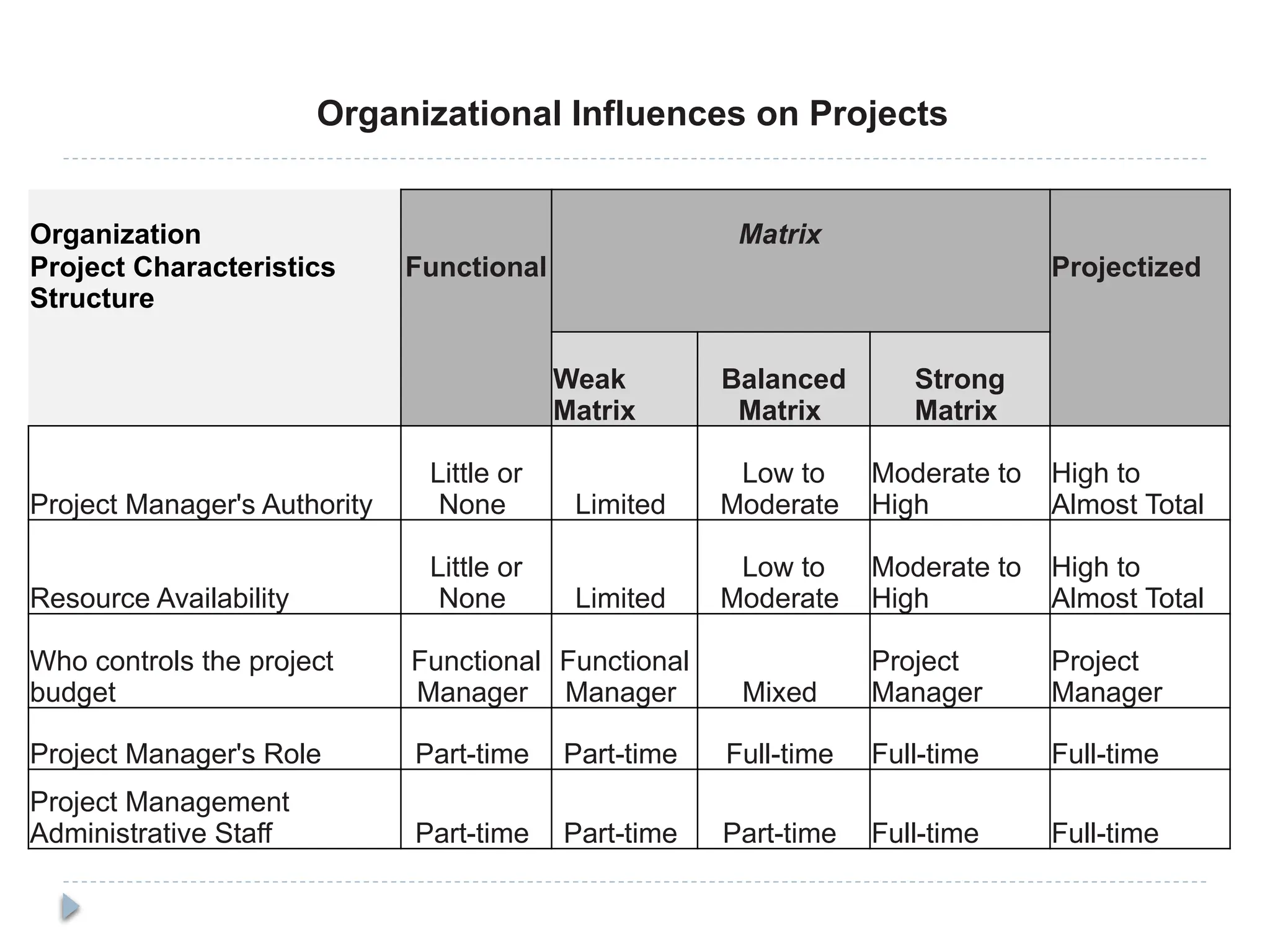
Organization Matrix
Project Characteristics
Structure
Functional Projectized
Weak
Matrix
Balanced
Matrix
Strong
Matrix
Project Manager's Authority
Little or
None Limited
Low to
Moderate
Moderate to
High
High to
Almost Total
Resource Availability
Little or
None Limited
Low to
Moderate
Moderate to
High
High to
Almost Total
Who controls the project
budget
Functional
Manager
Functional
Manager Mixed
Project
Manager
Project
Manager
Project Manager's Role Part-time Part-time Full-time Full-time Full-time
Project Management
Administrative Staff Part-time Part-time Part-time Full-time Full-time
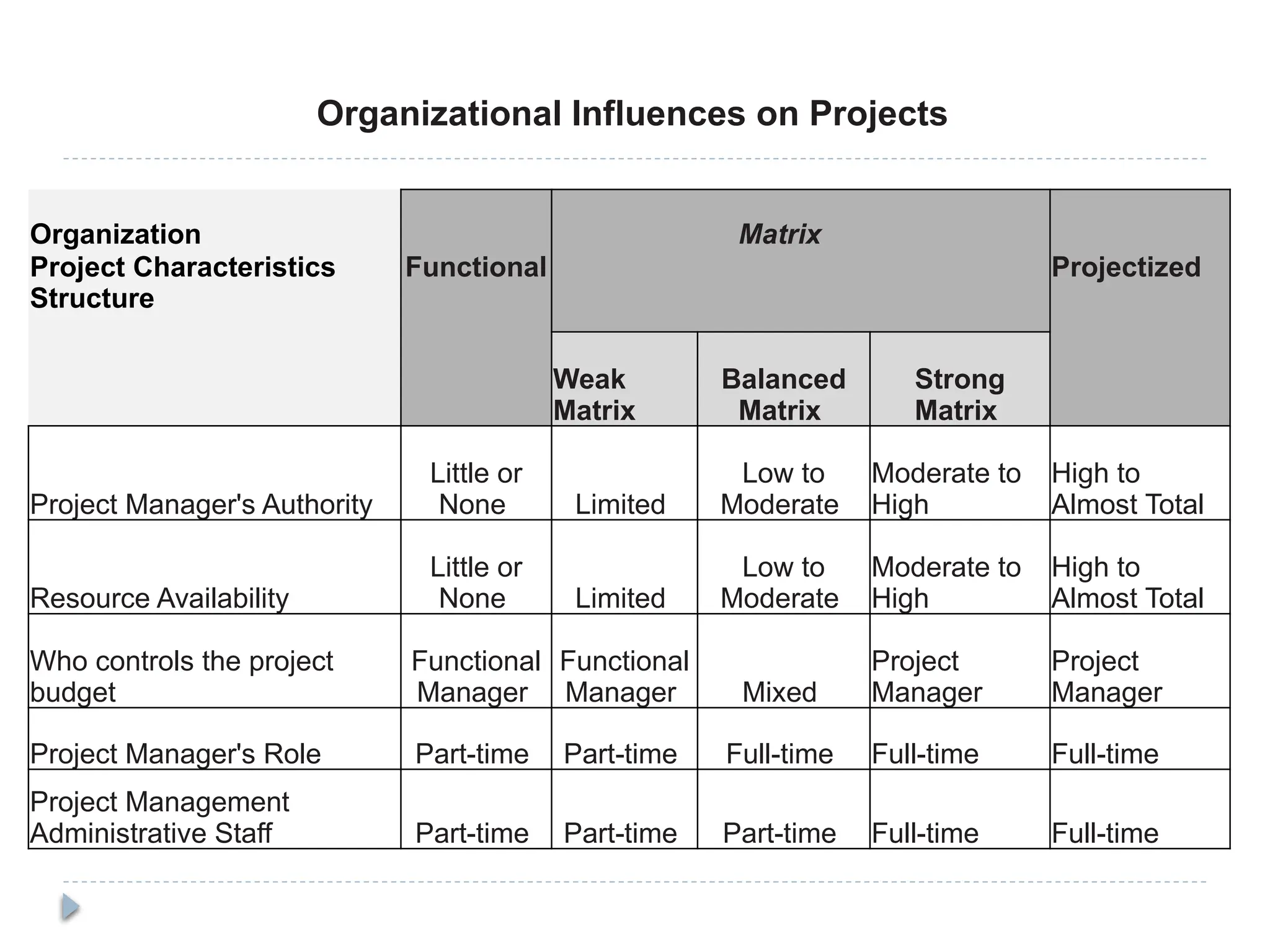
Organizational Influences on Projects
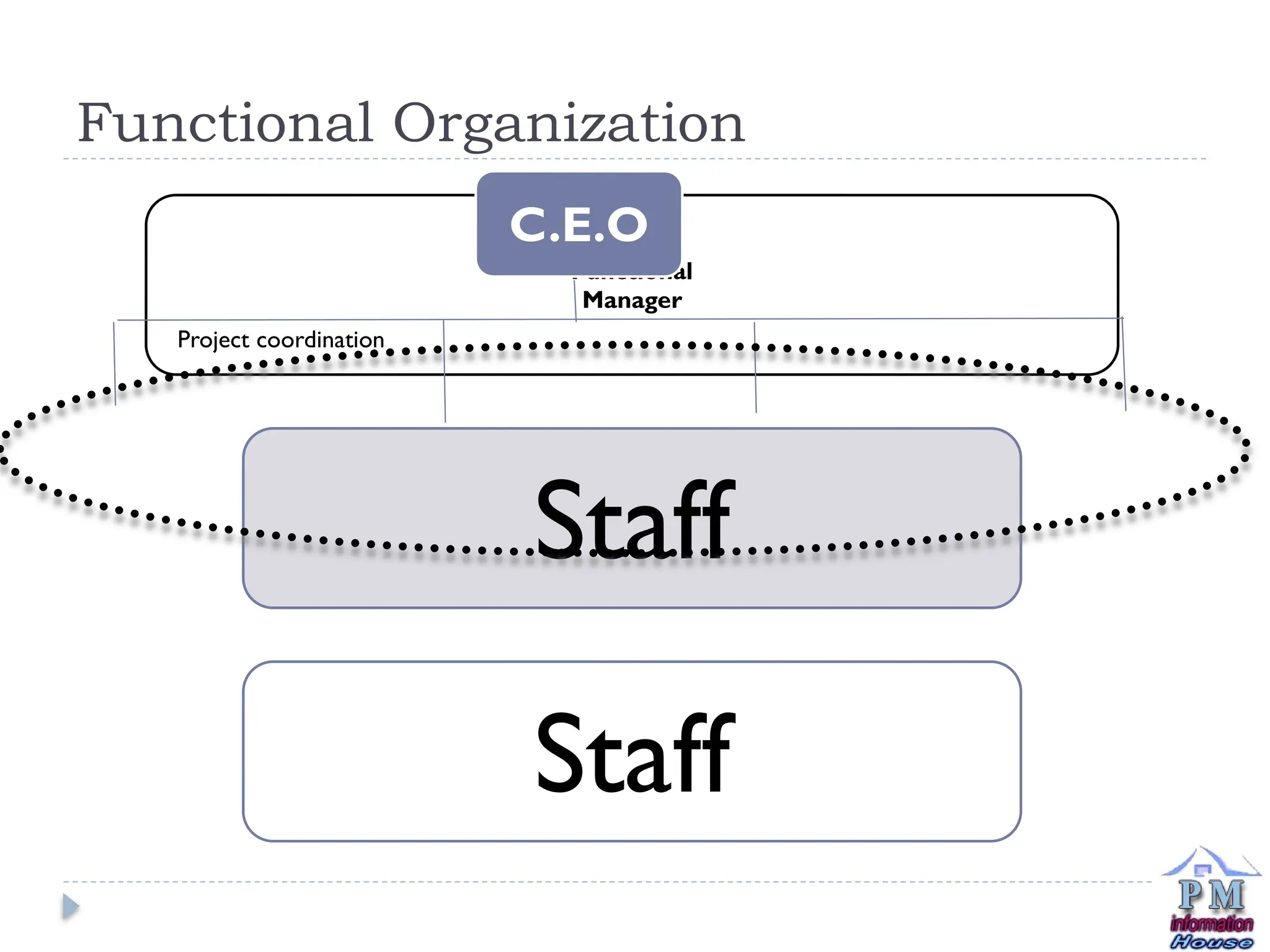
Functional Organization
Functional
Manager
Staff
Staff
C.E.O
Project coordination
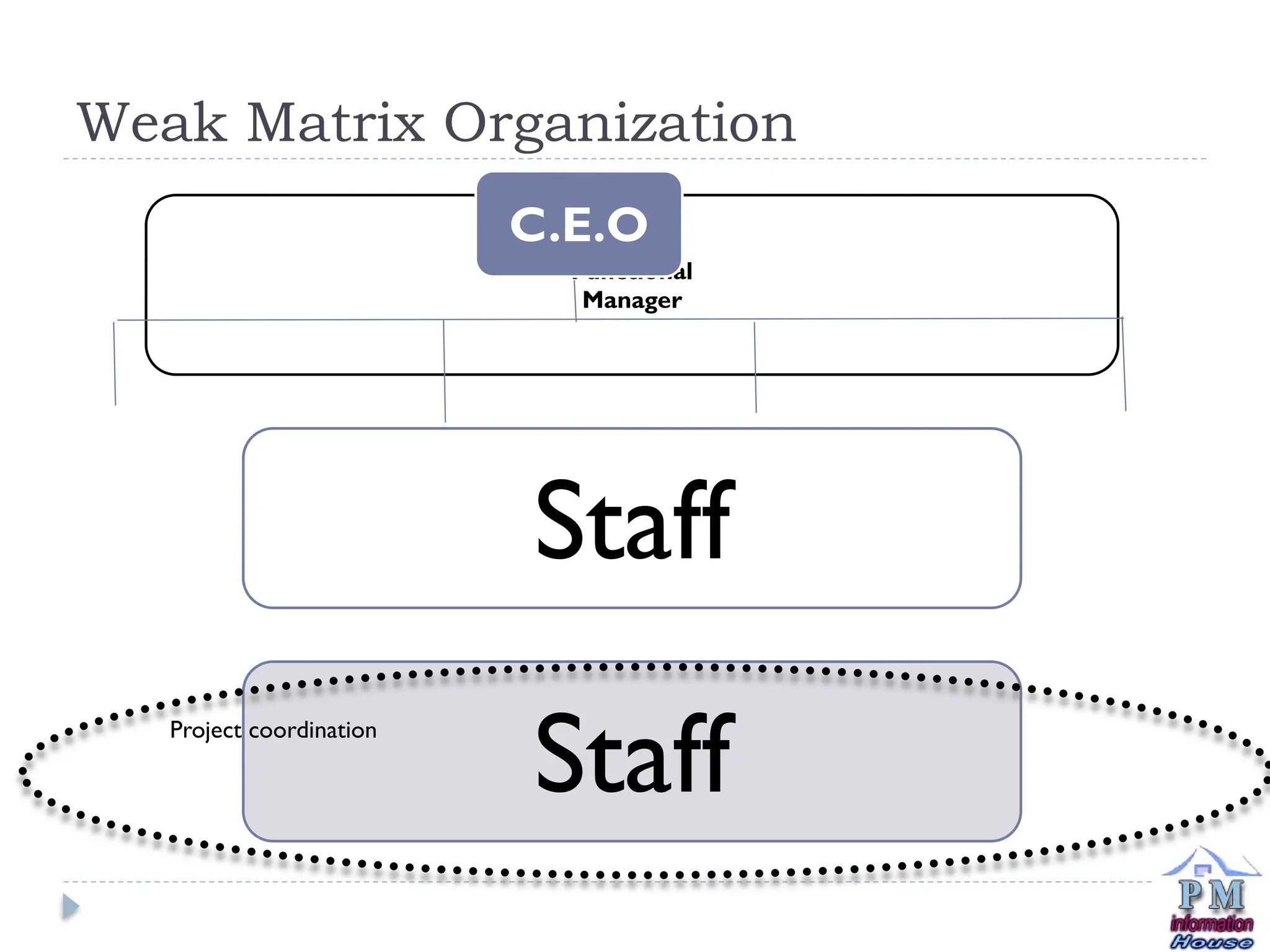
Weak Matrix Organization
Functional
Manager
Staff
Staff
C.E.O
Project coordination
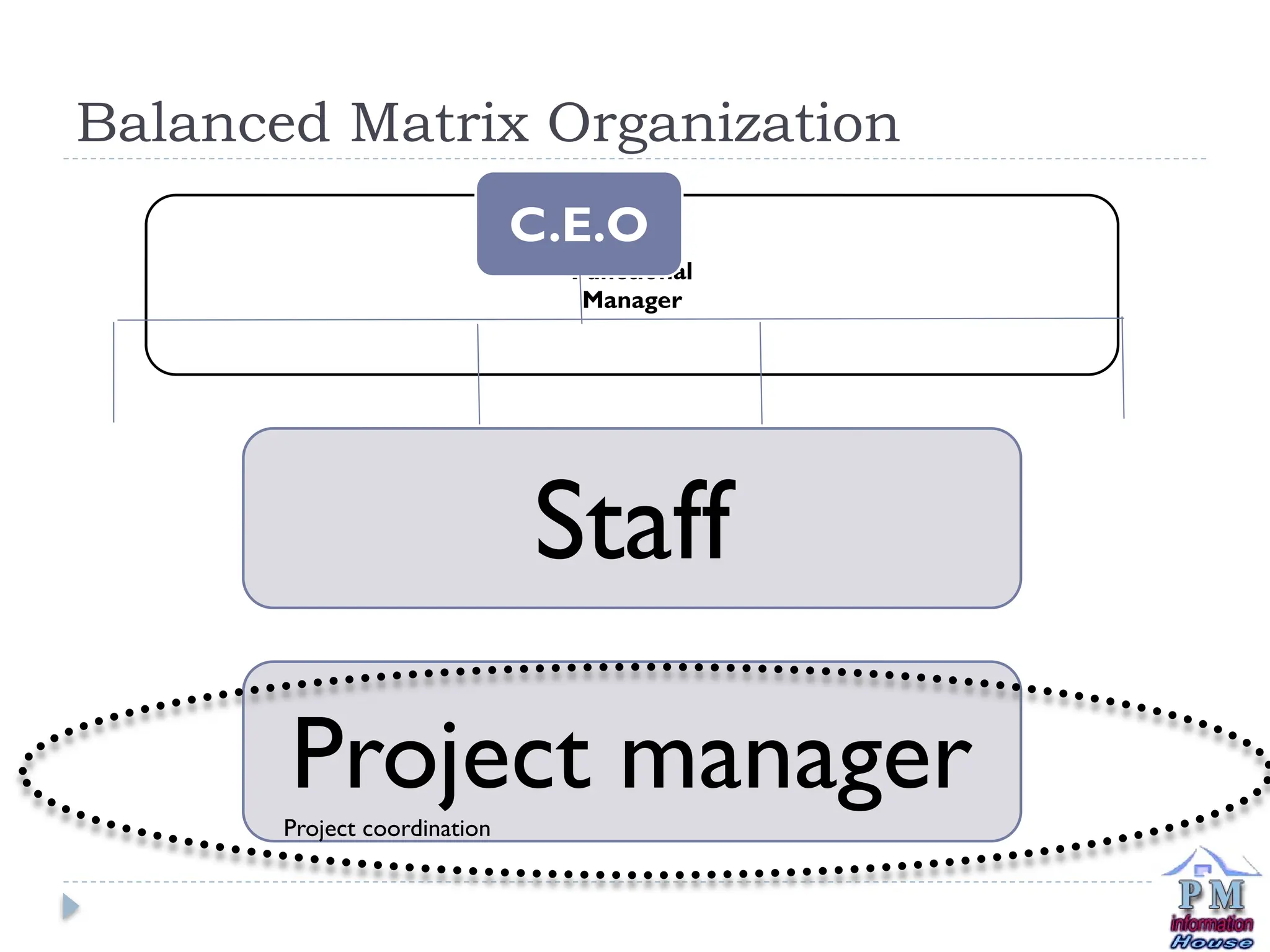
Balanced Matrix Organization
Functional
Manager
Staff
Project manager
C.E.O
Project coordination
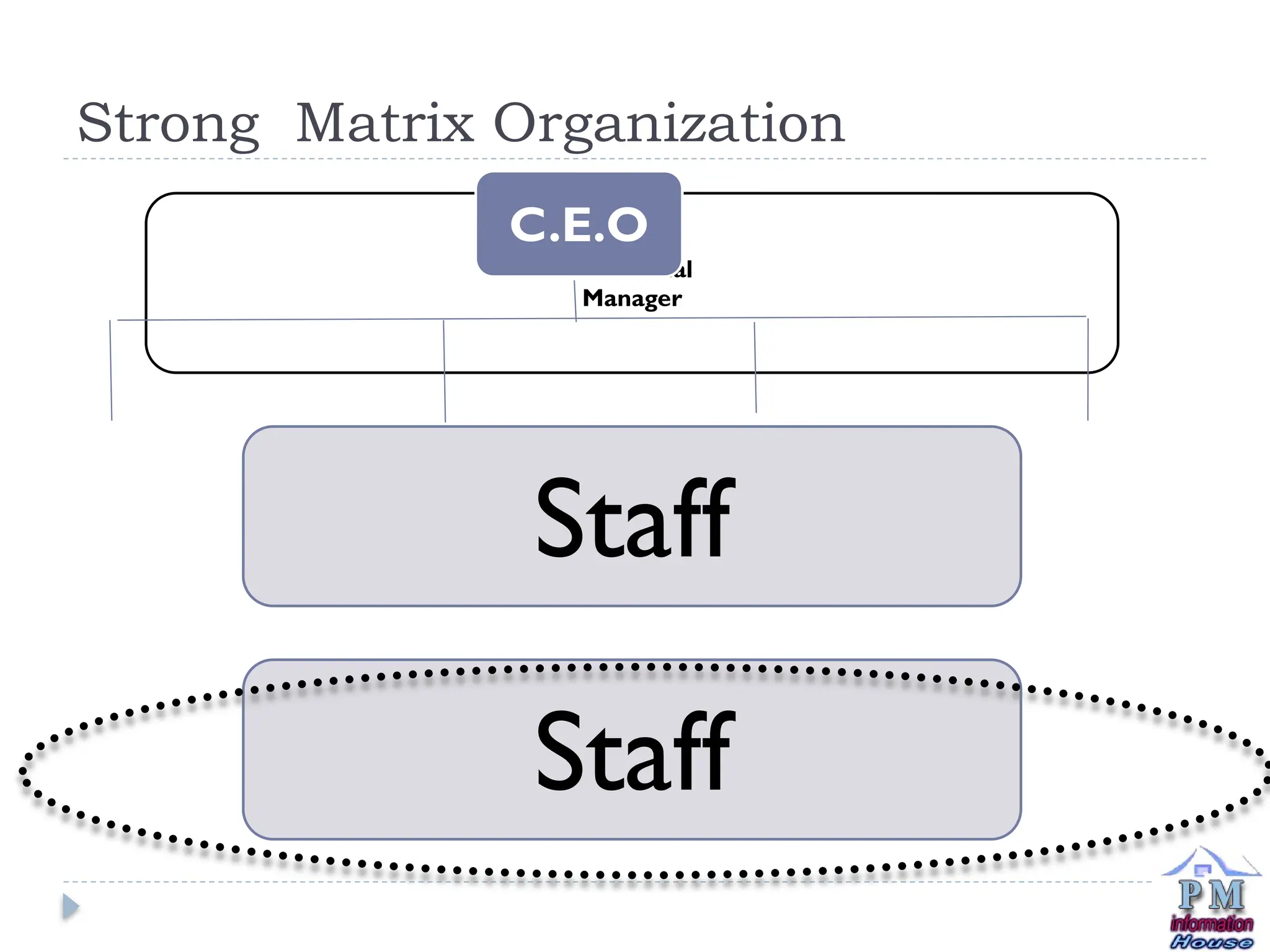
Strong Matrix Organization
Functional
Manager
Staff
Staff
C.E.O
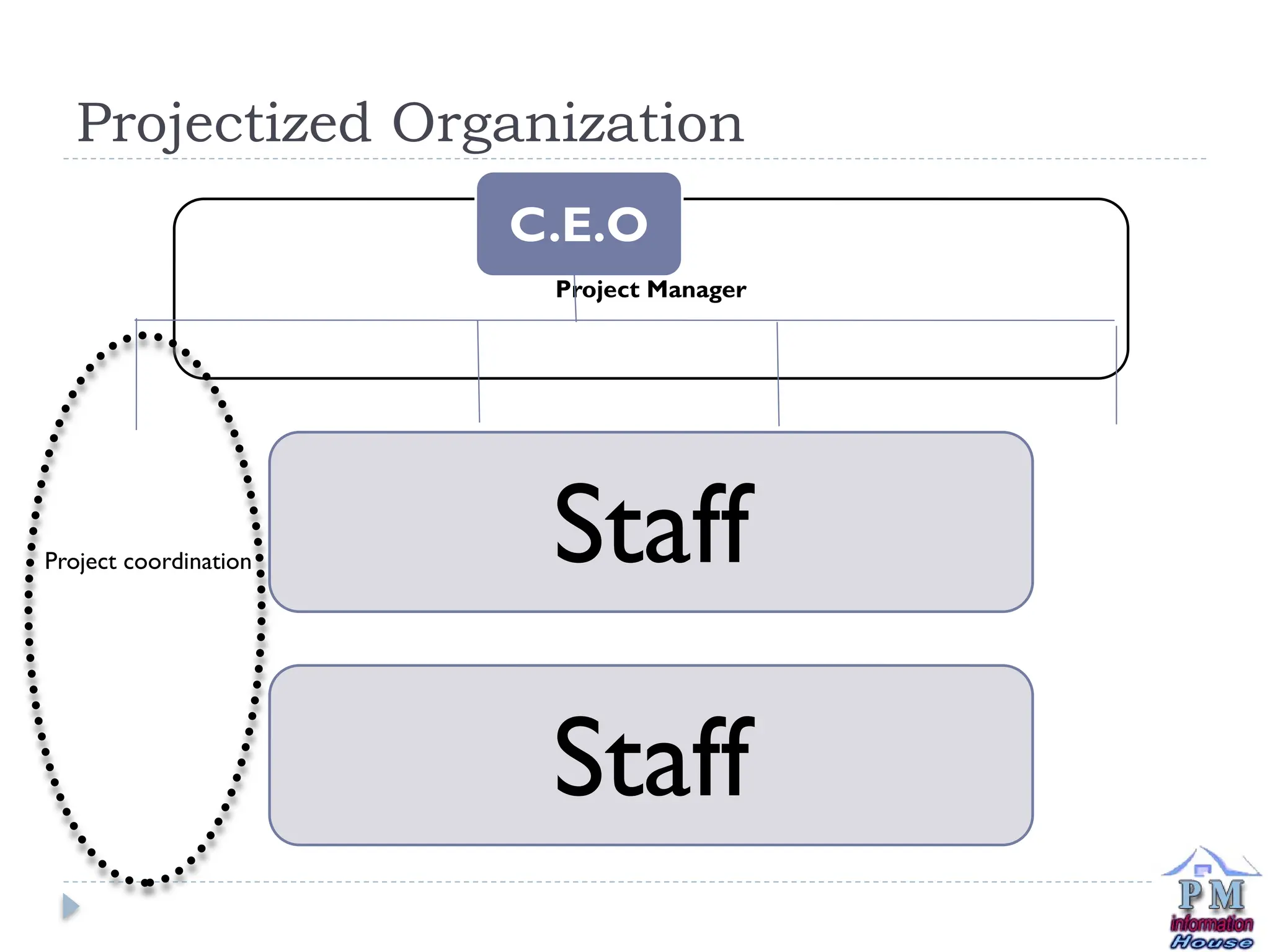
Projectized Organization
Project Manager
Staff
Staff
C.E.O
Project coordination
Organization Matrix
Project Characteristics
Structure
Functional Projectized
Weak
Matrix
Balanced
Matrix
Strong
Matrix
Project Manager's Authority
Little or
None Limited
Low to
Moderate
Moderate to
High
High to
Almost Total
Resource Availability
Little or
None Limited
Low to
Moderate
Moderate to
High
High to
Almost Total
Who controls the project
budget
Functional
Manager
Functional
Manager Mixed
Project
Manager
Project
Manager
Project Manager's Role Part-time Part-time Full-time Full-time Full-time
Project Management
Administrative Staff Part-time Part-time Part-time Full-time Full-time
Organizational Influences on Projects
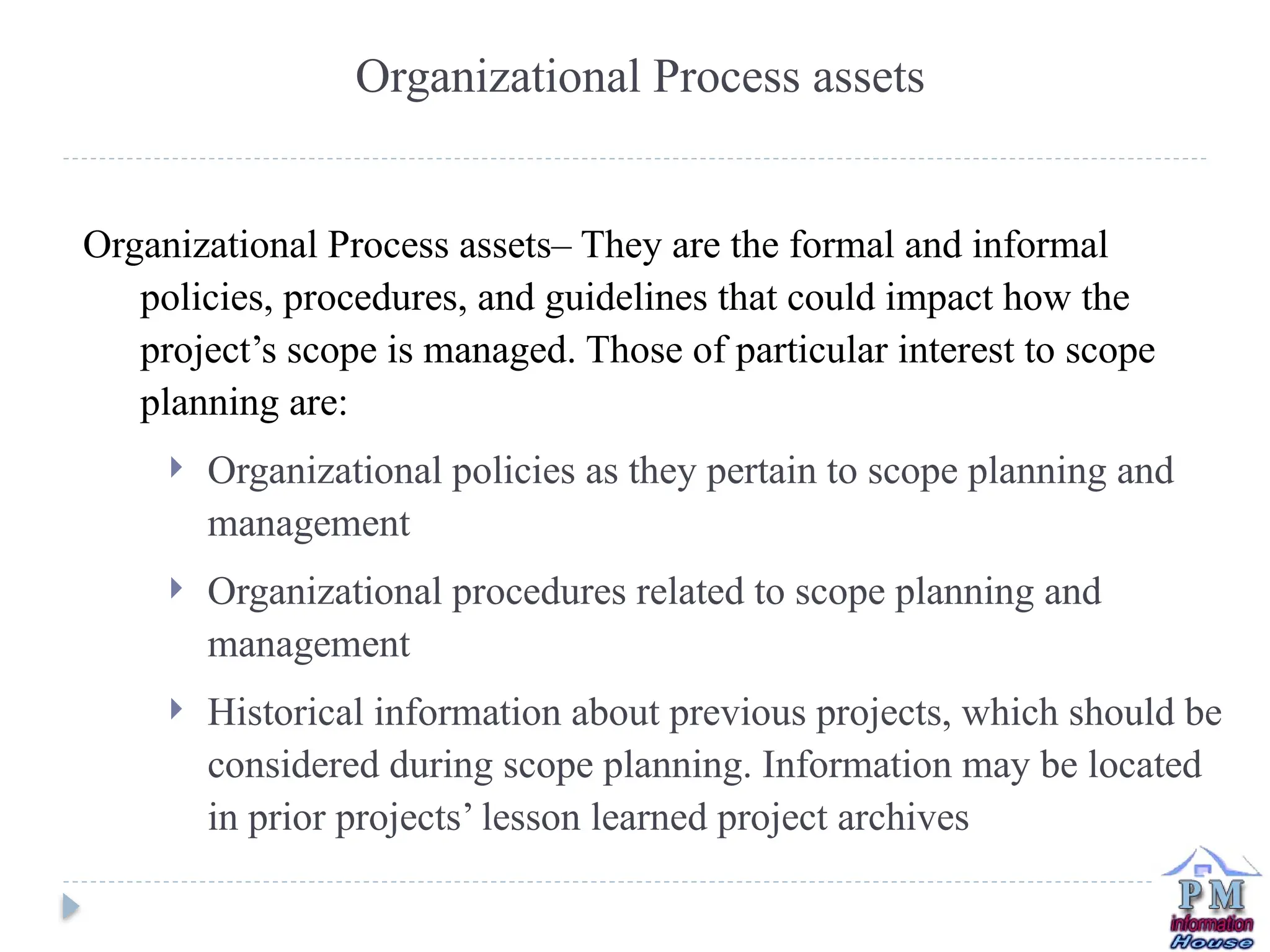
Organizational Process assets– They are the formal and informal
policies, procedures, and guidelines that could impact how the
project’s scope is managed. Those of particular interest to scope
planning are:
 Organizational policies as they pertain to scope planning and
management
 Organizational procedures related to scope planning and
management
 Historical information about previous projects, which should be
considered during scope planning. Information may be located
in prior projects’ lesson learned project archives
Organizational Process assets
QUESTIONS?
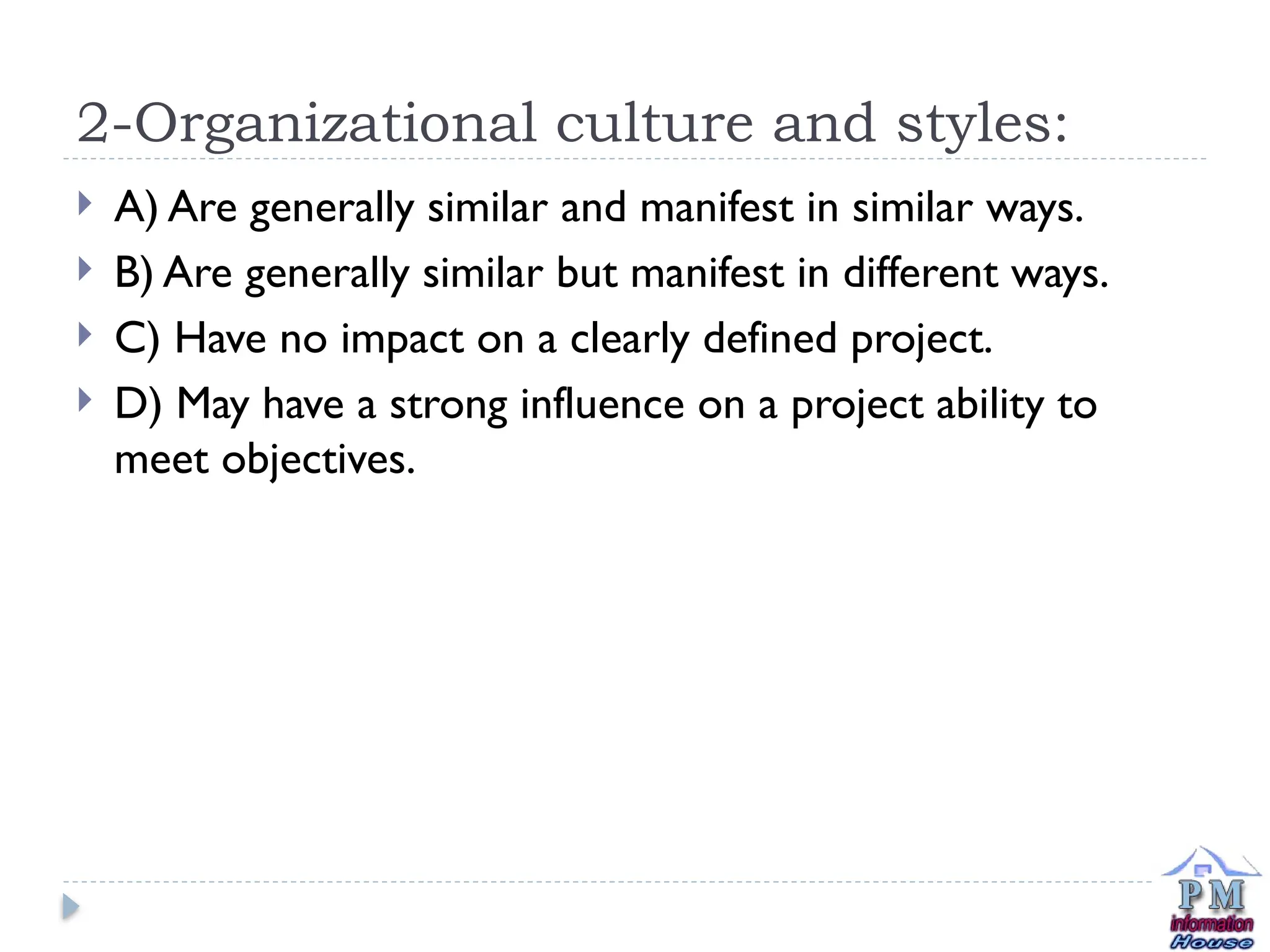
2-Organizational culture and styles:
 A) Are generally similar and manifest in similar ways.
 B) Are generally similar but manifest in different ways.
 C) Have no impact on a clearly defined project.
 D) May have a strong influence on a project ability to
meet objectives.
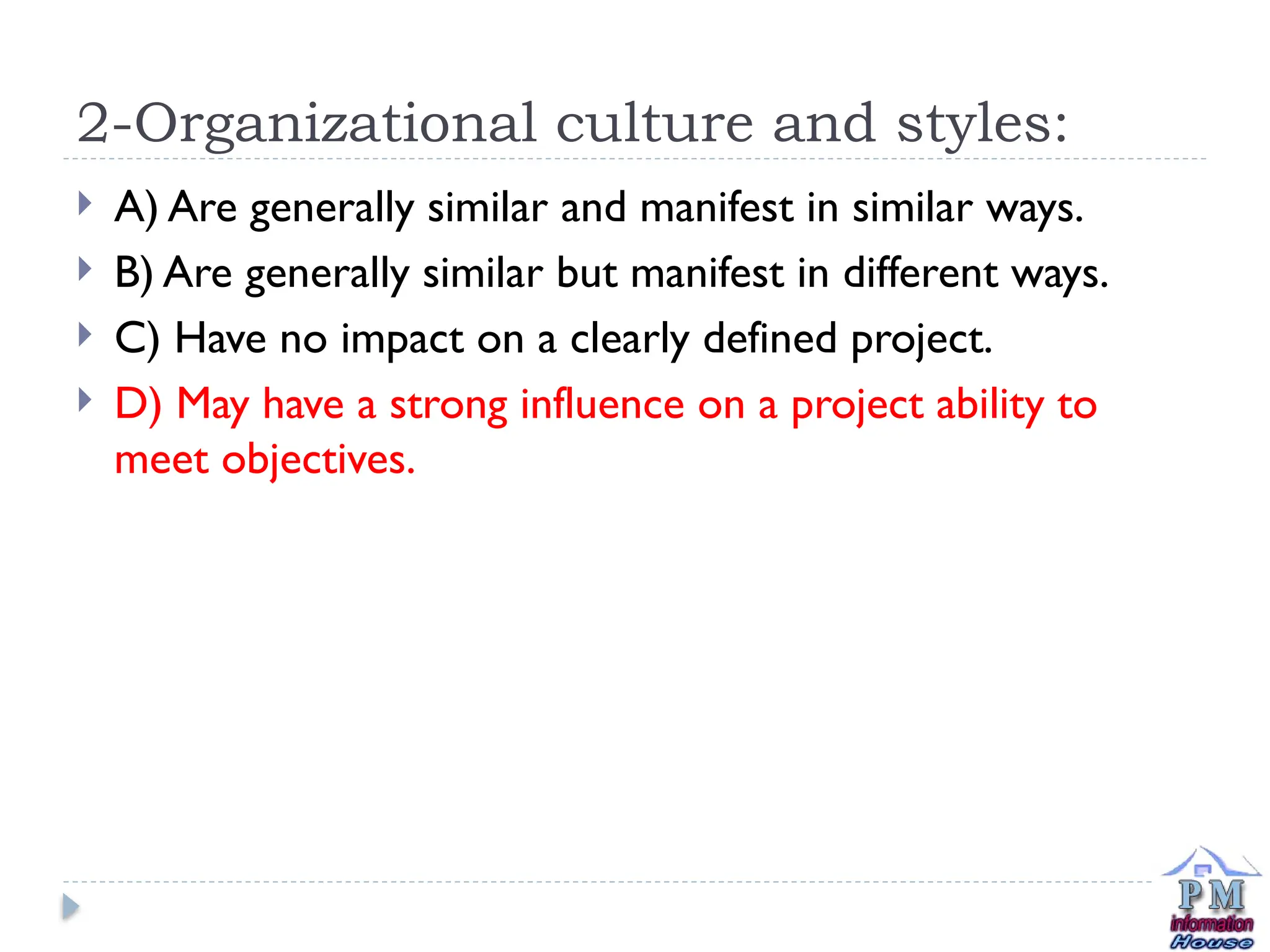
2-Organizational culture and styles:
 A) Are generally similar and manifest in similar ways.
 B) Are generally similar but manifest in different ways.
 C) Have no impact on a clearly defined project.
 D) May have a strong influence on a project ability to
meet objectives.
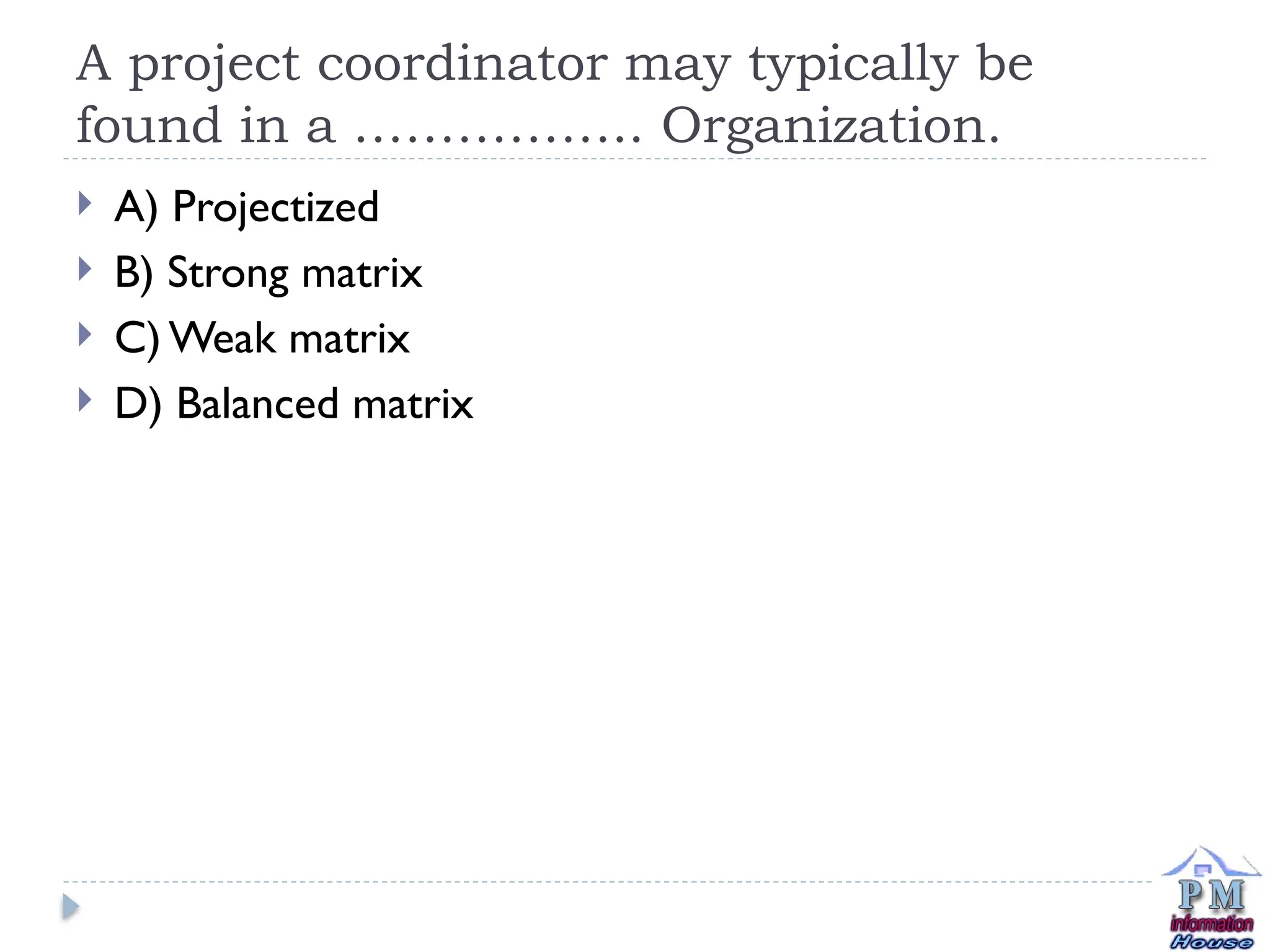
A project coordinator may typically be
found in a …………….. Organization.
 A) Projectized
 B) Strong matrix
 C) Weak matrix
 D) Balanced matrix
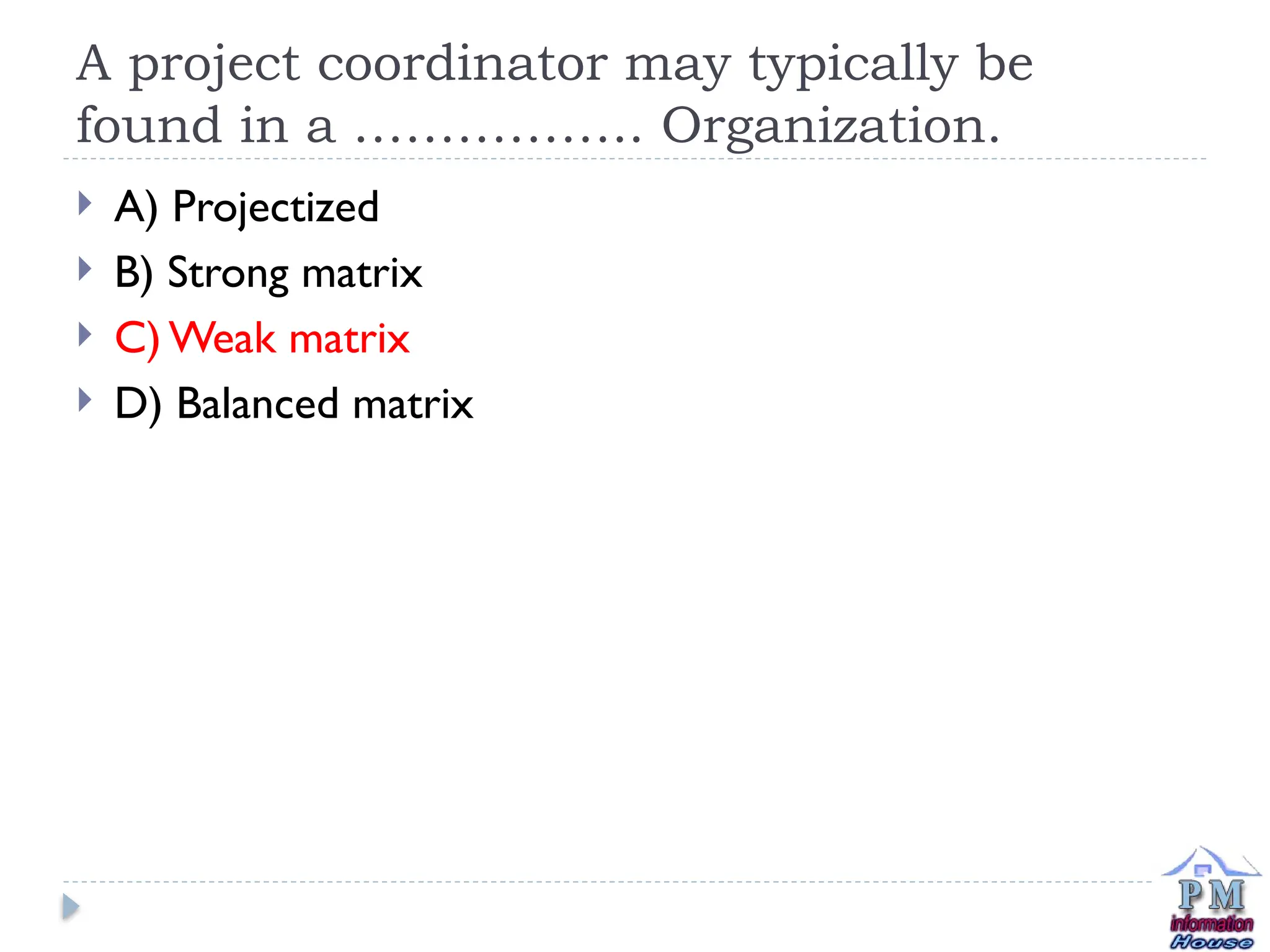
A project coordinator may typically be
found in a …………….. Organization.
 A) Projectized
 B) Strong matrix
 C) Weak matrix
 D) Balanced matrix
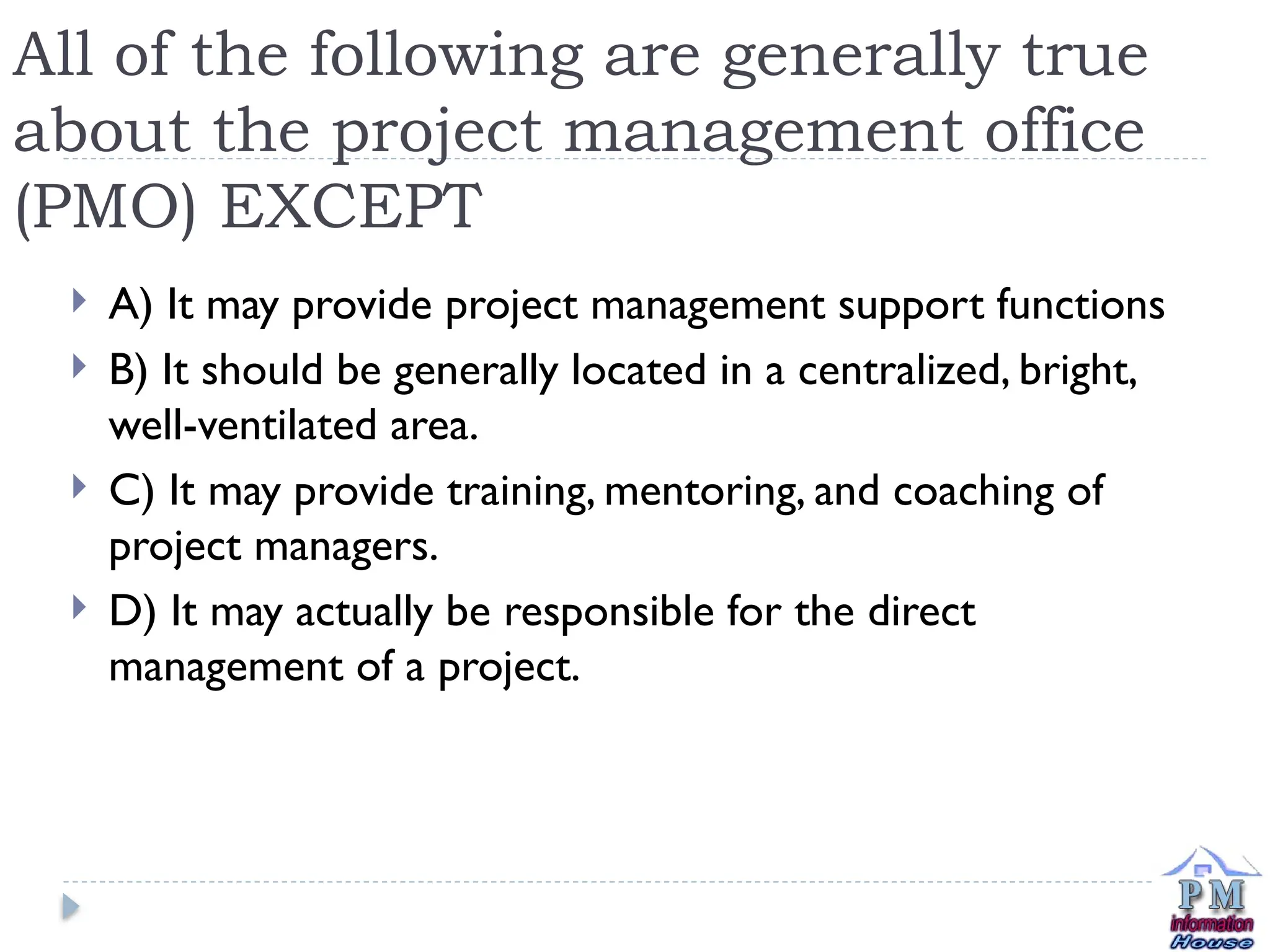
All of the following are generally true
about the project management office
(PMO) EXCEPT
 A) It may provide project management support functions
 B) It should be generally located in a centralized, bright,
well-ventilated area.
 C) It may provide training, mentoring, and coaching of
project managers.
 D) It may actually be responsible for the direct
management of a project.
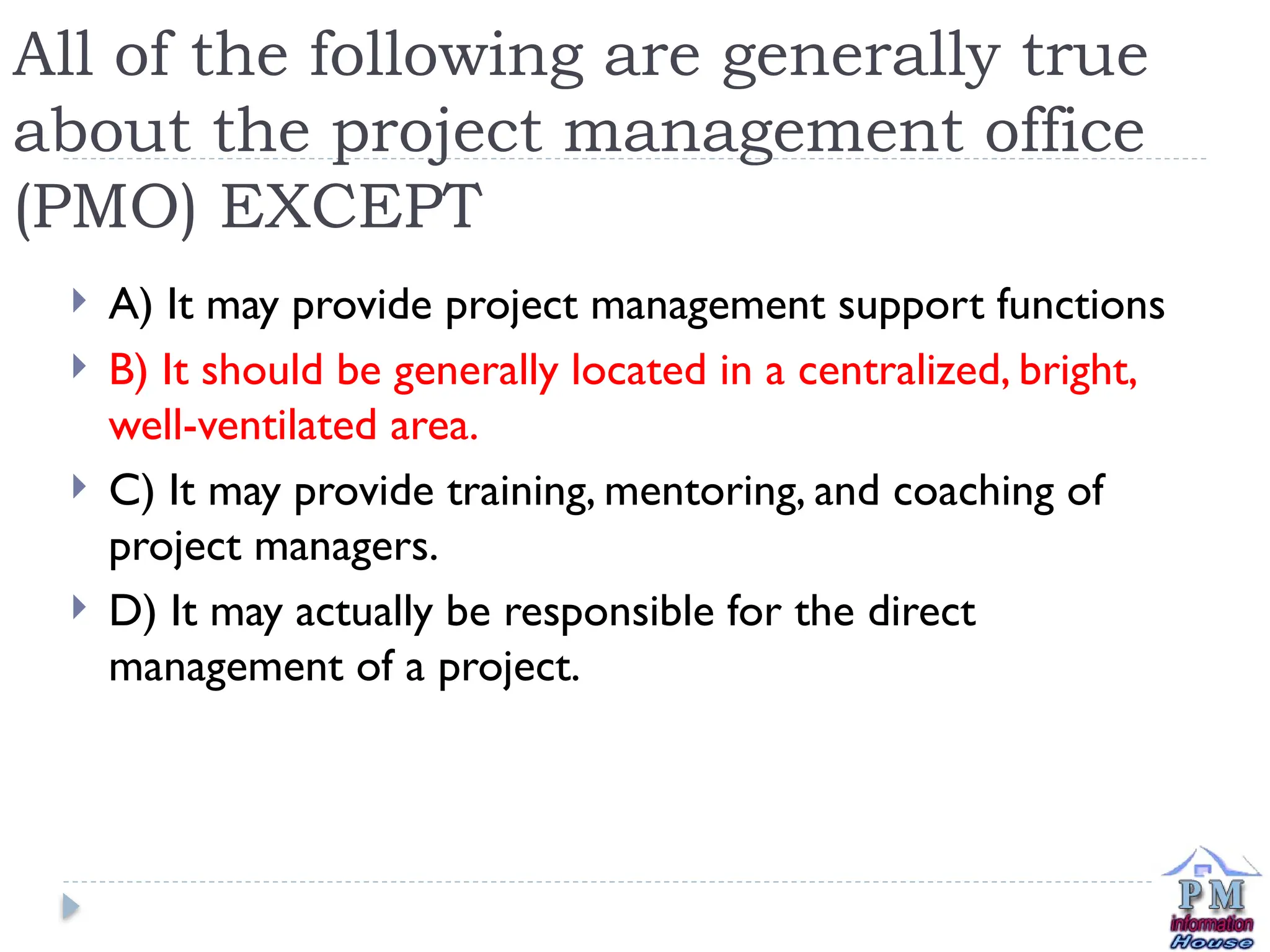
All of the following are generally true
about the project management office
(PMO) EXCEPT
 A) It may provide project management support functions
 B) It should be generally located in a centralized, bright,
well-ventilated area.
 C) It may provide training, mentoring, and coaching of
project managers.
 D) It may actually be responsible for the direct
management of a project.
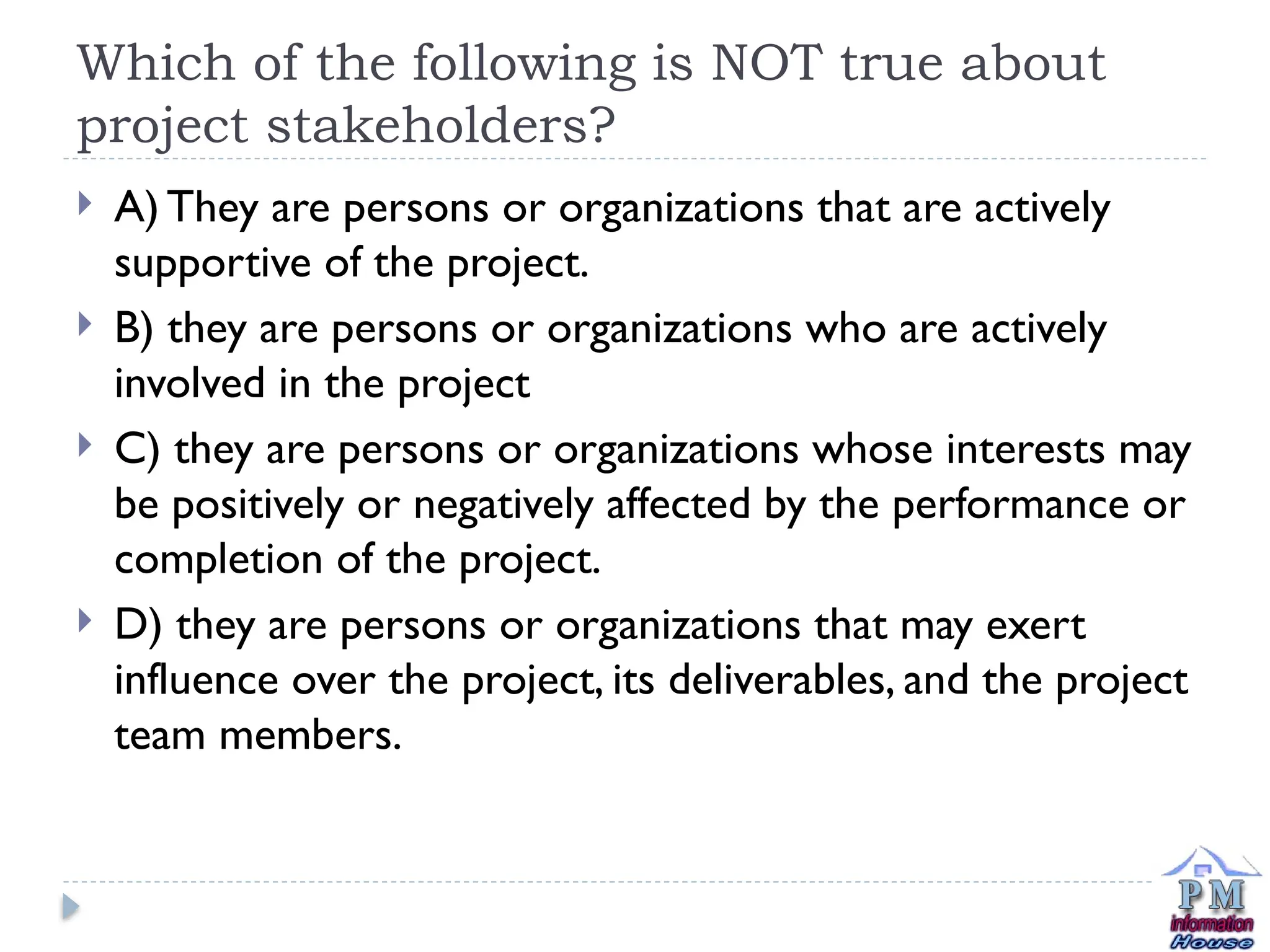
Which of the following is NOT true about
project stakeholders?
 A) They are persons or organizations that are actively
supportive of the project.
 B) they are persons or organizations who are actively
involved in the project
 C) they are persons or organizations whose interests may
be positively or negatively affected by the performance or
completion of the project.
 D) they are persons or organizations that may exert
influence over the project, its deliverables, and the project
team members.
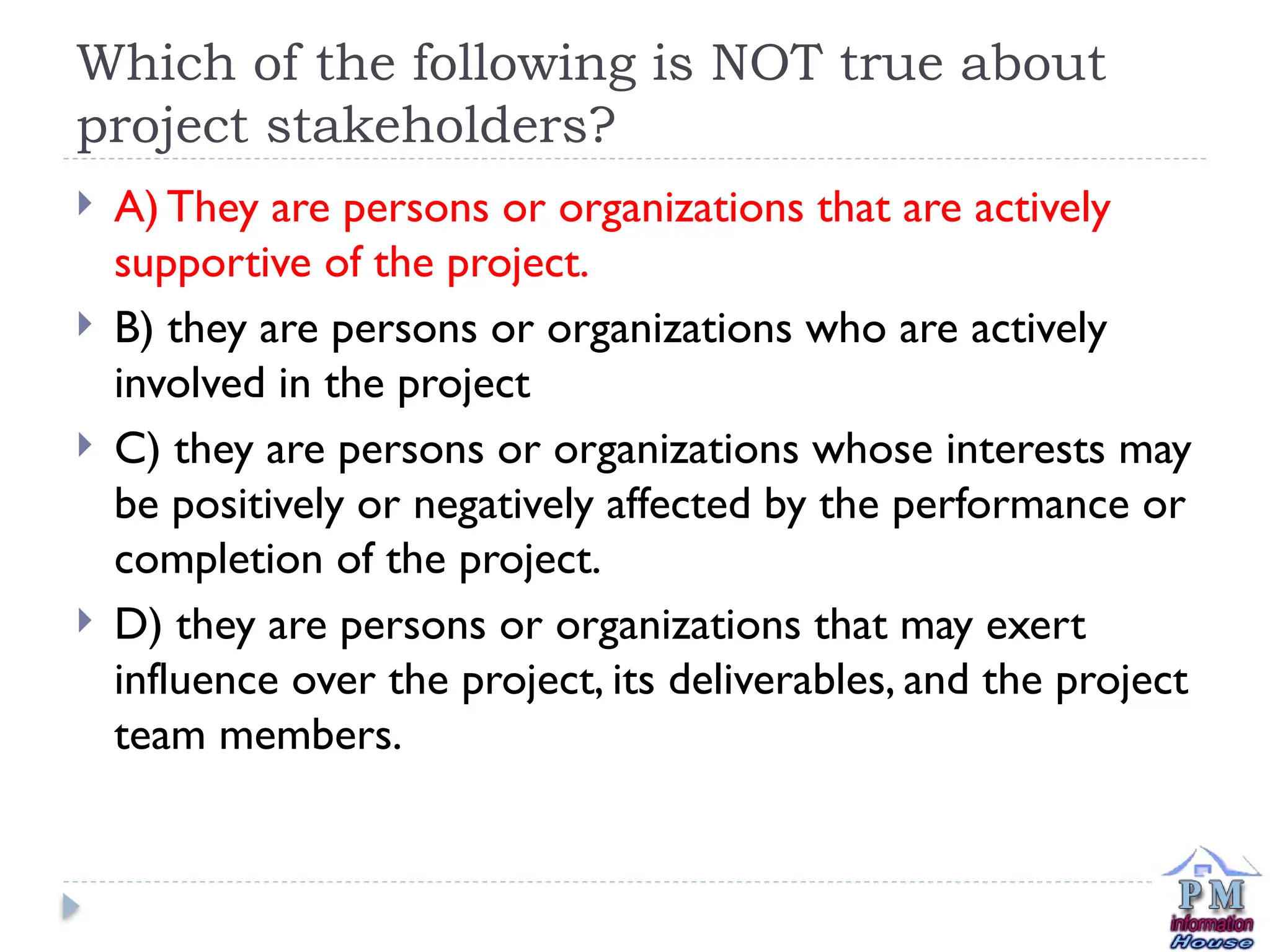
Which of the following is NOT true about
project stakeholders?
 A) They are persons or organizations that are actively
supportive of the project.
 B) they are persons or organizations who are actively
involved in the project
 C) they are persons or organizations whose interests may
be positively or negatively affected by the performance or
completion of the project.
 D) they are persons or organizations that may exert
influence over the project, its deliverables, and the project
team members.
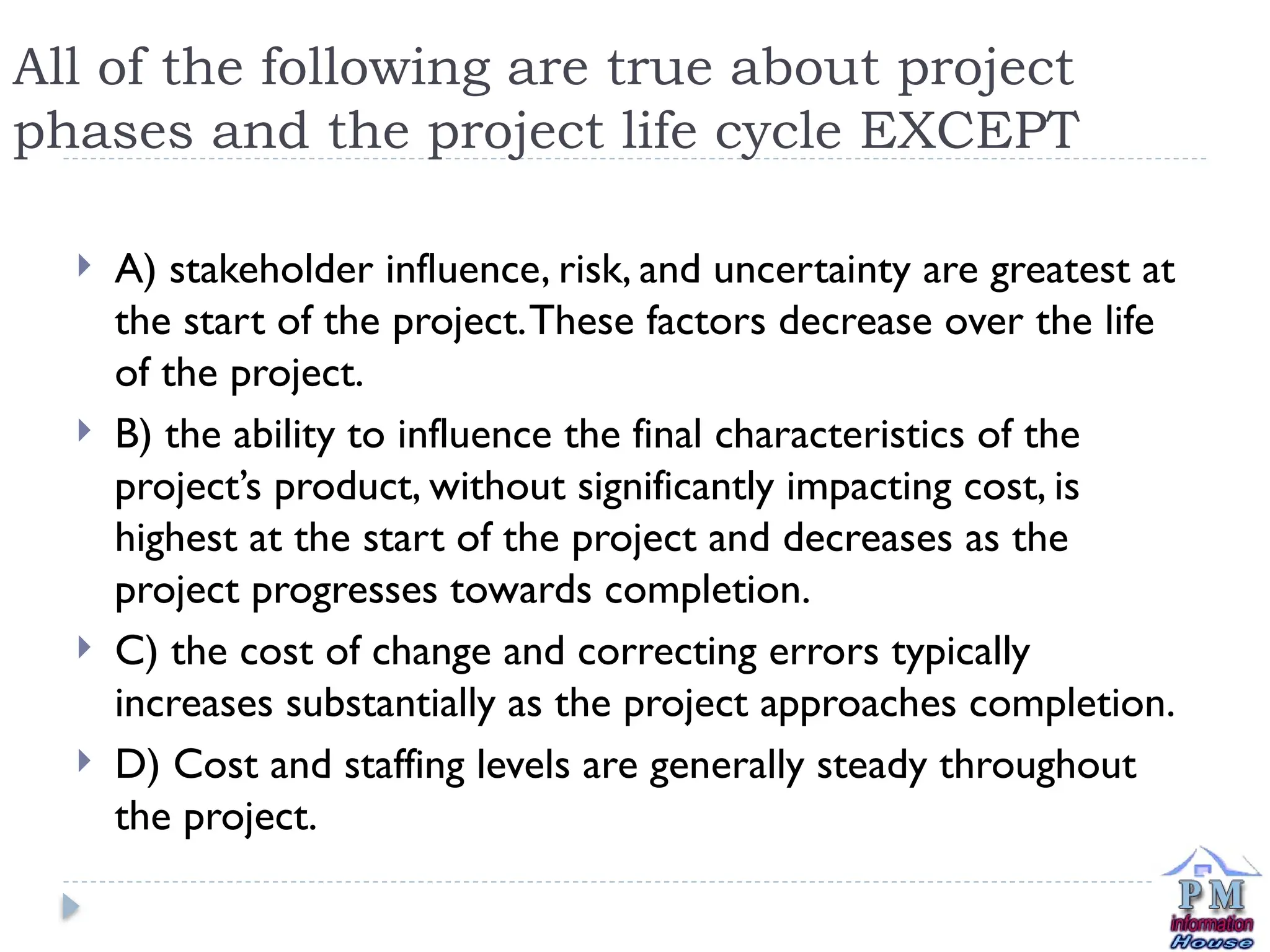
All of the following are true about project
phases and the project life cycle EXCEPT
 A) stakeholder influence, risk, and uncertainty are greatest at
the start of the project.These factors decrease over the life
of the project.
 B) the ability to influence the final characteristics of the
project’s product, without significantly impacting cost, is
highest at the start of the project and decreases as the
project progresses towards completion.
 C) the cost of change and correcting errors typically
increases substantially as the project approaches completion.
 D) Cost and staffing levels are generally steady throughout
the project.
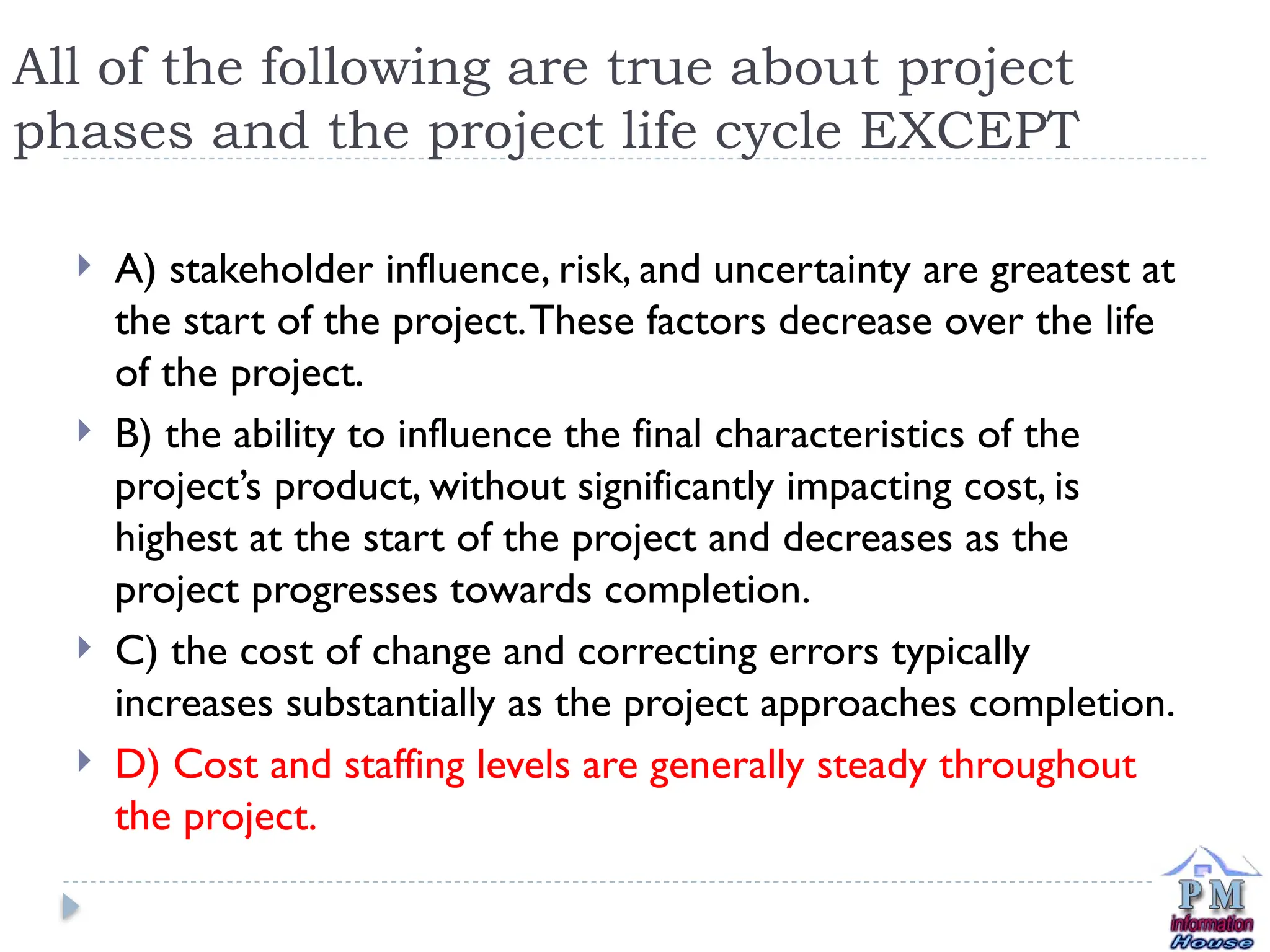
All of the following are true about project
phases and the project life cycle EXCEPT
 A) stakeholder influence, risk, and uncertainty are greatest at
the start of the project.These factors decrease over the life
of the project.
 B) the ability to influence the final characteristics of the
project’s product, without significantly impacting cost, is
highest at the start of the project and decreases as the
project progresses towards completion.
 C) the cost of change and correcting errors typically
increases substantially as the project approaches completion.
 D) Cost and staffing levels are generally steady throughout
the project.
Section 11 –
The Standard for Project
Management
of A Project
 Chapter 3 –Project
Management Process
Interactions
 Project Management
interaction
 Project Management
Process Group
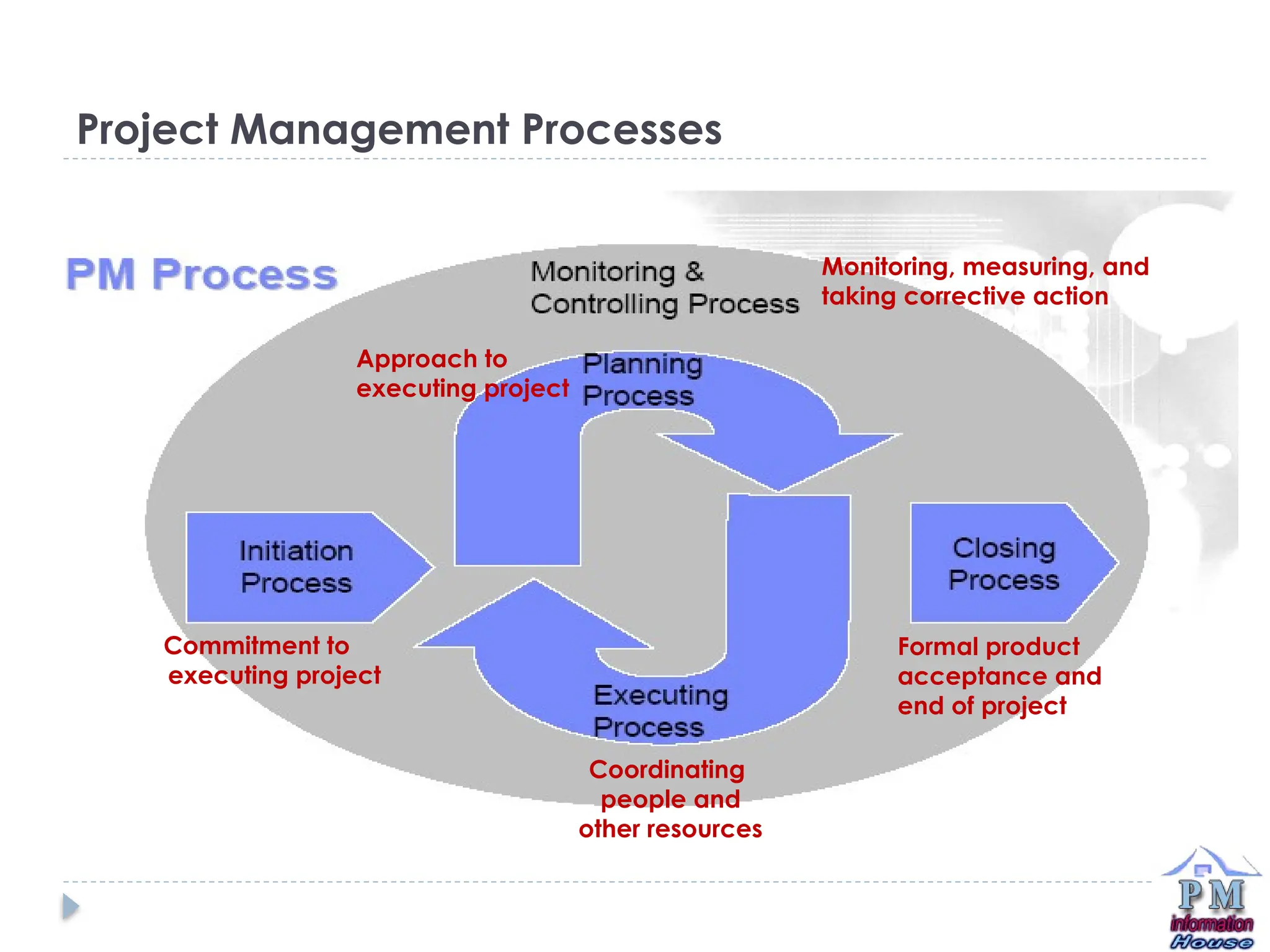
Commitment to
executing project
Approach to
executing project
Coordinating
people and
other resources
Formal product
acceptance and
end of project
Monitoring, measuring, and
taking corrective action
Project Management Processes
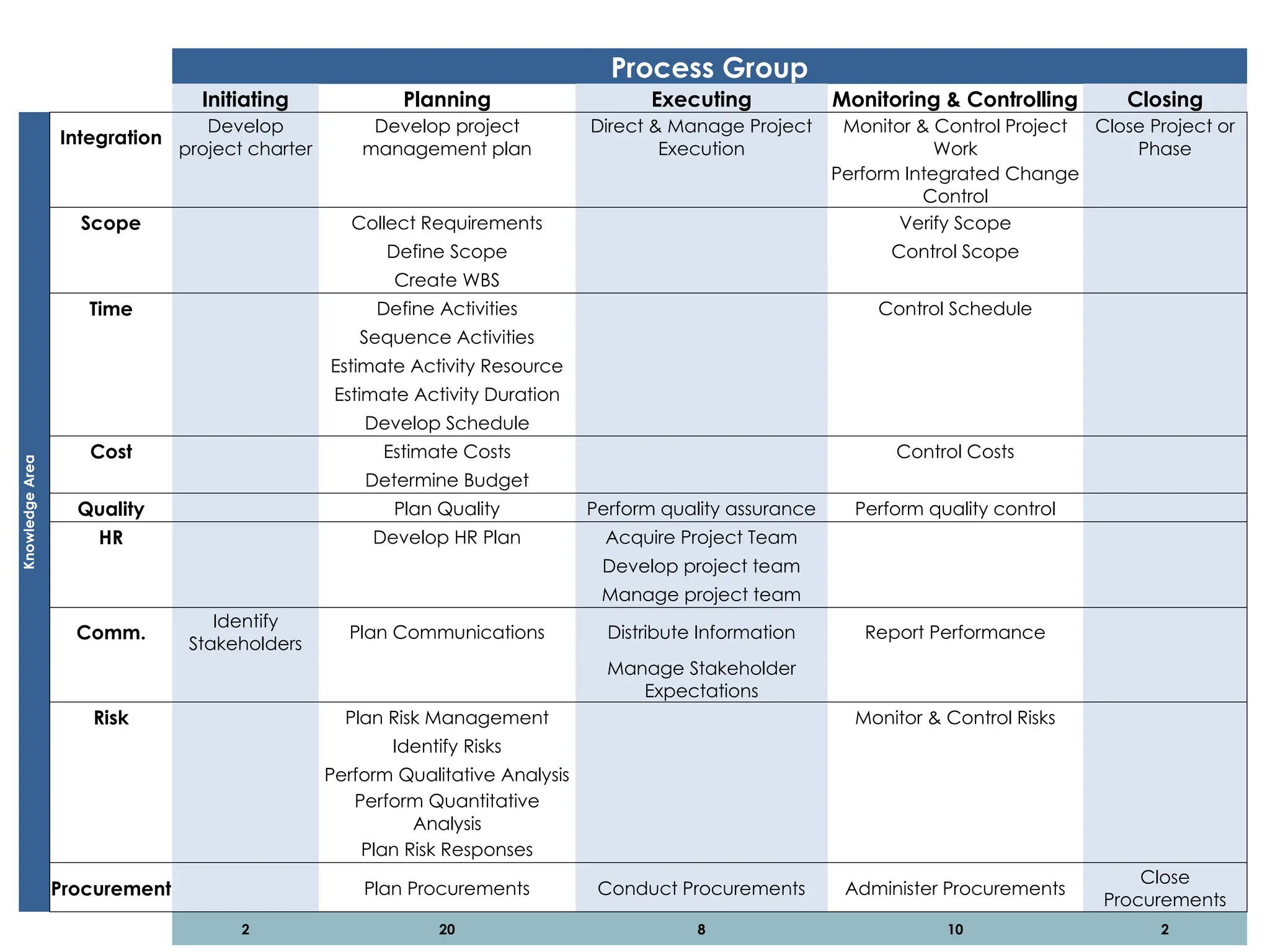
Process Group
Initiating Planning Executing Monitoring & Controlling Closing
Knowledge
Area
Integration
Develop
project charter
Develop project
management plan
Direct & Manage Project
Execution
Monitor & Control Project
Work
Close Project or
Phase
Perform Integrated Change
Control
Scope Collect Requirements Verify Scope
Define Scope Control Scope
Create WBS
Time Define Activities Control Schedule
Sequence Activities
Estimate Activity Resource
Estimate Activity Duration
Develop Schedule
Cost Estimate Costs Control Costs
Determine Budget
Quality Plan Quality Perform quality assurance Perform quality control
HR Develop HR Plan Acquire Project Team
Develop project team
Manage project team
Comm.
Identify
Stakeholders
Plan Communications Distribute Information Report Performance
Manage Stakeholder
Expectations
Risk Plan Risk Management Monitor & Control Risks
Identify Risks
Perform Qualitative Analysis
Perform Quantitative
Analysis
Plan Risk Responses
Procurement Plan Procurements Conduct Procurements Administer Procurements
Close
Procurements
2 20 8 10 2
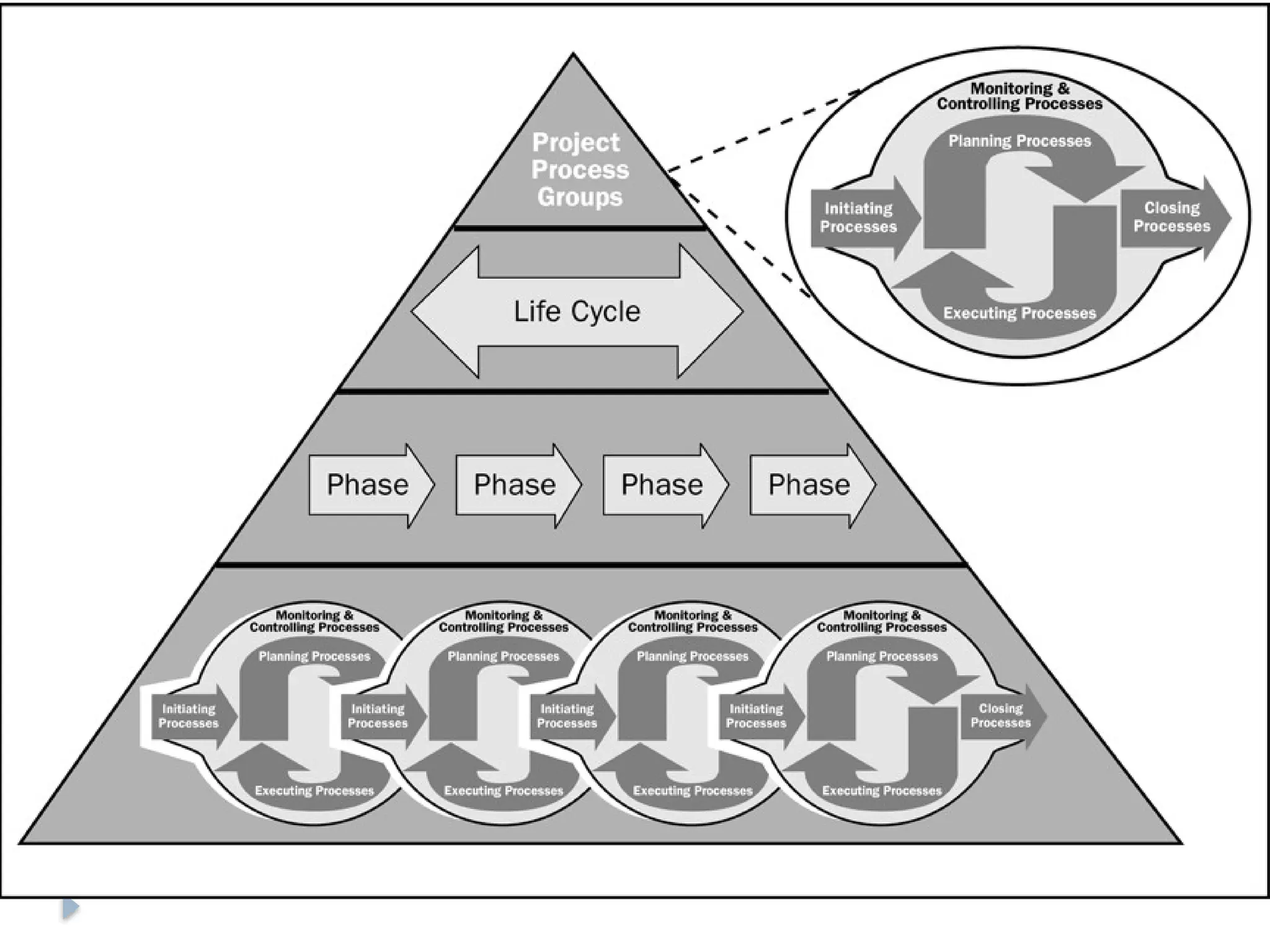
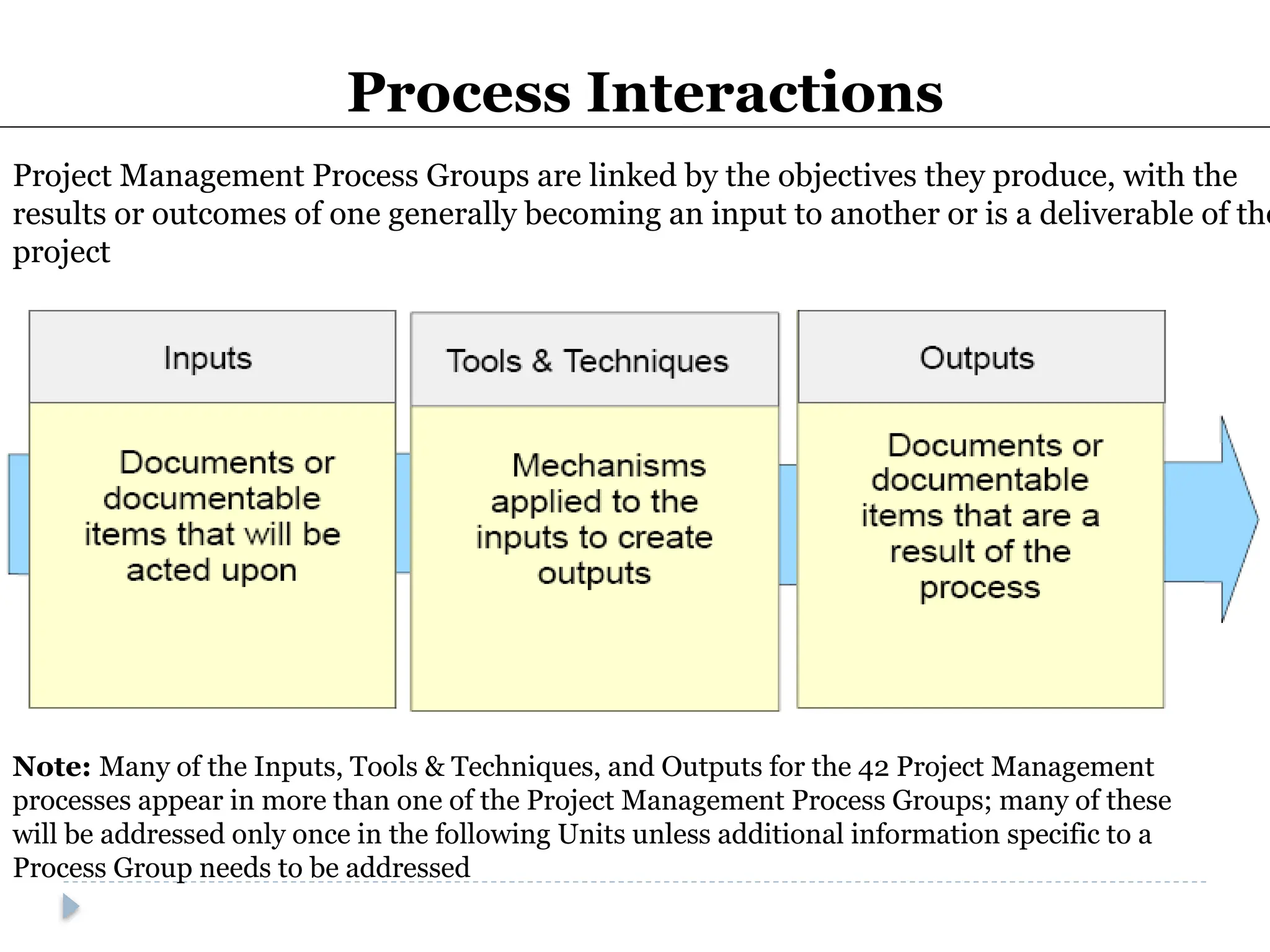
Process Interactions
Project Management Process Groups are linked by the objectives they produce, with the
results or outcomes of one generally becoming an input to another or is a deliverable of the
project
Note: Many of the Inputs, Tools & Techniques, and Outputs for the 42 Project Management
processes appear in more than one of the Project Management Process Groups; many of these
will be addressed only once in the following Units unless additional information specific to a
Process Group needs to be addressed
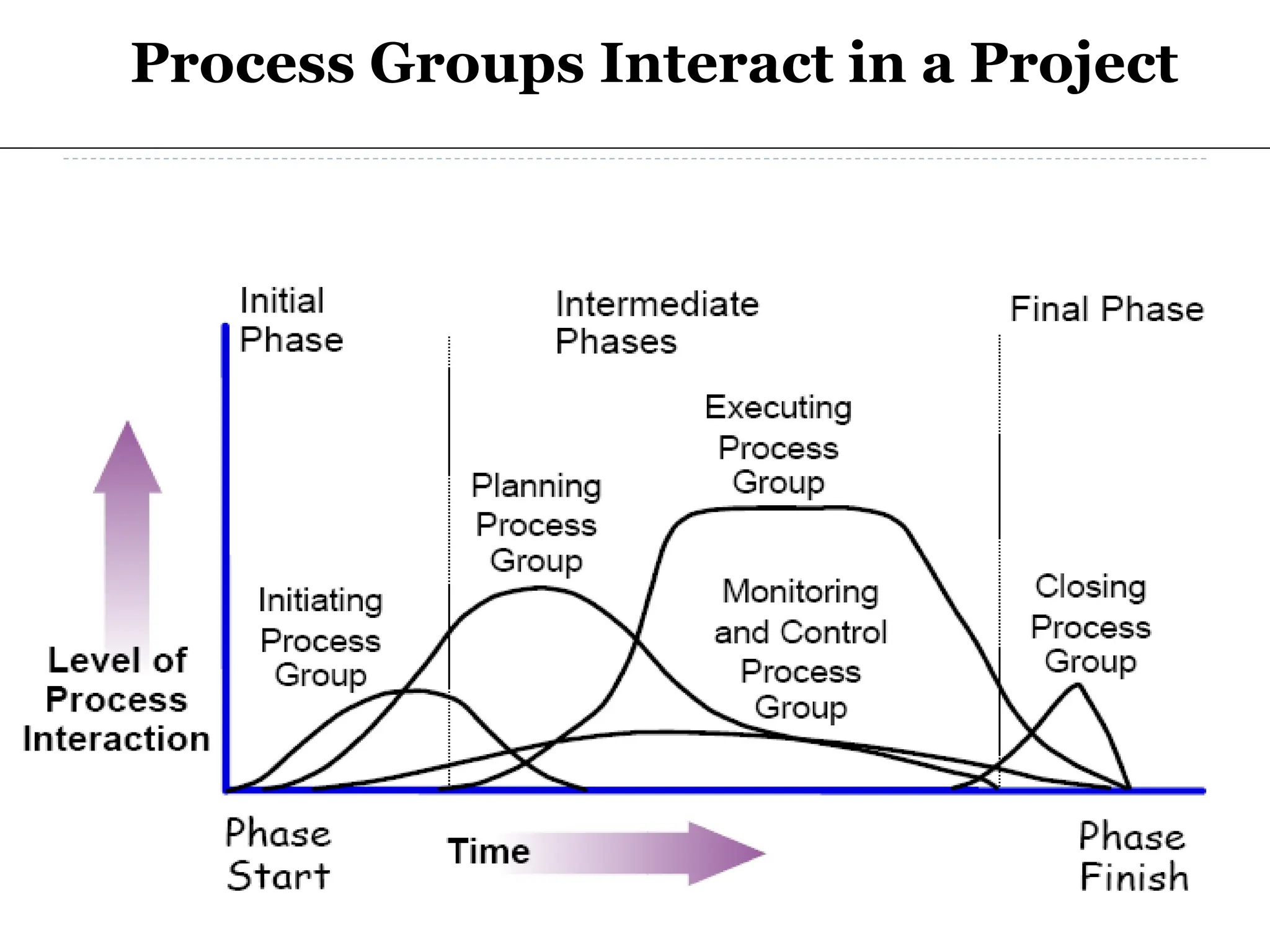
Process Groups Interact in a Project
QUESTIONS?
3- the linkages between project management
process groups are best described by the
following
 A) The WBS links process groups.
 B) process groups are linked by their planned objectives –
the summary objectives of one often becomes the
detailed action plan for another.
 C) process groups are linked by the outputs they
produce- the output of one process generally becomes an
input to another process or is a deliverable of the
project.
 D) there are no significant links between discrete process
groups.
3- the linkages between project management
process groups are best described by the
following
 A) The WBS links process groups.
 B) process groups are linked by their planned objectives –
the summary objectives of one often becomes the
detailed action plan for another.
 C) process groups are linked by the outputs they
produce- the output of one process generally becomes an
input to another process or is a deliverable of the
project.
 D) there are no significant links between discrete process
groups.
The initiating process group consists of the
processes performed to:
 A) Define a new project or a new phase of an existing
project by obtaining authorization to start the project or
phase.
 B) Deploy risk mitigation strategies to enhance the
likelihood of project success.
 C) Establish and describe the need for a project selection
process.
 D) Approve the market analysis to ensure resolution of
potential contract disputes.
The initiating process group consists of the
processes performed to:
 A) Define a new project or a new phase of an existing
project by obtaining authorization to start the project or
phase.
 B) Deploy risk mitigation strategies to enhance the
likelihood of project success.
 C) Establish and describe the need for a project selection
process.
 D) Approve the market analysis to ensure resolution of
potential contract disputes.
The schedule control process for a project
 A) Focuses on starting the project earlier than scheduled
to help mitigate schedule risk.
 B) Is necessary for monitoring the status of the project
and managing changes to the schedule baseline.
 C) Is concerned mainly with activities that are on the
critical path
 D) Should focus entirely on activities that are difficult to
carry out
The schedule control process for a project
 A) Focuses on starting the project earlier than scheduled
to help mitigate schedule risk.
 B) Is necessary for monitoring the status of the project
and managing changes to the schedule baseline.
 C) Is concerned mainly with activities that are on the
critical path
 D) Should focus entirely on activities that are difficult to
carry out
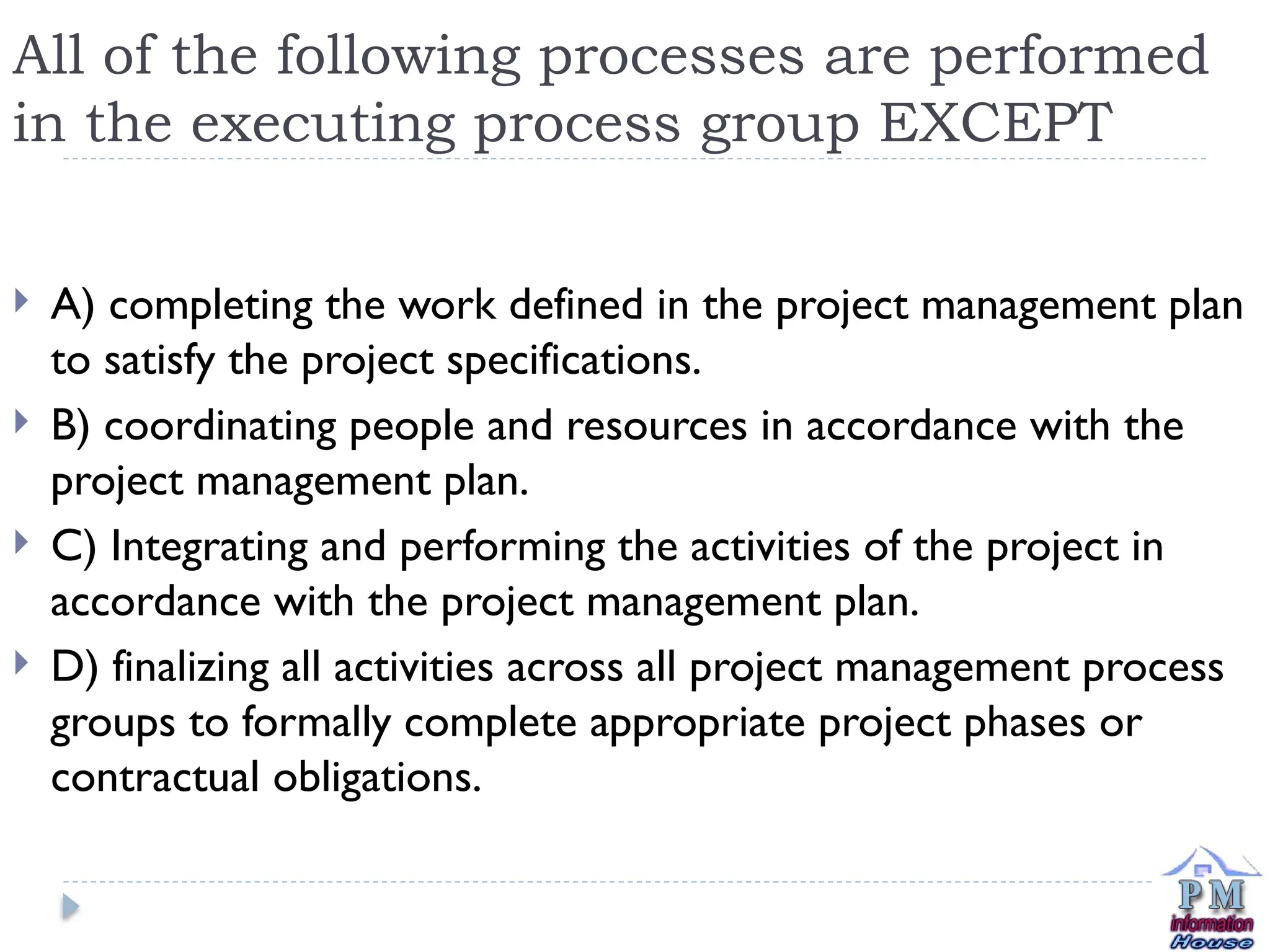
All of the following processes are performed
in the executing process group EXCEPT
 A) completing the work defined in the project management plan
to satisfy the project specifications.
 B) coordinating people and resources in accordance with the
project management plan.
 C) Integrating and performing the activities of the project in
accordance with the project management plan.
 D) finalizing all activities across all project management process
groups to formally complete appropriate project phases or
contractual obligations.
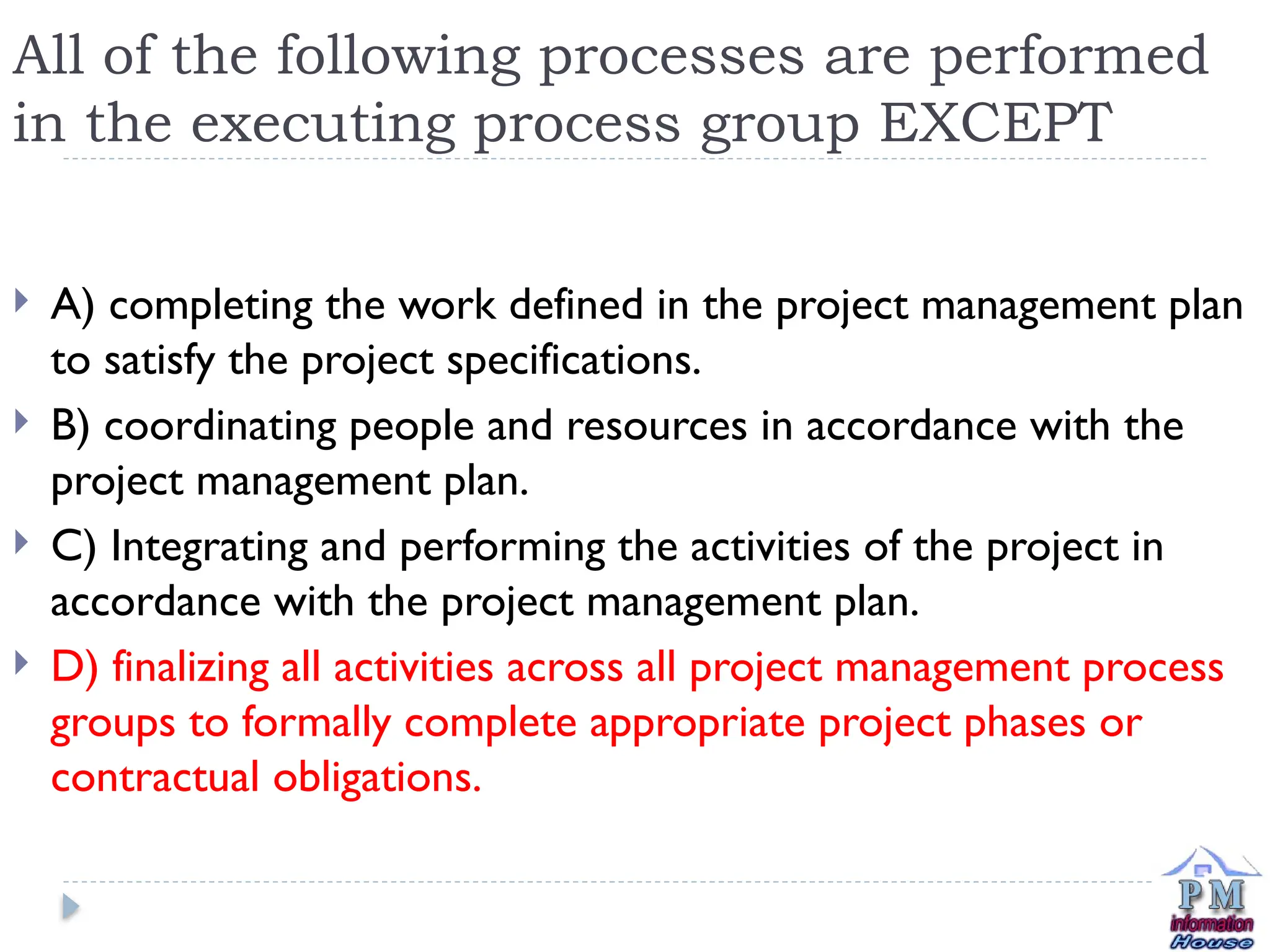
All of the following processes are performed
in the executing process group EXCEPT
 A) completing the work defined in the project management plan
to satisfy the project specifications.
 B) coordinating people and resources in accordance with the
project management plan.
 C) Integrating and performing the activities of the project in
accordance with the project management plan.
 D) finalizing all activities across all project management process
groups to formally complete appropriate project phases or
contractual obligations.
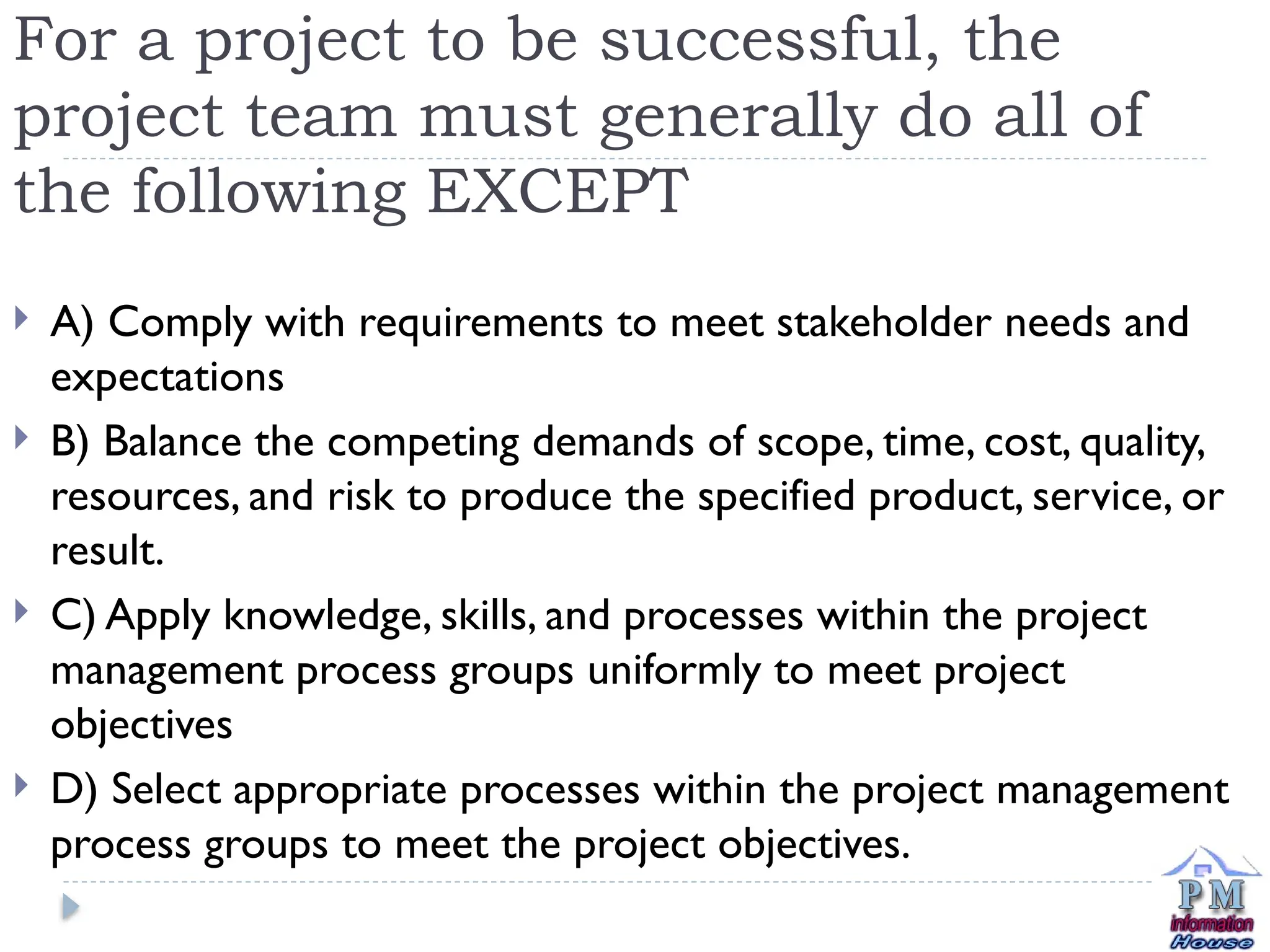
For a project to be successful, the
project team must generally do all of
the following EXCEPT
 A) Comply with requirements to meet stakeholder needs and
expectations
 B) Balance the competing demands of scope, time, cost, quality,
resources, and risk to produce the specified product, service, or
result.
 C) Apply knowledge, skills, and processes within the project
management process groups uniformly to meet project
objectives
 D) Select appropriate processes within the project management
process groups to meet the project objectives.
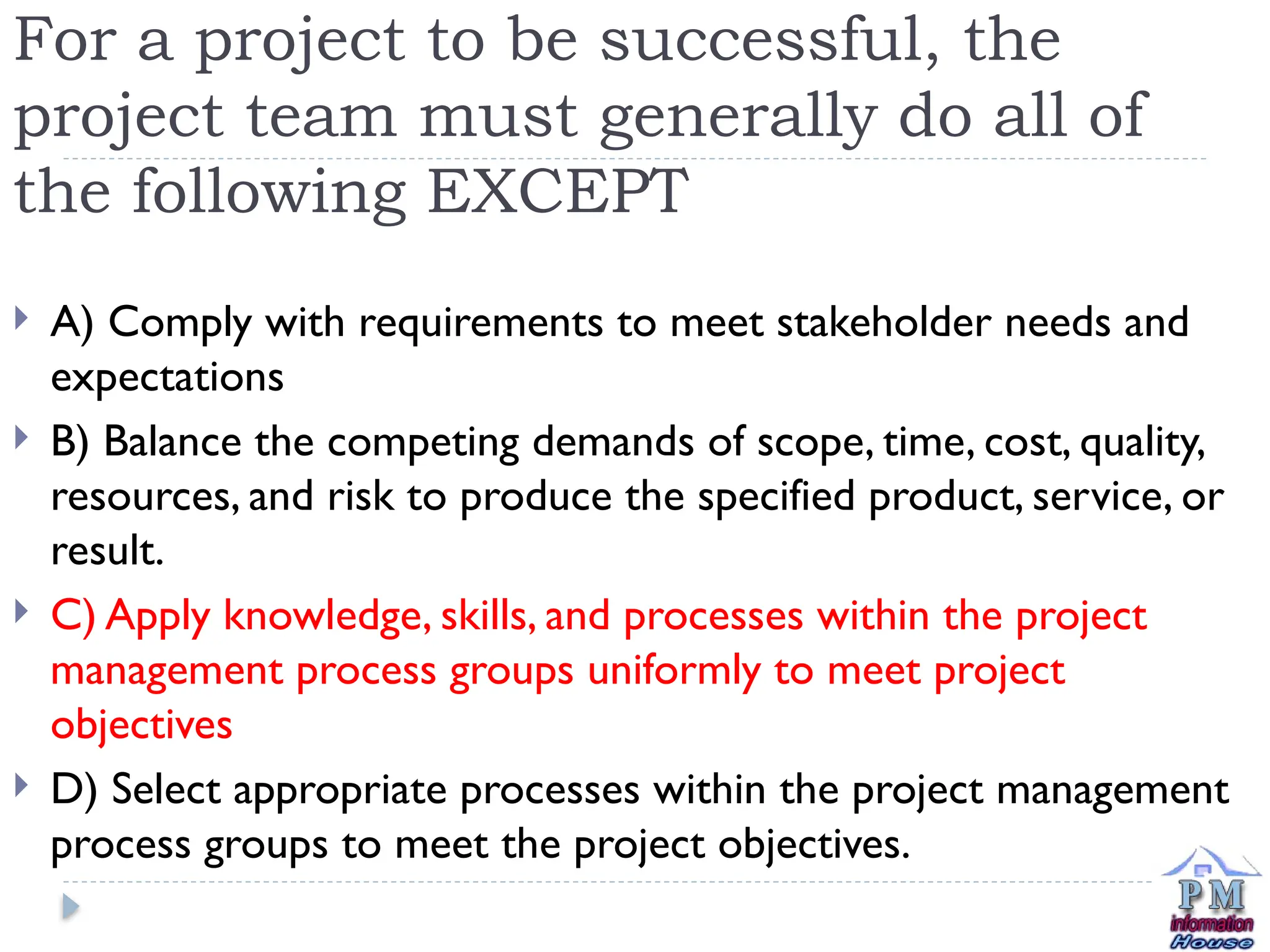
For a project to be successful, the
project team must generally do all of
the following EXCEPT
 A) Comply with requirements to meet stakeholder needs and
expectations
 B) Balance the competing demands of scope, time, cost, quality,
resources, and risk to produce the specified product, service, or
result.
 C) Apply knowledge, skills, and processes within the project
management process groups uniformly to meet project
objectives
 D) Select appropriate processes within the project management
process groups to meet the project objectives.
Thank you

A-PMP Preparation Course, 0905 - Ch 1,2,3 - Framework-v2.pptx

  • 1.
    PMP Preparation Course TheProject Management framework Eng.Akram Alnajjar , PgMP , PMP , PSP www.pmhouse.org
  • 2.
     My nameis Mohamed Seleam  Certified Project Management Professional PMP by PMI / USA  Postgraduate Diploma for business administration Suis Canal University 1991  BSC , Business Administration 1989  PM consultant and owner of an Import firm  Currently working as lecturer for Arab Academy , ITI, PMI Mena Chapter PM information house, IPA, Orascom, Brisk  more than fifteen years of experience in the field of project management and marketing .  very aware of today's complex business environment with firms of different types and sizes and with people of different cultures. Who am I?
  • 3.
    Participant Introductions ü ü Name ü ü Organization Role inorganization Why do you attend this course? What is your expectations ?
  • 4.
    Ground Rules ToEnhance Performance Start on time to End on time Mobile Phone Silent Please Questions after Permeation RATHOLE TO CONCENTRATE Presents 100 % to get your certificate
  • 5.
    From To To 5:00PM 5:45PM Technical Session 5:45 PM 6:00 PM Break (Praying) 6:00 PM 7:30 PM Technical Session 7:30 PM 8:00 PM Coffee break 8:00 PM 10:00 PM Technical Session Daily Agenda Start on time = End on time
  • 6.
    Section I -Project Framework Management  PMP Certifications and Requirements  Chapter 1 – Introduction  Chapter 2 –Project Life Cycle and Organization  Chapter 3 –Project Management Process Interactions
  • 7.
  • 8.
    Chapter 1 - Introduction Purpose of the PMBOK® Guide  What is a Project?  What is Project management?  Relationships Among Project Management  Program Management , Operations Management  Role of Project Manager  ProjectsVs. Operational Work  Enterprise Environmental Factors
  • 9.
    Purpose of thisPMBOK® Guide  The primary purpose of the PMBOK® Guide is to identify that Subset of the Project Management Body of Knowledge that is generally recognized as good practice.  Provides common terminology
  • 10.
    What is aProject  A project is a temporary endeavor undertaken to create a unique product service, or result. •Temporary Has a definite beginning and end, not an on-going effort. Ceases when objectives have been attained. Team disbanded upon completion. •Unique The product or service is different in some way from other products or services.
  • 11.
    What is ProjectManagement The application of knowledge, skills, tools, and techniques to project activities to meet project requirements Project Management
  • 12.
    Project constraints Balancing thecompeting Project constraints  Scope  Quality  Schedule  Budget  Resources , and  Risk Managing Project Include
  • 13.
    Organizational Strategic Hierarchy Organization alStrategy Portfolio Management Program Management Project Management Portfolio management facilitates the alignment of investments in projects and programs with strategy.
  • 14.
    Relationship Between ProjectManagement, Program Management, and Portfolio Management  Portfolio management A portfolio is a collection of projects or programs and other work that are grouped together to facilitate effective management of that work to meet strategic business objectives.  Program management A program is defined as a group of related projects managed in a coordinated way to obtain benefits and control not available from managing them individually.  Projects and strategic planning Projects are often utilized as a means of achieving an organization’s strategic plan.
  • 15.
    Project Program Portfolio Scopeof work Narrow scope with specific deliverables Wider scope – provide benefits and capabilities to program Business scope – depends on strategic goals of the organization Role of Manager •Called project manager •Manages technicians, specialists etc. • Conducts detailed planning to manage deliverables of the project • Monitors and controls the projects products •Called program manager •Manages project managers •Create high-level plans providing guidance to projects •Monitors projects and ongoing work through governance structures •Called portfolio manager •Manages or coordinates portfolio management staff •Creates and maintains processes for the aggregate portfolio •Monitors aggregate performance and value indicators Skills required •Project managers are team players who motivate with their knowledge and skills •Leadership style focuses on task delivery and directive to meet success criteria •Program managers are leaders who provide vision and leadership •Leadership style focuses on managing relationships and conflict resolution •Portfolio managers are leaders providing insight and synthesis •Leadership style focuses on adding value to portfolio management staff Projects, Programs, and Portfolios
  • 16.
    Relationship Between ProjectManagement, Program Management, and Portfolio Management  Project management office (PMO) A (PMO) is an organizational body or entity assigned various responsibilities related to the centralized and coordinated management of those projects under its domain.  Project management and operations management Operations are an organizational function performing the ongoing execution of activities that produce the same product or provide a repetitive service
  • 17.
    Projects vs. Operationalwork  Similarities with Operations:  Performed by people  Constrained by limited resource  Planned, executed and controlled  Differences from Operations:  Operations are on-going; projects temporary  Operations repetitive; Projects unique
  • 18.
    Personal = howthe project management team behaves when performing the project or activity Knowledge = What he Knows about Project management Performance = What able to do or accomplish while applying their project management knowledge Project manager Role of Project Manager
  • 19.
    Enterprise Environmental Factors Enterprise Environmental Factors include, but are not limited to the following:  • Organizational culture and structure,  • Government or industry standards (e.g., regulatory agency regulations, codes of conduct,  product standards, quality standards, and workmanship standards),  • Infrastructure (e.g., existing facilities and capital equipment),  • Existing human resources (e.g., skills, disciplines, and knowledge, such as design,  development, law, contracting, and purchasing),  • Personnel administration (e.g., hiring and firing guidelines, employee performance  reviews, and training records),  • Company work authorization systems,  • Marketplace conditions,  • Stakeholder risk tolerances,  • Commercial databases (e.g., standardized cost estimating data, industry risk study  information, and risk databases), or  • Project management information systems (e.g., an automated tool suite, such as a  scheduling software tool, a configuration management system, an information collection  and distribution system, or web interfaces to other online automated systems).
  • 20.
  • 21.
    Managing a projecttypically includes:  A) Balancing the competing project constraints including scope, quality, schedule, budget, recourses, and risk .  B) integrating requirements of profitability, low cost, and legal responsibility.  C) Implementation of software, hardware, and other systems to enhance organizational efficiency.  D) Supporting human factors, communications, discipline, and performance management.
  • 22.
    Managing a projecttypically includes:  A) Balancing the competing project constraints including scope, quality, schedule, budget, recourses, and risk .  B) integrating requirements of profitability, low cost, and legal responsibility.  C) Implementation of software, hardware, and other systems to enhance organizational efficiency.  D) Supporting human factors, communications, discipline, and performance management.
  • 23.
    Portfolio management refersto:  A) Managing various contents of project file.  B) Managing the levels of financial authority to facilitate project decision making.  C) Identifying, prioritizing, authorizing, managing, and controlling projects, programs, and other related work, to achieve specific strategic business objectives.  D) Applying recourses-leveling heuristics across all the organization’s projects to achieve the organization’s strategic objectives.
  • 24.
    Portfolio management refersto:  A) Managing various contents of project file.  B) Managing the levels of financial authority to facilitate project decision making.  C) Identifying, prioritizing, authorizing, managing, and controlling projects, programs, and other related work, to achieve specific strategic business objectives.  D) Applying recourses-leveling heuristics across all the organization’s projects to achieve the organization’s strategic objectives.
  • 25.
    All of thefollowing are true about projects and operations EXCEPT:  A) Operations are ongoing, repetitive, and permanent endeavors while projects are temporary endeavors.  B) Projects require project management while operations require business process management or operations management.  C) Projects can intersect with operations at various points during the product life cycle.At each point, deliverables and knowledge are transferred between the project and operations for implementation of the delivered work.  D) Projects, because of their temporary nature, cannot help achieve an organization’s goals.Therefore, strategic activities in the organization can be generally addressed within the organization’s normal operations.
  • 26.
    All of thefollowing are true about projects and operations EXCEPT:  A) Operations are ongoing, repetitive, and permanent endeavors while projects are temporary endeavors.  B) Projects require project management while operations require business process management or operations management.  C) Projects can intersect with operations at various points during the product life cycle.At each point, deliverables and knowledge are transferred between the project and operations for implementation of the delivered work.  D) Projects, because of their temporary nature, cannot help achieve an organization’s goals.Therefore, strategic activities in the organization can be generally addressed within the organization’s normal operations.
  • 27.
    Project success ismeasured by:  A) Degree to which the project satisfies its time and budget objectives.  B) Triple constraints of schedule, cost, and technical performance.  C) Product and project quality, timelines, budget compliance, and degree of customer satisfaction.  D) Degree to which the project satisfies the needs for which it was undertaken and its long-term contribution to aggregate performance of the organization’s portfolio.
  • 28.
    Project success ismeasured by:  A) Degree to which the project satisfies its time and budget objectives.  B) Triple constraints of schedule, cost, and technical performance.  C) Product and project quality, timelines, budget compliance, and degree of customer satisfaction.  D) Degree to which the project satisfies the needs for which it was undertaken and its long-term contribution to aggregate performance of the organization’s portfolio.
  • 29.
    The PMBOK guideis the standard for:  A ) Managing all projects all of the time across all industries.  B ) Managing all projects all of the time across some types of industries.  C ) Managing most projects most of the time across many types of industries.  D ) Managing some projects some of the time across few types of industries .
  • 30.
    The PMBOK guideis the standard for:  A ) Managing all projects all of the time across all industries.  B ) Managing all projects all of the time across some types of industries.  C ) Managing most projects most of the time across many types of industries.  D ) Managing some projects some of the time across few types of industries .
  • 31.
    Project Life CycleOverview Stakeholders Organizational Influences Chapter 2 Project Life Cycle
  • 32.
    The project lifecycle Overview a project life cycle is a collection of generally sequential and sometimes overlapping project phases whose name and number are determined by the management and control needs of the organization or organizations involved in the project, the nature of the project itself, and its area of application.
  • 33.
    Start Organizing and Preparing Carryingout theWork Close Cost and Staffing Level Time - Characteristics of The Project Life Cycle 16
  • 34.
    Time Low High • Stakeholder influence •Risk of not meeting objectives • Amount at stake • Cost of changes Early Late Characteristics of The Project Life Cycle (con.)
  • 35.
    Phase to PhaseRelationships Initiating Planning Executing Closing Initiating Planning Executing Closing
  • 36.
  • 37.
    Organization Matrix Project Characteristics Structure FunctionalProjectized Weak Matrix Balanced Matrix Strong Matrix Project Manager's Authority Little or None Limited Low to Moderate Moderate to High High to Almost Total Resource Availability Little or None Limited Low to Moderate Moderate to High High to Almost Total Who controls the project budget Functional Manager Functional Manager Mixed Project Manager Project Manager Project Manager's Role Part-time Part-time Full-time Full-time Full-time Project Management Administrative Staff Part-time Part-time Part-time Full-time Full-time Organizational Influences on Projects
  • 38.
  • 39.
  • 40.
  • 41.
  • 42.
  • 43.
    Organization Matrix Project Characteristics Structure FunctionalProjectized Weak Matrix Balanced Matrix Strong Matrix Project Manager's Authority Little or None Limited Low to Moderate Moderate to High High to Almost Total Resource Availability Little or None Limited Low to Moderate Moderate to High High to Almost Total Who controls the project budget Functional Manager Functional Manager Mixed Project Manager Project Manager Project Manager's Role Part-time Part-time Full-time Full-time Full-time Project Management Administrative Staff Part-time Part-time Part-time Full-time Full-time Organizational Influences on Projects
  • 44.
    Organizational Process assets–They are the formal and informal policies, procedures, and guidelines that could impact how the project’s scope is managed. Those of particular interest to scope planning are:  Organizational policies as they pertain to scope planning and management  Organizational procedures related to scope planning and management  Historical information about previous projects, which should be considered during scope planning. Information may be located in prior projects’ lesson learned project archives Organizational Process assets
  • 45.
  • 46.
    2-Organizational culture andstyles:  A) Are generally similar and manifest in similar ways.  B) Are generally similar but manifest in different ways.  C) Have no impact on a clearly defined project.  D) May have a strong influence on a project ability to meet objectives.
  • 47.
    2-Organizational culture andstyles:  A) Are generally similar and manifest in similar ways.  B) Are generally similar but manifest in different ways.  C) Have no impact on a clearly defined project.  D) May have a strong influence on a project ability to meet objectives.
  • 48.
    A project coordinatormay typically be found in a …………….. Organization.  A) Projectized  B) Strong matrix  C) Weak matrix  D) Balanced matrix
  • 49.
    A project coordinatormay typically be found in a …………….. Organization.  A) Projectized  B) Strong matrix  C) Weak matrix  D) Balanced matrix
  • 50.
    All of thefollowing are generally true about the project management office (PMO) EXCEPT  A) It may provide project management support functions  B) It should be generally located in a centralized, bright, well-ventilated area.  C) It may provide training, mentoring, and coaching of project managers.  D) It may actually be responsible for the direct management of a project.
  • 51.
    All of thefollowing are generally true about the project management office (PMO) EXCEPT  A) It may provide project management support functions  B) It should be generally located in a centralized, bright, well-ventilated area.  C) It may provide training, mentoring, and coaching of project managers.  D) It may actually be responsible for the direct management of a project.
  • 52.
    Which of thefollowing is NOT true about project stakeholders?  A) They are persons or organizations that are actively supportive of the project.  B) they are persons or organizations who are actively involved in the project  C) they are persons or organizations whose interests may be positively or negatively affected by the performance or completion of the project.  D) they are persons or organizations that may exert influence over the project, its deliverables, and the project team members.
  • 53.
    Which of thefollowing is NOT true about project stakeholders?  A) They are persons or organizations that are actively supportive of the project.  B) they are persons or organizations who are actively involved in the project  C) they are persons or organizations whose interests may be positively or negatively affected by the performance or completion of the project.  D) they are persons or organizations that may exert influence over the project, its deliverables, and the project team members.
  • 54.
    All of thefollowing are true about project phases and the project life cycle EXCEPT  A) stakeholder influence, risk, and uncertainty are greatest at the start of the project.These factors decrease over the life of the project.  B) the ability to influence the final characteristics of the project’s product, without significantly impacting cost, is highest at the start of the project and decreases as the project progresses towards completion.  C) the cost of change and correcting errors typically increases substantially as the project approaches completion.  D) Cost and staffing levels are generally steady throughout the project.
  • 55.
    All of thefollowing are true about project phases and the project life cycle EXCEPT  A) stakeholder influence, risk, and uncertainty are greatest at the start of the project.These factors decrease over the life of the project.  B) the ability to influence the final characteristics of the project’s product, without significantly impacting cost, is highest at the start of the project and decreases as the project progresses towards completion.  C) the cost of change and correcting errors typically increases substantially as the project approaches completion.  D) Cost and staffing levels are generally steady throughout the project.
  • 56.
    Section 11 – TheStandard for Project Management of A Project  Chapter 3 –Project Management Process Interactions  Project Management interaction  Project Management Process Group
  • 57.
    Commitment to executing project Approachto executing project Coordinating people and other resources Formal product acceptance and end of project Monitoring, measuring, and taking corrective action Project Management Processes
  • 59.
    Process Group Initiating PlanningExecuting Monitoring & Controlling Closing Knowledge Area Integration Develop project charter Develop project management plan Direct & Manage Project Execution Monitor & Control Project Work Close Project or Phase Perform Integrated Change Control Scope Collect Requirements Verify Scope Define Scope Control Scope Create WBS Time Define Activities Control Schedule Sequence Activities Estimate Activity Resource Estimate Activity Duration Develop Schedule Cost Estimate Costs Control Costs Determine Budget Quality Plan Quality Perform quality assurance Perform quality control HR Develop HR Plan Acquire Project Team Develop project team Manage project team Comm. Identify Stakeholders Plan Communications Distribute Information Report Performance Manage Stakeholder Expectations Risk Plan Risk Management Monitor & Control Risks Identify Risks Perform Qualitative Analysis Perform Quantitative Analysis Plan Risk Responses Procurement Plan Procurements Conduct Procurements Administer Procurements Close Procurements 2 20 8 10 2
  • 60.
    Process Interactions Project ManagementProcess Groups are linked by the objectives they produce, with the results or outcomes of one generally becoming an input to another or is a deliverable of the project Note: Many of the Inputs, Tools & Techniques, and Outputs for the 42 Project Management processes appear in more than one of the Project Management Process Groups; many of these will be addressed only once in the following Units unless additional information specific to a Process Group needs to be addressed
  • 61.
  • 62.
  • 63.
    3- the linkagesbetween project management process groups are best described by the following  A) The WBS links process groups.  B) process groups are linked by their planned objectives – the summary objectives of one often becomes the detailed action plan for another.  C) process groups are linked by the outputs they produce- the output of one process generally becomes an input to another process or is a deliverable of the project.  D) there are no significant links between discrete process groups.
  • 64.
    3- the linkagesbetween project management process groups are best described by the following  A) The WBS links process groups.  B) process groups are linked by their planned objectives – the summary objectives of one often becomes the detailed action plan for another.  C) process groups are linked by the outputs they produce- the output of one process generally becomes an input to another process or is a deliverable of the project.  D) there are no significant links between discrete process groups.
  • 65.
    The initiating processgroup consists of the processes performed to:  A) Define a new project or a new phase of an existing project by obtaining authorization to start the project or phase.  B) Deploy risk mitigation strategies to enhance the likelihood of project success.  C) Establish and describe the need for a project selection process.  D) Approve the market analysis to ensure resolution of potential contract disputes.
  • 66.
    The initiating processgroup consists of the processes performed to:  A) Define a new project or a new phase of an existing project by obtaining authorization to start the project or phase.  B) Deploy risk mitigation strategies to enhance the likelihood of project success.  C) Establish and describe the need for a project selection process.  D) Approve the market analysis to ensure resolution of potential contract disputes.
  • 67.
    The schedule controlprocess for a project  A) Focuses on starting the project earlier than scheduled to help mitigate schedule risk.  B) Is necessary for monitoring the status of the project and managing changes to the schedule baseline.  C) Is concerned mainly with activities that are on the critical path  D) Should focus entirely on activities that are difficult to carry out
  • 68.
    The schedule controlprocess for a project  A) Focuses on starting the project earlier than scheduled to help mitigate schedule risk.  B) Is necessary for monitoring the status of the project and managing changes to the schedule baseline.  C) Is concerned mainly with activities that are on the critical path  D) Should focus entirely on activities that are difficult to carry out
  • 69.
    All of thefollowing processes are performed in the executing process group EXCEPT  A) completing the work defined in the project management plan to satisfy the project specifications.  B) coordinating people and resources in accordance with the project management plan.  C) Integrating and performing the activities of the project in accordance with the project management plan.  D) finalizing all activities across all project management process groups to formally complete appropriate project phases or contractual obligations.
  • 70.
    All of thefollowing processes are performed in the executing process group EXCEPT  A) completing the work defined in the project management plan to satisfy the project specifications.  B) coordinating people and resources in accordance with the project management plan.  C) Integrating and performing the activities of the project in accordance with the project management plan.  D) finalizing all activities across all project management process groups to formally complete appropriate project phases or contractual obligations.
  • 71.
    For a projectto be successful, the project team must generally do all of the following EXCEPT  A) Comply with requirements to meet stakeholder needs and expectations  B) Balance the competing demands of scope, time, cost, quality, resources, and risk to produce the specified product, service, or result.  C) Apply knowledge, skills, and processes within the project management process groups uniformly to meet project objectives  D) Select appropriate processes within the project management process groups to meet the project objectives.
  • 72.
    For a projectto be successful, the project team must generally do all of the following EXCEPT  A) Comply with requirements to meet stakeholder needs and expectations  B) Balance the competing demands of scope, time, cost, quality, resources, and risk to produce the specified product, service, or result.  C) Apply knowledge, skills, and processes within the project management process groups uniformly to meet project objectives  D) Select appropriate processes within the project management process groups to meet the project objectives.
  • 73.

Editor's Notes

  • #3 KEY Allow participants (and instructor) to introduce themselves and tell others something about their program management experience. HOW Instructor can begin by introducing him/herself and answering one of the questions on the slide. Tell participants that, in the interest of time, they should answer one of the three questions on the next slide. Either this can be done as a whole group activity or, if time is an issue, have participants introduce themselves to a partner. Then, ask for volunteers to introduce another person to the rest of the group, telling a little bit about that person. TIME 30 min
  • #9 CASE STUDY
  • #15 KEY Discuss the organizational strategic hierarchy and where program management lies. HOW This is a slide that encapsulates previous content. We’ve already talked about projects, programs, and portfolios. This diagram shows how they fit together in an organization. Ask participants where they fit in this hierarchy in their organizations. Ask how this affects decisions they make. “A portfolio is most likely one of the truest measures of an organization’s intent, direction, and progress. It is where investment decisions are made, resources are allocated, and priorities are identified. If a portfolio’s components are not aligned [with] the strategy, the organization can reasonably question why they are being undertaken.” (The Standard for Program Management, p. 6). Lead a discussion about what the program manager needs to know about each of these tiers. Is it important for the program manager to understand the organizational strategy? If so, why? Those individuals in the bottom right-hand corner will not understand where they fit in the organizational strategy if good communication does not exist up and down the hierarchy. TIME 5 min
  • #20 KEY Show how program managers interact with projects. HOW This slide shows the role of the program manager in relation to projects. TIME 4 min
  • #35 WHY? - Because you’ve been told to!
  • #39 KEY Describe the types of stakeholders. HOW State that there are many types of stakeholders. Discuss each one listed on the slide: [Project] sponsors are the persons in an organization whose support and approval is required for a project to start and continue. End users are those customers using the product or service. An end user might not necessarily pay directly for the product or service. For example, a company may have paid for the development of a special software package designed for its specific needs; however, it is the employees of the company who are the end users. Customers are either outside or within the performing organization. External customers are often (but not always) paying directly for the project, or the product or service that results from the project. The public may be an external stakeholder to a project. In some organizations, internal stakeholders are required to “pay” for project products and services. Other project teams or functional divisions within our organization will often be affected by your projects or use the products and services that results from your projects. Senior Management is the executive level of the performing organization—such as the president and vice presidents. Suppliers/Vendors are persons or organizations that furnish supplies or services to a prime contractor or another subcontractor. Subcontractors are persons or organizations responsible for the performance of a contract or subcontract. Team members are the individuals on the project team. Regulatory agencies develop regulations based on laws and ensures compliance with the regulations. Examples include the Environmental Protection Agency (EPA) or the Occupational Safety and Health Administration (OSHA). Ask participants to share examples of these types of stakeholders and customers from their own projects. For those participants who are planning to take the PMP® exam, note that the PMBOK® Guide lists four examples of stakeholders: customers, sponsors, the performing organization, and the public. TIME 2 min