PHYSICS
CAPACITORS
Short revision series
Capaitors
 2 conductors separated by an insulator
 Capacitance iss the ability of a conductor to
store charge. Measured in Farads F.
 C = Q  Q
p.d V V
Q = CV
V = Q/C
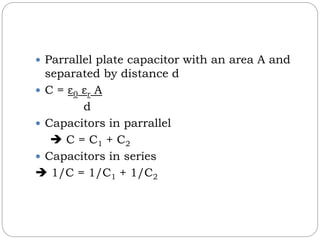
 Parrallel plate capacitor with an area A and
separated by distance d
 C = ε0 εr A
d
 Capacitors in parrallel
 C = C1 + C2
 Capacitors in series
 1/C = 1/C1 + 1/C2
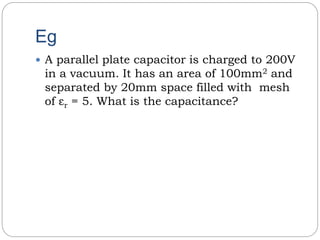
Eg
 A parallel plate capacitor is charged to 200V
in a vacuum. It has an area of 100mm2 and
separated by 20mm space filled with mesh
of εr = 5. What is the capacitance?
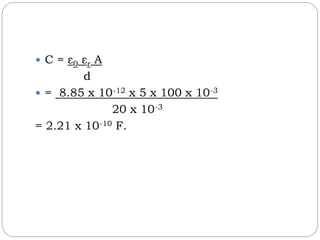
 C = ε0 εr A
d
 = 8.85 x 10-12 x 5 x 100 x 10-3
20 x 10-3
= 2.21 x 10⁻¹⁰ F.
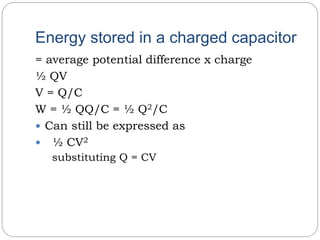
Energy stored in a charged capacitor
= average potential difference x charge
½ QV
V = Q/C
W = ½ QQ/C = ½ Q2/C
 Can still be expressed as
 ½ CV2
substituting Q = CV
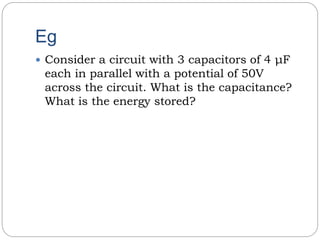
Eg
 Consider a circuit with 3 capacitors of 4 μF
each in parallel with a potential of 50V
across the circuit. What is the capacitance?
What is the energy stored?
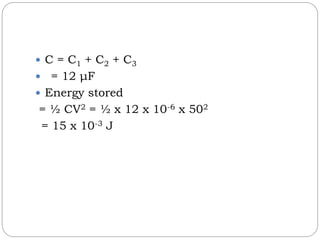
 C = C1 + C2 + C3
 = 12 μF
 Energy stored
= ½ CV2 = ½ x 12 x 10-6 x 502
= 15 x 10-3 J
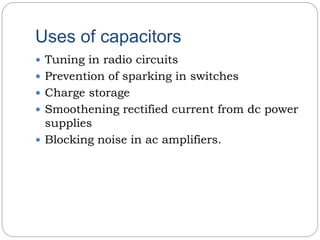
Uses of capacitors
 Tuning in radio circuits
 Prevention of sparking in switches
 Charge storage
 Smoothening rectified current from dc power
supplies
 Blocking noise in ac amplifiers.
END

Capacitorsprepwalk

  • 1.
  • 2.
    Capaitors  2 conductorsseparated by an insulator  Capacitance iss the ability of a conductor to store charge. Measured in Farads F.  C = Q  Q p.d V V Q = CV V = Q/C
  • 3.
     Parrallel platecapacitor with an area A and separated by distance d  C = ε0 εr A d  Capacitors in parrallel  C = C1 + C2  Capacitors in series  1/C = 1/C1 + 1/C2
  • 4.
    Eg  A parallelplate capacitor is charged to 200V in a vacuum. It has an area of 100mm2 and separated by 20mm space filled with mesh of εr = 5. What is the capacitance?
  • 5.
     C =ε0 εr A d  = 8.85 x 10-12 x 5 x 100 x 10-3 20 x 10-3 = 2.21 x 10⁻¹⁰ F.
  • 6.
    Energy stored ina charged capacitor = average potential difference x charge ½ QV V = Q/C W = ½ QQ/C = ½ Q2/C  Can still be expressed as  ½ CV2 substituting Q = CV
  • 7.
    Eg  Consider acircuit with 3 capacitors of 4 μF each in parallel with a potential of 50V across the circuit. What is the capacitance? What is the energy stored?
  • 8.
     C =C1 + C2 + C3  = 12 μF  Energy stored = ½ CV2 = ½ x 12 x 10-6 x 502 = 15 x 10-3 J
  • 9.
    Uses of capacitors Tuning in radio circuits  Prevention of sparking in switches  Charge storage  Smoothening rectified current from dc power supplies  Blocking noise in ac amplifiers.
  • 10.