Presentation of Solid State Physics
Submitted To:
Prof. Mashal Hanif
Submitted By:
Hassan Ashiq
CONTENTS
 Introduction
 Bio Savart’s Law
 Hall Effect
 Applications
Introduction
“Magnetostatics is the study of magnetic fields in systems where the currents are
steady (not changing with time)”
 In 1820,
 By scientist Oersted.
 He perform an experiment in which he flow current on a conductor, then the
magnetic field will produced in surroundings.
 Then its was deeply studied by Biot Sawart law.
Biot Savart Law
It states that
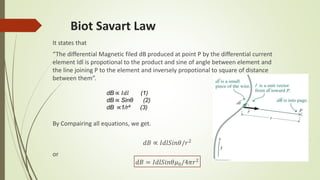
“The differential Magnetic filed dB produced at point P by the differential current
element Idl is propotional to the product and sine of angle between element and
the line joining P to the element and inversely propotional to square of distance
between them”.
By Compairing all equations, we get.
𝑑𝐵 ∝ 𝐼𝑑𝑙𝑆𝑖𝑛𝜃/𝑟2
or
𝑑𝐵 = 𝐼𝑑𝑙𝑆𝑖𝑛𝜃𝜇0/4𝜋𝑟2
dB ∝ 𝐼𝑑𝑙 (1)
dB ∝ Sinθ (2)
dB ∝1/r² (3)
Hall Effect
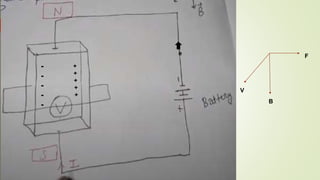
 In 1879 Edwin Hall observed that when an electrical current passes through a
sample placed in a magnetic field, a potential proportional to the current and to
the magnetic field is developed across the material in a direction perpendicular
to both the current and to the magnetic field. This effect is known as the Hall
effect,
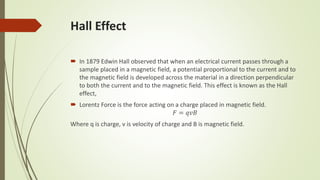
 Lorentz Force is the force acting on a charge placed in magnetic field.
𝐹 = 𝑞𝑣𝐵
Where q is charge, v is velocity of charge and B is magnetic field.
B
V
Fe
-
-
-
-
-
Applications
 Determination of Semiconductor Type
 Measurement of Magnetic Flux Density
 Measurement of Power in an em Wave
 Determination of Mobility
 In instrument called Hall Effect Multiplier
Hall effect

Hall effect

  • 1.
    Presentation of SolidState Physics Submitted To: Prof. Mashal Hanif Submitted By: Hassan Ashiq
  • 2.
    CONTENTS  Introduction  BioSavart’s Law  Hall Effect  Applications
  • 3.
    Introduction “Magnetostatics is thestudy of magnetic fields in systems where the currents are steady (not changing with time)”  In 1820,  By scientist Oersted.  He perform an experiment in which he flow current on a conductor, then the magnetic field will produced in surroundings.  Then its was deeply studied by Biot Sawart law.
  • 4.
    Biot Savart Law Itstates that “The differential Magnetic filed dB produced at point P by the differential current element Idl is propotional to the product and sine of angle between element and the line joining P to the element and inversely propotional to square of distance between them”. By Compairing all equations, we get. 𝑑𝐵 ∝ 𝐼𝑑𝑙𝑆𝑖𝑛𝜃/𝑟2 or 𝑑𝐵 = 𝐼𝑑𝑙𝑆𝑖𝑛𝜃𝜇0/4𝜋𝑟2 dB ∝ 𝐼𝑑𝑙 (1) dB ∝ Sinθ (2) dB ∝1/r² (3)
  • 5.
    Hall Effect  In1879 Edwin Hall observed that when an electrical current passes through a sample placed in a magnetic field, a potential proportional to the current and to the magnetic field is developed across the material in a direction perpendicular to both the current and to the magnetic field. This effect is known as the Hall effect,  Lorentz Force is the force acting on a charge placed in magnetic field. 𝐹 = 𝑞𝑣𝐵 Where q is charge, v is velocity of charge and B is magnetic field.
  • 6.
  • 7.
    Applications  Determination ofSemiconductor Type  Measurement of Magnetic Flux Density  Measurement of Power in an em Wave  Determination of Mobility  In instrument called Hall Effect Multiplier