ALLPPT.com _ Free PowerPoint Templates, Diagrams and Charts
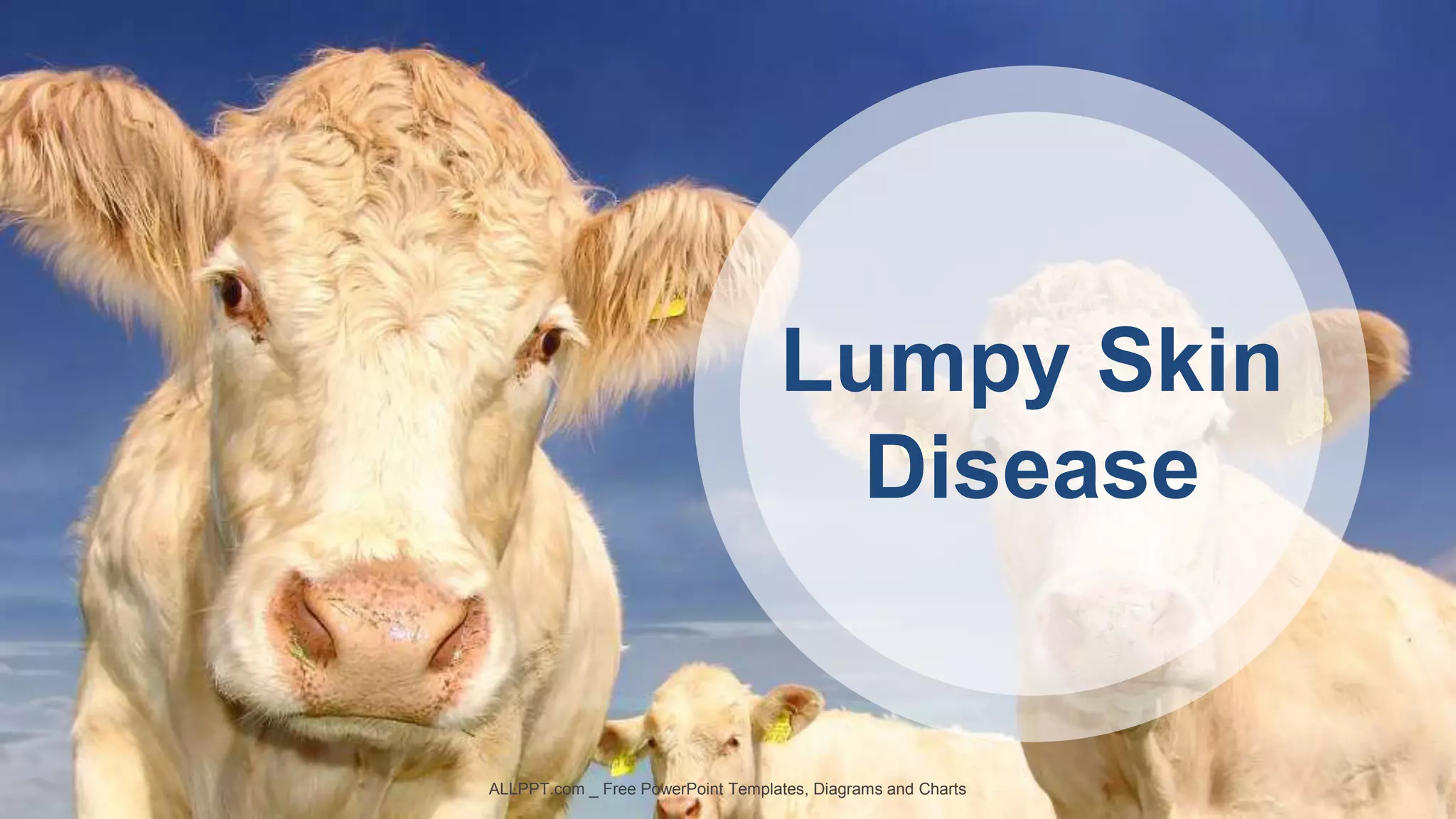
Lumpy Skin
Disease
What is lumpy-skin disease (LSD)?
 Lumpy skin disease (LSD) is a pox viral disease of
cattle with a major socio-economic impact .
The disease is characterized by fever, multiple firm,
circumscribed skin nodules, and necrotic plaques in
the mucous membranes(chiefly of the upper
respiratory tract and oral cavity) and swelling of the
peripheral lymph nodes.
DEFINITION
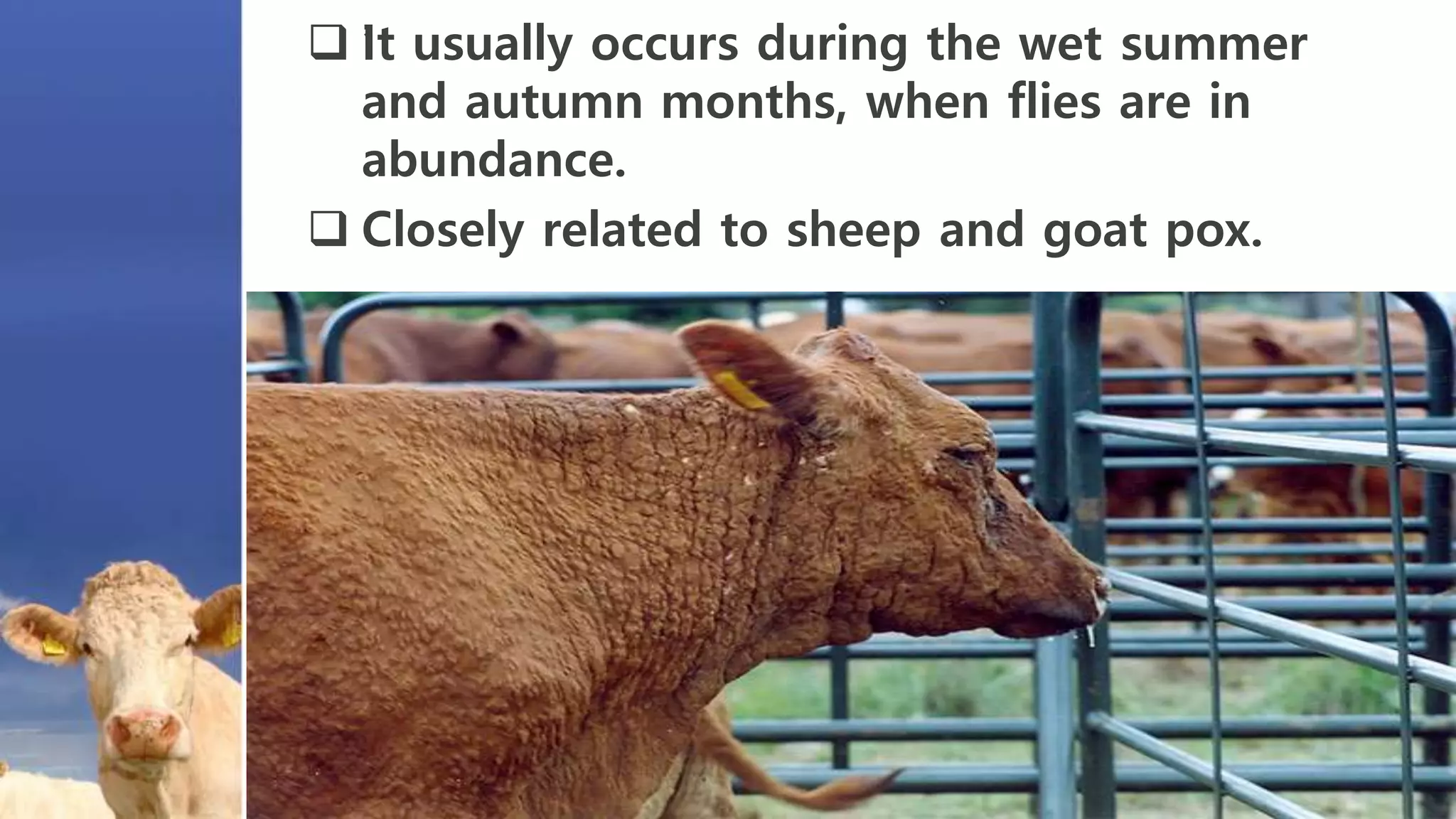
 ’It usually occurs during the wet summer
and autumn months, when flies are in
abundance.
 Closely related to sheep and goat pox.
ECONOMIC IMPACT
Why is lumpy-skin disease so important?
 Up to 45% of your herd can get infected and the mortality
(death) rate may reach 10%.
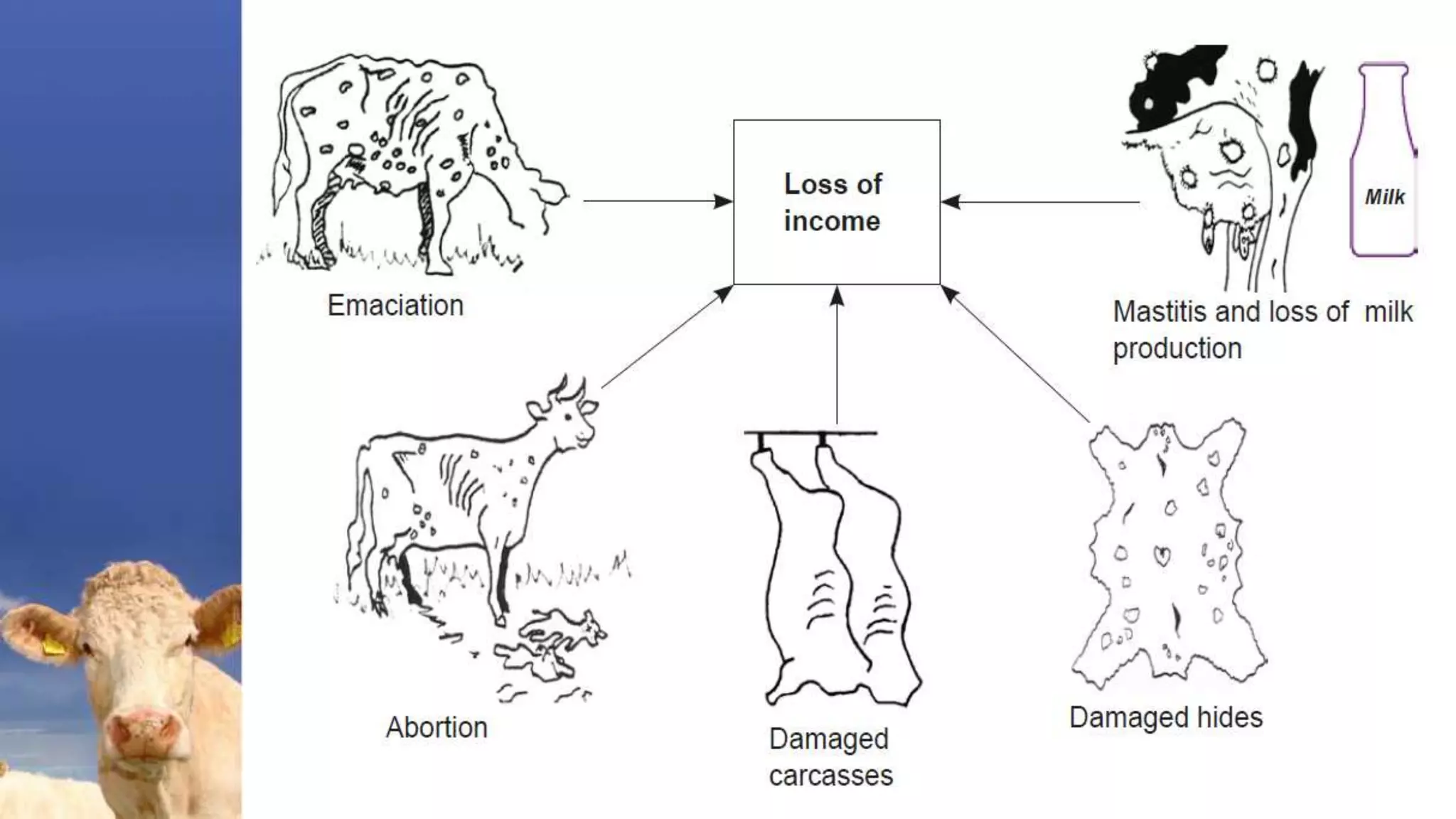
 The disease causes emaciation (loss of body condition
because of unwillingness to eat); temporary or permanent loss
of milk production, lowered or complete loss of fertility in
bulls and cows, abortion as wells permanent damage to hides
(skin).
TRANSMISSION
How do cattle become infected?
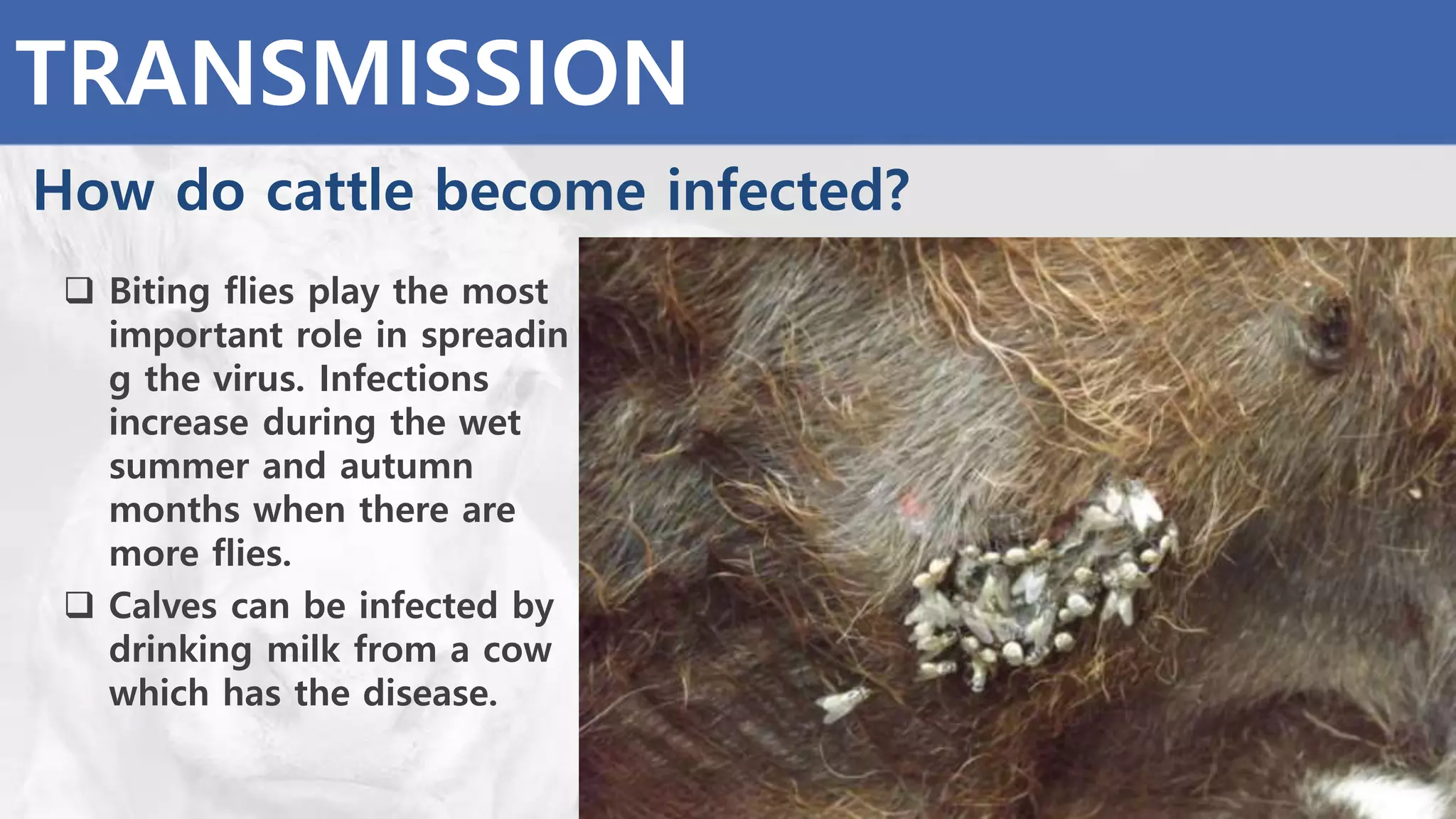
 Biting flies play the most
important role in spreadin
g the virus. Infections
increase during the wet
summer and autumn
months when there are
more flies.
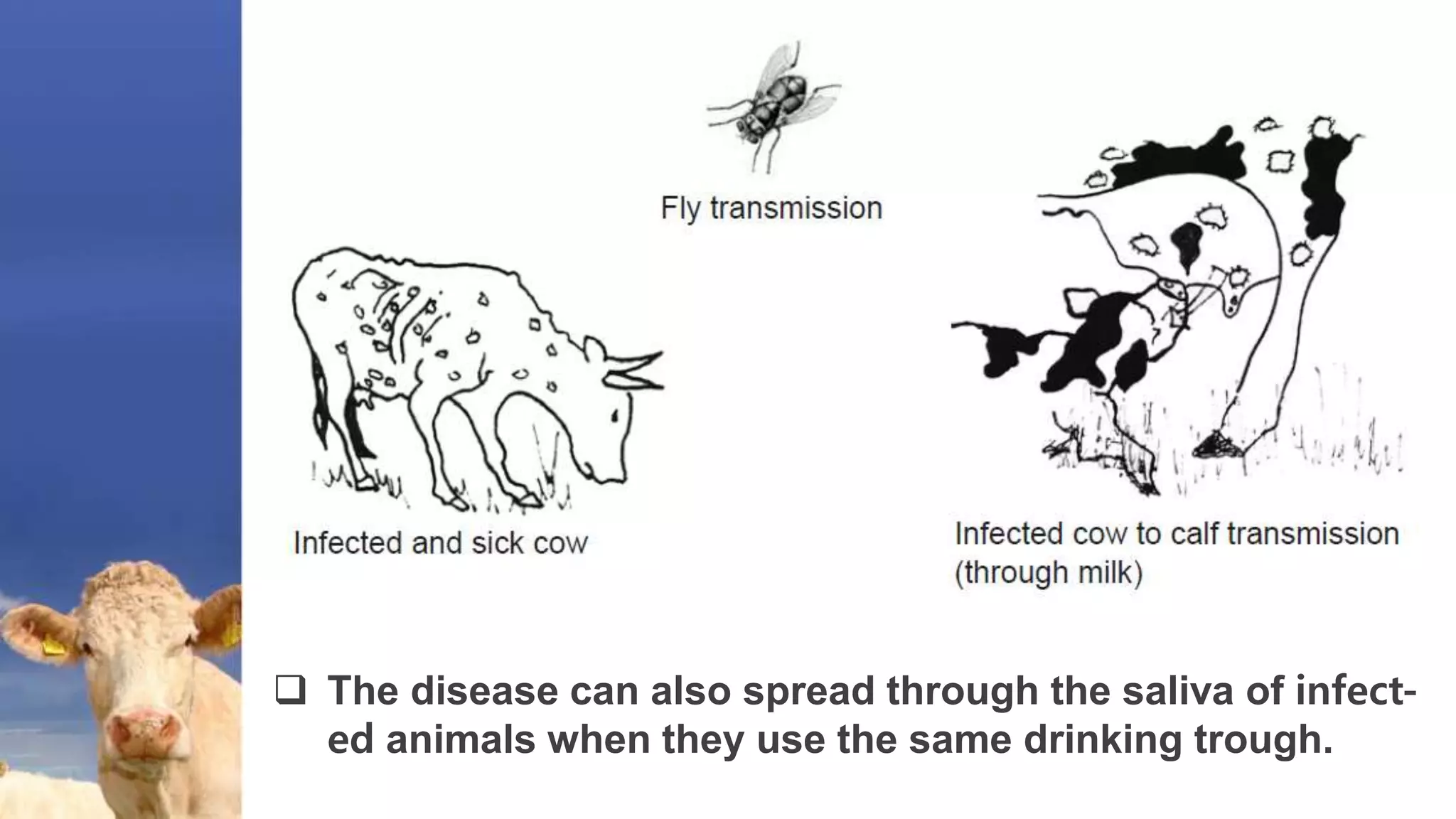
 Calves can be infected by
drinking milk from a cow
which has the disease.
 The disease can also spread through the saliva of infect-
ed animals when they use the same drinking trough.
.
SOURCES OF VIRUS
 Skin nodules, scabs and crusts contain relatively high amounts of
LSDV. Virus can be isolated from this material for up to 35 days
and likely for longer.
 LSDV can be isolated from saliva, ocular and nasal discharge.
 LSDV is found in the blood (viraemia) intermittently from
approximately 7 to 21 days post-infection at lower levels than
present in skin nodules.
 Shedding in semen may be prolonged; LSDV has been isolated
from the semen of an experimentally infected bull 42 days post-
inoculation.
 There has been one reported of placental transmission of LSD.
 LSD does not cause chronic disease.
DIAGNOSIS AND DIFFERENTIAL DIAGNOSIS
Clinical signs
Any one or more of the following:
 ’Skin nodules and ulcers:
– can vary from a few to hundreds
– the size ranges from 0,5–5 cm
– they occur anywhere on the skin, including the nose, udder and
vulva in cows, the scrotum in bulls, as well as in the mouth (the gums)
 ’Legs which become swollen and develop sores.
 ’Enlarged superficial lymph nodes.
 ’Pneumonia/coughing as a result of secondary infection of the
respiratory tract(the windpipe) and lungs.
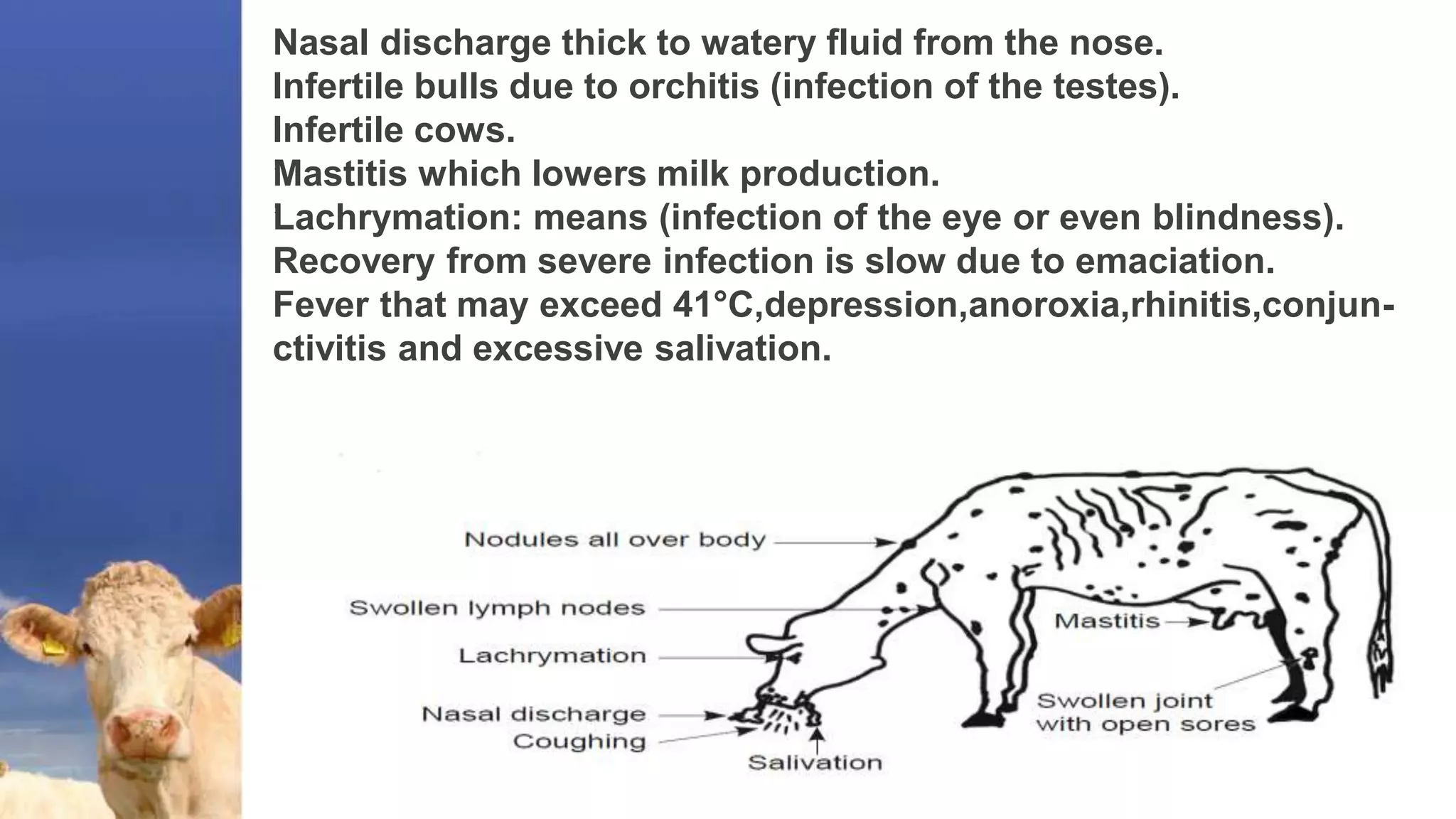
Nasal discharge thick to watery fluid from the nose.
Infertile bulls due to orchitis (infection of the testes).
’Infertile cows.
’Mastitis which lowers milk production.
’Lachrymation: means (infection of the eye or even blindness).
Recovery from severe infection is slow due to emaciation.
Fever that may exceed 41°C,depression,anoroxia,rhinitis,conjun-
ctivitis and excessive salivation.
’.
DIFFERENTIAL DIAGNOSIS
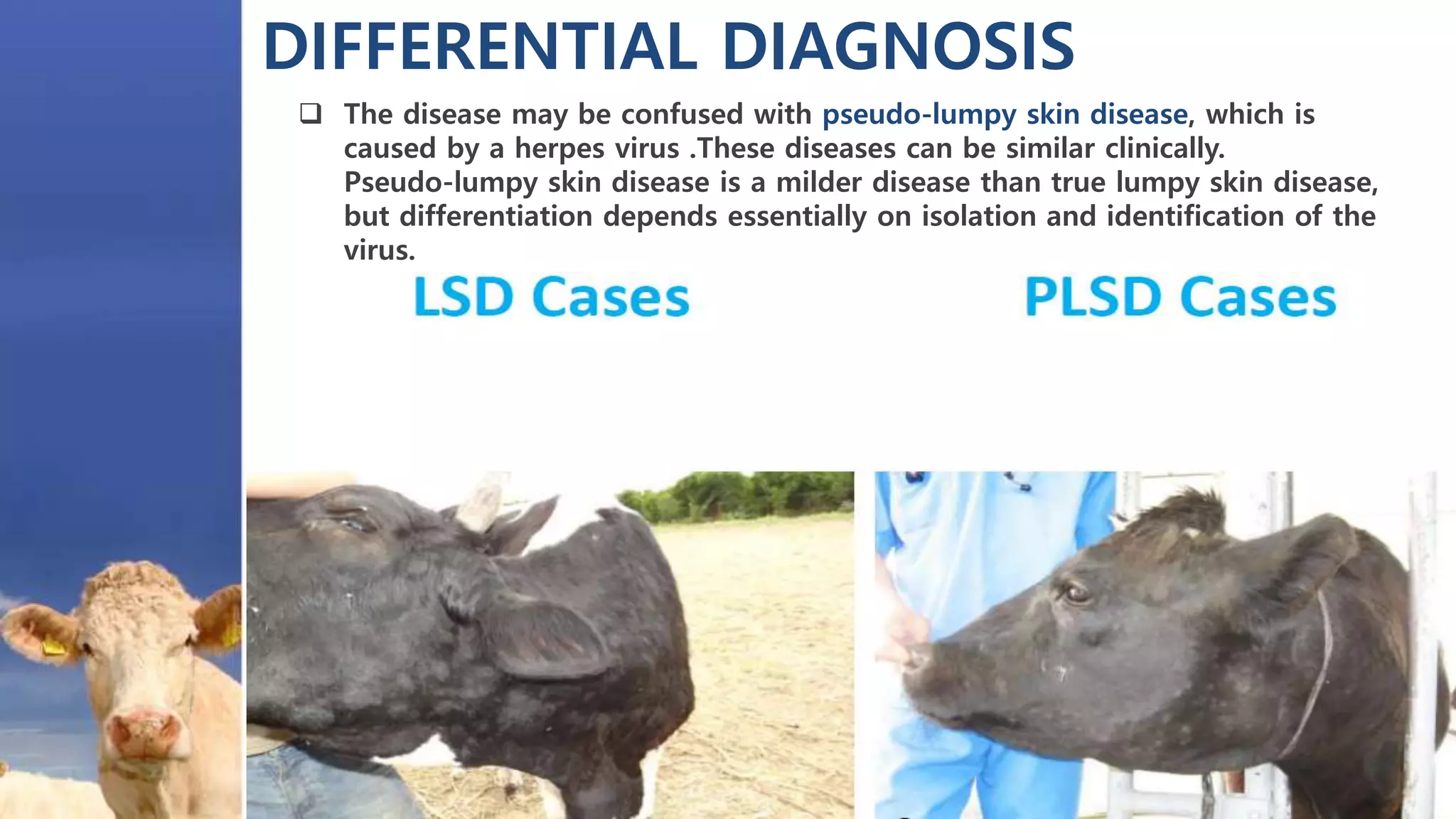
 The disease may be confused with pseudo-lumpy skin disease, which is
caused by a herpes virus .These diseases can be similar clinically.
Pseudo-lumpy skin disease is a milder disease than true lumpy skin disease,
but differentiation depends essentially on isolation and identification of the
virus.
 Subcutaneous or intradermal inoculation of cattle with LSDV results in the
development of a localized swelling at the site of inoculation after 4 to 7 days
and enlargement of the regional lymph nodes while generalized eruption of skin
nodules usually occurs 7 to 19 days after inoculation.
Viral replication in pericytes, endothelial cells and probably other cells in blood
vessel and lymph vessel walls causes vasculitis and lymphagitis in some vessels in
affected areas. In severe cases infarction may result.
 In experimentally infected cattle LSDV was demonstrated in saliva at least for
11 days after the development of fever, in semen for 42 days and in skin nodules
for 39 days. Viraemia occurred after the initial febrile reaction and persisted for
two weeks.
 Immunity after recovery from natural infection is life-long in most cattle; calves
of immune cows acquire maternal antibody and are resistant to clinical disease
for about six months.
PATHOGENESIS
LABORATORY DIAGNOSIS
Identification of the agent:
 Polymerase chain reaction (PCR) is the least expensive
and quickest method for detection of LSDV.
 Electron microscopy can be used to identify the classic
poxvirus virion but cannot differentiate to genus or
species level.
TREATMENT AND PREVENTION
How is LSD treated?
There is NO TREATMENT for lumpy-skin disease.
Nonspecific treatment (antibiotics, anti-inflammatory drugs and vitamin
injections) is usually directed at treating the secondary bacterial infections,
inflammation and fever, and improving the appetite of the animal.
How can you prevent lumpy-skin disease in your herd?
Prevention is the cheapest and best method of control of the disease. If
your animals are protected, you will not suffer any production or financial
losses as a result of the ill effects of the disease.
VACCINATION (THE BEST)
The attenuated Neethling strain vaccine is a product that contains a
weakened LSD virus When this vaccine is administered the animal will
develop protective antibodies.
All cattle should be vaccinated annually (once a year), and preferably
before the summer rains to ensure good protection.
Calves which are under 6 months old and were born to cows which
have been vaccinated or had the disease , do not need to be
vaccinated. However, as soon as they are 6 months old, they have to
be vaccinated annually.
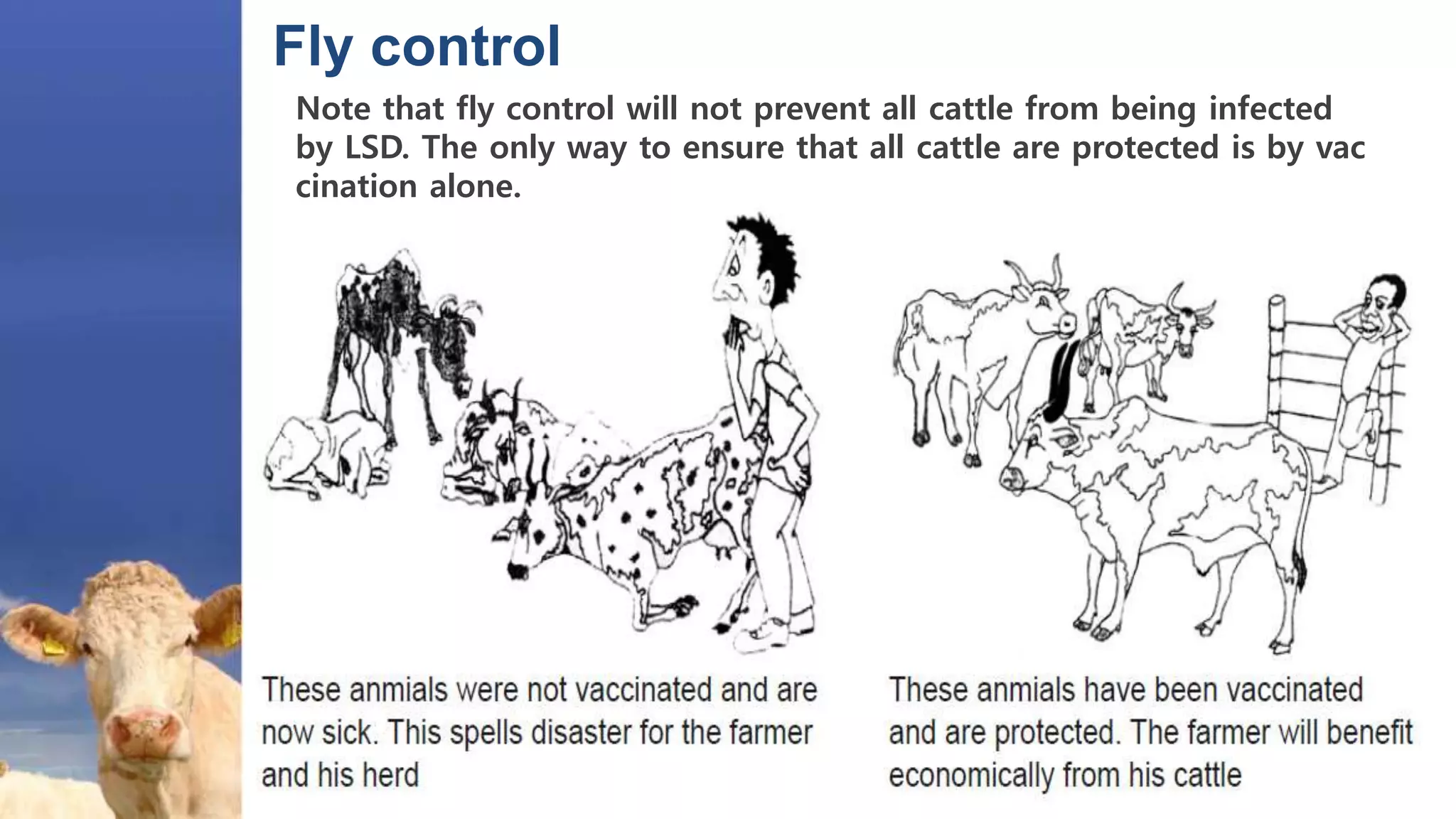
Fly control
Note that fly control will not prevent all cattle from being infected
by LSD. The only way to ensure that all cattle are protected is by vac
cination alone.
REFERENCES AND RESOURCES
Lumpy Skin Disease Photo Albumhj.pptx ENTER HERE ^_^
http://jvi.asm.org/content/75/15/7122.short
https://www.epizone-eu.net/en/Home/show/Lumpy-skin-disease-1.htm
https://www.cabdirect.org/cabdirect/abstract/20103088905
http://reproductive-immunology.imedpub.com/lumpy-skin-disease.php?aid=17596
https://www.farmersweekly.co.za/farm-basics/how-to-livestock/what-is-lumpy-skin-dise
ase/
https://www.researchgate.net/publication/303028800_Serum_Biochemistry_of_Lumpy_S
kin_Disease_Virus-Infected_Cattle
https://link.springer.com/chapter/10.1007/978-3-662-39771-8_3
https://www.merckvetmanual.com/integumentary-system/pox-diseases/lumpy-skin-dis
ease
http://www.kalro.org:8080/repository/handle/0/6286
Thank you

Lumpy skin disease- ppt file

  • 1.
    ALLPPT.com _ FreePowerPoint Templates, Diagrams and Charts Lumpy Skin Disease
  • 2.
    What is lumpy-skindisease (LSD)?  Lumpy skin disease (LSD) is a pox viral disease of cattle with a major socio-economic impact . The disease is characterized by fever, multiple firm, circumscribed skin nodules, and necrotic plaques in the mucous membranes(chiefly of the upper respiratory tract and oral cavity) and swelling of the peripheral lymph nodes. DEFINITION
  • 3.
     ’It usuallyoccurs during the wet summer and autumn months, when flies are in abundance.  Closely related to sheep and goat pox.
  • 4.
    ECONOMIC IMPACT Why islumpy-skin disease so important?  Up to 45% of your herd can get infected and the mortality (death) rate may reach 10%.  The disease causes emaciation (loss of body condition because of unwillingness to eat); temporary or permanent loss of milk production, lowered or complete loss of fertility in bulls and cows, abortion as wells permanent damage to hides (skin).
  • 6.
    TRANSMISSION How do cattlebecome infected?  Biting flies play the most important role in spreadin g the virus. Infections increase during the wet summer and autumn months when there are more flies.  Calves can be infected by drinking milk from a cow which has the disease.
  • 7.
     The diseasecan also spread through the saliva of infect- ed animals when they use the same drinking trough. .
  • 8.
    SOURCES OF VIRUS Skin nodules, scabs and crusts contain relatively high amounts of LSDV. Virus can be isolated from this material for up to 35 days and likely for longer.  LSDV can be isolated from saliva, ocular and nasal discharge.  LSDV is found in the blood (viraemia) intermittently from approximately 7 to 21 days post-infection at lower levels than present in skin nodules.  Shedding in semen may be prolonged; LSDV has been isolated from the semen of an experimentally infected bull 42 days post- inoculation.  There has been one reported of placental transmission of LSD.  LSD does not cause chronic disease.
  • 9.
    DIAGNOSIS AND DIFFERENTIALDIAGNOSIS Clinical signs Any one or more of the following:  ’Skin nodules and ulcers: – can vary from a few to hundreds – the size ranges from 0,5–5 cm – they occur anywhere on the skin, including the nose, udder and vulva in cows, the scrotum in bulls, as well as in the mouth (the gums)  ’Legs which become swollen and develop sores.  ’Enlarged superficial lymph nodes.  ’Pneumonia/coughing as a result of secondary infection of the respiratory tract(the windpipe) and lungs.
  • 10.
    Nasal discharge thickto watery fluid from the nose. Infertile bulls due to orchitis (infection of the testes). ’Infertile cows. ’Mastitis which lowers milk production. ’Lachrymation: means (infection of the eye or even blindness). Recovery from severe infection is slow due to emaciation. Fever that may exceed 41°C,depression,anoroxia,rhinitis,conjun- ctivitis and excessive salivation. ’.
  • 11.
    DIFFERENTIAL DIAGNOSIS  Thedisease may be confused with pseudo-lumpy skin disease, which is caused by a herpes virus .These diseases can be similar clinically. Pseudo-lumpy skin disease is a milder disease than true lumpy skin disease, but differentiation depends essentially on isolation and identification of the virus.
  • 12.
     Subcutaneous orintradermal inoculation of cattle with LSDV results in the development of a localized swelling at the site of inoculation after 4 to 7 days and enlargement of the regional lymph nodes while generalized eruption of skin nodules usually occurs 7 to 19 days after inoculation. Viral replication in pericytes, endothelial cells and probably other cells in blood vessel and lymph vessel walls causes vasculitis and lymphagitis in some vessels in affected areas. In severe cases infarction may result.  In experimentally infected cattle LSDV was demonstrated in saliva at least for 11 days after the development of fever, in semen for 42 days and in skin nodules for 39 days. Viraemia occurred after the initial febrile reaction and persisted for two weeks.  Immunity after recovery from natural infection is life-long in most cattle; calves of immune cows acquire maternal antibody and are resistant to clinical disease for about six months. PATHOGENESIS
  • 13.
    LABORATORY DIAGNOSIS Identification ofthe agent:  Polymerase chain reaction (PCR) is the least expensive and quickest method for detection of LSDV.  Electron microscopy can be used to identify the classic poxvirus virion but cannot differentiate to genus or species level.
  • 14.
    TREATMENT AND PREVENTION Howis LSD treated? There is NO TREATMENT for lumpy-skin disease. Nonspecific treatment (antibiotics, anti-inflammatory drugs and vitamin injections) is usually directed at treating the secondary bacterial infections, inflammation and fever, and improving the appetite of the animal. How can you prevent lumpy-skin disease in your herd? Prevention is the cheapest and best method of control of the disease. If your animals are protected, you will not suffer any production or financial losses as a result of the ill effects of the disease.
  • 15.
    VACCINATION (THE BEST) Theattenuated Neethling strain vaccine is a product that contains a weakened LSD virus When this vaccine is administered the animal will develop protective antibodies. All cattle should be vaccinated annually (once a year), and preferably before the summer rains to ensure good protection. Calves which are under 6 months old and were born to cows which have been vaccinated or had the disease , do not need to be vaccinated. However, as soon as they are 6 months old, they have to be vaccinated annually.
  • 16.
    Fly control Note thatfly control will not prevent all cattle from being infected by LSD. The only way to ensure that all cattle are protected is by vac cination alone.
  • 17.
    REFERENCES AND RESOURCES LumpySkin Disease Photo Albumhj.pptx ENTER HERE ^_^ http://jvi.asm.org/content/75/15/7122.short https://www.epizone-eu.net/en/Home/show/Lumpy-skin-disease-1.htm https://www.cabdirect.org/cabdirect/abstract/20103088905 http://reproductive-immunology.imedpub.com/lumpy-skin-disease.php?aid=17596 https://www.farmersweekly.co.za/farm-basics/how-to-livestock/what-is-lumpy-skin-dise ase/ https://www.researchgate.net/publication/303028800_Serum_Biochemistry_of_Lumpy_S kin_Disease_Virus-Infected_Cattle https://link.springer.com/chapter/10.1007/978-3-662-39771-8_3 https://www.merckvetmanual.com/integumentary-system/pox-diseases/lumpy-skin-dis ease http://www.kalro.org:8080/repository/handle/0/6286
  • 18.