NATIONAL CANCER
CONTROL PROGRAM
PRAMOD KUMAR
CANCER
Cancer refers to a class of
disease in which a cell or a
group of cell divide and
replicate uncontrollably,
intrude into adjacent cells
and tissues and ultimately
spread to other parts of
the body than the location
at which they arose.
BURDEN OF CANCER:
• According to IARC, there were 10.9 million new cases,
6.7 million deaths, and 24.6 million persons living
with cancer in the year 2002.
• Lung cancer is the most common cancer worldwide
followed by the breast cancer.
• Cancer has became one of the ten leading causes of
death in India. It is estimated that there are nearly 2-
2.5 million cancer cases at any given point of time.
Over 8-9 lakh new cases and 4 lakh deaths occur
annually due to cancer.
Cont..
• Cancer of oral cavity and lungs in male and
cervix in females account for over 50% of all
cancer deaths in India.
• WHO has estimated that 91 % of oral cancer in
south-east Asia are directly attributing to the
use of tobacco and this is the leading cause of
oral cavity and lung cancer in India.
Report of National Cancer Registries
and Atlas of Cancer in India
• There are 97.8 to 121.9 cancer cases per 1,00,000
population in urban males.
• There are 92.2 to 135.3 cancer cases per 1,00,000
population in urban females.
• There are 46.2 cases of cancer per 1,00,000
population in rural males.
Cont..
• There are 57.7 cancer cases per 1,00,000 population
in rural females.
• One in about 15 men and one in about 12 women in
the urban areas could develop cancer in their
lifetime.
• Incidence rate of esophageal cancer is women of
Bangalore is one of the highest (8.3 per 1,00,000) in
the world.
• Cancer of tongue in males in Bhopal (8.8 per
1,00,000) is the highest in the world.
Cont..
• Cancer of stomach is one of the main cancer in
males in southern registries.
• Gall bladder cancer in Delhi women is one of the
highest ( 8.9 per 1,00,000) in the world.
• 75-80 % of the patients are in advanced stage of
disease at the time of first attendance.
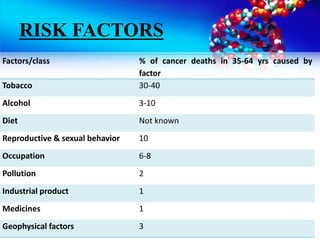
RISK FACTORS
Factors/class % of cancer deaths in 35-64 yrs caused by
factor
Tobacco 30-40
Alcohol 3-10
Diet Not known
Reproductive & sexual behavior 10
Occupation 6-8
Pollution 2
Industrial product 1
Medicines 1
Geophysical factors 3
OTHER CAUSATIVE FACTORS;
• Infection: Approximately 20 % of the cancers among
men and women in developing countries is
attributable for infectious agents as opposed to 9%
in developed countries.
• Tobacco : It is the most important identified cause of
cancer and is responsible for about 40 to 50 % of
cancers.
• Deit : It is responsible for 10-70 % of cancers. In India
dietary habits may be responsible for about 10 to 20
% of cancers.
Cont..
• Pesticides: Increase incidence of cancer in Punjab
particularly Malwa region a cotton belt where at
least 15 different pesticides sprays which are
acephate, dichloropropene, diurene, flucometaron,
pendimethalin, tribufos.
- Due to high cost of cancer treatment in state
people go to nearby states such as Rajasthan
and Delhi.
- As 70-199 patients going to Bikaner daily
using a particular trained ferried from
Bhatinda to Bikaner locally named as
“cancer train” .
Cont..
• Education, socioeconomic status and health facilities :
Lack of knowledge and many beliefs systems such as
cancers are incurable leading to late presentation and
poor treatment compliance.
- Lack of trained oncologist, supporting staff, family
dislocation for cancer treatment to a new city, cost
of medical burden make the compliance to
treatment poor.
- Comorbidity such as TB, Malaria, Measels,
causing immunocompromised states lead to poor
tolerance to chemotherapy
NATIONAL CANCER CONTROL
PROGRAM
INRODUCTION:
The cancer control program was
started in 1975-76 as a central
sector project. It was renamed as
the National Cancer Control
Program (NCCP) in 1985 and
revised in 2004.
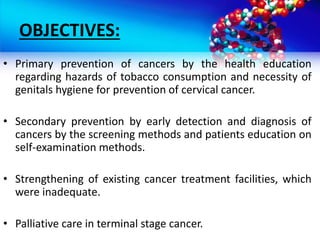
OBJECTIVES:
• Primary prevention of cancers by the health education
regarding hazards of tobacco consumption and necessity of
genitals hygiene for prevention of cervical cancer.
• Secondary prevention by early detection and diagnosis of
cancers by the screening methods and patients education on
self-examination methods.
• Strengthening of existing cancer treatment facilities, which
were inadequate.
• Palliative care in terminal stage cancer.
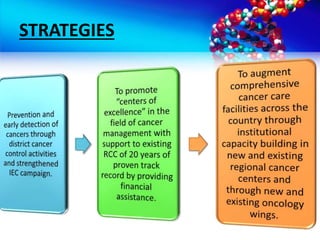
STRATEGIES
Cont..
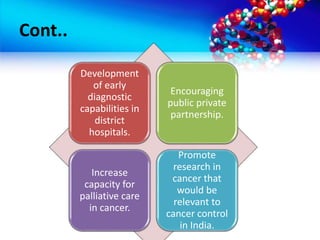
Development
of early
diagnostic
capabilities in
district
hospitals.
Encouraging
public private
partnership.
Increase
capacity for
palliative care
in cancer.
Promote
research in
cancer that
would be
relevant to
cancer control
in India.
Cont..
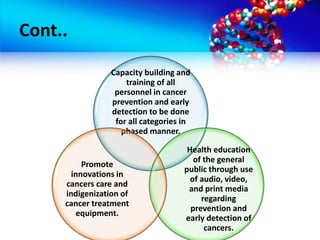
Capacity building and
training of all
personnel in cancer
prevention and early
detection to be done
for all categories in
phased manner.
Health education
of the general
public through use
of audio, video,
and print media
regarding
prevention and
early detection of
cancers.
Promote
innovations in
cancers care and
indigenization of
cancer treatment
equipment.
ORGANIZATIONAL STRUCTURE
It is at two levels- central government and state
government with linkage through the central
council of health. It is suggested the respective
executive committees should be assisted by a
newly constituted National Cancer Control Board
at the central level and state level by the
corresponding Cancer Control is an oncologist
who head the cancer control cell at the
Directorate General of Health Services.
Cont..
NATIONAL CANCER CONTROL PROGRAM MANAGEMTNT CHART
Chief Project Director (DG)
Vice Project Director (Addl. DG)
Steering Committee
Project director
Administrative division Technical devision
Planning coordination non-tech Tech MIS Health Dev. Of service GEA
- Undersecretary - Epidemiologist
- Consultant - Bio- statistician
- Section officer - Computer program
- Assistant - Sr. Program assistant
- UDC - Health educator
- LDC - Statistical assistant
- Computer
- UDC
- LDC
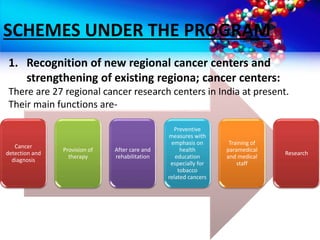
SCHEMES UNDER THE PROGRAM
Cancer
detection and
diagnosis
Provision of
therapy
After care and
rehabilitation
Preventive
measures with
emphasis on
health
education
especially for
tobacco
related cancers
Training of
paramedical
and medical
staff
Research
1. Recognition of new regional cancer centers and
strengthening of existing regiona; cancer centers:
There are 27 regional cancer research centers in India at present.
Their main functions are-
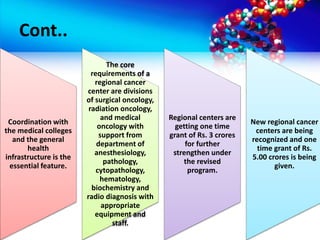
Cont..
Coordination with
the medical colleges
and the general
health
infrastructure is the
essential feature.
The core
requirements of a
regional cancer
center are divisions
of surgical oncology,
radiation oncology,
and medical
oncology with
support from
department of
anesthesiology,
pathology,
cytopathology,
hematology,
biochemistry and
radio diagnosis with
appropriate
equipment and
staff.
Regional centers are
getting one time
grant of Rs. 3 crores
for further
strengthen under
the revised
program.
New regional cancer
centers are being
recognized and one
time grant of Rs.
5.00 crores is being
given.
Cont..
Cobalt Therapy Installation:
• One crore for non-government and 1.5 crore
for government institution per unit for cobalt
therapy unit and other radiotherapy
equipment have been brought under this
scheme.
• Financial assistance of Rs. 30 lacs for
mammography unit is also available to the
institutions having cobalt unit.
Cont..
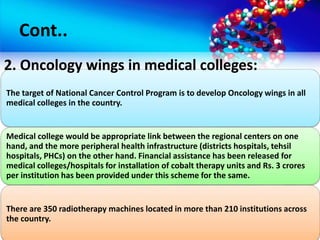
The target of National Cancer Control Program is to develop Oncology wings in all
medical colleges in the country.
Medical college would be appropriate link between the regional centers on one
hand, and the more peripheral health infrastructure (districts hospitals, tehsil
hospitals, PHCs) on the other hand. Financial assistance has been released for
medical colleges/hospitals for installation of cobalt therapy units and Rs. 3 crores
per institution has been provided under this scheme for the same.
There are 350 radiotherapy machines located in more than 210 institutions across
the country.
2. Oncology wings in medical colleges:
Cont..
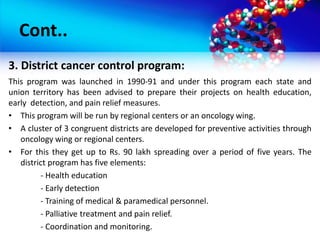
This program was launched in 1990-91 and under this program each state and
union territory has been advised to prepare their projects on health education,
early detection, and pain relief measures.
• This program will be run by regional centers or an oncology wing.
• A cluster of 3 congruent districts are developed for preventive activities through
oncology wing or regional centers.
• For this they get up to Rs. 90 lakh spreading over a period of five years. The
district program has five elements:
- Health education
- Early detection
- Training of medical & paramedical personnel.
- Palliative treatment and pain relief.
- Coordination and monitoring.
3. District cancer control program:
Cont..
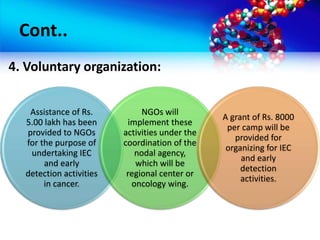
Assistance of Rs.
5.00 lakh has been
provided to NGOs
for the purpose of
undertaking IEC
and early
detection activities
in cancer.
NGOs will
implement these
activities under the
coordination of the
nodal agency,
which will be
regional center or
oncology wing.
A grant of Rs. 8000
per camp will be
provided for
organizing for IEC
and early
detection
activities.
4. Voluntary organization:
IMPLEMENTATION
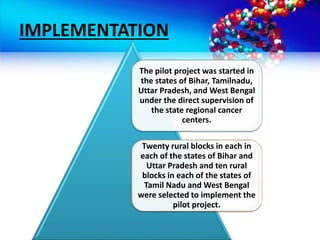
The pilot project was started in
the states of Bihar, Tamilnadu,
Uttar Pradesh, and West Bengal
under the direct supervision of
the state regional cancer
centers.
Twenty rural blocks in each in
each of the states of Bihar and
Uttar Pradesh and ten rural
blocks in each of the states of
Tamil Nadu and West Bengal
were selected to implement the
pilot project.
Cont..
For each block 20 female non
communicable disease (NCD)
workers have been selected
and these workers play a
pivotal role in the success of
the project.
For the selected NCD workers
2-3 days of intensive training
programs were organized in
small groups by the
respective supervising
regional cancer centers.
Cont..
For every 10blocks, 5
medical officers and
1 consultant doctor
have been recruited.
The responsibilities
were to guide and
supervise the NCD
workers. They also
scrutinize the filled
up forms to ensure
completeness of the
forms and good
quality of data.
The regional cancer
centers have set up
early cancer
detection clinics in
the community
either in their own
peripheral
extensions or in the
primary health
centres of the area
where the project is
running.
This program is now
comes under NRHM.
NEW INITIATIVES:
India has become the
member of
International Agency
for Research on Cancer
(IARC).
Onconet- India:
Telemedicine project to
connect 27 RCCs and
each RCC with 4 to 5
peripheral centers is
being operationalized
and C-DAC Trivandrum
is also involved.
Training of
cytopathologist and
cytotechnicians in the
quality assurance in
pap smear technology.
Cont..
Participation in health
Melas and
distribution of health
education material.
Postage stamp depicting “Breast
Self-Examination” was brought out
by the department of posts on
National Cancer Awareness day.
National cancer Awareness day is
celebrated on the birth anniversary
of Nobel Laureate Madam Curie, 7th
Nov.
Cont..
Telecast of a health
magazine ‘kalyani’ in the
current year with cancer
and anti tobacco items
under the agreement with
Prasar Bharti & MOHFW.
Broadcast of health
education audio material
developed by CNCI,
Kolkatta, through FM
radio.
RESEARCH ARTICLE
A survey of the educational environment for
oncologists as perceived by surgical oncology
professionals in India
• Background: The current educational environment
may need enhancement to tackle the rising cancer
burden in India. The aim of this study was to
conduct a survey of Surgical Oncologists to identify
their perceptions of the current state of Oncology
education in India.
Cont..
• Methods: An Institutional Review Board
approved questionnaire was developed to
target the audience of the 2009 annual
meeting of the Indian Association of Surgical
Oncology in India. The survey collected
demographic information and asked
respondents to provide their opinions about
Oncology education in India.
Cont..
• Results: A total of 205 out of 408 attendee’s
participated in the survey with a 42.7% response
rate. The majority of respondents felt that
Oncology education was poor to fair during
medical school (75%), residency (56%) and for
practicing physicians (71%). The majority of
participants also felt that the quality of
continuing medical education was poor and that
minimal emphasis was placed on evidence based
medicine.
Cont..
• Conclusions: The results of our survey
demonstrate that the majority of respondents
feel that the current educational environment
for Oncology in India should be enhanced. The
study identified perceptions of several gaps
and needs, which can be the targets for
implementing measures to enhance the
training of Oncology professionals.
Cancer control program

Cancer control program

  • 1.
  • 2.
    CANCER Cancer refers toa class of disease in which a cell or a group of cell divide and replicate uncontrollably, intrude into adjacent cells and tissues and ultimately spread to other parts of the body than the location at which they arose.
  • 3.
    BURDEN OF CANCER: •According to IARC, there were 10.9 million new cases, 6.7 million deaths, and 24.6 million persons living with cancer in the year 2002. • Lung cancer is the most common cancer worldwide followed by the breast cancer. • Cancer has became one of the ten leading causes of death in India. It is estimated that there are nearly 2- 2.5 million cancer cases at any given point of time. Over 8-9 lakh new cases and 4 lakh deaths occur annually due to cancer.
  • 4.
    Cont.. • Cancer oforal cavity and lungs in male and cervix in females account for over 50% of all cancer deaths in India. • WHO has estimated that 91 % of oral cancer in south-east Asia are directly attributing to the use of tobacco and this is the leading cause of oral cavity and lung cancer in India.
  • 5.
    Report of NationalCancer Registries and Atlas of Cancer in India • There are 97.8 to 121.9 cancer cases per 1,00,000 population in urban males. • There are 92.2 to 135.3 cancer cases per 1,00,000 population in urban females. • There are 46.2 cases of cancer per 1,00,000 population in rural males.
  • 6.
    Cont.. • There are57.7 cancer cases per 1,00,000 population in rural females. • One in about 15 men and one in about 12 women in the urban areas could develop cancer in their lifetime. • Incidence rate of esophageal cancer is women of Bangalore is one of the highest (8.3 per 1,00,000) in the world. • Cancer of tongue in males in Bhopal (8.8 per 1,00,000) is the highest in the world.
  • 7.
    Cont.. • Cancer ofstomach is one of the main cancer in males in southern registries. • Gall bladder cancer in Delhi women is one of the highest ( 8.9 per 1,00,000) in the world. • 75-80 % of the patients are in advanced stage of disease at the time of first attendance.
  • 8.
    RISK FACTORS Factors/class %of cancer deaths in 35-64 yrs caused by factor Tobacco 30-40 Alcohol 3-10 Diet Not known Reproductive & sexual behavior 10 Occupation 6-8 Pollution 2 Industrial product 1 Medicines 1 Geophysical factors 3
  • 9.
    OTHER CAUSATIVE FACTORS; •Infection: Approximately 20 % of the cancers among men and women in developing countries is attributable for infectious agents as opposed to 9% in developed countries. • Tobacco : It is the most important identified cause of cancer and is responsible for about 40 to 50 % of cancers. • Deit : It is responsible for 10-70 % of cancers. In India dietary habits may be responsible for about 10 to 20 % of cancers.
  • 10.
    Cont.. • Pesticides: Increaseincidence of cancer in Punjab particularly Malwa region a cotton belt where at least 15 different pesticides sprays which are acephate, dichloropropene, diurene, flucometaron, pendimethalin, tribufos. - Due to high cost of cancer treatment in state people go to nearby states such as Rajasthan and Delhi. - As 70-199 patients going to Bikaner daily using a particular trained ferried from Bhatinda to Bikaner locally named as “cancer train” .
  • 11.
    Cont.. • Education, socioeconomicstatus and health facilities : Lack of knowledge and many beliefs systems such as cancers are incurable leading to late presentation and poor treatment compliance. - Lack of trained oncologist, supporting staff, family dislocation for cancer treatment to a new city, cost of medical burden make the compliance to treatment poor. - Comorbidity such as TB, Malaria, Measels, causing immunocompromised states lead to poor tolerance to chemotherapy
  • 12.
    NATIONAL CANCER CONTROL PROGRAM INRODUCTION: Thecancer control program was started in 1975-76 as a central sector project. It was renamed as the National Cancer Control Program (NCCP) in 1985 and revised in 2004.
  • 13.
    OBJECTIVES: • Primary preventionof cancers by the health education regarding hazards of tobacco consumption and necessity of genitals hygiene for prevention of cervical cancer. • Secondary prevention by early detection and diagnosis of cancers by the screening methods and patients education on self-examination methods. • Strengthening of existing cancer treatment facilities, which were inadequate. • Palliative care in terminal stage cancer.
  • 14.
  • 15.
    Cont.. Development of early diagnostic capabilities in district hospitals. Encouraging publicprivate partnership. Increase capacity for palliative care in cancer. Promote research in cancer that would be relevant to cancer control in India.
  • 16.
    Cont.. Capacity building and trainingof all personnel in cancer prevention and early detection to be done for all categories in phased manner. Health education of the general public through use of audio, video, and print media regarding prevention and early detection of cancers. Promote innovations in cancers care and indigenization of cancer treatment equipment.
  • 17.
    ORGANIZATIONAL STRUCTURE It isat two levels- central government and state government with linkage through the central council of health. It is suggested the respective executive committees should be assisted by a newly constituted National Cancer Control Board at the central level and state level by the corresponding Cancer Control is an oncologist who head the cancer control cell at the Directorate General of Health Services.
  • 18.
    Cont.. NATIONAL CANCER CONTROLPROGRAM MANAGEMTNT CHART Chief Project Director (DG) Vice Project Director (Addl. DG) Steering Committee Project director Administrative division Technical devision Planning coordination non-tech Tech MIS Health Dev. Of service GEA - Undersecretary - Epidemiologist - Consultant - Bio- statistician - Section officer - Computer program - Assistant - Sr. Program assistant - UDC - Health educator - LDC - Statistical assistant - Computer - UDC - LDC
  • 19.
    SCHEMES UNDER THEPROGRAM Cancer detection and diagnosis Provision of therapy After care and rehabilitation Preventive measures with emphasis on health education especially for tobacco related cancers Training of paramedical and medical staff Research 1. Recognition of new regional cancer centers and strengthening of existing regiona; cancer centers: There are 27 regional cancer research centers in India at present. Their main functions are-
  • 20.
    Cont.. Coordination with the medicalcolleges and the general health infrastructure is the essential feature. The core requirements of a regional cancer center are divisions of surgical oncology, radiation oncology, and medical oncology with support from department of anesthesiology, pathology, cytopathology, hematology, biochemistry and radio diagnosis with appropriate equipment and staff. Regional centers are getting one time grant of Rs. 3 crores for further strengthen under the revised program. New regional cancer centers are being recognized and one time grant of Rs. 5.00 crores is being given.
  • 21.
    Cont.. Cobalt Therapy Installation: •One crore for non-government and 1.5 crore for government institution per unit for cobalt therapy unit and other radiotherapy equipment have been brought under this scheme. • Financial assistance of Rs. 30 lacs for mammography unit is also available to the institutions having cobalt unit.
  • 22.
    Cont.. The target ofNational Cancer Control Program is to develop Oncology wings in all medical colleges in the country. Medical college would be appropriate link between the regional centers on one hand, and the more peripheral health infrastructure (districts hospitals, tehsil hospitals, PHCs) on the other hand. Financial assistance has been released for medical colleges/hospitals for installation of cobalt therapy units and Rs. 3 crores per institution has been provided under this scheme for the same. There are 350 radiotherapy machines located in more than 210 institutions across the country. 2. Oncology wings in medical colleges:
  • 23.
    Cont.. This program waslaunched in 1990-91 and under this program each state and union territory has been advised to prepare their projects on health education, early detection, and pain relief measures. • This program will be run by regional centers or an oncology wing. • A cluster of 3 congruent districts are developed for preventive activities through oncology wing or regional centers. • For this they get up to Rs. 90 lakh spreading over a period of five years. The district program has five elements: - Health education - Early detection - Training of medical & paramedical personnel. - Palliative treatment and pain relief. - Coordination and monitoring. 3. District cancer control program:
  • 24.
    Cont.. Assistance of Rs. 5.00lakh has been provided to NGOs for the purpose of undertaking IEC and early detection activities in cancer. NGOs will implement these activities under the coordination of the nodal agency, which will be regional center or oncology wing. A grant of Rs. 8000 per camp will be provided for organizing for IEC and early detection activities. 4. Voluntary organization:
  • 25.
    IMPLEMENTATION The pilot projectwas started in the states of Bihar, Tamilnadu, Uttar Pradesh, and West Bengal under the direct supervision of the state regional cancer centers. Twenty rural blocks in each in each of the states of Bihar and Uttar Pradesh and ten rural blocks in each of the states of Tamil Nadu and West Bengal were selected to implement the pilot project.
  • 26.
    Cont.. For each block20 female non communicable disease (NCD) workers have been selected and these workers play a pivotal role in the success of the project. For the selected NCD workers 2-3 days of intensive training programs were organized in small groups by the respective supervising regional cancer centers.
  • 27.
    Cont.. For every 10blocks,5 medical officers and 1 consultant doctor have been recruited. The responsibilities were to guide and supervise the NCD workers. They also scrutinize the filled up forms to ensure completeness of the forms and good quality of data. The regional cancer centers have set up early cancer detection clinics in the community either in their own peripheral extensions or in the primary health centres of the area where the project is running. This program is now comes under NRHM.
  • 28.
    NEW INITIATIVES: India hasbecome the member of International Agency for Research on Cancer (IARC). Onconet- India: Telemedicine project to connect 27 RCCs and each RCC with 4 to 5 peripheral centers is being operationalized and C-DAC Trivandrum is also involved. Training of cytopathologist and cytotechnicians in the quality assurance in pap smear technology.
  • 29.
    Cont.. Participation in health Melasand distribution of health education material. Postage stamp depicting “Breast Self-Examination” was brought out by the department of posts on National Cancer Awareness day. National cancer Awareness day is celebrated on the birth anniversary of Nobel Laureate Madam Curie, 7th Nov.
  • 30.
    Cont.. Telecast of ahealth magazine ‘kalyani’ in the current year with cancer and anti tobacco items under the agreement with Prasar Bharti & MOHFW. Broadcast of health education audio material developed by CNCI, Kolkatta, through FM radio.
  • 31.
    RESEARCH ARTICLE A surveyof the educational environment for oncologists as perceived by surgical oncology professionals in India • Background: The current educational environment may need enhancement to tackle the rising cancer burden in India. The aim of this study was to conduct a survey of Surgical Oncologists to identify their perceptions of the current state of Oncology education in India.
  • 32.
    Cont.. • Methods: AnInstitutional Review Board approved questionnaire was developed to target the audience of the 2009 annual meeting of the Indian Association of Surgical Oncology in India. The survey collected demographic information and asked respondents to provide their opinions about Oncology education in India.
  • 33.
    Cont.. • Results: Atotal of 205 out of 408 attendee’s participated in the survey with a 42.7% response rate. The majority of respondents felt that Oncology education was poor to fair during medical school (75%), residency (56%) and for practicing physicians (71%). The majority of participants also felt that the quality of continuing medical education was poor and that minimal emphasis was placed on evidence based medicine.
  • 34.
    Cont.. • Conclusions: Theresults of our survey demonstrate that the majority of respondents feel that the current educational environment for Oncology in India should be enhanced. The study identified perceptions of several gaps and needs, which can be the targets for implementing measures to enhance the training of Oncology professionals.