PRESENTED BY
ARPAN HAJRA
4th YEAR,B.SC NURSING
SARVODAY COLLEGE OF NURSING
Sexually Transmitted Disease control programme activities as
per WHO estimates around 10% of all adults are infected with
curable STI (sexually transmitted infection) each year.
Department of NACO coordinates RTI and STD at all levels of
the health care free standardized STI/RTI services provided
through 1160 clinics situated at government health care facilities,
at district hospital level, and above.
These clinics named as "Suraksha Clinics" provided sexual and
reproductive health services.
• The sexually transmitted disease (STD) are a
group of communicable disease that are
transmitted pre predominantly by sexual contact
and caused by a wide range of bacterial, viral,
protozoal and fungal agents.
 The reliable on incidence and prevalence of
sexually transmitted disease are limited.
It is estimated by National AIDS control
organization that the annual incidence rate of STI
cases are occurring annually in the county.
 Approximately 5.6 million disability adjusted life
years were lost due to STI in India.
A National STD control program was started in
1946.
Focus:
on the health seeking behaviour of individuals with
STDs and on conducting social stigma.
 The national STD control program was made on
integral part of the national AIDS control program in
1992.
•Explain the epidemiological impact of sexually
transmitted disease.
•Discuss ways to reduce risk for STD.
•Examine how condoms can reduce risk for STD.
•Describe the clinical presentation of STD.
•Outline the management, complication and prevention of
STD.
1) CASE DETECTION
Case Detection is on essential part of any control program.
Screening
High priority is given to screening of special groups, pregnant women,
blood donors ,industrial workers, army ,police, refugees, convicts, restaurant
and hotel staff etc.
Cluster testing
Here the patients are asked two name other persons of the sex who more
in the same sociosexual environment.
2) case holding and treatment
There is tendency on a part of patients suffering from STD to disappear or
drop out before treatment is complete.
It consist of the administration of full therapeutic dose of
treatment to persons recently exposed to STD while a waiting the
result of lab test.
 4)personal prophylaxis
Contraceptives - mechanical barriers can be recommended for
personal prophylaxis against STD.
Vaccines- the development of vaccine for hepatitis B has raised
hope that the vaccine will be found for other STD.
5)HEALTH EDUCATION
• Health education is an integral part of STD control program.It is
help the individual alter behaviour in an effort to avoid STD.
Syndromic management is recommended by
National AIDS Control Organization (NACO) for case
management at the primary health care level the
effectiveness of syndromic management in Omen is
currently under debate, but it is recognize that
effectiveness of RTI (including STI) varies widely within
the country.
There are a few studies, in which it has been
found that the quality of STD case management especially,
STD counselling for prevention, in STD clinics in inadequate
and poor.
 PARTNER NOTIFICATION
Partner notification is seen a cornerstone of the
effective STI management but studies in India have shown
that this procedure is rarely discussed or initiated by
healthcare providers.
Aside straightening case management, the other
pillars of public health intervention for STI control are
implemented more particularly through out the country.
There has been a public sector syphilis screening
program for pregnant women since 1950s.
Nationally on 57% of women received antenatal care
in public sector an approximate 90000 women
development cervical cancer in India.
•Training of healthcare workers in both public and
private sector in comprehensive STD case
management.
•Development of appropriate laboratory services for
the diagnosis of STD.
•One of the major action was Strengthening the
existing facilities and structure of STD clinics.
1. Initial planning
2. Intervention strategies
3. Support components
4. Monitoring and valuation
 INITIAL PLANNING
This requires initial planning which comprise the following steps -
• Problem definition
• Establishment priorities
• setting objectives
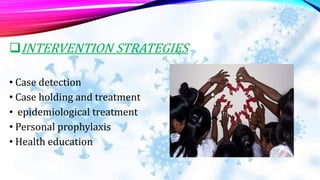
INTERVENTION STRATEGIES
• Case detection
• Case holding and treatment
• epidemiological treatment
• Personal prophylaxis
• Health education
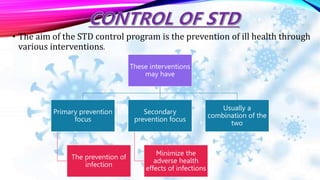
• The aim of the STD control program is the prevention of ill health through
various interventions.
These interventions
may have
Primary prevention
focus
The prevention of
infection
Secondary
prevention focus
Minimize the
adverse health
effects of infections
Usually a
combination of the
two
Standardized training to the medical and paramedical
personal based on syndrome care management approach.
Counselling services from trained counselor in Suraksha
clinics.
Colour coded syndromic drop kits are being Centrally
processed and supplied to these clinics.
REQUIREMENTS TO MANAGE STI
• Accurate diagnosis
• Treatment and first encounter
• Rapid cure with effective drugs
• Condom promotion
• Partner notification
• Education/ counselling
•As on July 1993, the regional STD centers have
trained as many as 98 medical officers and 112
paramedical personnel.
•About 56 medical colleges, hospitals, laboratories,
public health laboratories are participated.
•Regional STD five trained centers launch and under
these 274 medical officers were trained.
 BIBLIOGRAPHY
•K. Park, essential of community health
nursing 26 edition Bhamarajadias Bhasat
publisher, India.page no 347
•Neelam Kumari, A text book of
community health nursing -2 .2011
edition pv publisher in India.
•www.slideshare.com//www.https.STD
control programme.- 349
STD contol programme.pptx

STD contol programme.pptx

  • 1.
    PRESENTED BY ARPAN HAJRA 4thYEAR,B.SC NURSING SARVODAY COLLEGE OF NURSING
  • 2.
    Sexually Transmitted Diseasecontrol programme activities as per WHO estimates around 10% of all adults are infected with curable STI (sexually transmitted infection) each year. Department of NACO coordinates RTI and STD at all levels of the health care free standardized STI/RTI services provided through 1160 clinics situated at government health care facilities, at district hospital level, and above. These clinics named as "Suraksha Clinics" provided sexual and reproductive health services.
  • 3.
    • The sexuallytransmitted disease (STD) are a group of communicable disease that are transmitted pre predominantly by sexual contact and caused by a wide range of bacterial, viral, protozoal and fungal agents.
  • 4.
     The reliableon incidence and prevalence of sexually transmitted disease are limited. It is estimated by National AIDS control organization that the annual incidence rate of STI cases are occurring annually in the county.  Approximately 5.6 million disability adjusted life years were lost due to STI in India.
  • 5.
    A National STDcontrol program was started in 1946. Focus: on the health seeking behaviour of individuals with STDs and on conducting social stigma.  The national STD control program was made on integral part of the national AIDS control program in 1992.
  • 6.
    •Explain the epidemiologicalimpact of sexually transmitted disease. •Discuss ways to reduce risk for STD. •Examine how condoms can reduce risk for STD. •Describe the clinical presentation of STD. •Outline the management, complication and prevention of STD.
  • 7.
    1) CASE DETECTION CaseDetection is on essential part of any control program. Screening High priority is given to screening of special groups, pregnant women, blood donors ,industrial workers, army ,police, refugees, convicts, restaurant and hotel staff etc. Cluster testing Here the patients are asked two name other persons of the sex who more in the same sociosexual environment. 2) case holding and treatment There is tendency on a part of patients suffering from STD to disappear or drop out before treatment is complete.
  • 8.
    It consist ofthe administration of full therapeutic dose of treatment to persons recently exposed to STD while a waiting the result of lab test.  4)personal prophylaxis Contraceptives - mechanical barriers can be recommended for personal prophylaxis against STD. Vaccines- the development of vaccine for hepatitis B has raised hope that the vaccine will be found for other STD. 5)HEALTH EDUCATION • Health education is an integral part of STD control program.It is help the individual alter behaviour in an effort to avoid STD.
  • 9.
    Syndromic management isrecommended by National AIDS Control Organization (NACO) for case management at the primary health care level the effectiveness of syndromic management in Omen is currently under debate, but it is recognize that effectiveness of RTI (including STI) varies widely within the country.
  • 10.
    There are afew studies, in which it has been found that the quality of STD case management especially, STD counselling for prevention, in STD clinics in inadequate and poor.  PARTNER NOTIFICATION Partner notification is seen a cornerstone of the effective STI management but studies in India have shown that this procedure is rarely discussed or initiated by healthcare providers.
  • 11.
    Aside straightening casemanagement, the other pillars of public health intervention for STI control are implemented more particularly through out the country. There has been a public sector syphilis screening program for pregnant women since 1950s. Nationally on 57% of women received antenatal care in public sector an approximate 90000 women development cervical cancer in India.
  • 12.
    •Training of healthcareworkers in both public and private sector in comprehensive STD case management. •Development of appropriate laboratory services for the diagnosis of STD. •One of the major action was Strengthening the existing facilities and structure of STD clinics.
  • 13.
    1. Initial planning 2.Intervention strategies 3. Support components 4. Monitoring and valuation  INITIAL PLANNING This requires initial planning which comprise the following steps - • Problem definition • Establishment priorities • setting objectives
  • 14.
    INTERVENTION STRATEGIES • Casedetection • Case holding and treatment • epidemiological treatment • Personal prophylaxis • Health education
  • 15.
    • The aimof the STD control program is the prevention of ill health through various interventions. These interventions may have Primary prevention focus The prevention of infection Secondary prevention focus Minimize the adverse health effects of infections Usually a combination of the two
  • 16.
    Standardized training tothe medical and paramedical personal based on syndrome care management approach. Counselling services from trained counselor in Suraksha clinics. Colour coded syndromic drop kits are being Centrally processed and supplied to these clinics.
  • 17.
    REQUIREMENTS TO MANAGESTI • Accurate diagnosis • Treatment and first encounter • Rapid cure with effective drugs • Condom promotion • Partner notification • Education/ counselling
  • 18.
    •As on July1993, the regional STD centers have trained as many as 98 medical officers and 112 paramedical personnel. •About 56 medical colleges, hospitals, laboratories, public health laboratories are participated. •Regional STD five trained centers launch and under these 274 medical officers were trained.
  • 19.
     BIBLIOGRAPHY •K. Park,essential of community health nursing 26 edition Bhamarajadias Bhasat publisher, India.page no 347 •Neelam Kumari, A text book of community health nursing -2 .2011 edition pv publisher in India. •www.slideshare.com//www.https.STD control programme.- 349