National Programme for
Prevention & Control of Cancer,
Diabetes, Cardiovascular
Diseases and Stroke
NPCDCS
Introduction
• India is experiencing a rapid health transition with
large and rising burden of chronic non-communicable
diseases
• In 2016, NCDs accounted for 60% of deaths
• NCDS surpass the burden of communicable diseases
• Thus, the need for National Programme on Prevention
and Control of Diabetes, Cardiovascular diseases and
Stroke was envisaged.
• Later on this programme was integrated with National
Cancer Control Programme and it became National
Programme for Prevention and Control of Cancer,
Diabetes, Cardiovascular diseases and Stroke.
• During the 11th FYP, 100 identified districts in 21 states
have been covered under the programme. During the
12th FYP, all the districts were brought under the
programme in a phased manner.
Components
• The National Programme has 2 components
• a.Diabetes, Cardiovascular Disease and
Stroke (DCS) component
• b.Cancer component
a.Diabetes, CVDs &
Stroke Component
• The programme focusses on
the
• i.health promotion,
• ii.capacity building including
human resource
development,
• iii.early diagnosis and Mx of
these diseases with
integration with the primary
health care system.
The main objectives are :
i.Prevent and control common NCDs through behaviour and life style changes
ii.Provide early diagnosis and Mx of common NCDs
iii.Build capacity at various levels of health care for prevention, diagnosis and treatment of
common NCDs
iv.Train human resource within the public health set-up viz. doctors, paramedics and
nursing staff to cope with the increasing burden of NCDs.
v.Establish and develop capacity for palliative and rehabilitative care.
Strategies
under the
programme
• i.promoting healthy lifestyle through
massive health education and mass media
efforts at country level,
• ii.opportunistic screening of persons above
the age of 30 years,
• iii.establishment of NCD clinics at CHC and
District level,
• iv.development of trained manpower and
• strengthening of tertiary level health
facilities
Activities at Sub
Centre
• Health promotion and life-style
change – by organizing camps,
interpersonal communication,
posters, banners etc.
• Opportunistic screening of
population above 30 years
• Suspected cases will be referred
to CHCs for further diagnosis and
Mx
Activities at CHC
• NCD clinic at CHC – diagnosis by required
investigations
• Home visits & monthly clinics – Appointed
nurses will visit bedridden cases, supervise
the work of health workers and attend
monthly clinics being held in the villages on a
random basis
• Referrals - complicated cases of DM, HTN
shall be referred from CHCs to DH for further
investigations and management
Activities at
District
Hospital
• NCD clinic at DH shall screen persons above 30 years
for DM, HTN, CVD etc. to identify high risk individuals
• Detailed investigation will be done in respect of
persons those who are referred from CHCs
• Shall provide regular Mx and annual assessment of
persons suffering from cancer, diabetes and HTN.
• People with established CVD are
managed at DH
• They shall provide home based
palliative care for chronic,
debilitating and progressive patients.
• Apart from clinical services, DH shall
be involved in promotion of healthy
life-style through health education
and counselling to the patients and
their attendants.
Urban Health check up scheme
• Urban Health Check up Scheme for
diabetes and high blood pressure
• The scheme has the following objectives
• a.To screen urban slum population for DM
and high blood pressure
• b.To create database for prevalence of
diabetes and high blood pressure in urban
slums
• c.To sensitise the urban slum population
about healthy life-style
• The NCD cells at the centre, state
and district will implement and
monitor the National Programme
for Prevention and Control of
Cancer, Diabetes, CVD and Stroke
in various states
• The National NCD cell has been
established at the centre.
New Initiatives under
the programme
• Intervention for prevention and
control of Rheumatic Heart Disease
under NPCDCS and Rashtriya Bal
Swasthya Karyakram.
• Integration of AYUSH with NPCDCS
• Integration of RNTCP with NPCDCS
to articulate a national strategy for
management of TB and Diabetes
comorbidities in India.
b.Cancer component
• Cancer is an important public health problem in India,
with nearly 10 lakh new cases occurring every year
• The National Cancer Control Programme was launches
in 1975-76
• During 2010, the programme was integrated with
NPCDCS
• The objectives of this programme were
• a.Primary prevention of cancers by health education
• b.Secondary prevention by screening/self examination
method ; and
• c.Tertiary prevention i.e strengthening of the existing
institutions of comprehensive therapy including
palliative therapy
The schemes under
this programme are
A.Regional Cancer
centre Scheme
B.Oncology Wing
Development
Scheme
C.Decentralised NGO
scheme
D.IEC activities at
central level
E.Research and
training
A.Regional Cancer centre scheme
• The existing regional cancer
centres are being further
strengthened to act as referral
centres for complicated and
difficult cases at the tertiary level.
B.Oncology Wing Development Scheme
• This scheme has been initiated to fill up the
geographic gaps in the availability of cancer
treatment facilities in the country.
• Central assistance is provided for purchase of
equipment, which include a cobalt unit besides
other equipment
• A part of the grant can be used for the civil
work, but the manpower is to be provided by
the concerned state govt/institution.
C.Decentralised NGO scheme
This scheme is meant for IEC
activities and early detection
of cancer
The scheme is operated by
the nodal agencies and the
NGOs are given financial
assistance for undertaking
health education and early
detection activities of cancer
D.IEC
activities at
central level
• IEC activities to give wider publicity about the
Anti Tobacco Legislation for discouraging the
consumption of cigarettes and other tobacco
related products, and for creating awareness
among masses about the ill effects of
consumption of tobacco and tobacco related
products.
• Nov 7th is observed as National Cancer
Awareness Day in the country
E.Research
and Training
• Training programmes, monitoring and
research activities will be organized at the
central level under this scheme.
• Following training manuals have been
developed under the NCCP for capacity
building in cancer control at district level.
• a.Manual for health professionals
• b.Manual for cytology
• c.Manual for palliative care
• d.Manual for tobacco cessation
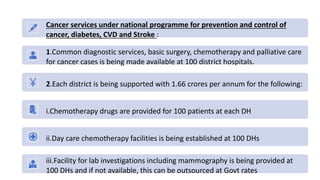
Cancer services under national programme for prevention and control of
cancer, diabetes, CVD and Stroke :
1.Common diagnostic services, basic surgery, chemotherapy and palliative care
for cancer cases is being made available at 100 district hospitals.
2.Each district is being supported with 1.66 crores per annum for the following:
i.Chemotherapy drugs are provided for 100 patients at each DH
ii.Day care chemotherapy facilities is being established at 100 DHs
iii.Facility for lab investigations including mammography is being provided at
100 DHs and if not available, this can be outsourced at Govt rates
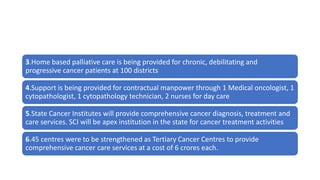
3.Home based palliative care is being provided for chronic, debilitating and
progressive cancer patients at 100 districts
4.Support is being provided for contractual manpower through 1 Medical oncologist, 1
cytopathologist, 1 cytopathology technician, 2 nurses for day care
5.State Cancer Institutes will provide comprehensive cancer diagnosis, treatment and
care services. SCI will be apex institution in the state for cancer treatment activities
6.45 centres were to be strengthened as Tertiary Cancer Centres to provide
comprehensive cancer care services at a cost of 6 crores each.
Thankyou

NPCDCS.pptx

  • 1.
    National Programme for Prevention& Control of Cancer, Diabetes, Cardiovascular Diseases and Stroke NPCDCS
  • 3.
    Introduction • India isexperiencing a rapid health transition with large and rising burden of chronic non-communicable diseases • In 2016, NCDs accounted for 60% of deaths • NCDS surpass the burden of communicable diseases • Thus, the need for National Programme on Prevention and Control of Diabetes, Cardiovascular diseases and Stroke was envisaged.
  • 4.
    • Later onthis programme was integrated with National Cancer Control Programme and it became National Programme for Prevention and Control of Cancer, Diabetes, Cardiovascular diseases and Stroke. • During the 11th FYP, 100 identified districts in 21 states have been covered under the programme. During the 12th FYP, all the districts were brought under the programme in a phased manner.
  • 5.
    Components • The NationalProgramme has 2 components • a.Diabetes, Cardiovascular Disease and Stroke (DCS) component • b.Cancer component
  • 6.
    a.Diabetes, CVDs & StrokeComponent • The programme focusses on the • i.health promotion, • ii.capacity building including human resource development, • iii.early diagnosis and Mx of these diseases with integration with the primary health care system.
  • 7.
    The main objectivesare : i.Prevent and control common NCDs through behaviour and life style changes ii.Provide early diagnosis and Mx of common NCDs iii.Build capacity at various levels of health care for prevention, diagnosis and treatment of common NCDs iv.Train human resource within the public health set-up viz. doctors, paramedics and nursing staff to cope with the increasing burden of NCDs. v.Establish and develop capacity for palliative and rehabilitative care.
  • 8.
    Strategies under the programme • i.promotinghealthy lifestyle through massive health education and mass media efforts at country level, • ii.opportunistic screening of persons above the age of 30 years, • iii.establishment of NCD clinics at CHC and District level, • iv.development of trained manpower and • strengthening of tertiary level health facilities
  • 9.
    Activities at Sub Centre •Health promotion and life-style change – by organizing camps, interpersonal communication, posters, banners etc. • Opportunistic screening of population above 30 years • Suspected cases will be referred to CHCs for further diagnosis and Mx
  • 10.
    Activities at CHC •NCD clinic at CHC – diagnosis by required investigations • Home visits & monthly clinics – Appointed nurses will visit bedridden cases, supervise the work of health workers and attend monthly clinics being held in the villages on a random basis • Referrals - complicated cases of DM, HTN shall be referred from CHCs to DH for further investigations and management
  • 11.
    Activities at District Hospital • NCDclinic at DH shall screen persons above 30 years for DM, HTN, CVD etc. to identify high risk individuals • Detailed investigation will be done in respect of persons those who are referred from CHCs • Shall provide regular Mx and annual assessment of persons suffering from cancer, diabetes and HTN.
  • 12.
    • People withestablished CVD are managed at DH • They shall provide home based palliative care for chronic, debilitating and progressive patients. • Apart from clinical services, DH shall be involved in promotion of healthy life-style through health education and counselling to the patients and their attendants.
  • 13.
    Urban Health checkup scheme • Urban Health Check up Scheme for diabetes and high blood pressure • The scheme has the following objectives • a.To screen urban slum population for DM and high blood pressure • b.To create database for prevalence of diabetes and high blood pressure in urban slums • c.To sensitise the urban slum population about healthy life-style
  • 14.
    • The NCDcells at the centre, state and district will implement and monitor the National Programme for Prevention and Control of Cancer, Diabetes, CVD and Stroke in various states • The National NCD cell has been established at the centre.
  • 15.
    New Initiatives under theprogramme • Intervention for prevention and control of Rheumatic Heart Disease under NPCDCS and Rashtriya Bal Swasthya Karyakram. • Integration of AYUSH with NPCDCS • Integration of RNTCP with NPCDCS to articulate a national strategy for management of TB and Diabetes comorbidities in India.
  • 16.
    b.Cancer component • Canceris an important public health problem in India, with nearly 10 lakh new cases occurring every year • The National Cancer Control Programme was launches in 1975-76 • During 2010, the programme was integrated with NPCDCS • The objectives of this programme were • a.Primary prevention of cancers by health education • b.Secondary prevention by screening/self examination method ; and • c.Tertiary prevention i.e strengthening of the existing institutions of comprehensive therapy including palliative therapy
  • 17.
    The schemes under thisprogramme are A.Regional Cancer centre Scheme B.Oncology Wing Development Scheme C.Decentralised NGO scheme D.IEC activities at central level E.Research and training
  • 18.
    A.Regional Cancer centrescheme • The existing regional cancer centres are being further strengthened to act as referral centres for complicated and difficult cases at the tertiary level.
  • 19.
    B.Oncology Wing DevelopmentScheme • This scheme has been initiated to fill up the geographic gaps in the availability of cancer treatment facilities in the country. • Central assistance is provided for purchase of equipment, which include a cobalt unit besides other equipment • A part of the grant can be used for the civil work, but the manpower is to be provided by the concerned state govt/institution.
  • 20.
    C.Decentralised NGO scheme Thisscheme is meant for IEC activities and early detection of cancer The scheme is operated by the nodal agencies and the NGOs are given financial assistance for undertaking health education and early detection activities of cancer
  • 21.
    D.IEC activities at central level •IEC activities to give wider publicity about the Anti Tobacco Legislation for discouraging the consumption of cigarettes and other tobacco related products, and for creating awareness among masses about the ill effects of consumption of tobacco and tobacco related products. • Nov 7th is observed as National Cancer Awareness Day in the country
  • 22.
    E.Research and Training • Trainingprogrammes, monitoring and research activities will be organized at the central level under this scheme. • Following training manuals have been developed under the NCCP for capacity building in cancer control at district level. • a.Manual for health professionals • b.Manual for cytology • c.Manual for palliative care • d.Manual for tobacco cessation
  • 23.
    Cancer services undernational programme for prevention and control of cancer, diabetes, CVD and Stroke : 1.Common diagnostic services, basic surgery, chemotherapy and palliative care for cancer cases is being made available at 100 district hospitals. 2.Each district is being supported with 1.66 crores per annum for the following: i.Chemotherapy drugs are provided for 100 patients at each DH ii.Day care chemotherapy facilities is being established at 100 DHs iii.Facility for lab investigations including mammography is being provided at 100 DHs and if not available, this can be outsourced at Govt rates
  • 24.
    3.Home based palliativecare is being provided for chronic, debilitating and progressive cancer patients at 100 districts 4.Support is being provided for contractual manpower through 1 Medical oncologist, 1 cytopathologist, 1 cytopathology technician, 2 nurses for day care 5.State Cancer Institutes will provide comprehensive cancer diagnosis, treatment and care services. SCI will be apex institution in the state for cancer treatment activities 6.45 centres were to be strengthened as Tertiary Cancer Centres to provide comprehensive cancer care services at a cost of 6 crores each.
  • 25.

Editor's Notes

  • #9 Increased intake of healthy foods Increased physical activity Avoidance of tobacco and alcohol Stress management