Pancreatic Cancer
Chi-Hua(Richard) Lu
Pharm.D Candidate, Class of 2018
University at Buffalo
chihualu@buffalo.edu
Contents
 Introduction
 Treatment Overview
 Current Treatment Options
 Investigational Treatments
 Conclusion
Introduction
 Pathophysiology
 Epidemiology
 Risk Factors
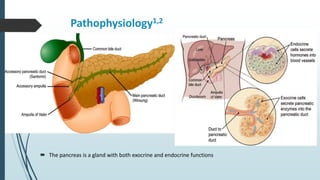
Pathophysiology1,2
 The pancreas is a gland with both exocrine and endocrine functions
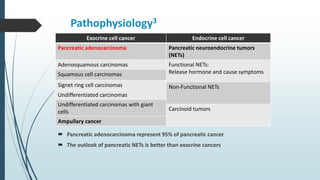
Pathophysiology3
 Pancreatic adenocarcinoma represent 95% of pancreatic cancer
 The outlook of pancreatic NETs is better than exocrine cancers
Exocrine cell cancer Endocrine cell cancer
Pancreatic adenocarcinoma Pancreatic neuroendocrine tumors
(NETs)
Adenosquamous carcinomas Functional NETs:
Release hormone and cause symptomsSquamous cell carcinomas
Signet ring cell carcinomas Non-Functional NETs
Undifferentiated carcinomas
Undifferentiated carcinomas with giant
cells Carcinoid tumors
Ampullary cancer
Epidemiology4
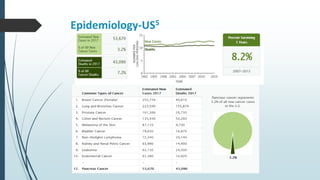
Epidemiology-US5
Epidemiology-US5
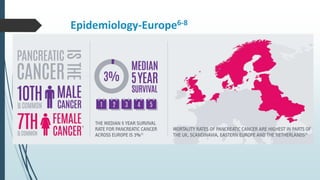
Epidemiology-Europe6-8
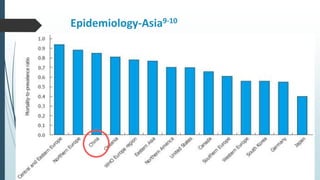
Epidemiology-Asia9-10
Japan China
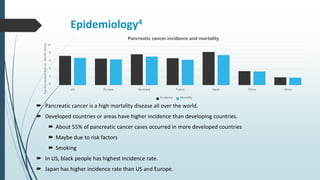
Epidemiology4
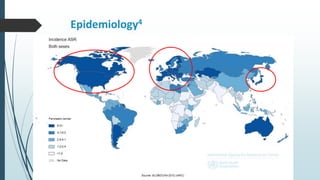
 Pancreatic cancer is a high mortality disease all over the world.
 Developed countries or areas have higher incidence than developing countries.
 About 55% of pancreatic cancer cases occurred in more developed countries
 Maybe due to risk factors
 Smoking
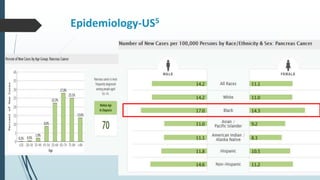
 In US, black people has highest incidence rate.
 Japan has higher incidence rate than US and Europe.
0
2
4
6
8
10
US Europe Germany France Japan China Africa
Age-StandardisedRateper100,000(World)
Pancreatic cancer incidence and mortality
Incidence Mortality
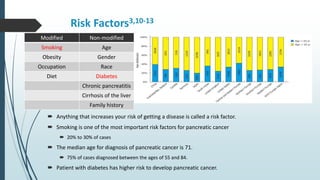
Risk Factors3,10-13
 Anything that increases your risk of getting a disease is called a risk factor.
 Smoking is one of the most important risk factors for pancreatic cancer
 20% to 30% of cases
 The median age for diagnosis of pancreatic cancer is 71.
 75% of cases diagnosed between the ages of 55 and 84.
 Patient with diabetes has higher risk to develop pancreatic cancer.
Modified Non-modified
Smoking Age
Obesity Gender
Occupation Race
Diet Diabetes
Chronic pancreatitis
Cirrhosis of the liver
Family history
Treatment Overview
 Presentation and Diagnosis
 Workup and Staging
 Potential Biomarkers
 Treatment Overview
 Treatment Guidelines
Presentation and Diagnosis3,11,12,14
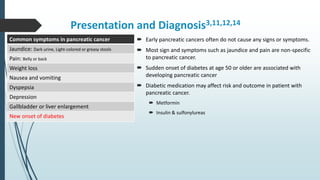
 Early pancreatic cancers often do not cause any signs or symptoms.
 Most sign and symptoms such as jaundice and pain are non-specific
to pancreatic cancer.
 Sudden onset of diabetes at age 50 or older are associated with
developing pancreatic cancer
 Diabetic medication may affect risk and outcome in patient with
pancreatic cancer.
 Metformin
 Insulin & sulfonylureas
Common symptoms in pancreatic cancer
Jaundice: Dark urine, Light-colored or greasy stools
Pain: Belly or back
Weight loss
Nausea and vomiting
Dyspepsia
Depression
Gallbladder or liver enlargement
New onset of diabetes
Presentation and Diagnosis3,11,12,14
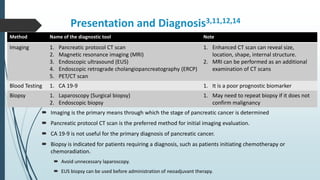
 Imaging is the primary means through which the stage of pancreatic cancer is determined
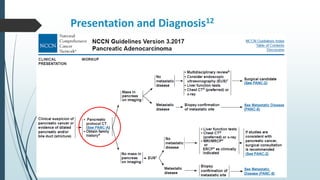
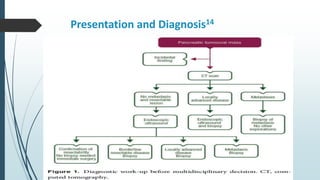
 Pancreatic protocol CT scan is the preferred method for initial imaging evaluation.
 CA 19-9 is not useful for the primary diagnosis of pancreatic cancer.
 Biopsy is indicated for patients requiring a diagnosis, such as patients initiating chemotherapy or
chemoradiation.
 Avoid unnecessary laparoscopy.
 EUS biopsy can be used before administration of neoadjuvant therapy.
Method Name of the diagnostic tool Note
Imaging 1. Pancreatic protocol CT scan
2. Magnetic resonance imaging (MRI)
3. Endoscopic ultrasound (EUS)
4. Endoscopic retrograde cholangiopancreatography (ERCP)
5. PET/CT scan
1. Enhanced CT scan can reveal size,
location, shape, internal structure.
2. MRI can be performed as an additional
examination of CT scans
Blood Testing 1. CA 19-9 1. It is a poor prognostic biomarker
Biopsy 1. Laparoscopy (Surgical biopsy)
2. Endoscopic biopsy
1. May need to repeat biopsy if it does not
confirm malignancy
Presentation and Diagnosis12
Presentation and Diagnosis14
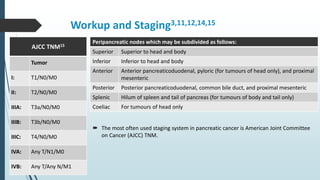
Workup and Staging3,11,12,14,15
 The most often used staging system in pancreatic cancer is American Joint Committee
on Cancer (AJCC) TNM.
AJCC TNM15
Tumor
I: T1/N0/M0
II: T2/N0/M0
IIIA: T3a/N0/M0
IIIB: T3b/N0/M0
IIIC: T4/N0/M0
IVA: Any T/N1/M0
IVB: Any T/Any N/M1
Peripancreatic nodes which may be subdivided as follows:
Superior Superior to head and body
Inferior Inferior to head and body
Anterior Anterior pancreaticoduodenal, pyloric (for tumours of head only), and proximal
mesenteric
Posterior Posterior pancreaticoduodenal, common bile duct, and proximal mesenteric
Splenic Hilum of spleen and tail of pancreas (for tumours of body and tail only)
Coeliac For tumours of head only
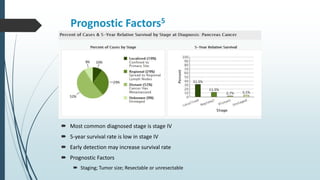
Prognostic Factors5
 Most common diagnosed stage is stage IV
 5-year survival rate is low in stage IV
 Early detection may increase survival rate
 Prognostic Factors
 Staging; Tumor size; Resectable or unresectable
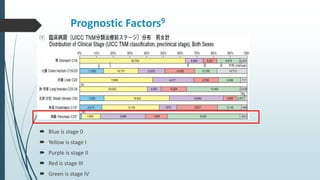
Prognostic Factors9
 Blue is stage 0
 Yellow is stage I
 Purple is stage II
 Red is stage III
 Green is stage IV
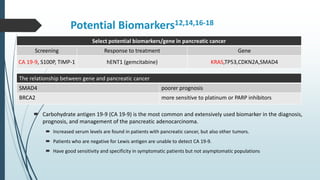
Potential Biomarkers12,14,16-18
 Carbohydrate antigen 19-9 (CA 19-9) is the most common and extensively used biomarker in the diagnosis,
prognosis, and management of the pancreatic adenocarcinoma.
 Increased serum levels are found in patients with pancreatic cancer, but also other tumors.
 Patients who are negative for Lewis antigen are unable to detect CA 19-9.
 Have good sensitivity and specificity in symptomatic patients but not asymptomatic populations
Select potential biomarkers/gene in pancreatic cancer
Screening Response to treatment Gene
CA 19-9, S100P, TIMP-1 hENT1 (gemcitabine) KRAS,TP53,CDKN2A,SMAD4
The relationship between gene and pancreatic cancer
SMAD4 poorer prognosis
BRCA2 more sensitive to platinum or PARP inhibitors
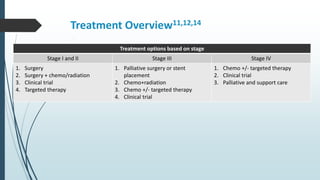
Treatment Overview11,12,14
Treatment options based on stage
Stage I and II Stage III Stage IV
1. Surgery
2. Surgery + chemo/radiation
3. Clinical trial
4. Targeted therapy
1. Palliative surgery or stent
placement
2. Chemo+radiation
3. Chemo +/- targeted therapy
4. Clinical trial
1. Chemo +/- targeted therapy
2. Clinical trial
3. Palliative and support care
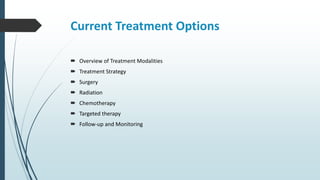
Current Treatment Options
 Overview of Treatment Modalities
 Treatment Strategy
 Surgery
 Radiation
 Chemotherapy
 Targeted therapy
 Follow-up and Monitoring
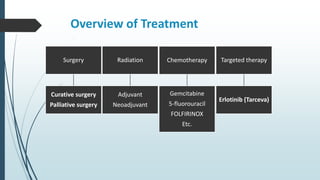
Overview of Treatment
Surgery
Curative surgery
Palliative surgery
Radiation
Adjuvant
Neoadjuvant
Targeted therapy
Erlotinib (Tarceva)
Chemotherapy
Gemcitabine
5-fluorouracil
FOLFIRINOX
Etc.
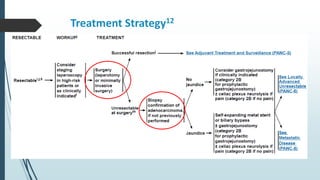
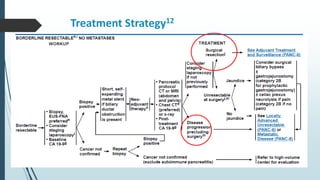
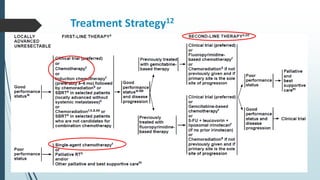
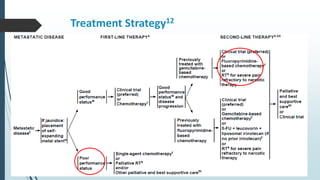
Treatment Strategy12
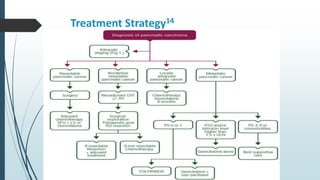
Treatment Strategy14
Surgery12,14,19
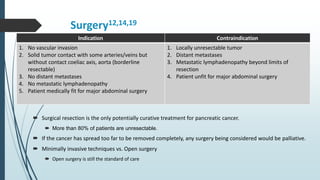
 Surgical resection is the only potentially curative treatment for pancreatic cancer.
 More than 80% of patients are unresectable.
 If the cancer has spread too far to be removed completely, any surgery being considered would be palliative.
 Minimally invasive techniques vs. Open surgery
 Open surgery is still the standard of care
Indication Contraindication
1. No vascular invasion
2. Solid tumor contact with some arteries/veins but
without contact coeliac axis, aorta (borderline
resectable)
3. No distant metastases
4. No metastatic lymphadenopathy
5. Patient medically fit for major abdominal surgery
1. Locally unresectable tumor
2. Distant metastases
3. Metastatic lymphadenopathy beyond limits of
resection
4. Patient unfit for major abdominal surgery
Radiation20
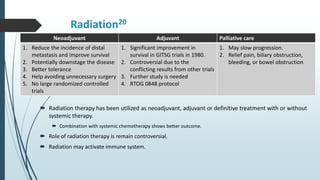
 Radiation therapy has been utilized as neoadjuvant, adjuvant or definitive treatment with or without
systemic therapy.
 Combination with systemic chemotherapy shows better outcome.
 Role of radiation therapy is remain controversial.
 Radiation may activate immune system.
Neoadjuvant Adjuvant Palliative care
1. Reduce the incidence of distal
metastasis and improve survival
2. Potentially downstage the disease
3. Better tolerance
4. Help avoiding unnecessary surgery
5. No large randomized controlled
trials
1. Significant improvement in
survival in GITSG trials in 1980.
2. Controversial due to the
conflicting results from other trials
3. Further study is needed
4. RTOG 0848 protocol
1. May slow progression.
2. Relief pain, biliary obstruction,
bleeding, or bowel obstruction
Chemotherapy3,12,14
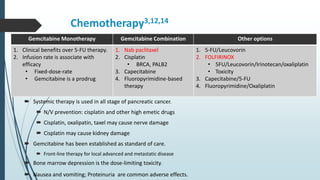
 Systemic therapy is used in all stage of pancreatic cancer.
 N/V prevention: cisplatin and other high emetic drugs
 Cisplatin, oxalipatin, taxel may cause nerve damage
 Cisplatin may cause kidney damage
 Gemcitabine has been established as standard of care.
 Front-line therapy for local advanced and metastatic disease
 Bone marrow depression is the dose-limiting toxicity.
 Nausea and vomiting; Proteinuria are common adverse effects.
Gemcitabine Monotherapy Gemcitabine Combination Other options
1. Clinical benefits over 5-FU therapy.
2. Infusion rate is associate with
efficacy
• Fixed-dose-rate
• Gemcitabine is a prodrug
1. Nab paclitaxel
2. Cisplatin
• BRCA, PALB2
3. Capecitabine
4. Fluoropyrimidine-based
therapy
1. 5-FU/Leucovorin
2. FOLFIRINOX
• 5FU/Leucovorin/Irinotecan/oxaliplatin
• Toxicity
3. Capecitabine/5-FU
4. Fluoropyrimidine/Oxaliplatin
First line therapy comparison21
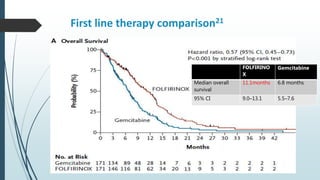
 It was a randomized, phase 2–3 trial of receiving FOLFIRINOX or gemcitabine.
 Patients with confirmed, measurable metastatic pancreatic adenocarcinoma and treatment-naïve.
 The primary end point was overall survival.
FOLFIRINOX
(N = 171)
Gemcitabine
(N = 171)
Objective Response Rate, n (%)
[95% CI]
P value
54 (31.6)
[24.7–39.1]
< 0.001
16 (9.4)
[5–14.7]
—
Response, n (%)
Complete response
Partial response
Stable disease
Progressive disease
Could not be evaluated
1 (0.6)
53 (31.0)
66 (38.6)
26 (15.2)
25 (14.6)
0
16 (9.4)
71 (41.5)
59 (34.5)
25 (14.6)
Rate of disease control, n (%)
[95% CI]
P value
120 (70.2)
[62.7–76.9]
< 0.001
87 (50.9)
[43.1–58.6]
—
First line therapy comparison21
FOLFIRINO
X
Gemcitabine
Median overall
survival
11.1months 6.8 months
95% CI 9.0–13.1 5.5–7.6
First line therapy comparison21
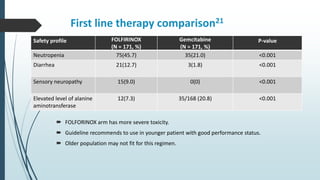
 FOLFORINOX arm has more severe toxicity.
 Guideline recommends to use in younger patient with good performance status.
 Older population may not fit for this regimen.
Safety profile FOLFIRINOX
(N = 171, %)
Gemcitabine
(N = 171, %)
P-value
Neutropenia 75(45.7) 35(21.0) <0.001
Diarrhea 21(12.7) 3(1.8) <0.001
Sensory neuropathy 15(9.0) 0(0) <0.001
Elevated level of alanine
aminotransferase
12(7.3) 35/168 (20.8) <0.001
First line therapy comparison22
 It was a randomized, phase 3 trial receiving of Nab-Paclitaxel/gemcitabine or gemcitabine.
 Patients with confirmed, measurable metastatic pancreatic adenocarcinoma and treatment-naïve.
 The primary end point was overall survival.
Nab-Paclitaxel/Gemcitabine
(N = 431)
Gemcitabine
(N = 430)
Objective Response Rate, n (%)
[95% CI]
P value
99 (23)
[19–27]
< 0.001
31 (7)
[5–10]
—
Response, n (%)
Complete response
Partial response
Stable disease
Progressive disease
Could not be evaluated
1 (<1)
98 (23)
118 (27)
86 (20)
128 (30)
0
31 (7)
122 (28)
110 (26)
167 (39)
Rate of disease control, n (%)
[95% CI]
P value
206 (48)
[43–53]
< 0.001
141 (33)
[28–37]
—
First line therapy comparison22
Gemcitabine/
nab-paclitaxel
Gemcitabine
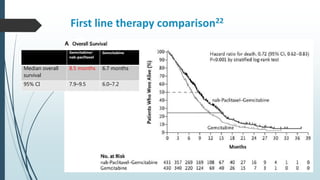
Median overall
survival
8.5 months 6.7 months
95% CI 7.9–9.5 6.0–7.2
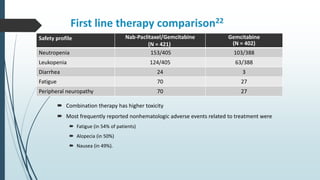
First line therapy comparison22
 Combination therapy has higher toxicity
 Most frequently reported nonhematologic adverse events related to treatment were
 Fatigue (in 54% of patients)
 Alopecia (in 50%)
 Nausea (in 49%).
Safety profile Nab-Paclitaxel/Gemcitabine
(N = 421)
Gemcitabine
(N = 402)
Neutropenia 153/405 103/388
Leukopenia 124/405 63/388
Diarrhea 24 3
Fatigue 70 27
Peripheral neuropathy 70 27
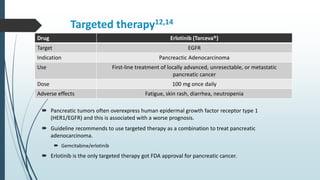
Targeted therapy12,14
 Pancreatic tumors often overexpress human epidermal growth factor receptor type 1
(HER1/EGFR) and this is associated with a worse prognosis.
 Guideline recommends to use targeted therapy as a combination to treat pancreatic
adenocarcinoma.
 Gemcitabine/erlotinib
 Erlotinib is the only targeted therapy got FDA approval for pancreatic cancer.
Drug Erlotinib (Tarceva®)
Target EGFR
Indication Pancreactic Adenocarcinoma
Use First-line treatment of locally advanced, unresectable, or metastatic
pancreatic cancer
Dose 100 mg once daily
Adverse effects Fatigue, skin rash, diarrhea, neutropenia
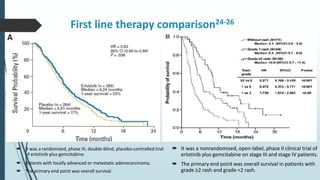
First line therapy comparison24-26
 It was a randomized, phase III, double-blind, placebo-controlled trial
of erlotinib plus gemcitabine.
 Patients with locally advanced or metastatic adenocarcinoma.
 The primary end point was overall survival.
 It was a nonrandomised, open-label, phase II clinical trial of
erlotinib plus gemcitabine on stage III and stage IV patients.
 The primary end point was overall survival in patients with
grade ≥2 rash and grade <2 rash.
Follow-up and Monitoring11,12,14
 Considering the poor prognosis of the disease upon diagnosis of a recurrence, there is no evidence
that regular follow-up after initial therapy with curative intent has any impact on the outcome.
 Follow-up visits should concentrate on symptoms, nutrition, and psycho-social support.
 For patients with resected disease
 History and physical examination every 3-6 months for 2 years
 CT scan every 3-6 months for 2 years
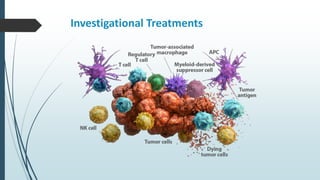
Investigational Treatments
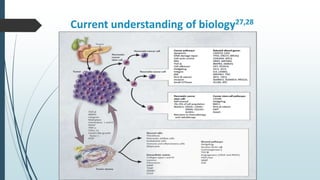
Current understanding of biology27,28
Immunotherapy29-31
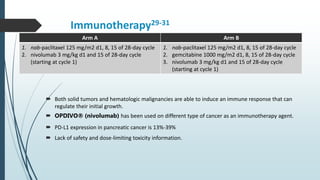
 Both solid tumors and hematologic malignancies are able to induce an immune response that can
regulate their initial growth.
 OPDIVO® (nivolumab) has been used on different type of cancer as an immunotherapy agent.
 PD-L1 expression in pancreatic cancer is 13%-39%
 Lack of safety and dose-limiting toxicity information.
Arm A Arm B
1. nab-paclitaxel 125 mg/m2 d1, 8, 15 of 28-day cycle
2. nivolumab 3 mg/kg d1 and 15 of 28-day cycle
(starting at cycle 1)
1. nab-paclitaxel 125 mg/m2 d1, 8, 15 of 28-day cycle
2. gemcitabine 1000 mg/m2 d1, 8, 15 of 28-day cycle
3. nivolumab 3 mg/kg d1 and 15 of 28-day cycle
(starting at cycle 1)
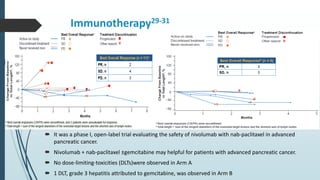
Immunotherapy29-31
 It was a phase I, open-label trial evaluating the safety of nivolumab with nab-paclitaxel in advanced
pancreatic cancer.
 Nivolumab + nab-paclitaxel ±gemcitabine may helpful for patients with advanced pancreatic cancer.
 No dose-limiting-toxicities (DLTs)were observed in Arm A
 1 DLT, grade 3 hepatitis attributed to gemcitabine, was observed in Arm B
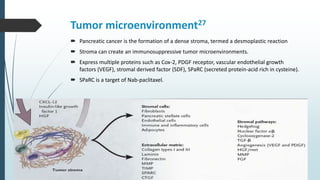
Tumor microenvironment27
 Pancreatic cancer is the formation of a dense stroma, termed a desmoplastic reaction
 Stroma can create an immunosuppressive tumor microenvironments.
 Express multiple proteins such as Cox-2, PDGF receptor, vascular endothelial growth
factors (VEGF), stromal derived factor (SDF), SPaRC (secreted protein-acid rich in cysteine).
 SPaRC is a target of Nab-paclitaxel.
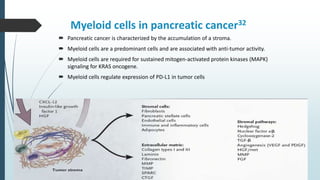
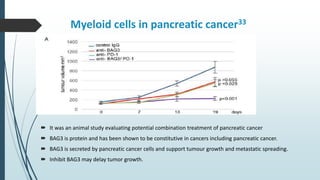
Myeloid cells in pancreatic cancer32
 Pancreatic cancer is characterized by the accumulation of a stroma.
 Myeloid cells are a predominant cells and are associated with anti-tumor activity.
 Myeloid cells are required for sustained mitogen-activated protein kinases (MAPK)
signaling for KRAS oncogene.
 Myeloid cells regulate expression of PD-L1 in tumor cells
Myeloid cells in pancreatic cancer33
 It was an animal study evaluating potential combination treatment of pancreatic cancer
 BAG3 is protein and has been shown to be constitutive in cancers including pancreatic cancer.
 BAG3 is secreted by pancreatic cancer cells and support tumour growth and metastatic spreading.
 Inhibit BAG3 may delay tumor growth.
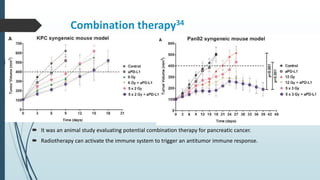
Combination therapy34
 It was an animal study evaluating potential combination therapy for pancreatic cancer.
 Radiotherapy can activate the immune system to trigger an antitumor immune response.
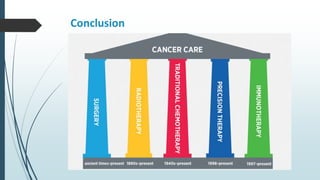
Conclusion
Reference
1. Hammer GD, McPhee SJ. Pathophysiology of Disease: An Introduction to Clinical Medicine, 7e; 2013 Available at:
http://accesspharmacy.mhmedical.com/content.aspx?sectionid=53555696&bookid=961&Resultclick=2 Accessed: September 21, 2017
2. Von hoff DD, Renschler MF. Letter to the Editor Re: Ahn DH, Krishna K, Blazer M, et al. "A modified regimen of biweekly gemcitabine and nab-paclitaxel in patients with metastatic
pancreatic cancer is both tolerable and effective: a retrospective analysis." Ther Adv Med Oncol https://doi.org/10.1177/1758834016676011. Ther Adv Med Oncol. 2017;9(6):441-443.
3. American Cancer Society. Cancer Facts & Figures 2017. Atlanta, Ga: American Cancer Society; 2017.
4. GLOBOCAN 2012: Population fact sheets. Available at: http://globocan.iarc.fr/Pages/fact_sheets_population.aspx. Accessed September 22th , 2017
5. SEER Cancer Stat Facts: Pancreas Cancer. National Cancer Institute. Bethesda, MD, http://seer.cancer.gov/statfacts/html/pancreas.html
6. Malvezzi M, Bertuccio P, Levi F, La Vecchia C, Negri E, et al. European cancer mortality predictions for the year 2013. Annals of Oncol. 2013; 24:792-800
7. Carrato et al, 2015. “A Systematic Review of the Burden of Pancreatic Cancer in Europe: Real-World Impact on Survival, Quality of Life and Costs.” DOI 10.1007/s12029-015-9724-1
8. Farthing, M, Roberts, S, Samuel D, Williams D, et al. Survey of digestive health across Europe: Final report Part 1: The burden of gastrointestinal diseases and the organisation and
delivery of gastroenterology services across Europe, United European Gastroenterology Journal, December 2014 vol. 2 no. 6 539-543
9. Available at: http://ganjoho.jp/en/professional/statistics/brochure/2016_en.html. Accessed October 10, 2017
10. Lin, Q. J., Yang, F., Jin, C., & Fu, D. L. (2015). Current status and progress of pancreatic cancer in China. World Journal of Gastroenterology: WJG, 21(26), 7988.
11. Pancreatic Cancer Treatment (PDQ®)–Health Professional Version was originally published by the National Cancer Institute
12. Pancreatic Adenocarcinoma, Version 3.2017, NCCN Clinical Practice Guidelines in Oncology.
13. Lowenfels, A. B., & Maisonneuve, P. (2004). Epidemiology and prevention of pancreatic cancer. Japanese Journal of Clinical Oncology, 34(5), 238-244.
14. Cancer of the pancreas: ESMO clinical practice guidelines for diagnosis, treatment and follow-up Ann Oncol, 26 (Suppl. 5) (2015), pp. v56-v68
15. Egner, J. R. (2010). AJCC cancer staging manual. JAMA, 304(15), 1726-1727
16. Hu, H., Zhang, Q., Huang, C., Shen, Y., Chen, X., Shi, X., & Tang, W. (2014). Diagnostic value of S100P for pancreatic cancer: a meta-analysis. Tumor Biology, 35(10), 9479-9485.
17. Capello, M., Bantis, L. E., Scelo, G., Zhao, Y., Li, P., Dhillon, D. S., ... & Maitra, A. (2017). Sequential validation of blood-based protein biomarker candidates for early-stage pancreatic
cancer. JNCI: Journal of the National Cancer Institute, 109(4).
18. Waddell, N., Pajic, M., Patch, A. M., Chang, D. K., Kassahn, K. S., Bailey, P., ... & Quinn, M. C. (2015). Whole genomes redefine the mutational landscape of pancreatic cancer. Nature,
518(7540), 495.
Reference
19. Clancy, T. E. (2015). Surgery for pancreatic cancer. Hematology/oncology clinics of North America, 29(4), 701-716
20. Wang, F., & Kumar, P. (2011). The role of radiotherapy in management of pancreatic cancer. Journal of gastrointestinal oncology, 2(3), 157.
21. Conroy, T., Desseigne, F., Ychou, M., Bouché, O., Guimbaud, R., Bécouarn, Y., ... & Bennouna, J. (2011). FOLFIRINOX versus gemcitabine for metastatic pancreatic cancer. New England Journal of Medicine, 364(19), 1817-1825.
22. Von Hoff, D. D., Ervin, T., Arena, F. P., Chiorean, E. G., Infante, J., Moore, M., ... & Harris, M. (2013). Increased survival in pancreatic cancer with nab-paclitaxel plus gemcitabine. New England Journal of Medicine, 369(18), 1691-
1703.
23. Gerber, D. E. (2008). Targeted therapies: a new generation of cancer treatments. American family physician, 77(3).
24. Moore, M. J., Goldstein, D., Hamm, J., Figer, A., Hecht, J. R., Gallinger, S., ... & Campos, D. (2007). Erlotinib plus gemcitabine compared with gemcitabine alone in patients with advanced pancreatic cancer: a phase III trial of the
National Cancer Institute of Canada Clinical Trials Group. Journal of clinical oncology, 25(15), 1960-1966.
25. Aranda, E., Manzano, J. L., Rivera, F., Galán, M., Valladares-Ayerbes, M., Pericay, C., ... & Sastre, J. (2011). Phase II open-label study of erlotinib in combination with gemcitabine in unresectable and/or metastatic adenocarcinoma of
the pancreas: relationship between skin rash and survival (Pantar study). Annals of oncology, 23(7), 1919-1925.
26. Yang, Z. Y., Yuan, J. Q., Di, M. Y., Zheng, D. Y., Chen, J. Z., Ding, H., ... & Tang, J. L. (2013). Gemcitabine plus erlotinib for advanced pancreatic cancer: a systematic review with meta-analysis. PloS one, 8(3), e57528.
27. Hidalgo, M. (2012). New insights into pancreatic cancer biology. annals of Oncology, 23(suppl_10), x135-x138.
28. Makohon-Moore, A., & Iacobuzio-Donahue, C. A. (2016). Pancreatic cancer biology and genetics from an evolutionary perspective. Nature reviews Cancer, 16(9), 553-565.
29. Nomi, T., Sho, M., Akahori, T., Hamada, K., Kubo, A., Kanehiro, H., ... & Nakajima, Y. (2007). Clinical significance and therapeutic potential of the programmed death-1 ligand/programmed death-1 pathway in human pancreatic
cancer. Clinical cancer research, 13(7), 2151-2157.
30. Soares, K. C., Rucki, A. A., Wu, A. A., Olino, K., Xiao, Q., Chai, Y., ... & Yao, S. (2015). PD-1/PD-L1 blockade together with vaccine therapy facilitates effector T cell infiltration into pancreatic tumors. Journal of immunotherapy
(Hagerstown, Md.: 1997), 38(1), 1.
31. Wainberg, Z. A., Hochster, H. S., George, B., Gutierrez, M., Johns, M. E., Chiorean, E. G., ... & Chen, T. (2017). Phase I study of nivolumab (nivo)+ nab-paclitaxel (nab-P)±gemcitabine (Gem) in solid tumors: Interim results from the
pancreatic cancer (PC) cohorts.
32. Zhang, Y., Velez-Delgado, A., Mathew, E., Li, D., Mendez, F. M., Flannagan, K., ... & di Magliano, M. P. (2016). Myeloid cells are required for PD-1/PD-L1 checkpoint activation and the establishment of an immunosuppressive
environment in pancreatic cancer. Gut, gutjnl-2016.
33. Iorio, V., Rosati, A., D'Auria, R., De Marco, M., Marzullo, L., Basile, A., ... & Sala, G. (2017). Combined effect of anti-BAG3 and anti-PD-1 treatment on macrophage infiltrate, CD8+ T cell number and tumour growth in pancreatic
cancer. Gut, gutjnl-2017
34. Azad, A., Lim, S. Y., D'Costa, Z., Jones, K., Diana, A., Sansom, O. J., ... & Muschel, R. J. (2016). PD‐L1 blockade enhances response of pancreatic ductal adenocarcinoma to radiotherapy. EMBO molecular medicine, e201606674.
Question ?

Pancreatic cancer presentaion

  • 1.
    Pancreatic Cancer Chi-Hua(Richard) Lu Pharm.DCandidate, Class of 2018 University at Buffalo chihualu@buffalo.edu
  • 2.
    Contents  Introduction  TreatmentOverview  Current Treatment Options  Investigational Treatments  Conclusion
  • 3.
  • 4.
    Pathophysiology1,2  The pancreasis a gland with both exocrine and endocrine functions
  • 5.
    Pathophysiology3  Pancreatic adenocarcinomarepresent 95% of pancreatic cancer  The outlook of pancreatic NETs is better than exocrine cancers Exocrine cell cancer Endocrine cell cancer Pancreatic adenocarcinoma Pancreatic neuroendocrine tumors (NETs) Adenosquamous carcinomas Functional NETs: Release hormone and cause symptomsSquamous cell carcinomas Signet ring cell carcinomas Non-Functional NETs Undifferentiated carcinomas Undifferentiated carcinomas with giant cells Carcinoid tumors Ampullary cancer
  • 6.
  • 7.
  • 8.
  • 9.
  • 10.
  • 11.
    Epidemiology4  Pancreatic canceris a high mortality disease all over the world.  Developed countries or areas have higher incidence than developing countries.  About 55% of pancreatic cancer cases occurred in more developed countries  Maybe due to risk factors  Smoking  In US, black people has highest incidence rate.  Japan has higher incidence rate than US and Europe. 0 2 4 6 8 10 US Europe Germany France Japan China Africa Age-StandardisedRateper100,000(World) Pancreatic cancer incidence and mortality Incidence Mortality
  • 12.
    Risk Factors3,10-13  Anythingthat increases your risk of getting a disease is called a risk factor.  Smoking is one of the most important risk factors for pancreatic cancer  20% to 30% of cases  The median age for diagnosis of pancreatic cancer is 71.  75% of cases diagnosed between the ages of 55 and 84.  Patient with diabetes has higher risk to develop pancreatic cancer. Modified Non-modified Smoking Age Obesity Gender Occupation Race Diet Diabetes Chronic pancreatitis Cirrhosis of the liver Family history
  • 13.
    Treatment Overview  Presentationand Diagnosis  Workup and Staging  Potential Biomarkers  Treatment Overview  Treatment Guidelines
  • 14.
    Presentation and Diagnosis3,11,12,14 Early pancreatic cancers often do not cause any signs or symptoms.  Most sign and symptoms such as jaundice and pain are non-specific to pancreatic cancer.  Sudden onset of diabetes at age 50 or older are associated with developing pancreatic cancer  Diabetic medication may affect risk and outcome in patient with pancreatic cancer.  Metformin  Insulin & sulfonylureas Common symptoms in pancreatic cancer Jaundice: Dark urine, Light-colored or greasy stools Pain: Belly or back Weight loss Nausea and vomiting Dyspepsia Depression Gallbladder or liver enlargement New onset of diabetes
  • 15.
    Presentation and Diagnosis3,11,12,14 Imaging is the primary means through which the stage of pancreatic cancer is determined  Pancreatic protocol CT scan is the preferred method for initial imaging evaluation.  CA 19-9 is not useful for the primary diagnosis of pancreatic cancer.  Biopsy is indicated for patients requiring a diagnosis, such as patients initiating chemotherapy or chemoradiation.  Avoid unnecessary laparoscopy.  EUS biopsy can be used before administration of neoadjuvant therapy. Method Name of the diagnostic tool Note Imaging 1. Pancreatic protocol CT scan 2. Magnetic resonance imaging (MRI) 3. Endoscopic ultrasound (EUS) 4. Endoscopic retrograde cholangiopancreatography (ERCP) 5. PET/CT scan 1. Enhanced CT scan can reveal size, location, shape, internal structure. 2. MRI can be performed as an additional examination of CT scans Blood Testing 1. CA 19-9 1. It is a poor prognostic biomarker Biopsy 1. Laparoscopy (Surgical biopsy) 2. Endoscopic biopsy 1. May need to repeat biopsy if it does not confirm malignancy
  • 16.
  • 17.
  • 18.
    Workup and Staging3,11,12,14,15 The most often used staging system in pancreatic cancer is American Joint Committee on Cancer (AJCC) TNM. AJCC TNM15 Tumor I: T1/N0/M0 II: T2/N0/M0 IIIA: T3a/N0/M0 IIIB: T3b/N0/M0 IIIC: T4/N0/M0 IVA: Any T/N1/M0 IVB: Any T/Any N/M1 Peripancreatic nodes which may be subdivided as follows: Superior Superior to head and body Inferior Inferior to head and body Anterior Anterior pancreaticoduodenal, pyloric (for tumours of head only), and proximal mesenteric Posterior Posterior pancreaticoduodenal, common bile duct, and proximal mesenteric Splenic Hilum of spleen and tail of pancreas (for tumours of body and tail only) Coeliac For tumours of head only
  • 19.
    Prognostic Factors5  Mostcommon diagnosed stage is stage IV  5-year survival rate is low in stage IV  Early detection may increase survival rate  Prognostic Factors  Staging; Tumor size; Resectable or unresectable
  • 20.
    Prognostic Factors9  Blueis stage 0  Yellow is stage I  Purple is stage II  Red is stage III  Green is stage IV
  • 21.
    Potential Biomarkers12,14,16-18  Carbohydrateantigen 19-9 (CA 19-9) is the most common and extensively used biomarker in the diagnosis, prognosis, and management of the pancreatic adenocarcinoma.  Increased serum levels are found in patients with pancreatic cancer, but also other tumors.  Patients who are negative for Lewis antigen are unable to detect CA 19-9.  Have good sensitivity and specificity in symptomatic patients but not asymptomatic populations Select potential biomarkers/gene in pancreatic cancer Screening Response to treatment Gene CA 19-9, S100P, TIMP-1 hENT1 (gemcitabine) KRAS,TP53,CDKN2A,SMAD4 The relationship between gene and pancreatic cancer SMAD4 poorer prognosis BRCA2 more sensitive to platinum or PARP inhibitors
  • 22.
    Treatment Overview11,12,14 Treatment optionsbased on stage Stage I and II Stage III Stage IV 1. Surgery 2. Surgery + chemo/radiation 3. Clinical trial 4. Targeted therapy 1. Palliative surgery or stent placement 2. Chemo+radiation 3. Chemo +/- targeted therapy 4. Clinical trial 1. Chemo +/- targeted therapy 2. Clinical trial 3. Palliative and support care
  • 23.
    Current Treatment Options Overview of Treatment Modalities  Treatment Strategy  Surgery  Radiation  Chemotherapy  Targeted therapy  Follow-up and Monitoring
  • 24.
    Overview of Treatment Surgery Curativesurgery Palliative surgery Radiation Adjuvant Neoadjuvant Targeted therapy Erlotinib (Tarceva) Chemotherapy Gemcitabine 5-fluorouracil FOLFIRINOX Etc.
  • 25.
  • 26.
  • 27.
  • 28.
  • 29.
  • 30.
    Surgery12,14,19  Surgical resectionis the only potentially curative treatment for pancreatic cancer.  More than 80% of patients are unresectable.  If the cancer has spread too far to be removed completely, any surgery being considered would be palliative.  Minimally invasive techniques vs. Open surgery  Open surgery is still the standard of care Indication Contraindication 1. No vascular invasion 2. Solid tumor contact with some arteries/veins but without contact coeliac axis, aorta (borderline resectable) 3. No distant metastases 4. No metastatic lymphadenopathy 5. Patient medically fit for major abdominal surgery 1. Locally unresectable tumor 2. Distant metastases 3. Metastatic lymphadenopathy beyond limits of resection 4. Patient unfit for major abdominal surgery
  • 31.
    Radiation20  Radiation therapyhas been utilized as neoadjuvant, adjuvant or definitive treatment with or without systemic therapy.  Combination with systemic chemotherapy shows better outcome.  Role of radiation therapy is remain controversial.  Radiation may activate immune system. Neoadjuvant Adjuvant Palliative care 1. Reduce the incidence of distal metastasis and improve survival 2. Potentially downstage the disease 3. Better tolerance 4. Help avoiding unnecessary surgery 5. No large randomized controlled trials 1. Significant improvement in survival in GITSG trials in 1980. 2. Controversial due to the conflicting results from other trials 3. Further study is needed 4. RTOG 0848 protocol 1. May slow progression. 2. Relief pain, biliary obstruction, bleeding, or bowel obstruction
  • 32.
    Chemotherapy3,12,14  Systemic therapyis used in all stage of pancreatic cancer.  N/V prevention: cisplatin and other high emetic drugs  Cisplatin, oxalipatin, taxel may cause nerve damage  Cisplatin may cause kidney damage  Gemcitabine has been established as standard of care.  Front-line therapy for local advanced and metastatic disease  Bone marrow depression is the dose-limiting toxicity.  Nausea and vomiting; Proteinuria are common adverse effects. Gemcitabine Monotherapy Gemcitabine Combination Other options 1. Clinical benefits over 5-FU therapy. 2. Infusion rate is associate with efficacy • Fixed-dose-rate • Gemcitabine is a prodrug 1. Nab paclitaxel 2. Cisplatin • BRCA, PALB2 3. Capecitabine 4. Fluoropyrimidine-based therapy 1. 5-FU/Leucovorin 2. FOLFIRINOX • 5FU/Leucovorin/Irinotecan/oxaliplatin • Toxicity 3. Capecitabine/5-FU 4. Fluoropyrimidine/Oxaliplatin
  • 33.
    First line therapycomparison21  It was a randomized, phase 2–3 trial of receiving FOLFIRINOX or gemcitabine.  Patients with confirmed, measurable metastatic pancreatic adenocarcinoma and treatment-naïve.  The primary end point was overall survival. FOLFIRINOX (N = 171) Gemcitabine (N = 171) Objective Response Rate, n (%) [95% CI] P value 54 (31.6) [24.7–39.1] < 0.001 16 (9.4) [5–14.7] — Response, n (%) Complete response Partial response Stable disease Progressive disease Could not be evaluated 1 (0.6) 53 (31.0) 66 (38.6) 26 (15.2) 25 (14.6) 0 16 (9.4) 71 (41.5) 59 (34.5) 25 (14.6) Rate of disease control, n (%) [95% CI] P value 120 (70.2) [62.7–76.9] < 0.001 87 (50.9) [43.1–58.6] —
  • 34.
    First line therapycomparison21 FOLFIRINO X Gemcitabine Median overall survival 11.1months 6.8 months 95% CI 9.0–13.1 5.5–7.6
  • 35.
    First line therapycomparison21  FOLFORINOX arm has more severe toxicity.  Guideline recommends to use in younger patient with good performance status.  Older population may not fit for this regimen. Safety profile FOLFIRINOX (N = 171, %) Gemcitabine (N = 171, %) P-value Neutropenia 75(45.7) 35(21.0) <0.001 Diarrhea 21(12.7) 3(1.8) <0.001 Sensory neuropathy 15(9.0) 0(0) <0.001 Elevated level of alanine aminotransferase 12(7.3) 35/168 (20.8) <0.001
  • 36.
    First line therapycomparison22  It was a randomized, phase 3 trial receiving of Nab-Paclitaxel/gemcitabine or gemcitabine.  Patients with confirmed, measurable metastatic pancreatic adenocarcinoma and treatment-naïve.  The primary end point was overall survival. Nab-Paclitaxel/Gemcitabine (N = 431) Gemcitabine (N = 430) Objective Response Rate, n (%) [95% CI] P value 99 (23) [19–27] < 0.001 31 (7) [5–10] — Response, n (%) Complete response Partial response Stable disease Progressive disease Could not be evaluated 1 (<1) 98 (23) 118 (27) 86 (20) 128 (30) 0 31 (7) 122 (28) 110 (26) 167 (39) Rate of disease control, n (%) [95% CI] P value 206 (48) [43–53] < 0.001 141 (33) [28–37] —
  • 37.
    First line therapycomparison22 Gemcitabine/ nab-paclitaxel Gemcitabine Median overall survival 8.5 months 6.7 months 95% CI 7.9–9.5 6.0–7.2
  • 38.
    First line therapycomparison22  Combination therapy has higher toxicity  Most frequently reported nonhematologic adverse events related to treatment were  Fatigue (in 54% of patients)  Alopecia (in 50%)  Nausea (in 49%). Safety profile Nab-Paclitaxel/Gemcitabine (N = 421) Gemcitabine (N = 402) Neutropenia 153/405 103/388 Leukopenia 124/405 63/388 Diarrhea 24 3 Fatigue 70 27 Peripheral neuropathy 70 27
  • 39.
    Targeted therapy12,14  Pancreatictumors often overexpress human epidermal growth factor receptor type 1 (HER1/EGFR) and this is associated with a worse prognosis.  Guideline recommends to use targeted therapy as a combination to treat pancreatic adenocarcinoma.  Gemcitabine/erlotinib  Erlotinib is the only targeted therapy got FDA approval for pancreatic cancer. Drug Erlotinib (Tarceva®) Target EGFR Indication Pancreactic Adenocarcinoma Use First-line treatment of locally advanced, unresectable, or metastatic pancreatic cancer Dose 100 mg once daily Adverse effects Fatigue, skin rash, diarrhea, neutropenia
  • 40.
    First line therapycomparison24-26  It was a randomized, phase III, double-blind, placebo-controlled trial of erlotinib plus gemcitabine.  Patients with locally advanced or metastatic adenocarcinoma.  The primary end point was overall survival.  It was a nonrandomised, open-label, phase II clinical trial of erlotinib plus gemcitabine on stage III and stage IV patients.  The primary end point was overall survival in patients with grade ≥2 rash and grade <2 rash.
  • 41.
    Follow-up and Monitoring11,12,14 Considering the poor prognosis of the disease upon diagnosis of a recurrence, there is no evidence that regular follow-up after initial therapy with curative intent has any impact on the outcome.  Follow-up visits should concentrate on symptoms, nutrition, and psycho-social support.  For patients with resected disease  History and physical examination every 3-6 months for 2 years  CT scan every 3-6 months for 2 years
  • 42.
  • 43.
  • 44.
    Immunotherapy29-31  Both solidtumors and hematologic malignancies are able to induce an immune response that can regulate their initial growth.  OPDIVO® (nivolumab) has been used on different type of cancer as an immunotherapy agent.  PD-L1 expression in pancreatic cancer is 13%-39%  Lack of safety and dose-limiting toxicity information. Arm A Arm B 1. nab-paclitaxel 125 mg/m2 d1, 8, 15 of 28-day cycle 2. nivolumab 3 mg/kg d1 and 15 of 28-day cycle (starting at cycle 1) 1. nab-paclitaxel 125 mg/m2 d1, 8, 15 of 28-day cycle 2. gemcitabine 1000 mg/m2 d1, 8, 15 of 28-day cycle 3. nivolumab 3 mg/kg d1 and 15 of 28-day cycle (starting at cycle 1)
  • 45.
    Immunotherapy29-31  It wasa phase I, open-label trial evaluating the safety of nivolumab with nab-paclitaxel in advanced pancreatic cancer.  Nivolumab + nab-paclitaxel ±gemcitabine may helpful for patients with advanced pancreatic cancer.  No dose-limiting-toxicities (DLTs)were observed in Arm A  1 DLT, grade 3 hepatitis attributed to gemcitabine, was observed in Arm B
  • 46.
    Tumor microenvironment27  Pancreaticcancer is the formation of a dense stroma, termed a desmoplastic reaction  Stroma can create an immunosuppressive tumor microenvironments.  Express multiple proteins such as Cox-2, PDGF receptor, vascular endothelial growth factors (VEGF), stromal derived factor (SDF), SPaRC (secreted protein-acid rich in cysteine).  SPaRC is a target of Nab-paclitaxel.
  • 47.
    Myeloid cells inpancreatic cancer32  Pancreatic cancer is characterized by the accumulation of a stroma.  Myeloid cells are a predominant cells and are associated with anti-tumor activity.  Myeloid cells are required for sustained mitogen-activated protein kinases (MAPK) signaling for KRAS oncogene.  Myeloid cells regulate expression of PD-L1 in tumor cells
  • 48.
    Myeloid cells inpancreatic cancer33  It was an animal study evaluating potential combination treatment of pancreatic cancer  BAG3 is protein and has been shown to be constitutive in cancers including pancreatic cancer.  BAG3 is secreted by pancreatic cancer cells and support tumour growth and metastatic spreading.  Inhibit BAG3 may delay tumor growth.
  • 49.
    Combination therapy34  Itwas an animal study evaluating potential combination therapy for pancreatic cancer.  Radiotherapy can activate the immune system to trigger an antitumor immune response.
  • 50.
  • 51.
    Reference 1. Hammer GD,McPhee SJ. Pathophysiology of Disease: An Introduction to Clinical Medicine, 7e; 2013 Available at: http://accesspharmacy.mhmedical.com/content.aspx?sectionid=53555696&bookid=961&Resultclick=2 Accessed: September 21, 2017 2. Von hoff DD, Renschler MF. Letter to the Editor Re: Ahn DH, Krishna K, Blazer M, et al. "A modified regimen of biweekly gemcitabine and nab-paclitaxel in patients with metastatic pancreatic cancer is both tolerable and effective: a retrospective analysis." Ther Adv Med Oncol https://doi.org/10.1177/1758834016676011. Ther Adv Med Oncol. 2017;9(6):441-443. 3. American Cancer Society. Cancer Facts & Figures 2017. Atlanta, Ga: American Cancer Society; 2017. 4. GLOBOCAN 2012: Population fact sheets. Available at: http://globocan.iarc.fr/Pages/fact_sheets_population.aspx. Accessed September 22th , 2017 5. SEER Cancer Stat Facts: Pancreas Cancer. National Cancer Institute. Bethesda, MD, http://seer.cancer.gov/statfacts/html/pancreas.html 6. Malvezzi M, Bertuccio P, Levi F, La Vecchia C, Negri E, et al. European cancer mortality predictions for the year 2013. Annals of Oncol. 2013; 24:792-800 7. Carrato et al, 2015. “A Systematic Review of the Burden of Pancreatic Cancer in Europe: Real-World Impact on Survival, Quality of Life and Costs.” DOI 10.1007/s12029-015-9724-1 8. Farthing, M, Roberts, S, Samuel D, Williams D, et al. Survey of digestive health across Europe: Final report Part 1: The burden of gastrointestinal diseases and the organisation and delivery of gastroenterology services across Europe, United European Gastroenterology Journal, December 2014 vol. 2 no. 6 539-543 9. Available at: http://ganjoho.jp/en/professional/statistics/brochure/2016_en.html. Accessed October 10, 2017 10. Lin, Q. J., Yang, F., Jin, C., & Fu, D. L. (2015). Current status and progress of pancreatic cancer in China. World Journal of Gastroenterology: WJG, 21(26), 7988. 11. Pancreatic Cancer Treatment (PDQ®)–Health Professional Version was originally published by the National Cancer Institute 12. Pancreatic Adenocarcinoma, Version 3.2017, NCCN Clinical Practice Guidelines in Oncology. 13. Lowenfels, A. B., & Maisonneuve, P. (2004). Epidemiology and prevention of pancreatic cancer. Japanese Journal of Clinical Oncology, 34(5), 238-244. 14. Cancer of the pancreas: ESMO clinical practice guidelines for diagnosis, treatment and follow-up Ann Oncol, 26 (Suppl. 5) (2015), pp. v56-v68 15. Egner, J. R. (2010). AJCC cancer staging manual. JAMA, 304(15), 1726-1727 16. Hu, H., Zhang, Q., Huang, C., Shen, Y., Chen, X., Shi, X., & Tang, W. (2014). Diagnostic value of S100P for pancreatic cancer: a meta-analysis. Tumor Biology, 35(10), 9479-9485. 17. Capello, M., Bantis, L. E., Scelo, G., Zhao, Y., Li, P., Dhillon, D. S., ... & Maitra, A. (2017). Sequential validation of blood-based protein biomarker candidates for early-stage pancreatic cancer. JNCI: Journal of the National Cancer Institute, 109(4). 18. Waddell, N., Pajic, M., Patch, A. M., Chang, D. K., Kassahn, K. S., Bailey, P., ... & Quinn, M. C. (2015). Whole genomes redefine the mutational landscape of pancreatic cancer. Nature, 518(7540), 495.
  • 52.
    Reference 19. Clancy, T.E. (2015). Surgery for pancreatic cancer. Hematology/oncology clinics of North America, 29(4), 701-716 20. Wang, F., & Kumar, P. (2011). The role of radiotherapy in management of pancreatic cancer. Journal of gastrointestinal oncology, 2(3), 157. 21. Conroy, T., Desseigne, F., Ychou, M., Bouché, O., Guimbaud, R., Bécouarn, Y., ... & Bennouna, J. (2011). FOLFIRINOX versus gemcitabine for metastatic pancreatic cancer. New England Journal of Medicine, 364(19), 1817-1825. 22. Von Hoff, D. D., Ervin, T., Arena, F. P., Chiorean, E. G., Infante, J., Moore, M., ... & Harris, M. (2013). Increased survival in pancreatic cancer with nab-paclitaxel plus gemcitabine. New England Journal of Medicine, 369(18), 1691- 1703. 23. Gerber, D. E. (2008). Targeted therapies: a new generation of cancer treatments. American family physician, 77(3). 24. Moore, M. J., Goldstein, D., Hamm, J., Figer, A., Hecht, J. R., Gallinger, S., ... & Campos, D. (2007). Erlotinib plus gemcitabine compared with gemcitabine alone in patients with advanced pancreatic cancer: a phase III trial of the National Cancer Institute of Canada Clinical Trials Group. Journal of clinical oncology, 25(15), 1960-1966. 25. Aranda, E., Manzano, J. L., Rivera, F., Galán, M., Valladares-Ayerbes, M., Pericay, C., ... & Sastre, J. (2011). Phase II open-label study of erlotinib in combination with gemcitabine in unresectable and/or metastatic adenocarcinoma of the pancreas: relationship between skin rash and survival (Pantar study). Annals of oncology, 23(7), 1919-1925. 26. Yang, Z. Y., Yuan, J. Q., Di, M. Y., Zheng, D. Y., Chen, J. Z., Ding, H., ... & Tang, J. L. (2013). Gemcitabine plus erlotinib for advanced pancreatic cancer: a systematic review with meta-analysis. PloS one, 8(3), e57528. 27. Hidalgo, M. (2012). New insights into pancreatic cancer biology. annals of Oncology, 23(suppl_10), x135-x138. 28. Makohon-Moore, A., & Iacobuzio-Donahue, C. A. (2016). Pancreatic cancer biology and genetics from an evolutionary perspective. Nature reviews Cancer, 16(9), 553-565. 29. Nomi, T., Sho, M., Akahori, T., Hamada, K., Kubo, A., Kanehiro, H., ... & Nakajima, Y. (2007). Clinical significance and therapeutic potential of the programmed death-1 ligand/programmed death-1 pathway in human pancreatic cancer. Clinical cancer research, 13(7), 2151-2157. 30. Soares, K. C., Rucki, A. A., Wu, A. A., Olino, K., Xiao, Q., Chai, Y., ... & Yao, S. (2015). PD-1/PD-L1 blockade together with vaccine therapy facilitates effector T cell infiltration into pancreatic tumors. Journal of immunotherapy (Hagerstown, Md.: 1997), 38(1), 1. 31. Wainberg, Z. A., Hochster, H. S., George, B., Gutierrez, M., Johns, M. E., Chiorean, E. G., ... & Chen, T. (2017). Phase I study of nivolumab (nivo)+ nab-paclitaxel (nab-P)±gemcitabine (Gem) in solid tumors: Interim results from the pancreatic cancer (PC) cohorts. 32. Zhang, Y., Velez-Delgado, A., Mathew, E., Li, D., Mendez, F. M., Flannagan, K., ... & di Magliano, M. P. (2016). Myeloid cells are required for PD-1/PD-L1 checkpoint activation and the establishment of an immunosuppressive environment in pancreatic cancer. Gut, gutjnl-2016. 33. Iorio, V., Rosati, A., D'Auria, R., De Marco, M., Marzullo, L., Basile, A., ... & Sala, G. (2017). Combined effect of anti-BAG3 and anti-PD-1 treatment on macrophage infiltrate, CD8+ T cell number and tumour growth in pancreatic cancer. Gut, gutjnl-2017 34. Azad, A., Lim, S. Y., D'Costa, Z., Jones, K., Diana, A., Sansom, O. J., ... & Muschel, R. J. (2016). PD‐L1 blockade enhances response of pancreatic ductal adenocarcinoma to radiotherapy. EMBO molecular medicine, e201606674.
  • 53.