Xanit Hospital Internacional
Avenida de los Argonautas s/n, 29630, Benalmádena, Málaga. Tlf: 952 367 190 - Fax: 952 367 191 - www.xanit.net
Xanit Oncology InstituteXanit Oncology Institute
Targeted Therapy in CancerTargeted Therapy in Cancer
Dr Rafael Trujillo VilchezDr Rafael Trujillo Vilchez
Area de OncologArea de Oncologííaa
Hospital Xanit InternacionalHospital Xanit Internacional
Chemotherapy vs Targeted Therapy
• Chemotherapy:
– Drugs that effect cells that are doubling
– Not very specific
– Mostly intravenous, some oral agents
– Cytotoxic
• Targeted therapy:
– Drugs that inhibit a more specific target in cells
– Many are oral agents
– Mixture of cytostatic and cytotoxic
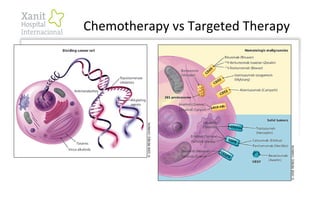
Chemotherapy vs Targeted Therapy
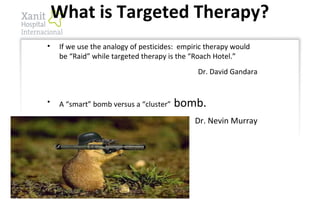
• If we use the analogy of pesticides: empiric therapy would
be “Raid” while targeted therapy is the “Roach Hotel.”
Dr. David Gandara
• A “smart” bomb versus a “cluster” bomb.
Dr. Nevin Murray
What is Targeted Therapy?
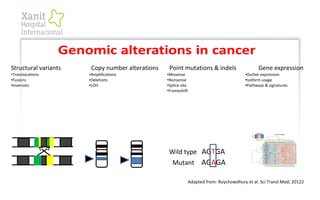
Structural variants
•Translocations
•Fusions
•Inversion
Copy number alterations
•Amplifications
•Deletions
•LOH
Point mutations & indels
•Missense
•Nonsense
•Splice site
•Frameshift
Gene expression
•Outlier expression
•Isoform usage
•Pathways & signatures
Wild type AGTGA
Mutant AGAGA
Adapted from: Roychowdhury et al. Sci Transl Med; 20122
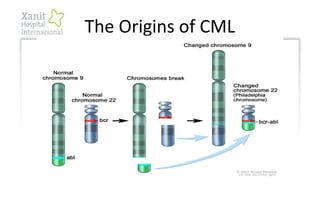
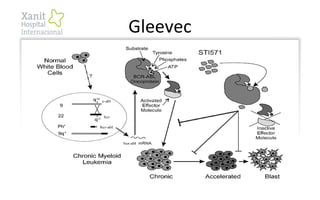
The Origins of CML
Gleevec
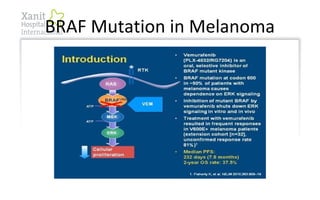
BRAF Mutation in Melanoma
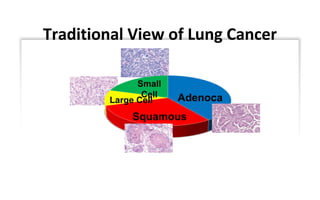
Traditional View of Lung Cancer
Adenoca
Small
Cell
Large Cell
Squamous
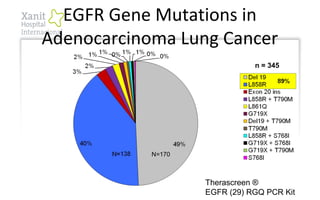
EGFR Gene Mutations in
Adenocarcinoma Lung Cancer
N=170
n = 345
Therascreen ®
EGFR (29) RGQ PCR Kit
Presentation
• EGFR mutations
– RADIANT adjuvant results in EGFR mutations
– Uncommon EGFR mutations
– Resistance in EGFR mutations (+) patients
• ALK gene rearrangements
– Resistance in ALK gene rearrangement (+) patients
• BRAF mutations
• Other mutations, fusions and amplifications
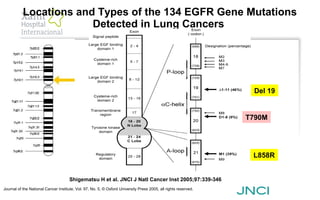
Locations and Types of the 134 EGFR Gene Mutations
Detected in Lung Cancers
Shigematsu H et al. JNCI J Natl Cancer Inst 2005;97:339-346
Journal of the National Cancer Institute, Vol. 97, No. 5, © Oxford University Press 2005, all rights reserved.
L858R
Del 19
T790M
EML4-ALK Mutation in
Lung Cancer
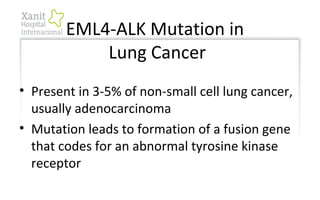
• Present in 3-5% of non-small cell lung cancer,
usually adenocarcinoma
• Mutation leads to formation of a fusion gene
that codes for an abnormal tyrosine kinase
receptor
~250 kb ~300 kb
t(2;5) ALK gene
breakpoint region
2p23 regionTelomere Centromere
3’ 5’
FISH Assay for ALK Rearrangement*
Break-apart FISH assay
for ALK-fusion genes1
ALK 29.3
EML4 42.3
ALK break-apart FISH assay
[Courtesy John Iafrate, Massachusetts General Hospital]
1
Shaw AT et al. J Clin Oncol
2009;27:4247–4253
q36.1
q36.3
q37.2
q34
q32.1
q32.3
q33.2
q31.3
q24.3
q24.1
q23.2
q22.2
q22.1
q21.2
q14.3
q14.1
q12.3
q12.1
p12
p13.2
p14
p16.1
p16.3
p22.1
p23.2
p22.3
p24.1
p24.3
p25.2
q36.1
q36.3
q37.2
q34
q32.1
q32.3
q33.2
q31.3
q24.3
q24.1
q23.2
q22.2
q22.1
q21.2
q14.3
q14.1
q12.3
q12.1
p12
p13.2
p14
p16.1
p16.3
p22.1
p23.2
p22.3
p24.1
p24.3
p25.2
Split signal
Non-split signal
*Assay is positive if rearrangements can be detected in ≥15% of cells
FISH = fluorescence in situ hybridization
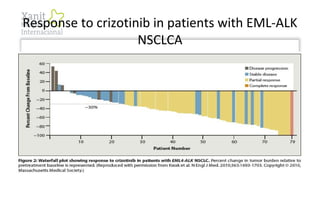
Response to crizotinib in patients with EML-ALK
NSCLCA
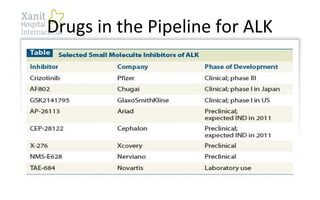
Drugs in the Pipeline for ALK
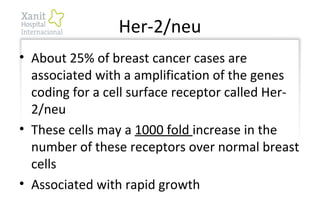
Her-2/neu
• About 25% of breast cancer cases are
associated with a amplification of the genes
coding for a cell surface receptor called Her-
2/neu
• These cells may a 1000 fold increase in the
number of these receptors over normal breast
cells
• Associated with rapid growth
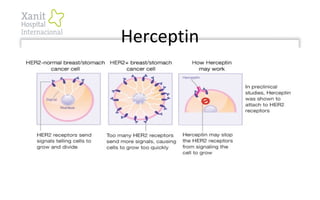
Herceptin
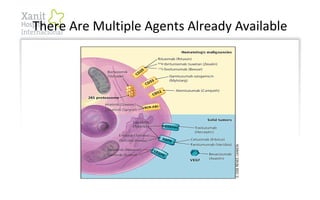
There Are Multiple Agents Already Available
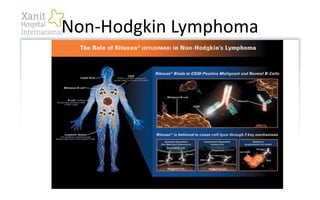
Non-Hodgkin Lymphoma
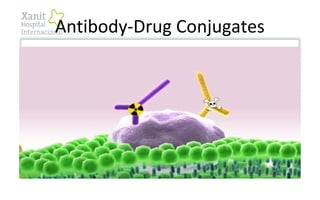
Antibody-Drug Conjugates
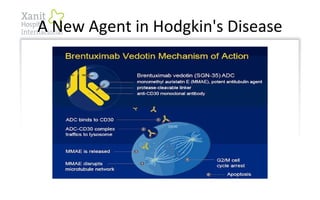
A New Agent in Hodgkin's Disease
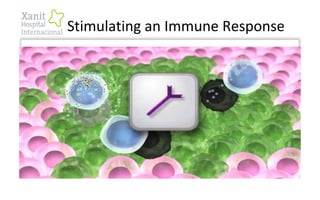
Stimulating an Immune Response
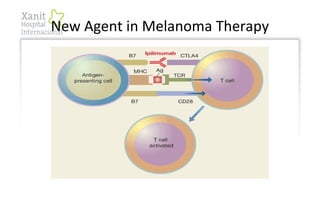
New Agent in Melanoma Therapy
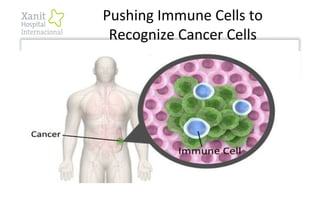
Pushing Immune Cells to
Recognize Cancer Cells
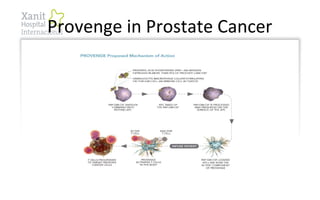
Provenge in Prostate Cancer
www.xanit.net

Targeted Therapy in Cancer

  • 1.
    Xanit Hospital Internacional Avenidade los Argonautas s/n, 29630, Benalmádena, Málaga. Tlf: 952 367 190 - Fax: 952 367 191 - www.xanit.net Xanit Oncology InstituteXanit Oncology Institute Targeted Therapy in CancerTargeted Therapy in Cancer Dr Rafael Trujillo VilchezDr Rafael Trujillo Vilchez Area de OncologArea de Oncologííaa Hospital Xanit InternacionalHospital Xanit Internacional
  • 2.
    Chemotherapy vs TargetedTherapy • Chemotherapy: – Drugs that effect cells that are doubling – Not very specific – Mostly intravenous, some oral agents – Cytotoxic • Targeted therapy: – Drugs that inhibit a more specific target in cells – Many are oral agents – Mixture of cytostatic and cytotoxic
  • 3.
  • 4.
    • If weuse the analogy of pesticides: empiric therapy would be “Raid” while targeted therapy is the “Roach Hotel.” Dr. David Gandara • A “smart” bomb versus a “cluster” bomb. Dr. Nevin Murray What is Targeted Therapy?
  • 5.
    Structural variants •Translocations •Fusions •Inversion Copy numberalterations •Amplifications •Deletions •LOH Point mutations & indels •Missense •Nonsense •Splice site •Frameshift Gene expression •Outlier expression •Isoform usage •Pathways & signatures Wild type AGTGA Mutant AGAGA Adapted from: Roychowdhury et al. Sci Transl Med; 20122
  • 8.
  • 9.
  • 10.
  • 11.
    Traditional View ofLung Cancer Adenoca Small Cell Large Cell Squamous
  • 12.
    EGFR Gene Mutationsin Adenocarcinoma Lung Cancer N=170 n = 345 Therascreen ® EGFR (29) RGQ PCR Kit
  • 13.
    Presentation • EGFR mutations –RADIANT adjuvant results in EGFR mutations – Uncommon EGFR mutations – Resistance in EGFR mutations (+) patients • ALK gene rearrangements – Resistance in ALK gene rearrangement (+) patients • BRAF mutations • Other mutations, fusions and amplifications
  • 14.
    Locations and Typesof the 134 EGFR Gene Mutations Detected in Lung Cancers Shigematsu H et al. JNCI J Natl Cancer Inst 2005;97:339-346 Journal of the National Cancer Institute, Vol. 97, No. 5, © Oxford University Press 2005, all rights reserved. L858R Del 19 T790M
  • 15.
    EML4-ALK Mutation in LungCancer • Present in 3-5% of non-small cell lung cancer, usually adenocarcinoma • Mutation leads to formation of a fusion gene that codes for an abnormal tyrosine kinase receptor
  • 16.
    ~250 kb ~300kb t(2;5) ALK gene breakpoint region 2p23 regionTelomere Centromere 3’ 5’ FISH Assay for ALK Rearrangement* Break-apart FISH assay for ALK-fusion genes1 ALK 29.3 EML4 42.3 ALK break-apart FISH assay [Courtesy John Iafrate, Massachusetts General Hospital] 1 Shaw AT et al. J Clin Oncol 2009;27:4247–4253 q36.1 q36.3 q37.2 q34 q32.1 q32.3 q33.2 q31.3 q24.3 q24.1 q23.2 q22.2 q22.1 q21.2 q14.3 q14.1 q12.3 q12.1 p12 p13.2 p14 p16.1 p16.3 p22.1 p23.2 p22.3 p24.1 p24.3 p25.2 q36.1 q36.3 q37.2 q34 q32.1 q32.3 q33.2 q31.3 q24.3 q24.1 q23.2 q22.2 q22.1 q21.2 q14.3 q14.1 q12.3 q12.1 p12 p13.2 p14 p16.1 p16.3 p22.1 p23.2 p22.3 p24.1 p24.3 p25.2 Split signal Non-split signal *Assay is positive if rearrangements can be detected in ≥15% of cells FISH = fluorescence in situ hybridization
  • 17.
    Response to crizotinibin patients with EML-ALK NSCLCA
  • 18.
    Drugs in thePipeline for ALK
  • 20.
    Her-2/neu • About 25%of breast cancer cases are associated with a amplification of the genes coding for a cell surface receptor called Her- 2/neu • These cells may a 1000 fold increase in the number of these receptors over normal breast cells • Associated with rapid growth
  • 21.
  • 22.
    There Are MultipleAgents Already Available
  • 24.
  • 25.
  • 26.
    A New Agentin Hodgkin's Disease
  • 27.
  • 28.
    New Agent inMelanoma Therapy
  • 29.
    Pushing Immune Cellsto Recognize Cancer Cells
  • 30.
  • 31.

Editor's Notes

  • #7 we will first review three types of drugs that can be used as targeted therapies—small molecules, antibodies, and vaccines.
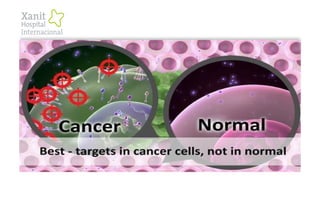
  • #8 The best target for therapy is a molecule or pathway that is present in cancer cells and absent in normal cells.
  • #9 The Philadelphia chromosome was first discovered and described in 1960 by Peter Nowell from University of Pennsylvania School of Medicine[8] and David Hungerford from the Fox Chase Cancer Center The exact chromosomal defect in Philadelphia chromosome is a translocation, in which parts of two chromosomes, 9 and 22, swap places. The result is that a fusion gene is created by juxtapositioning the Abl1 gene on chromosome 9 (region q34) to a part of the BCR ("breakpoint cluster region") gene on chromosome 22 (region q11)
  • #11 The BRAF mutation causes cells to proliferate without any control or normal programmed cell death (apoptosis). Approximately 50% of melanoma cells have the mutated BRAF gene. It is more common in the young and more likely present in metastatic disease compared with primary melanoma.
  • #15 Locations and types of the 134 epidermal growth factor receptor (EGFR) gene mutations detected in lung cancers. The structure of the EGFR gene is shown at left, and the locations and types of the mutations in the tyrosine kinase (TK) domain are shown at right. All mutations were located within exons 18–21, which encode the N lobe and part of the C lobe of EGFR (shaded area of the gene on the left, which is presented in magnified form on the right). Three major types of mutations (shown in bold) formed 94% of the 134 mutations detected and consisted of deletions in exon 19 immediately 5′ of the αC-helix (11 types, labeled Δ1–Δ11), duplications and/or insertions in exon 20 immediately 3′ of the αC-helix (eight types labeled D1–D8), and a single-point mutation, L858R (labeled M1), in the A-loop. The remaining 6% of mutations consisted of missense mutations in the P-loop in exon 18 (six types labeled M2–M7), in the αC-helix in exon 20 (a single type labeled M8), or in the A-loop in exon 21 (a single type labeled M9).
  • #16 The EML4-ALK fusion gene is responsible for approximately 3-5% of non-small-cell lung cancer(NSCLC). The vast majority of cases are adenocarcinomas. Through an unknown mechanism, cells with this mutation can no longer control their growth cycle, leading to uncontrolled proliferation and the potential for cancer.
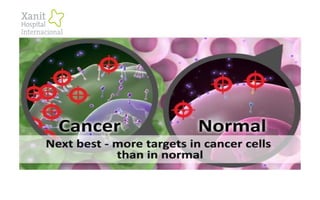
  • #20 The next best target for therapy is a molecule that is present more frequently in cancer cells compared to normal cells. In this case, it may be possible to adjust the dose of a drug so that cancer cells are killed more often than nearby normal cells.
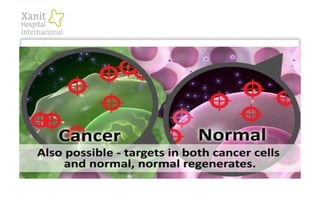
  • #24 Other possible targets for therapy include molecules that are present on both cancer cells and normal cells, but the patient's body can replace the normal cells that get destroyed.
  • #26 Second, they can also be used as delivery vehicles, guiding radioactive molecules or toxins to the cancer cells.
  • #27 an antibody-drug conjugate that works by binding to CD30 proteins on the surface of Hodgkin lymphoma cells. The ADC then forms a complex with CD30 and enters the cell. Inside the cell, the ADC’s chemotherapy component is released and kills the cancer cell. [
  • #28 Third, antibodies attached to a cell can trigger an immune response that destroys the cell.
  • #29 Ipilimumab or Yervoy is a monoclonal antibody against the CTLA-4 receptor on T cells (white blood cells that fight cancer). By blocking this receptor the T cell remains activated against cancer cells such as melanoma. Two phase III trials have shown a survival benefit over traditional melanoma treatment in the form of Dacarbazine or a peptide vaccine. The most recent presented at ASCO in June 2011 showed higher survival rates at 1 year (47.3% v’s 36.3%), 2 years (28.5% v’s 17.9%) and at 3 years (20.8% v’s 11.6%).
  • #30 Unlike other targeted therapies, therapeutic cancer vaccines do not act specifically on pathways in cancer cells. Instead, they act broadly by trying to activate the body's immune system to make it recognize and attack cancer cells. Eg: interleukin 2
  • #31 Developed based on concept of antigen-presenting cells (APCs), which include dendritic cells, macrophages and B lymphocytes APCs from patients blood are harvested by leukapheresis, sent to drug company (Dendreon), where they are incubated with recombinant fusion protein antigen containing PAP (prostatic acid phosphatase) and GM-CSF (granulocyte-macrophage colony-stimulating factor)
● These antigen-loaded APCs are infused into patient, and may prime a T-cell mediated immune response against prostatic cancer cells (J Clin Oncol 2006;24:3089)
  • #32 Sin duda, los directivos influyen notablemente en el grado de felicidad de las personas en el trabajo, pero la responsabilidad definitiva es de cada uno. Los directivos tienen tres obligaciones respecto de la felicidad en el lugar del trabajo: 1.- Lograr la satisfacción para sí. Un líder feliz es un modelo natural para sus empleados y contagia la buena disposición por naturaleza propia. El insatisfecho no puede crear la atmósfera de alegría para que la gente rinda al máximo en su trabajo. 2.- Conocer a su gente y ocuparse de ellos. No pueden estar a cargo de personas sin demostrar interés en ellos y conocerlos profundamente. 3.- Crear una atmósfera que ayude a la gente sentirse feliz. Abierta, positiva, con espíritu de equipo… Condiciones que la empresa debe de asegurar para que la felicidad sea posible. Condiciones mínimas: - Generar condiciones de trabajos seguros y sanos - Remuneraciones acordes a responsabilidades Otros factores que las empresas pueden estimular cuando se trata de hacer la empresa un lugar donde la felicidad sea más probable son: - Preocuparse por generar espacios que mejoren la calidad de vida de las personas - Generación y entrega de estímulos que puede hacer felices a su personal, materializados en viajes, premios, fiestas, guarderías… - Compatibilización de horarios de trabajo con los de la familia (Conciliación).