Contents
• Introduction
• What is Cancer?
• Classification
• Risk Factors
• Signals
• Detection
• Effects
• Treatments
• Dietary management
• Antioxidants v/s Free radicals
• Important Antioxidants
• Lifestyle changes
• Summery
Introduction
• A high intake of Antioxidants reduces
Cancer risk.
• Cancer treatments lead to oxidative
stress.
• Antioxidants fight against Free radicals.
What is Cancer?
• Refers to malignant neoplasm or tumor
• Mutation of cellular genes
• Uncontrolled growth
• Invasion
• Metastasis
What is Cancer?
• Exposure to chemical, physical &
biological factors
• Occur at any age
• In any part of the body
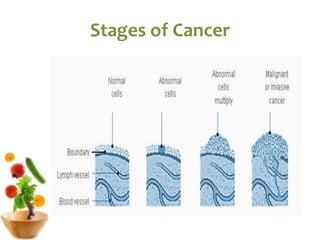
Stages of Cancer
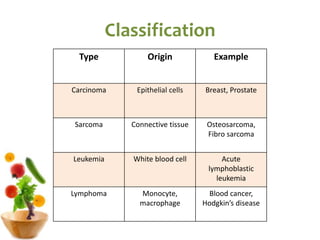
Classification
Type Origin Example
Carcinoma Epithelial cells Breast, Prostate
Sarcoma Connective tissue Osteosarcoma,
Fibro sarcoma
Leukemia White blood cell Acute
lymphoblastic
leukemia
Lymphoma Monocyte,
macrophage
Blood cancer,
Hodgkin’s disease
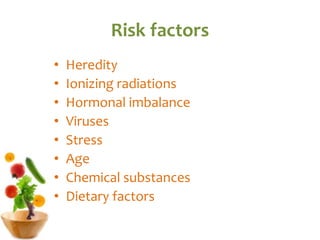
Risk factors
• Heredity
• Ionizing radiations
• Hormonal imbalance
• Viruses
• Stress
• Age
• Chemical substances
• Dietary factors
Risk factors
(chemical substances)
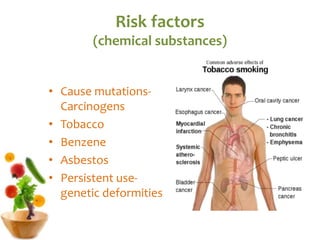
• Cause mutations-
Carcinogens
• Tobacco
• Benzene
• Asbestos
• Persistent use-
genetic deformities
Risk factors
(Dietary)
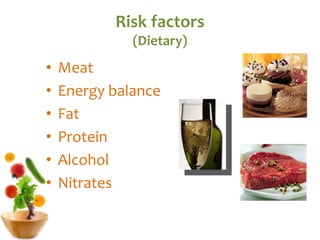
• Meat
• Energy balance
• Fat
• Protein
• Alcohol
• Nitrates
Signs & symptoms
• Local symptoms:
 Lumps
 Swellings
 Hemorrhage
 Ulceration
 Pain
• Metastatic symptoms:
 Enlarged lymph nodes
 Enlarged liver, spleen
 Pain or fracture of
bones
 Neurological symptoms
• Systemic symptoms:
 Weight loss
 Fatigue
 Sweating
 Anemia
 Immunological or
hormonal signals
Identification
• Breast Cancer
 Self examination
 Mammograms
 Clinical Breast
Exam
• Prostate Cancer
 DRE
 PSA
• Colon/Rectum
 Stool blood test
annually
 Digital rectal exam
 Sigmoidoscopy
 Colonoscopy
(virtual)
Identification
• Ovarian Cancer
Annual pelvic exam
Pelvic ultrasound with vaginal probe
• Cervical Cancer
Pelvic Exam
PAP Test
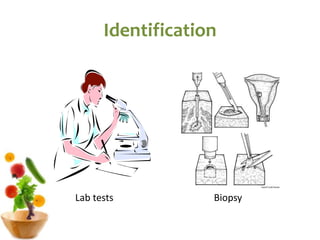
Identification
Biopsy
Lab tests
Systemic effects
• Abnormalities in
metabolism
• Anorexia
• Mal-absorption
• Fluid-electrolyte
imbalance
• Anemia
• Taste & appetite
changes
• Learned food
aversions
• Hypercalcemia
• osteomalacia
Treatments &
nutritional problems
• Chemotherapy
 Affects rapidly multiplying cells
 Both cancer & normal cells
 Cause side effects
 G.I. symptoms
 Anemia
 Fluid-electrolyte imbalance
 Changes in skin, hair/scalp, hearing, muscle,
blood, fertility, etc.
Treatments &
nutritional problems
• Radiotherapy
Loss of taste/ sensation
Anorexia, nausea, decreased appetite
Intestinal damage
Hemorrhage, obstruction
Diarrhea, mal-absorption
Lead to nutritional problems
Treatments &
nutritional problems
• Surgery
G.I., Head & neck surgery, Gastrectomy,
pancreatectomy
Improper ingestion, digestion & absorption
Loss of digestive enzymes
Long term tube feeding
Induced insulin dependent diabetes
Weight loss
Dietary management
• Objectives:
To meet increased metabolic demands
Prevent catabolism
Reduce symptoms
Dietary management
• Energy-(2000-
4000Kcal)
 Degree of
malnutrition &
Body trauma
 Excessive weight
loss
 Increased
metabolic demands
 Spare protein
• Protein-(80-100gm)
 Tissue regeneration
 Healing
 Rehabilitation
 Ensure anabolism
 Positive nitrogen
balance
Dietary management
• Vitamins & minerals
Optimal recommended intake
Supplements according to nutritional
status
• Fluid
Increased to compensate losses
To help kidneys
Protect against irritation & inflammation
Antioxidants v/s
Cancer
• Antioxidants- a molecule capable of
inhibiting the oxidation
• prevents cellular damage
• Free radicals- atoms or group of atoms
with unpaired electrons
• Formed on oxidation
• Pathway for cancer, aging, and a variety
of diseases
Antioxidants v/s
Cancer
• Apoptosis- Process of programmed cell
death
• 50-70 billion cells/ day die
• Excess- Atrophy like, ischemic damage
• Insufficient- Uncontrolled cell growth
• Antioxidants induces Apoptosis in
Cancer cells
• Potential role in Cancer
Important antioxidants
• β- carotene
 Lung cancer &
stomach, cervix,
esophageal,
throat, etc.
 CV disease in
smokers
 GLV’s, yellow-
orange fruits &
veggies
• Vitamin C
 G.I. tract, cervix
cancer
 CV disease
 Citrus fruits,
sprouted pulses
Important antioxidants
• Vitamin E
 Oral & pharyngeal
cancer
 CV diseases
 Cereals, cereal
products, oil seeds,
nuts
• Selenium, zinc,
copper & iron
 Esophageal &
stomach cancer
 Meats, seafood,
cereals & pulses
 Oysters, liver,
mushroom, nuts,
chocolate
Important
phyto-chemicals
• Terpenes
Act as antioxidant
Inhibit tumor growth
Tomatoes, parsley, oranges & spinach
• Lycopene
Two times as powerful as β- carotene
Reduce risk of prostate cancer
Tomatoes
Important
phyto-chemicals
• Flavonoids & phenols
 Scavenge free radical compounds
 Reduce risk of cancer
 Parsley, carrots, citrus fruits, cabbage,
cucumber, tomato, soy products, etc
• Isoflavones
 Act as carcinogen blockers
 Effective against hormone related cancers
 Soya bean & products
Important
phyto-chemicals
• Thiols
Sulphur containing phytonutrient
Regulate detoxifying enzymes
garlic & broccoli, cauliflower, cabbage
etc.
• Lignans
Protect against hormone related
cancers
Flax seeds, wheat bran, barley etc.
Improving
antioxidant intake
• Try new fruit or vegetable each week
• Double the normal serving size for
vegetables
• Eat fruit with curd
• Incorporate veggies in cereals & pulses
• Eating fruit as a snack
• Adding veggies to favorite recipes
Lifestyle changes
• Stop using tobacco
• Limit alcohol consumption
• Maintain a reasonable weight
• Increase physical activity
• Eat 5-9 fruits and vegetables daily
• Increase fiber and reduce fat
• Limit exposure to the sun
Cancer & Antioxidants-1.ppt

Cancer & Antioxidants-1.ppt

  • 2.
    Contents • Introduction • Whatis Cancer? • Classification • Risk Factors • Signals • Detection • Effects • Treatments • Dietary management • Antioxidants v/s Free radicals • Important Antioxidants • Lifestyle changes • Summery
  • 3.
    Introduction • A highintake of Antioxidants reduces Cancer risk. • Cancer treatments lead to oxidative stress. • Antioxidants fight against Free radicals.
  • 4.
    What is Cancer? •Refers to malignant neoplasm or tumor • Mutation of cellular genes • Uncontrolled growth • Invasion • Metastasis
  • 5.
    What is Cancer? •Exposure to chemical, physical & biological factors • Occur at any age • In any part of the body
  • 6.
  • 7.
    Classification Type Origin Example CarcinomaEpithelial cells Breast, Prostate Sarcoma Connective tissue Osteosarcoma, Fibro sarcoma Leukemia White blood cell Acute lymphoblastic leukemia Lymphoma Monocyte, macrophage Blood cancer, Hodgkin’s disease
  • 8.
    Risk factors • Heredity •Ionizing radiations • Hormonal imbalance • Viruses • Stress • Age • Chemical substances • Dietary factors
  • 9.
    Risk factors (chemical substances) •Cause mutations- Carcinogens • Tobacco • Benzene • Asbestos • Persistent use- genetic deformities
  • 10.
    Risk factors (Dietary) • Meat •Energy balance • Fat • Protein • Alcohol • Nitrates
  • 11.
    Signs & symptoms •Local symptoms:  Lumps  Swellings  Hemorrhage  Ulceration  Pain • Metastatic symptoms:  Enlarged lymph nodes  Enlarged liver, spleen  Pain or fracture of bones  Neurological symptoms • Systemic symptoms:  Weight loss  Fatigue  Sweating  Anemia  Immunological or hormonal signals
  • 12.
    Identification • Breast Cancer Self examination  Mammograms  Clinical Breast Exam • Prostate Cancer  DRE  PSA • Colon/Rectum  Stool blood test annually  Digital rectal exam  Sigmoidoscopy  Colonoscopy (virtual)
  • 13.
    Identification • Ovarian Cancer Annualpelvic exam Pelvic ultrasound with vaginal probe • Cervical Cancer Pelvic Exam PAP Test
  • 14.
  • 15.
    Systemic effects • Abnormalitiesin metabolism • Anorexia • Mal-absorption • Fluid-electrolyte imbalance • Anemia • Taste & appetite changes • Learned food aversions • Hypercalcemia • osteomalacia
  • 16.
    Treatments & nutritional problems •Chemotherapy  Affects rapidly multiplying cells  Both cancer & normal cells  Cause side effects  G.I. symptoms  Anemia  Fluid-electrolyte imbalance  Changes in skin, hair/scalp, hearing, muscle, blood, fertility, etc.
  • 17.
    Treatments & nutritional problems •Radiotherapy Loss of taste/ sensation Anorexia, nausea, decreased appetite Intestinal damage Hemorrhage, obstruction Diarrhea, mal-absorption Lead to nutritional problems
  • 18.
    Treatments & nutritional problems •Surgery G.I., Head & neck surgery, Gastrectomy, pancreatectomy Improper ingestion, digestion & absorption Loss of digestive enzymes Long term tube feeding Induced insulin dependent diabetes Weight loss
  • 19.
    Dietary management • Objectives: Tomeet increased metabolic demands Prevent catabolism Reduce symptoms
  • 20.
    Dietary management • Energy-(2000- 4000Kcal) Degree of malnutrition & Body trauma  Excessive weight loss  Increased metabolic demands  Spare protein • Protein-(80-100gm)  Tissue regeneration  Healing  Rehabilitation  Ensure anabolism  Positive nitrogen balance
  • 21.
    Dietary management • Vitamins& minerals Optimal recommended intake Supplements according to nutritional status • Fluid Increased to compensate losses To help kidneys Protect against irritation & inflammation
  • 22.
    Antioxidants v/s Cancer • Antioxidants-a molecule capable of inhibiting the oxidation • prevents cellular damage • Free radicals- atoms or group of atoms with unpaired electrons • Formed on oxidation • Pathway for cancer, aging, and a variety of diseases
  • 23.
    Antioxidants v/s Cancer • Apoptosis-Process of programmed cell death • 50-70 billion cells/ day die • Excess- Atrophy like, ischemic damage • Insufficient- Uncontrolled cell growth • Antioxidants induces Apoptosis in Cancer cells • Potential role in Cancer
  • 24.
    Important antioxidants • β-carotene  Lung cancer & stomach, cervix, esophageal, throat, etc.  CV disease in smokers  GLV’s, yellow- orange fruits & veggies • Vitamin C  G.I. tract, cervix cancer  CV disease  Citrus fruits, sprouted pulses
  • 25.
    Important antioxidants • VitaminE  Oral & pharyngeal cancer  CV diseases  Cereals, cereal products, oil seeds, nuts • Selenium, zinc, copper & iron  Esophageal & stomach cancer  Meats, seafood, cereals & pulses  Oysters, liver, mushroom, nuts, chocolate
  • 26.
    Important phyto-chemicals • Terpenes Act asantioxidant Inhibit tumor growth Tomatoes, parsley, oranges & spinach • Lycopene Two times as powerful as β- carotene Reduce risk of prostate cancer Tomatoes
  • 27.
    Important phyto-chemicals • Flavonoids &phenols  Scavenge free radical compounds  Reduce risk of cancer  Parsley, carrots, citrus fruits, cabbage, cucumber, tomato, soy products, etc • Isoflavones  Act as carcinogen blockers  Effective against hormone related cancers  Soya bean & products
  • 28.
    Important phyto-chemicals • Thiols Sulphur containingphytonutrient Regulate detoxifying enzymes garlic & broccoli, cauliflower, cabbage etc. • Lignans Protect against hormone related cancers Flax seeds, wheat bran, barley etc.
  • 29.
    Improving antioxidant intake • Trynew fruit or vegetable each week • Double the normal serving size for vegetables • Eat fruit with curd • Incorporate veggies in cereals & pulses • Eating fruit as a snack • Adding veggies to favorite recipes
  • 30.
    Lifestyle changes • Stopusing tobacco • Limit alcohol consumption • Maintain a reasonable weight • Increase physical activity • Eat 5-9 fruits and vegetables daily • Increase fiber and reduce fat • Limit exposure to the sun