What is Canal Fall?
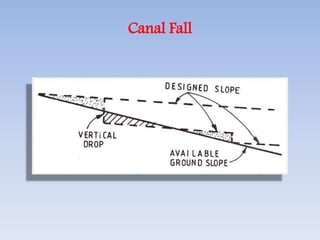
• Whenever the available natural ground slope
is steep than the designed bed slope of the
channel, the difference is adjusted by
constructing vertical ‘falls’ or ‘drops’ in the canal
bed at suitable intervals, as shown in figure
below.
• Such a drop in a natural canal bed will not be
stable and, therefore, in order to retain this drop,
a masonry structure is constructed. Such a
structure is called a Canal Fall or a Canal
drop.
Canal Fall
Canal Fall
Irrigation canals are designed for a prescribed bed
slope so that velocity becomes non silting or non
scouring. But if the ground topography is such that in
order to maintain the canal designed slope, indefinite
filling from falling ground level is to be made.
This indefinite filling is avoided by constructing a
hydraulic structure in the place of sudden bed level.
This hydraulic structure is called canal fall or drop.
Beyond the canal fall, canal again maintains its
designed slope.
Necessity of Canal Falls
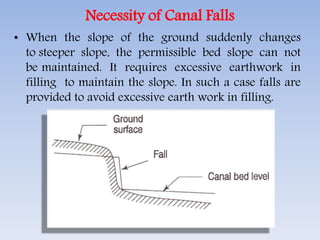
• When the slope of the ground suddenly changes
to steeper slope, the permissible bed slope can not
be maintained. It requires excessive earthwork in
filling to maintain the slope. In such a case falls are
provided to avoid excessive earth work in filling.
Necessity of Canal Falls
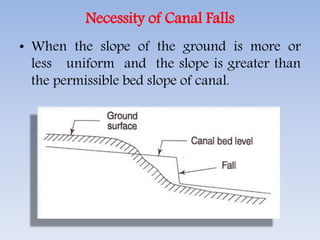
• When the slope of the ground is more or
less uniform and the slope is greater than
the permissible bed slope of canal.
Necessity of Canal Falls
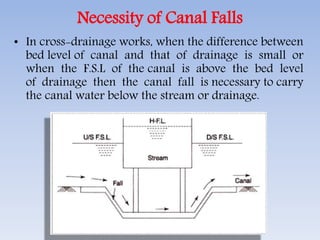
• In cross-drainage works, when the difference between
bed level of canal and that of drainage is small or
when the F.S.L of the canal is above the bed level
of drainage then the canal fall is necessary to carry
the canal water below the stream or drainage.
Types of Canal Fall
• Depending on the ground level conditions and
shape of the fall the various types of fall are:
Ogee Fall
• This type of fall has gradual convex and concave
surfaces i.e. in the ogee form.
• The gradual convex and concave surface is
provided with an aim to provide smooth
transition and to reduce disturbance and impact.
• A hydraulic jump is formed which dissipates a
part of kinetic energy.
• Upstream and downstream of the fall is provided
by Stone Pitching.
Ogee Fall
Types of Canal Fall
Rapid Fall
• When the natural ground level is even and
rapid, this rapid fall is suitable.
• It consists of long sloping glacis.
• Curtain walls are provided on both u/s and d/s
sides.
• Rubble masonry with cement grouting is
provided from u/s curtain wall to d/s curtain
wall.
• Masonry surface is finished with a rich
cement mortar.
Rapid Fall
Types of Canal Fall
Stepped Fall
• It consists of a series of vertical drops in the form of
steps.
• This steps is suitable in places where sloping ground is
very long and require a long glacis to connect the
higher bed level u/s with lower bed level d/s.
• It is practically a modification of rapid fall. The
sloping glacis is divided into a number of drops to
bring down the canal bed step by step to protect the
canal bed and sides from damage by erosion.
• Brick walls are provided at each drop. The bed of the
canal within the fall is protected by rubble masonry
with surface finishing by rich cement mortar.
Stepped Fall
Types of Canal Fall
Vertical Fall (Sarda Fall)
• In the vertical drop type fall the clear nappe
leaving the crest is made to impinge into a
cistern below.
• The cistern provides a water cushion and helps
to dissipate the surplus energy of the falling jet.
• Floor is made of concrete u/s and d/s side stone
pitching with cement grouting is provided.
• This type of fall is used in Sarda Canal UP and
therefore, it is also called Sarda Fall.
Vertical Fall
Types of Canal Fall
Straight Glacis Fall
• It consists of a straight glacis provided
with a crest wall.
• For dissipation of energy of flowing water,
a water cushion is provided.
• Curtain walls are provided at toe and heel.
• Stone pitching is required at upstream and
downstream of the fall.
Straight Glacis Fall
Types of Canal Fall
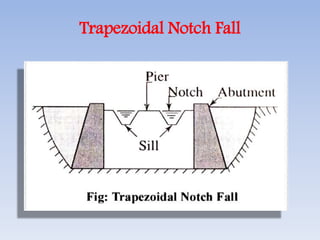
Trapezoidal Notch Fall
• In this type a body or foundation wall across the
channel consisting of several trapezoidal notches
between side pier and intermediate pier is
constructed.
• The sill of the notches are kept at upstream bed
level of the canal.
• The body wall is made of concrete.
• An impervious floor is provided to resist the
scouring effect of falling water.
• Upstream and downstream side of the fall is
protected by stone pitching finished with cement
grouting
Trapezoidal Notch Fall
Types of Canal Fall
Well or Cylinder Notch Fall
• In this type, water of canal from higher level
is thrown in a well or a cylinder from where
it escapes from bottom.
• Energy is dissipated in the well in turbulence.
• They are suitable for low discharges and are
economical also.
Types of Canal Fall
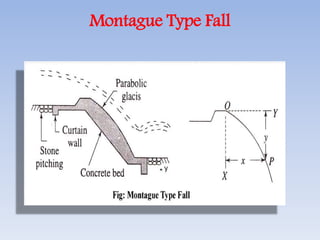
Montague Type Fall
• In the straight glacis type profile, energy
dissipation is not complete.
• Therefore, montague developed this type of
profile where energy dissipation takes place.
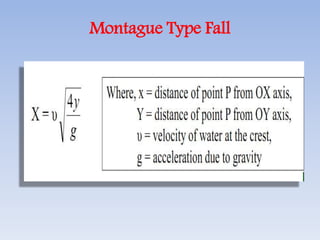
• This profile is parabolic and is given by the
following equation,
Montague Type Fall
Montague Type Fall
Types of Canal Fall
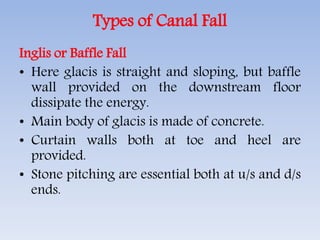
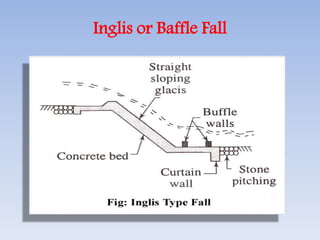
Inglis or Baffle Fall
• Here glacis is straight and sloping, but baffle
wall provided on the downstream floor
dissipate the energy.
• Main body of glacis is made of concrete.
• Curtain walls both at toe and heel are
provided.
• Stone pitching are essential both at u/s and d/s
ends.
Inglis or Baffle Fall
Canal Escape
• It is a side channel constructed to remove
surplus water from an irrigation channel (main
canal, branch canal, or distributary etc.) into a
natural drain.
• The water in the irrigation channel may become
surplus due to -
• Mistake
• Difficulty in regulation at the head
• Excessive rainfall in the upper reaches
• Outlets being closed by cultivators as they find
the demand of water is over

Canal falls

  • 1.
    What is CanalFall? • Whenever the available natural ground slope is steep than the designed bed slope of the channel, the difference is adjusted by constructing vertical ‘falls’ or ‘drops’ in the canal bed at suitable intervals, as shown in figure below. • Such a drop in a natural canal bed will not be stable and, therefore, in order to retain this drop, a masonry structure is constructed. Such a structure is called a Canal Fall or a Canal drop.
  • 2.
  • 3.
    Canal Fall Irrigation canalsare designed for a prescribed bed slope so that velocity becomes non silting or non scouring. But if the ground topography is such that in order to maintain the canal designed slope, indefinite filling from falling ground level is to be made. This indefinite filling is avoided by constructing a hydraulic structure in the place of sudden bed level. This hydraulic structure is called canal fall or drop. Beyond the canal fall, canal again maintains its designed slope.
  • 4.
    Necessity of CanalFalls • When the slope of the ground suddenly changes to steeper slope, the permissible bed slope can not be maintained. It requires excessive earthwork in filling to maintain the slope. In such a case falls are provided to avoid excessive earth work in filling.
  • 5.
    Necessity of CanalFalls • When the slope of the ground is more or less uniform and the slope is greater than the permissible bed slope of canal.
  • 6.
    Necessity of CanalFalls • In cross-drainage works, when the difference between bed level of canal and that of drainage is small or when the F.S.L of the canal is above the bed level of drainage then the canal fall is necessary to carry the canal water below the stream or drainage.
  • 7.
    Types of CanalFall • Depending on the ground level conditions and shape of the fall the various types of fall are: Ogee Fall • This type of fall has gradual convex and concave surfaces i.e. in the ogee form. • The gradual convex and concave surface is provided with an aim to provide smooth transition and to reduce disturbance and impact. • A hydraulic jump is formed which dissipates a part of kinetic energy. • Upstream and downstream of the fall is provided by Stone Pitching.
  • 8.
  • 9.
    Types of CanalFall Rapid Fall • When the natural ground level is even and rapid, this rapid fall is suitable. • It consists of long sloping glacis. • Curtain walls are provided on both u/s and d/s sides. • Rubble masonry with cement grouting is provided from u/s curtain wall to d/s curtain wall. • Masonry surface is finished with a rich cement mortar.
  • 10.
  • 11.
    Types of CanalFall Stepped Fall • It consists of a series of vertical drops in the form of steps. • This steps is suitable in places where sloping ground is very long and require a long glacis to connect the higher bed level u/s with lower bed level d/s. • It is practically a modification of rapid fall. The sloping glacis is divided into a number of drops to bring down the canal bed step by step to protect the canal bed and sides from damage by erosion. • Brick walls are provided at each drop. The bed of the canal within the fall is protected by rubble masonry with surface finishing by rich cement mortar.
  • 12.
  • 13.
    Types of CanalFall Vertical Fall (Sarda Fall) • In the vertical drop type fall the clear nappe leaving the crest is made to impinge into a cistern below. • The cistern provides a water cushion and helps to dissipate the surplus energy of the falling jet. • Floor is made of concrete u/s and d/s side stone pitching with cement grouting is provided. • This type of fall is used in Sarda Canal UP and therefore, it is also called Sarda Fall.
  • 14.
  • 15.
    Types of CanalFall Straight Glacis Fall • It consists of a straight glacis provided with a crest wall. • For dissipation of energy of flowing water, a water cushion is provided. • Curtain walls are provided at toe and heel. • Stone pitching is required at upstream and downstream of the fall.
  • 16.
  • 17.
    Types of CanalFall Trapezoidal Notch Fall • In this type a body or foundation wall across the channel consisting of several trapezoidal notches between side pier and intermediate pier is constructed. • The sill of the notches are kept at upstream bed level of the canal. • The body wall is made of concrete. • An impervious floor is provided to resist the scouring effect of falling water. • Upstream and downstream side of the fall is protected by stone pitching finished with cement grouting
  • 18.
  • 19.
    Types of CanalFall Well or Cylinder Notch Fall • In this type, water of canal from higher level is thrown in a well or a cylinder from where it escapes from bottom. • Energy is dissipated in the well in turbulence. • They are suitable for low discharges and are economical also.
  • 20.
    Types of CanalFall Montague Type Fall • In the straight glacis type profile, energy dissipation is not complete. • Therefore, montague developed this type of profile where energy dissipation takes place. • This profile is parabolic and is given by the following equation,
  • 21.
  • 22.
  • 23.
    Types of CanalFall Inglis or Baffle Fall • Here glacis is straight and sloping, but baffle wall provided on the downstream floor dissipate the energy. • Main body of glacis is made of concrete. • Curtain walls both at toe and heel are provided. • Stone pitching are essential both at u/s and d/s ends.
  • 24.
  • 25.
    Canal Escape • Itis a side channel constructed to remove surplus water from an irrigation channel (main canal, branch canal, or distributary etc.) into a natural drain. • The water in the irrigation channel may become surplus due to - • Mistake • Difficulty in regulation at the head • Excessive rainfall in the upper reaches • Outlets being closed by cultivators as they find the demand of water is over