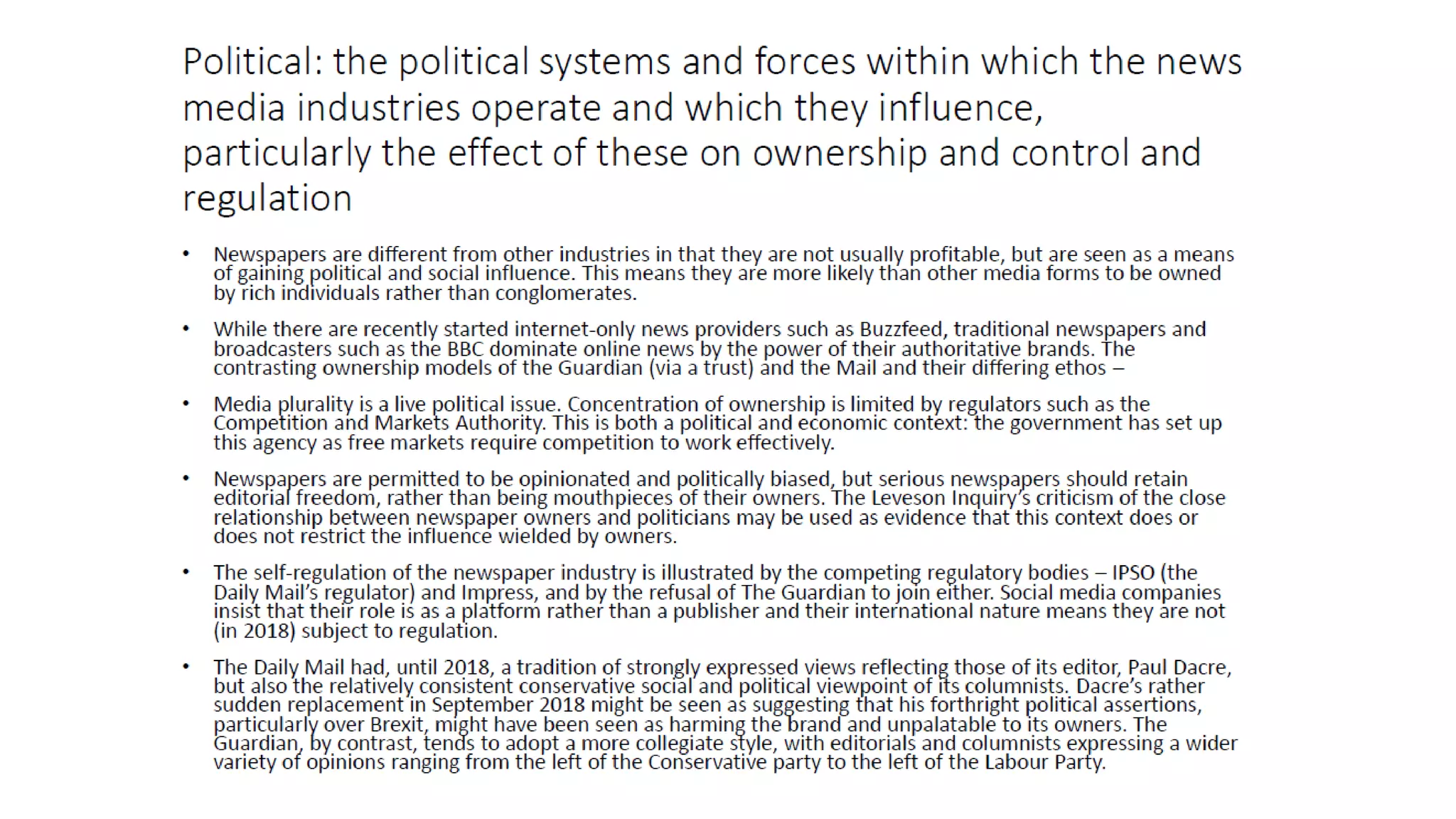
Explain how the political context in which
newspapers are produced, influences their
ownership and regulation. Refer to The Guardian
and The Daily Mail newspapers you have studied
to support your answer. [10]
Lesson Objectives: to explore the impact of
contexts in relation to the newspaper industry
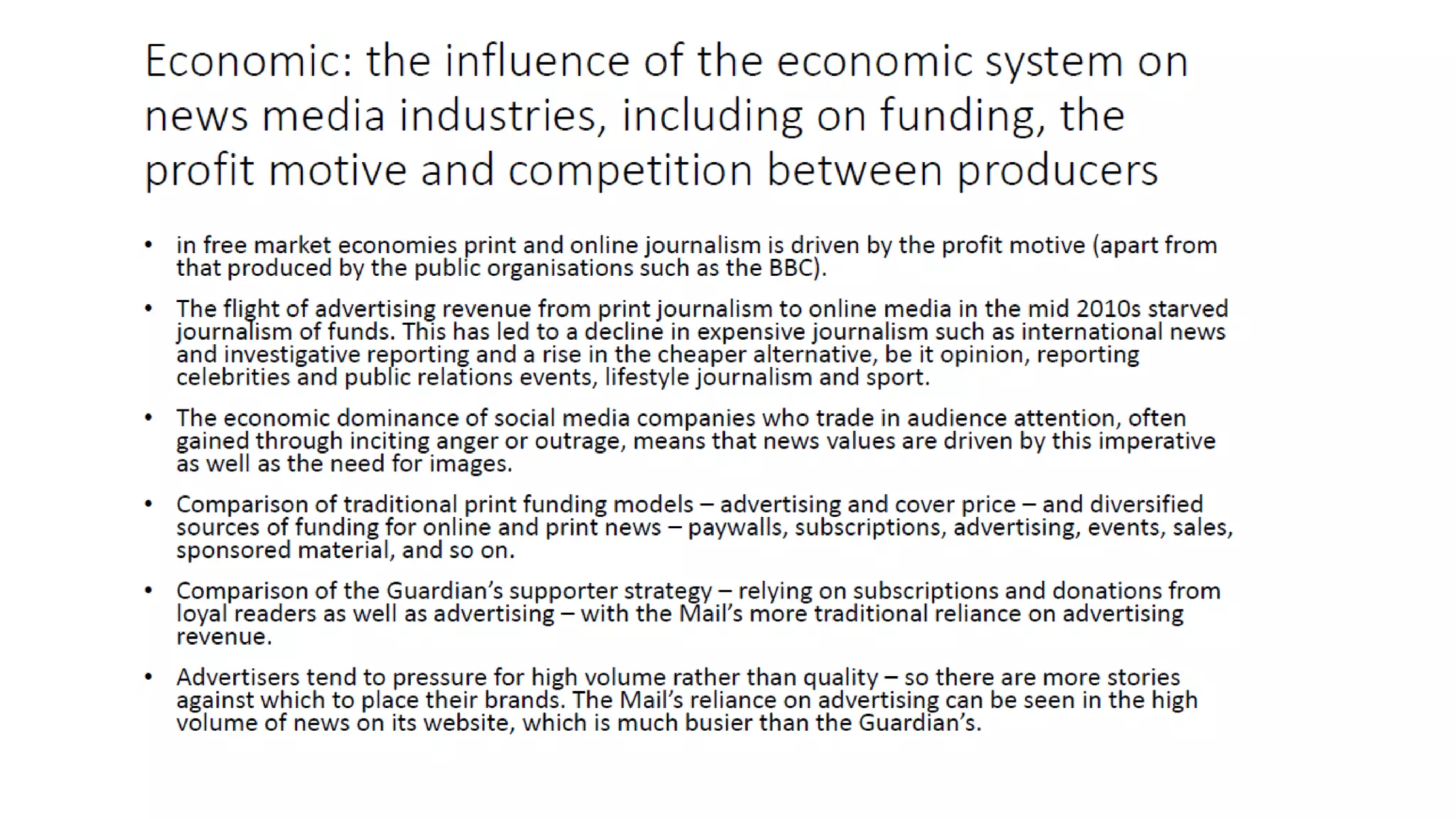
Economic contexts
• Declining print circulation – compare 2000 figures with 2019 figures
• Online readership – www.newsworks.org.uk
Compare online readership to those from October 2018 (they are rapidly
going out of date – proving how quickly online news is surging ahead.)
1. Which newspaper is more reliant on its online editions and social media
feeds compared to its print editions?
2. How, if at all, have these figures changed since October 2018?
3. The Guardian has a strategy of trying to attract ‘supporters’ (loyal
readers) rather than attracting readers to individual stories through clicks
on social media. How does the data suggest this strategy is working?
Political contexts
• Look at the concentration of ownership – circulation percentage of total sold in
the UK.
News International (Sun, The Times) 36%
Daily Mail and General Trust (Daily Mail) 23%
Reach plc (Daily Express, Daily Star and Daily Mirror) 23%
Telegraph Group (Daily Telegraph) 7%
Johnston Press (i) 5%
Nikkei/Financial Times Ltd (Financial Times) 4%
Guardian Media Group (The Guardian) 2%
1. What percentage of daily circulation is owned by the top three owners?
2. Name the two writers who argue that concentration of ownership decreases
quality and choice in newspapers.
Social and Cultural Contexts
Applying the ‘ideology toolkit’ to news articles you read. Look closely at media language
and see if you can find examples in the stories/layout/ news values.
• Individualism
• Liberal Democracy
• Welfarism
• Materialism
• Consumerism
• Sexism/patriarchal ideology
• Feminism
• Racism
• Anti-racism or Multiculturalism
• Ethnocentrism (or post-colonial melancholia)
Explain how the political context in which newspapers are produced, influences their
ownership and regulation. Refer to The Guardian and The Daily Mail newspapers you
have studied to support your answer. [10]
Influences
Profit
Political
Scott Trust
freedom in speech
free press
Proprietor
Regulation
Oligopolistic
What do these terms mean and why are
they significant?
Fill in the gaps on your example answer.
Examiner commentary
There is comprehensive knowledge and understanding of the political
contexts of media and their influence on media products and processes
meeting AO1. There is comprehensive demonstration of the knowledge and
understanding of how political contexts influence newspaper ownership and
regulation. This is also a balanced response to the question set with detailed
and accurate knowledge and understanding of relevant political contexts
included in the response, for example, the power of the press to shape
political discourse and influence policy highlights the important influence
that the relationship between politicians and the press has through providing
opportunities for political affiliations and bias. The answer is well supported
by detailed and accurate reference to The Guardian and The Daily Mail and
in relation to the Levinson enquiry (regulation) and ownership.

News contexts

  • 1.
    Explain how thepolitical context in which newspapers are produced, influences their ownership and regulation. Refer to The Guardian and The Daily Mail newspapers you have studied to support your answer. [10] Lesson Objectives: to explore the impact of contexts in relation to the newspaper industry
  • 6.
    Economic contexts • Decliningprint circulation – compare 2000 figures with 2019 figures • Online readership – www.newsworks.org.uk Compare online readership to those from October 2018 (they are rapidly going out of date – proving how quickly online news is surging ahead.) 1. Which newspaper is more reliant on its online editions and social media feeds compared to its print editions? 2. How, if at all, have these figures changed since October 2018? 3. The Guardian has a strategy of trying to attract ‘supporters’ (loyal readers) rather than attracting readers to individual stories through clicks on social media. How does the data suggest this strategy is working?
  • 7.
    Political contexts • Lookat the concentration of ownership – circulation percentage of total sold in the UK. News International (Sun, The Times) 36% Daily Mail and General Trust (Daily Mail) 23% Reach plc (Daily Express, Daily Star and Daily Mirror) 23% Telegraph Group (Daily Telegraph) 7% Johnston Press (i) 5% Nikkei/Financial Times Ltd (Financial Times) 4% Guardian Media Group (The Guardian) 2% 1. What percentage of daily circulation is owned by the top three owners? 2. Name the two writers who argue that concentration of ownership decreases quality and choice in newspapers.
  • 8.
    Social and CulturalContexts Applying the ‘ideology toolkit’ to news articles you read. Look closely at media language and see if you can find examples in the stories/layout/ news values. • Individualism • Liberal Democracy • Welfarism • Materialism • Consumerism • Sexism/patriarchal ideology • Feminism • Racism • Anti-racism or Multiculturalism • Ethnocentrism (or post-colonial melancholia)
  • 9.
    Explain how thepolitical context in which newspapers are produced, influences their ownership and regulation. Refer to The Guardian and The Daily Mail newspapers you have studied to support your answer. [10] Influences Profit Political Scott Trust freedom in speech free press Proprietor Regulation Oligopolistic What do these terms mean and why are they significant? Fill in the gaps on your example answer.
  • 10.
    Examiner commentary There iscomprehensive knowledge and understanding of the political contexts of media and their influence on media products and processes meeting AO1. There is comprehensive demonstration of the knowledge and understanding of how political contexts influence newspaper ownership and regulation. This is also a balanced response to the question set with detailed and accurate knowledge and understanding of relevant political contexts included in the response, for example, the power of the press to shape political discourse and influence policy highlights the important influence that the relationship between politicians and the press has through providing opportunities for political affiliations and bias. The answer is well supported by detailed and accurate reference to The Guardian and The Daily Mail and in relation to the Levinson enquiry (regulation) and ownership.