FILMMAKING
& VIDEO PRODUCTION
ZeeshanJawedShah
HISTORY OF FILM
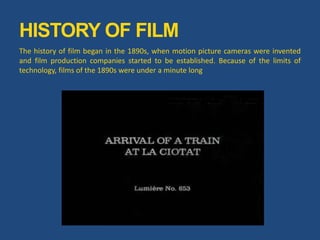
The history of film began in the 1890s, when motion picture cameras were invented
and film production companies started to be established. Because of the limits of
technology, films of the 1890s were under a minute long
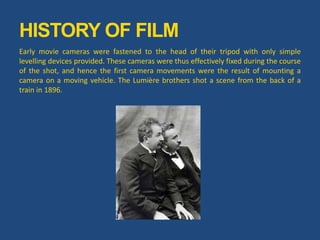
Early movie cameras were fastened to the head of their tripod with only simple
levelling devices provided. These cameras were thus effectively fixed during the course
of the shot, and hence the first camera movements were the result of mounting a
camera on a moving vehicle. The Lumière brothers shot a scene from the back of a
train in 1896.
HISTORY OF FILM
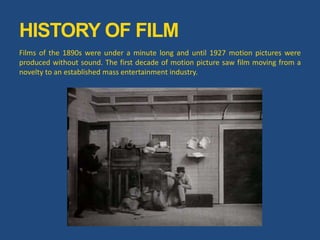
Films of the 1890s were under a minute long and until 1927 motion pictures were
produced without sound. The first decade of motion picture saw film moving from a
novelty to an established mass entertainment industry.
HISTORY OF FILM
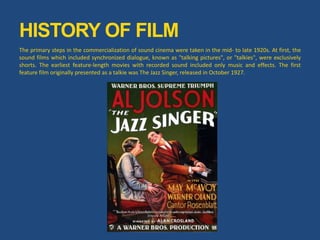
The primary steps in the commercialization of sound cinema were taken in the mid- to late 1920s. At first, the
sound films which included synchronized dialogue, known as "talking pictures", or "talkies", were exclusively
shorts. The earliest feature-length movies with recorded sound included only music and effects. The first
feature film originally presented as a talkie was The Jazz Singer, released in October 1927.
HISTORY OF FILM
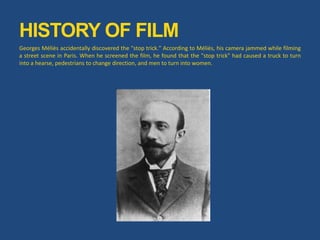
Georges Méliès accidentally discovered the "stop trick." According to Méliès, his camera jammed while filming
a street scene in Paris. When he screened the film, he found that the "stop trick" had caused a truck to turn
into a hearse, pedestrians to change direction, and men to turn into women.
HISTORY OF FILM
HISTORY OF FILM
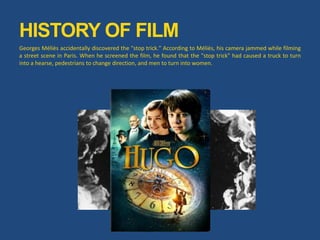
Georges Méliès accidentally discovered the "stop trick." According to Méliès, his camera jammed while filming
a street scene in Paris. When he screened the film, he found that the "stop trick" had caused a truck to turn
into a hearse, pedestrians to change direction, and men to turn into women.
WHAT IS FILM / VIDEO PRODUCTION
VISUAL
POEM
ANIMA-
TION
WHAT IS FILM / VIDEO PRODUCTION
MONTAGE
WHAT IS FILM / VIDEO PRODUCTION
TRAINING
VIDEOS
WHAT IS FILM / VIDEO PRODUCTION
COMME-
RCIALS
WHAT IS FILM / VIDEO PRODUCTION
PUBLIC SERVICE
ANNOUNCEMENTS
PSA
• Narrative Film • Documentary
WHAT IS FILM / VIDEO PRODUCTION
NARRATIVE FILM
Genres
• Action
• Romantic
• Comedy
• Drama
• Horror
• Thriller
• And the list goes on
DOCUMENTARY FILM
Genres
• Investigation Style
• Document Style
WHAT DO WE NEED?
Here is a general list of the intangible
requirements to create successful,
professional video:
• An understanding and working knowledge of the controls of your
equipment
• A well-organized plan of attack
• An ability to problem-solve calmly under pressure
• An eagerness and curiosity about how things work
• A devotion to detail
• An understanding of the value of safety
• A commitment to reliability and dependability
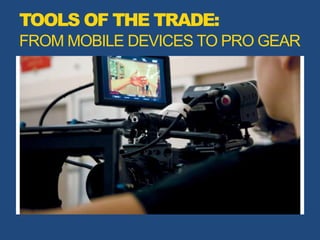
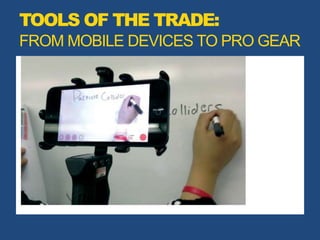
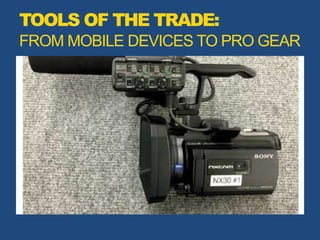
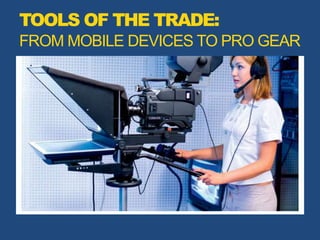
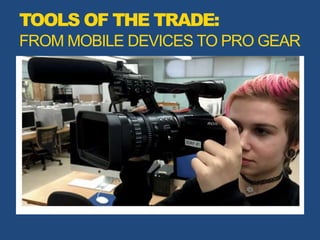
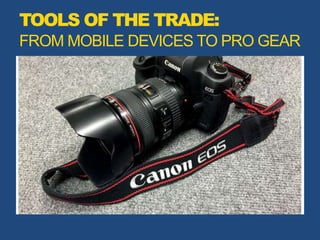
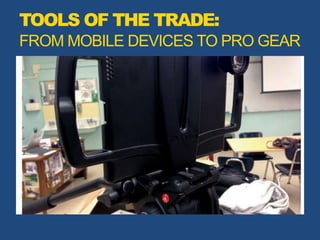
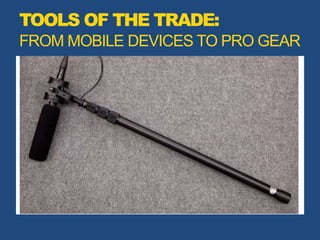
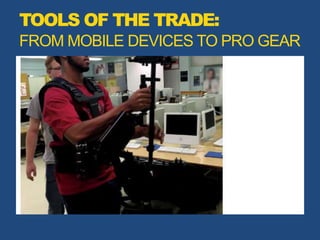
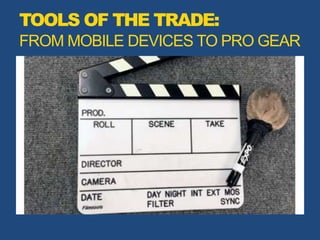
TOOLS OF THE TRADE:
FROM MOBILE DEVICES TO PRO GEAR
TOOLS OF THE TRADE:
FROM MOBILE DEVICES TO PRO GEAR
TOOLS OF THE TRADE:
FROM MOBILE DEVICES TO PRO GEAR
TOOLS OF THE TRADE:
FROM MOBILE DEVICES TO PRO GEAR
TOOLS OF THE TRADE:
FROM MOBILE DEVICES TO PRO GEAR
TOOLS OF THE TRADE:
FROM MOBILE DEVICES TO PRO GEAR
TOOLS OF THE TRADE:
FROM MOBILE DEVICES TO PRO GEAR
TOOLS OF THE TRADE:
FROM MOBILE DEVICES TO PRO GEAR
TOOLS OF THE TRADE:
FROM MOBILE DEVICES TO PRO GEAR
TOOLS OF THE TRADE:
FROM MOBILE DEVICES TO PRO GEAR
TOOLS OF THE TRADE:
FROM MOBILE DEVICES TO PRO GEAR
TOOLS OF THE TRADE:
FROM MOBILE DEVICES TO PRO GEAR
TOOLS OF THE TRADE:
FROM MOBILE DEVICES TO PRO GEAR
TOOLS OF THE TRADE:
FROM MOBILE DEVICES TO PRO GEAR
What is the main element
of filmmaking or video
production?
STORY….
• Even in the 20-second video of a skateboard trick,
there’s a progression; something is attempted, and
success or failure may result.
• The hardest of content creation is probably the Cute
Kitten Video. Even here in the lowest depths of
media creation, your audience of cute kitten
enthusiasts is going to wait and anticipate the cute
thing that kitten is going to do.
• A documentary about a veteran, his life story how he
fought in the war.
STORY
HOW DO WE START?
The journey of a
thousand miles
begins with a
single step
THE POETRY OF
CONTENT CREATION
In the BeginningContent creation—whether it’s
for a TV series, a feature film, or a
documentary—is based on three universal
elements that are universal.
• The main character, also known as the protagonist and
sometimes the hero. In our examples, they are your
friend the skateboarder and the cute kitten.
• The goal they go after—whether it’s the great trick (the
skateboarder) or, say, a ball of yarn (the kitten).
• Obstacles to that goal, such as a lack of motor skills or
the yarn rolling away.
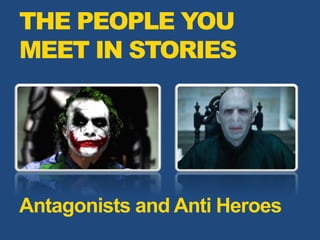
THE PEOPLE YOU
MEET IN STORIES
Antagonists and Anti Heroes
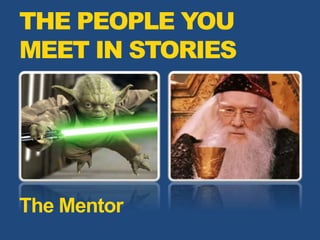
THE PEOPLE YOU
MEET IN STORIES
The Mentor
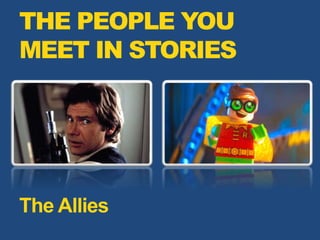
THE PEOPLE YOU
MEET IN STORIES
The Allies
THE PEOPLE YOU
MEET IN STORIES
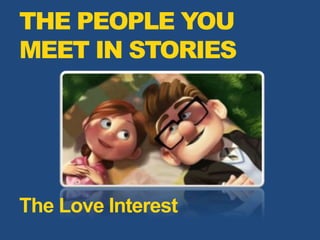
The Love Interest
THE PEOPLE YOU
MEET IN STORIES
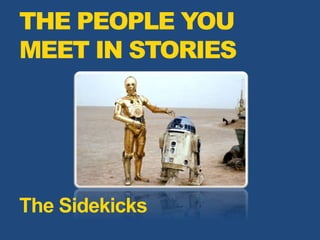
The Sidekicks
THE PEOPLE YOU
MEET IN STORIES
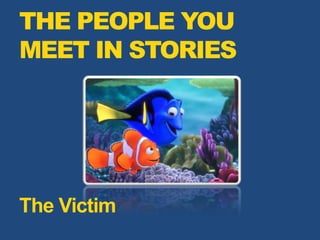
The Victim
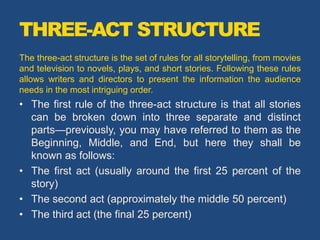
THREE-ACT STRUCTURE
The three-act structure is the set of rules for all storytelling, from movies
and television to novels, plays, and short stories. Following these rules
allows writers and directors to present the information the audience
needs in the most intriguing order.
• The first rule of the three-act structure is that all stories
can be broken down into three separate and distinct
parts—previously, you may have referred to them as the
Beginning, Middle, and End, but here they shall be
known as follows:
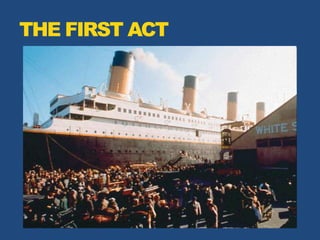
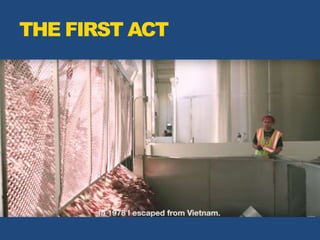
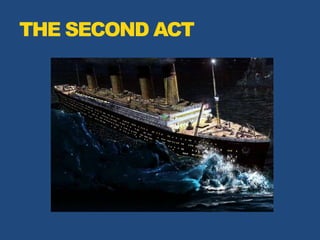
• The first act (usually around the first 25 percent of the
story)
• The second act (approximately the middle 50 percent)
• The third act (the final 25 percent)
Here we find
out the setup
THE FIRST ACT
THE FIRST ACT
THE FIRST ACT
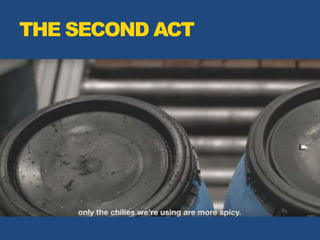
The rhythm picks
up and the pace
increases once
we move into the
second act.
THE SECOND ACT
THE SECOND ACT
THE SECOND ACT
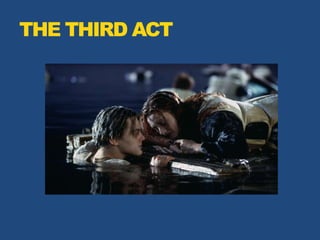
The third act feature
the big showdown
between the
protagonist and the
antagonist.
THE THIRD ACT
THE THIRD ACT
THE THIRD ACT
JOBS AND CREW
POSITIONS
Producer
• The producer is a day-to-day boss
responsible for making sure everyone
else is doing their job.
Writer
• The writer visualizes the plot and
theme; creates the characters, visual
descriptions, and dialogue; and
communicates with the director and
occasionally the actors about specific
aspects of the story.
Personality type: The writer needs to have a good
vocabulary and a visual, descriptive imagination.
JOBS AND CREW
POSITIONS
Director
• The “creative boss” of the movie, the director does the following:
• Transforms the script into a series of images or shots that can be filmed and
turns thoughts and ideas into pictures and performances. They have to hold the
whole project in their head to make sure everything that is filmed will all work
together well.
• Creates or oversees storyboards and shot lists to let crew members know what
the shots are.
• Casts actors who can give the necessary performances.
• Rehearses the actors and crew, giving them constructive feedback
• Oversees the creative process of the film from preproduction through
postproduction
• Personality type: The director needs to be a natural leader, visually and verbally
creative, and focused on getting the job done; they must also supportive of
people they work with. They deal mostly with the actors, director of photography,
camera operator, and producer. All other work on the production is channeled
through the director.
JOBS AND CREW
POSITIONS
Actors/Talent
• Actors play one or more onscreen
roles in a project.
JOBS AND CREW
POSITIONS
Cinematographer/Direct
or of Photography
• The director of photography (DP, or DoP in the United
Kingdom), also known at the cinematographer, is in
charge of the look of the film and the way light and
shadow are used to help create the tone or feeling of a
movie. They choose the type of film to create the
appropriate look as well as equipment to control or
shape the light. The DP works mostly with the director
and the camera operator.
Personality type: The DP must have good visual imagination and be visually
creative and artistic.
JOBS AND CREW
POSITIONS
Camera Operator
• The director designs the shots, but the
camera operator must record the shots;
therefore, the camera operator must have
especially good communication with the
director. The cameraperson is in charge of
maintaining the composition or framing,
the exposure, and the focus of the shot.
Personality type: The camera operator must be responsible and reliable
and like working with and learning new gear, as well as steady and
focused.
JOBS AND CREW
POSITIONS
Editor
• The editor reviews all the footage and cuts the movie either on film
or, increasingly these days, using a nonlinear editing (NLE) software
such as Avid Media Composer, Adobe Premiere Pro, or Final Cut
Pro X. The editor functions as the director’s second set of eyes,
working with the director to create the final finished version of the
movie.
• When possible, the editor should watch on the set to make sure the
director is giving them footage they can cut together well.
Personality type: The editor must have extremely high and exacting standards and
a lot of patience to look through hundreds of takes of shot after shot trying to find
“it”—the perfect balance, rhythm, and cut point to perfect the scene. Editor is one of
the main jobs that leads to directing.
JOBS AND CREW
POSITIONS
Sound Editor
• Sound editors cut the music, sound
effects, and rerecorded (or “looped”)
dialogue (ADR) into the film.
Personality type: Sound editors, like video editors, must like working with
computer programs. They often have little interaction with the rest of the crew
except for the director.
JOBS AND CREW
POSITIONS
Music Supervisor or
Composer
• The music supervisor helps the director choose prerecorded music
that matches the feeling of the scene or comments on it in an
appropriate way. Alternately, a composer writes and plays music
specifically written for the film.
• Music is a key component of a successful project, often conveying
the emotion that the script or performances sometimes hold back
on.
Personality type: The music supervisor or composer must have a sharp ear and a
keen sense of how to choose or compose music that captures and amplifies the
tone of each scene.
JOBS AND CREW
POSITIONS
PRODUCTION WORKFLOW:
THE THREE PS
In video production, there are
three main stages of the
process of creating a project:
• preproduction
• production
• postproduction
Preproduction
The preproduction stage begins when a decision is made to create a
project and goes through until the start of the production stage. The
steps that occur in preproduction include but are not limited to the
following:
• Writing the script
• Budgeting the entire production
• Scheduling the shoot
• Fundraising to meet the budget
• Hiring the crew
• Casting the talent
• Scouting locations
• Designing and building sets
• Rehearsing Renting equipment
PRODUCTION WORKFLOW:
THE THREE PS
Production
• The main phase of the production stage is
principal photography, when the bulk of the
shooting takes place.
PRODUCTION WORKFLOW:
THE THREE PS
Postproduction
• Postproduction (or post), as the name states, is the stage after
production, but it doesn’t necessarily have to wait until production
ends to start.
• Picture editing is the first phase of post, and in most circumstances
(live production excluded) takes a longer time than production.
Simple projects that have little to no visual effects (VFX) have a
smaller number of people working than the production stage
requires. A project that has visual effect shots, such as adding
background elements over a green screen or animations in the
foreground, requires more crew members in post.
• Postproduction also includes work on audio, titles and graphics, and
color correction.
PRODUCTION WORKFLOW:
THE THREE PS
THE SHOT
COMPOSINGFORMEANING
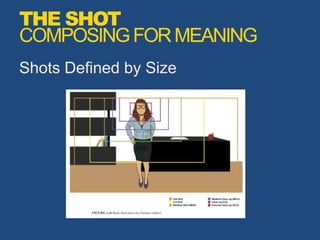
Shots Defined by Size
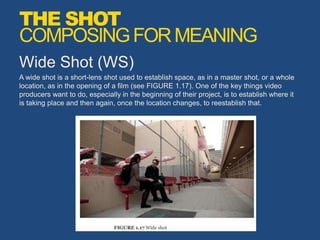
Wide Shot (WS)
A wide shot is a short-lens shot used to establish space, as in a master shot, or a whole
location, as in the opening of a film (see FIGURE 1.17). One of the key things video
producers want to do, especially in the beginning of their project, is to establish where it
is taking place and then again, once the location changes, to reestablish that.
THE SHOT
COMPOSINGFORMEANING
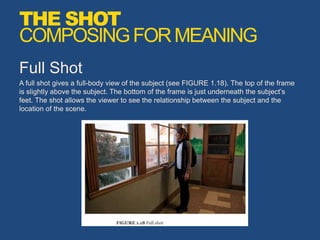
Full Shot
A full shot gives a full-body view of the subject (see FIGURE 1.18). The top of the frame
is slightly above the subject. The bottom of the frame is just underneath the subject’s
feet. The shot allows the viewer to see the relationship between the subject and the
location of the scene.
THE SHOT
COMPOSINGFORMEANING
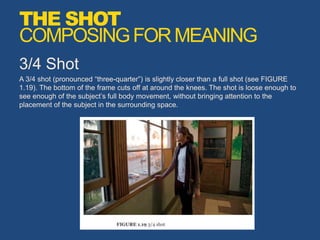
3/4 Shot
A 3/4 shot (pronounced “three-quarter”) is slightly closer than a full shot (see FIGURE
1.19). The bottom of the frame cuts off at around the knees. The shot is loose enough to
see enough of the subject’s full body movement, without bringing attention to the
placement of the subject in the surrounding space.
THE SHOT
COMPOSINGFORMEANING
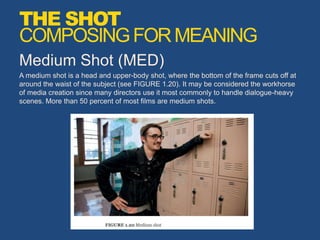
Medium Shot (MED)
A medium shot is a head and upper-body shot, where the bottom of the frame cuts off at
around the waist of the subject (see FIGURE 1.20). It may be considered the workhorse
of media creation since many directors use it most commonly to handle dialogue-heavy
scenes. More than 50 percent of most films are medium shots.
THE SHOT
COMPOSINGFORMEANING
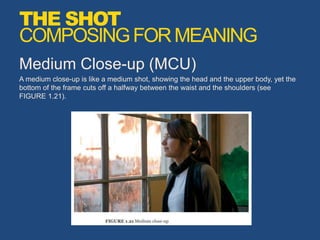
Medium Close-up (MCU)
A medium close-up is like a medium shot, showing the head and the upper body, yet the
bottom of the frame cuts off a halfway between the waist and the shoulders (see
FIGURE 1.21).
THE SHOT
COMPOSINGFORMEANING
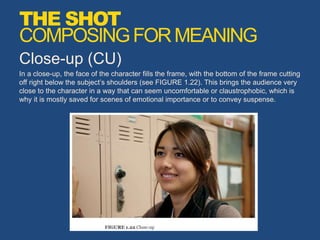
Close-up (CU)
In a close-up, the face of the character fills the frame, with the bottom of the frame cutting
off right below the subject’s shoulders (see FIGURE 1.22). This brings the audience very
close to the character in a way that can seem uncomfortable or claustrophobic, which is
why it is mostly saved for scenes of emotional importance or to convey suspense.
THE SHOT
COMPOSINGFORMEANING
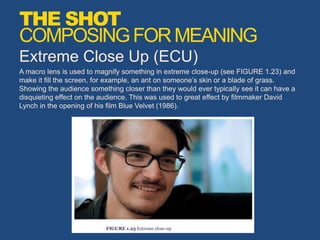
Extreme Close Up (ECU)
A macro lens is used to magnify something in extreme close-up (see FIGURE 1.23) and
make it fill the screen, for example, an ant on someone’s skin or a blade of grass.
Showing the audience something closer than they would ever typically see it can have a
disquieting effect on the audience. This was used to great effect by filmmaker David
Lynch in the opening of his film Blue Velvet (1986).
THE SHOT
COMPOSINGFORMEANING
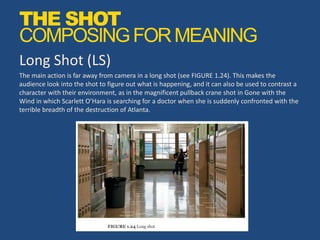
Long Shot (LS)
The main action is far away from camera in a long shot (see FIGURE 1.24). This makes the
audience look into the shot to figure out what is happening, and it can also be used to contrast a
character with their environment, as in the magnificent pullback crane shot in Gone with the
Wind in which Scarlett O’Hara is searching for a doctor when she is suddenly confronted with the
terrible breadth of the destruction of Atlanta.
THE SHOT
COMPOSINGFORMEANING
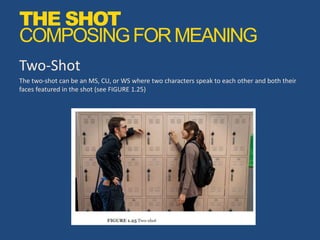
Two-Shot
The two-shot can be an MS, CU, or WS where two characters speak to each other and both their
faces featured in the shot (see FIGURE 1.25)
THE SHOT
COMPOSINGFORMEANING
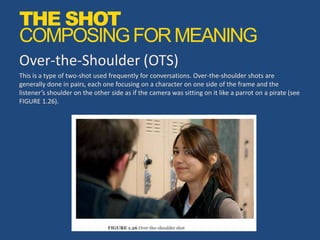
Over-the-Shoulder (OTS)
This is a type of two-shot used frequently for conversations. Over-the-shoulder shots are
generally done in pairs, each one focusing on a character on one side of the frame and the
listener’s shoulder on the other side as if the camera was sitting on it like a parrot on a pirate (see
FIGURE 1.26).
THE SHOT
COMPOSINGFORMEANING
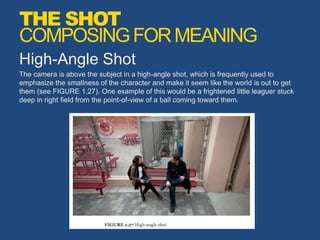
High-Angle Shot
The camera is above the subject in a high-angle shot, which is frequently used to
emphasize the smallness of the character and make it seem like the world is out to get
them (see FIGURE 1.27). One example of this would be a frightened little leaguer stuck
deep in right field from the point-of-view of a ball coming toward them.
THE SHOT
COMPOSINGFORMEANING
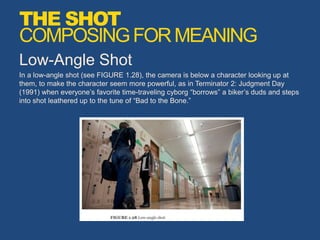
Low-Angle Shot
In a low-angle shot (see FIGURE 1.28), the camera is below a character looking up at
them, to make the character seem more powerful, as in Terminator 2: Judgment Day
(1991) when everyone’s favorite time-traveling cyborg “borrows” a biker’s duds and steps
into shot leathered up to the tune of “Bad to the Bone.”
THE SHOT
COMPOSINGFORMEANING
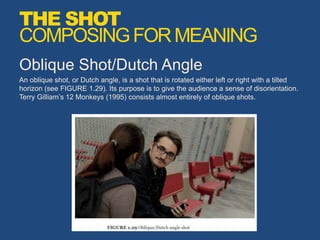
Oblique Shot/Dutch Angle
An oblique shot, or Dutch angle, is a shot that is rotated either left or right with a tilted
horizon (see FIGURE 1.29). Its purpose is to give the audience a sense of disorientation.
Terry Gilliam’s 12 Monkeys (1995) consists almost entirely of oblique shots.
THE SHOT
COMPOSINGFORMEANING
• Shots Defined by Camera Movement
• Handheld Camera vs. Camera on
Sticks (Tripod)
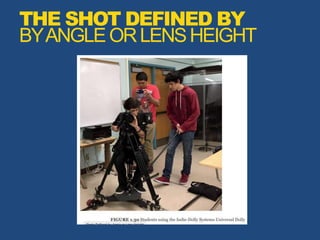
• Tracking Shot/Dolly Shot/Trucking
Shot
THE SHOT DEFINED BY
BYANGLEORLENSHEIGHT
THE SHOT DEFINED BY
BYANGLEORLENSHEIGHT
Pan/Tilt
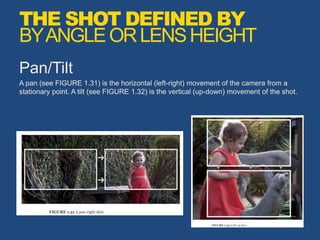
A pan (see FIGURE 1.31) is the horizontal (left-right) movement of the camera from a
stationary point. A tilt (see FIGURE 1.32) is the vertical (up-down) movement of the shot.
THE SHOT DEFINED BY
BYANGLEORLENSHEIGHT
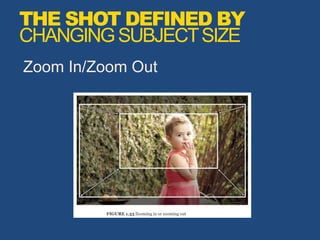
Zoom In/Zoom Out
THE SHOT DEFINED BY
CHANGINGSUBJECTSIZE
Kind of like special teams
in football, there are some
shots that have a special
job in a scene
THE SHOT
DEFINEDBYJOB
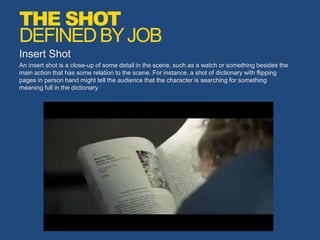
Insert Shot
An insert shot is a close-up of some detail in the scene, such as a watch or something besides the
main action that has some relation to the scene. For instance, a shot of dictionary with flipping
pages in person hand might tell the audience that the character is searching for something
meaning full in the dictionary.
THE SHOT
DEFINEDBYJOB
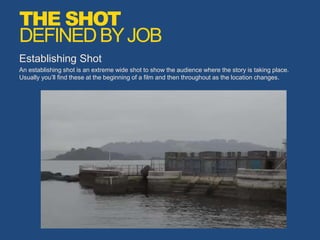
Establishing Shot
An establishing shot is an extreme wide shot to show the audience where the story is taking place.
Usually you’ll find these at the beginning of a film and then throughout as the location changes.
THE SHOT
DEFINEDBYJOB
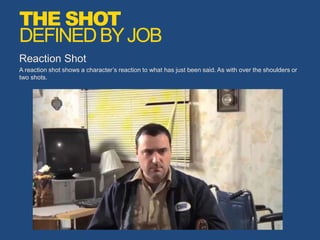
Reaction Shot
A reaction shot shows a character’s reaction to what has just been said. As with over the shoulders or
two shots.
THE SHOT
DEFINEDBYJOB
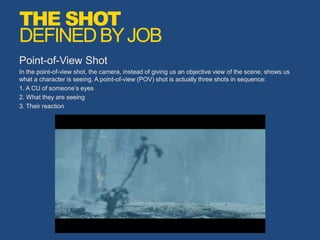
Point-of-View Shot
In the point-of-view shot, the camera, instead of giving us an objective view of the scene, shows us
what a character is seeing. A point-of-view (POV) shot is actually three shots in sequence:
1. A CU of someone’s eyes
2. What they are seeing
3. Their reaction
THE SHOT
DEFINEDBYJOB
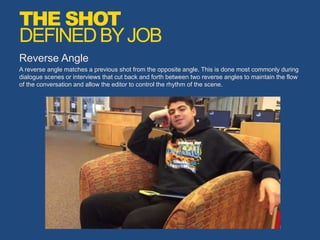
Reverse Angle
A reverse angle matches a previous shot from the opposite angle. This is done most commonly during
dialogue scenes or interviews that cut back and forth between two reverse angles to maintain the flow
of the conversation and allow the editor to control the rhythm of the scene.
THE SHOT
DEFINEDBYJOB
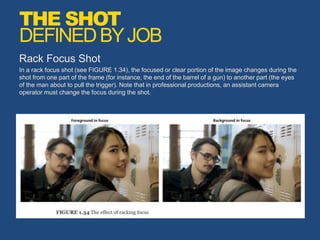
Rack Focus Shot
In a rack focus shot (see FIGURE 1.34), the focused or clear portion of the image changes during the
shot from one part of the frame (for instance, the end of the barrel of a gun) to another part (the eyes
of the man about to pull the trigger). Note that in professional productions, an assistant camera
operator must change the focus during the shot.
THE SHOT
DEFINEDBYJOB
•Slow Disclosure Shot
•Fast-Motion Shot
•Slow-Motion Shot
•Freeze Frame
THE SHOT
DEFINEDCAMERA ACTION
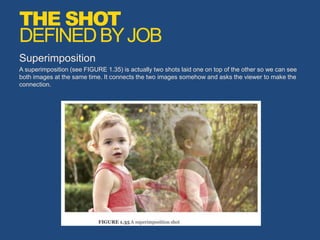
Superimposition
A superimposition (see FIGURE 1.35) is actually two shots laid one on top of the other so we can see
both images at the same time. It connects the two images somehow and asks the viewer to make the
connection.
THE SHOT
DEFINEDBYJOB
SHOOTING TO EDIT
• Media creators organize shoots around
simple logic. When you’re in a location,
you shoot all the scenes at that location if
you can.
• When you’re shooting a scene, make sure
you know what that scene is about, such
as a character’s frustration, and make sure
you get the reaction shot that lets the
audience make a connection to that
character and that feeling.
Continuity
• The majority of media projects relies on the illusion of continuity.
That is, Shot A is followed onscreen by Shot B, and once the editors
put the shots together, the audience will believe that it follows
directly after it, without any break in time or space, even if the two
shots were done three weeks apart, in different states.
• This illusion is a continuity of time and space created on film or
video as a mirror image of our real three-dimensional world. Editors,
who cut the picture together, must look at the storyboards and work
with the director to make sure the shots will work together to create
this alternate world.
• If the shots don’t work together and there seems to be a jump
forward or backward in time, this is referred to as a jump cut.
Sometimes, in a music video, fight scene, or chase scene, editors
use jump cuts on purpose.
SHOOTING TO EDIT
Matching Action
• Directors might use a dozen or more shots to document a single
action. Each of those shots must match the others in terms of the
lighting, the speed at which the characters move, the energy of the
actors’ performances, what the characters are wearing, and so on.
• The director will occasionally want to check with the continuity
person or the video playback to make sure.
SHOOTING TO EDIT
Stageline/180° Rule
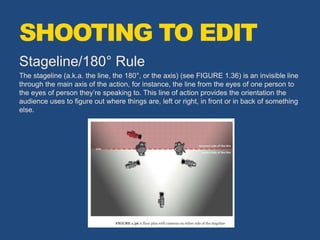
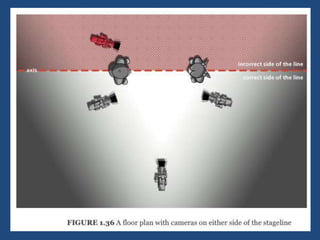
The stageline (a.k.a. the line, the 180°, or the axis) (see FIGURE 1.36) is an invisible line
through the main axis of the action, for instance, the line from the eyes of one person to
the eyes of person they’re speaking to. This line of action provides the orientation the
audience uses to figure out where things are, left or right, in front or in back of something
else.
SHOOTING TO EDIT
Screen Direction
Another aspect of space orientation that media
creators must be aware of is the rule of screen
direction, which says that if we see an object like a
car or a train moving from left to right, that object
will continue to move from left to right in following
shots unless we see it stop and turn around.
SHOOTING TO EDIT
Eyeline
Eyeline refers to the direction a character looks off-screen, left or right.
—“What was the eyeline of the last
scene, left or right?”
to make sure characters are looking the right way off-screen toward
each other.
SHOOTING TO EDIT
Blocking
• Blocking is the movement of actors or the camera during the scene. For
instance, an actor may enter a room, stop, find the person they are looking
for, cross to a seat next to them, and sit down. The director may tell the
camera operator to pan across the room to pick up the actor entering and
then pan back with the actor and tilt down as he sits.
• The director rehearses the blocking with the actors and camera operator
because, even though the actors’ movements should look spontaneous, the
actor needs to “hit their mark” on every take so they’ll be in focus. Likewise,
the camera operator’s moves must be equally rehearsed.
• If either the actor or cameraman is out of step or misses their mark, either
the shot will be out of focus or the composition will be ruined. For instance,
a head may appear in front of another head instead of next to it.
SHOOTING TO EDIT
Introduction to Filmmaking

Introduction to Filmmaking

  • 1.
  • 2.
    HISTORY OF FILM Thehistory of film began in the 1890s, when motion picture cameras were invented and film production companies started to be established. Because of the limits of technology, films of the 1890s were under a minute long
  • 3.
    Early movie cameraswere fastened to the head of their tripod with only simple levelling devices provided. These cameras were thus effectively fixed during the course of the shot, and hence the first camera movements were the result of mounting a camera on a moving vehicle. The Lumière brothers shot a scene from the back of a train in 1896. HISTORY OF FILM
  • 4.
    Films of the1890s were under a minute long and until 1927 motion pictures were produced without sound. The first decade of motion picture saw film moving from a novelty to an established mass entertainment industry. HISTORY OF FILM
  • 5.
    The primary stepsin the commercialization of sound cinema were taken in the mid- to late 1920s. At first, the sound films which included synchronized dialogue, known as "talking pictures", or "talkies", were exclusively shorts. The earliest feature-length movies with recorded sound included only music and effects. The first feature film originally presented as a talkie was The Jazz Singer, released in October 1927. HISTORY OF FILM
  • 6.
    Georges Méliès accidentallydiscovered the "stop trick." According to Méliès, his camera jammed while filming a street scene in Paris. When he screened the film, he found that the "stop trick" had caused a truck to turn into a hearse, pedestrians to change direction, and men to turn into women. HISTORY OF FILM
  • 7.
    HISTORY OF FILM GeorgesMéliès accidentally discovered the "stop trick." According to Méliès, his camera jammed while filming a street scene in Paris. When he screened the film, he found that the "stop trick" had caused a truck to turn into a hearse, pedestrians to change direction, and men to turn into women.
  • 8.
    WHAT IS FILM/ VIDEO PRODUCTION VISUAL POEM
  • 9.
    ANIMA- TION WHAT IS FILM/ VIDEO PRODUCTION
  • 10.
    MONTAGE WHAT IS FILM/ VIDEO PRODUCTION
  • 11.
    TRAINING VIDEOS WHAT IS FILM/ VIDEO PRODUCTION
  • 12.
    COMME- RCIALS WHAT IS FILM/ VIDEO PRODUCTION
  • 13.
  • 14.
    • Narrative Film• Documentary WHAT IS FILM / VIDEO PRODUCTION
  • 15.
    NARRATIVE FILM Genres • Action •Romantic • Comedy • Drama • Horror • Thriller • And the list goes on
  • 16.
  • 17.
    WHAT DO WENEED? Here is a general list of the intangible requirements to create successful, professional video: • An understanding and working knowledge of the controls of your equipment • A well-organized plan of attack • An ability to problem-solve calmly under pressure • An eagerness and curiosity about how things work • A devotion to detail • An understanding of the value of safety • A commitment to reliability and dependability
  • 18.
    TOOLS OF THETRADE: FROM MOBILE DEVICES TO PRO GEAR
  • 19.
    TOOLS OF THETRADE: FROM MOBILE DEVICES TO PRO GEAR
  • 20.
    TOOLS OF THETRADE: FROM MOBILE DEVICES TO PRO GEAR
  • 21.
    TOOLS OF THETRADE: FROM MOBILE DEVICES TO PRO GEAR
  • 22.
    TOOLS OF THETRADE: FROM MOBILE DEVICES TO PRO GEAR
  • 23.
    TOOLS OF THETRADE: FROM MOBILE DEVICES TO PRO GEAR
  • 24.
    TOOLS OF THETRADE: FROM MOBILE DEVICES TO PRO GEAR
  • 25.
    TOOLS OF THETRADE: FROM MOBILE DEVICES TO PRO GEAR
  • 26.
    TOOLS OF THETRADE: FROM MOBILE DEVICES TO PRO GEAR
  • 27.
    TOOLS OF THETRADE: FROM MOBILE DEVICES TO PRO GEAR
  • 28.
    TOOLS OF THETRADE: FROM MOBILE DEVICES TO PRO GEAR
  • 29.
    TOOLS OF THETRADE: FROM MOBILE DEVICES TO PRO GEAR
  • 30.
    TOOLS OF THETRADE: FROM MOBILE DEVICES TO PRO GEAR
  • 31.
    TOOLS OF THETRADE: FROM MOBILE DEVICES TO PRO GEAR
  • 32.
    What is themain element of filmmaking or video production? STORY….
  • 33.
    • Even inthe 20-second video of a skateboard trick, there’s a progression; something is attempted, and success or failure may result. • The hardest of content creation is probably the Cute Kitten Video. Even here in the lowest depths of media creation, your audience of cute kitten enthusiasts is going to wait and anticipate the cute thing that kitten is going to do. • A documentary about a veteran, his life story how he fought in the war. STORY
  • 34.
    HOW DO WESTART? The journey of a thousand miles begins with a single step
  • 35.
    THE POETRY OF CONTENTCREATION In the BeginningContent creation—whether it’s for a TV series, a feature film, or a documentary—is based on three universal elements that are universal. • The main character, also known as the protagonist and sometimes the hero. In our examples, they are your friend the skateboarder and the cute kitten. • The goal they go after—whether it’s the great trick (the skateboarder) or, say, a ball of yarn (the kitten). • Obstacles to that goal, such as a lack of motor skills or the yarn rolling away.
  • 36.
    THE PEOPLE YOU MEETIN STORIES Antagonists and Anti Heroes
  • 37.
    THE PEOPLE YOU MEETIN STORIES The Mentor
  • 38.
    THE PEOPLE YOU MEETIN STORIES The Allies
  • 39.
    THE PEOPLE YOU MEETIN STORIES The Love Interest
  • 40.
    THE PEOPLE YOU MEETIN STORIES The Sidekicks
  • 41.
    THE PEOPLE YOU MEETIN STORIES The Victim
  • 42.
    THREE-ACT STRUCTURE The three-actstructure is the set of rules for all storytelling, from movies and television to novels, plays, and short stories. Following these rules allows writers and directors to present the information the audience needs in the most intriguing order. • The first rule of the three-act structure is that all stories can be broken down into three separate and distinct parts—previously, you may have referred to them as the Beginning, Middle, and End, but here they shall be known as follows: • The first act (usually around the first 25 percent of the story) • The second act (approximately the middle 50 percent) • The third act (the final 25 percent)
  • 43.
    Here we find outthe setup THE FIRST ACT
  • 44.
  • 45.
  • 46.
    The rhythm picks upand the pace increases once we move into the second act. THE SECOND ACT
  • 47.
  • 48.
  • 49.
    The third actfeature the big showdown between the protagonist and the antagonist. THE THIRD ACT
  • 50.
  • 51.
  • 52.
    JOBS AND CREW POSITIONS Producer •The producer is a day-to-day boss responsible for making sure everyone else is doing their job.
  • 53.
    Writer • The writervisualizes the plot and theme; creates the characters, visual descriptions, and dialogue; and communicates with the director and occasionally the actors about specific aspects of the story. Personality type: The writer needs to have a good vocabulary and a visual, descriptive imagination. JOBS AND CREW POSITIONS
  • 54.
    Director • The “creativeboss” of the movie, the director does the following: • Transforms the script into a series of images or shots that can be filmed and turns thoughts and ideas into pictures and performances. They have to hold the whole project in their head to make sure everything that is filmed will all work together well. • Creates or oversees storyboards and shot lists to let crew members know what the shots are. • Casts actors who can give the necessary performances. • Rehearses the actors and crew, giving them constructive feedback • Oversees the creative process of the film from preproduction through postproduction • Personality type: The director needs to be a natural leader, visually and verbally creative, and focused on getting the job done; they must also supportive of people they work with. They deal mostly with the actors, director of photography, camera operator, and producer. All other work on the production is channeled through the director. JOBS AND CREW POSITIONS
  • 55.
    Actors/Talent • Actors playone or more onscreen roles in a project. JOBS AND CREW POSITIONS
  • 56.
    Cinematographer/Direct or of Photography •The director of photography (DP, or DoP in the United Kingdom), also known at the cinematographer, is in charge of the look of the film and the way light and shadow are used to help create the tone or feeling of a movie. They choose the type of film to create the appropriate look as well as equipment to control or shape the light. The DP works mostly with the director and the camera operator. Personality type: The DP must have good visual imagination and be visually creative and artistic. JOBS AND CREW POSITIONS
  • 57.
    Camera Operator • Thedirector designs the shots, but the camera operator must record the shots; therefore, the camera operator must have especially good communication with the director. The cameraperson is in charge of maintaining the composition or framing, the exposure, and the focus of the shot. Personality type: The camera operator must be responsible and reliable and like working with and learning new gear, as well as steady and focused. JOBS AND CREW POSITIONS
  • 58.
    Editor • The editorreviews all the footage and cuts the movie either on film or, increasingly these days, using a nonlinear editing (NLE) software such as Avid Media Composer, Adobe Premiere Pro, or Final Cut Pro X. The editor functions as the director’s second set of eyes, working with the director to create the final finished version of the movie. • When possible, the editor should watch on the set to make sure the director is giving them footage they can cut together well. Personality type: The editor must have extremely high and exacting standards and a lot of patience to look through hundreds of takes of shot after shot trying to find “it”—the perfect balance, rhythm, and cut point to perfect the scene. Editor is one of the main jobs that leads to directing. JOBS AND CREW POSITIONS
  • 59.
    Sound Editor • Soundeditors cut the music, sound effects, and rerecorded (or “looped”) dialogue (ADR) into the film. Personality type: Sound editors, like video editors, must like working with computer programs. They often have little interaction with the rest of the crew except for the director. JOBS AND CREW POSITIONS
  • 60.
    Music Supervisor or Composer •The music supervisor helps the director choose prerecorded music that matches the feeling of the scene or comments on it in an appropriate way. Alternately, a composer writes and plays music specifically written for the film. • Music is a key component of a successful project, often conveying the emotion that the script or performances sometimes hold back on. Personality type: The music supervisor or composer must have a sharp ear and a keen sense of how to choose or compose music that captures and amplifies the tone of each scene. JOBS AND CREW POSITIONS
  • 61.
    PRODUCTION WORKFLOW: THE THREEPS In video production, there are three main stages of the process of creating a project: • preproduction • production • postproduction
  • 62.
    Preproduction The preproduction stagebegins when a decision is made to create a project and goes through until the start of the production stage. The steps that occur in preproduction include but are not limited to the following: • Writing the script • Budgeting the entire production • Scheduling the shoot • Fundraising to meet the budget • Hiring the crew • Casting the talent • Scouting locations • Designing and building sets • Rehearsing Renting equipment PRODUCTION WORKFLOW: THE THREE PS
  • 63.
    Production • The mainphase of the production stage is principal photography, when the bulk of the shooting takes place. PRODUCTION WORKFLOW: THE THREE PS
  • 64.
    Postproduction • Postproduction (orpost), as the name states, is the stage after production, but it doesn’t necessarily have to wait until production ends to start. • Picture editing is the first phase of post, and in most circumstances (live production excluded) takes a longer time than production. Simple projects that have little to no visual effects (VFX) have a smaller number of people working than the production stage requires. A project that has visual effect shots, such as adding background elements over a green screen or animations in the foreground, requires more crew members in post. • Postproduction also includes work on audio, titles and graphics, and color correction. PRODUCTION WORKFLOW: THE THREE PS
  • 65.
  • 66.
    Wide Shot (WS) Awide shot is a short-lens shot used to establish space, as in a master shot, or a whole location, as in the opening of a film (see FIGURE 1.17). One of the key things video producers want to do, especially in the beginning of their project, is to establish where it is taking place and then again, once the location changes, to reestablish that. THE SHOT COMPOSINGFORMEANING
  • 67.
    Full Shot A fullshot gives a full-body view of the subject (see FIGURE 1.18). The top of the frame is slightly above the subject. The bottom of the frame is just underneath the subject’s feet. The shot allows the viewer to see the relationship between the subject and the location of the scene. THE SHOT COMPOSINGFORMEANING
  • 68.
    3/4 Shot A 3/4shot (pronounced “three-quarter”) is slightly closer than a full shot (see FIGURE 1.19). The bottom of the frame cuts off at around the knees. The shot is loose enough to see enough of the subject’s full body movement, without bringing attention to the placement of the subject in the surrounding space. THE SHOT COMPOSINGFORMEANING
  • 69.
    Medium Shot (MED) Amedium shot is a head and upper-body shot, where the bottom of the frame cuts off at around the waist of the subject (see FIGURE 1.20). It may be considered the workhorse of media creation since many directors use it most commonly to handle dialogue-heavy scenes. More than 50 percent of most films are medium shots. THE SHOT COMPOSINGFORMEANING
  • 70.
    Medium Close-up (MCU) Amedium close-up is like a medium shot, showing the head and the upper body, yet the bottom of the frame cuts off a halfway between the waist and the shoulders (see FIGURE 1.21). THE SHOT COMPOSINGFORMEANING
  • 71.
    Close-up (CU) In aclose-up, the face of the character fills the frame, with the bottom of the frame cutting off right below the subject’s shoulders (see FIGURE 1.22). This brings the audience very close to the character in a way that can seem uncomfortable or claustrophobic, which is why it is mostly saved for scenes of emotional importance or to convey suspense. THE SHOT COMPOSINGFORMEANING
  • 72.
    Extreme Close Up(ECU) A macro lens is used to magnify something in extreme close-up (see FIGURE 1.23) and make it fill the screen, for example, an ant on someone’s skin or a blade of grass. Showing the audience something closer than they would ever typically see it can have a disquieting effect on the audience. This was used to great effect by filmmaker David Lynch in the opening of his film Blue Velvet (1986). THE SHOT COMPOSINGFORMEANING
  • 73.
    Long Shot (LS) Themain action is far away from camera in a long shot (see FIGURE 1.24). This makes the audience look into the shot to figure out what is happening, and it can also be used to contrast a character with their environment, as in the magnificent pullback crane shot in Gone with the Wind in which Scarlett O’Hara is searching for a doctor when she is suddenly confronted with the terrible breadth of the destruction of Atlanta. THE SHOT COMPOSINGFORMEANING
  • 74.
    Two-Shot The two-shot canbe an MS, CU, or WS where two characters speak to each other and both their faces featured in the shot (see FIGURE 1.25) THE SHOT COMPOSINGFORMEANING
  • 75.
    Over-the-Shoulder (OTS) This isa type of two-shot used frequently for conversations. Over-the-shoulder shots are generally done in pairs, each one focusing on a character on one side of the frame and the listener’s shoulder on the other side as if the camera was sitting on it like a parrot on a pirate (see FIGURE 1.26). THE SHOT COMPOSINGFORMEANING
  • 76.
    High-Angle Shot The camerais above the subject in a high-angle shot, which is frequently used to emphasize the smallness of the character and make it seem like the world is out to get them (see FIGURE 1.27). One example of this would be a frightened little leaguer stuck deep in right field from the point-of-view of a ball coming toward them. THE SHOT COMPOSINGFORMEANING
  • 77.
    Low-Angle Shot In alow-angle shot (see FIGURE 1.28), the camera is below a character looking up at them, to make the character seem more powerful, as in Terminator 2: Judgment Day (1991) when everyone’s favorite time-traveling cyborg “borrows” a biker’s duds and steps into shot leathered up to the tune of “Bad to the Bone.” THE SHOT COMPOSINGFORMEANING
  • 78.
    Oblique Shot/Dutch Angle Anoblique shot, or Dutch angle, is a shot that is rotated either left or right with a tilted horizon (see FIGURE 1.29). Its purpose is to give the audience a sense of disorientation. Terry Gilliam’s 12 Monkeys (1995) consists almost entirely of oblique shots. THE SHOT COMPOSINGFORMEANING
  • 79.
    • Shots Definedby Camera Movement • Handheld Camera vs. Camera on Sticks (Tripod) • Tracking Shot/Dolly Shot/Trucking Shot THE SHOT DEFINED BY BYANGLEORLENSHEIGHT
  • 80.
    THE SHOT DEFINEDBY BYANGLEORLENSHEIGHT
  • 81.
    Pan/Tilt A pan (seeFIGURE 1.31) is the horizontal (left-right) movement of the camera from a stationary point. A tilt (see FIGURE 1.32) is the vertical (up-down) movement of the shot. THE SHOT DEFINED BY BYANGLEORLENSHEIGHT
  • 82.
    Zoom In/Zoom Out THESHOT DEFINED BY CHANGINGSUBJECTSIZE
  • 83.
    Kind of likespecial teams in football, there are some shots that have a special job in a scene THE SHOT DEFINEDBYJOB
  • 84.
    Insert Shot An insertshot is a close-up of some detail in the scene, such as a watch or something besides the main action that has some relation to the scene. For instance, a shot of dictionary with flipping pages in person hand might tell the audience that the character is searching for something meaning full in the dictionary. THE SHOT DEFINEDBYJOB
  • 85.
    Establishing Shot An establishingshot is an extreme wide shot to show the audience where the story is taking place. Usually you’ll find these at the beginning of a film and then throughout as the location changes. THE SHOT DEFINEDBYJOB
  • 86.
    Reaction Shot A reactionshot shows a character’s reaction to what has just been said. As with over the shoulders or two shots. THE SHOT DEFINEDBYJOB
  • 87.
    Point-of-View Shot In thepoint-of-view shot, the camera, instead of giving us an objective view of the scene, shows us what a character is seeing. A point-of-view (POV) shot is actually three shots in sequence: 1. A CU of someone’s eyes 2. What they are seeing 3. Their reaction THE SHOT DEFINEDBYJOB
  • 88.
    Reverse Angle A reverseangle matches a previous shot from the opposite angle. This is done most commonly during dialogue scenes or interviews that cut back and forth between two reverse angles to maintain the flow of the conversation and allow the editor to control the rhythm of the scene. THE SHOT DEFINEDBYJOB
  • 89.
    Rack Focus Shot Ina rack focus shot (see FIGURE 1.34), the focused or clear portion of the image changes during the shot from one part of the frame (for instance, the end of the barrel of a gun) to another part (the eyes of the man about to pull the trigger). Note that in professional productions, an assistant camera operator must change the focus during the shot. THE SHOT DEFINEDBYJOB
  • 90.
    •Slow Disclosure Shot •Fast-MotionShot •Slow-Motion Shot •Freeze Frame THE SHOT DEFINEDCAMERA ACTION
  • 91.
    Superimposition A superimposition (seeFIGURE 1.35) is actually two shots laid one on top of the other so we can see both images at the same time. It connects the two images somehow and asks the viewer to make the connection. THE SHOT DEFINEDBYJOB
  • 92.
    SHOOTING TO EDIT •Media creators organize shoots around simple logic. When you’re in a location, you shoot all the scenes at that location if you can. • When you’re shooting a scene, make sure you know what that scene is about, such as a character’s frustration, and make sure you get the reaction shot that lets the audience make a connection to that character and that feeling.
  • 93.
    Continuity • The majorityof media projects relies on the illusion of continuity. That is, Shot A is followed onscreen by Shot B, and once the editors put the shots together, the audience will believe that it follows directly after it, without any break in time or space, even if the two shots were done three weeks apart, in different states. • This illusion is a continuity of time and space created on film or video as a mirror image of our real three-dimensional world. Editors, who cut the picture together, must look at the storyboards and work with the director to make sure the shots will work together to create this alternate world. • If the shots don’t work together and there seems to be a jump forward or backward in time, this is referred to as a jump cut. Sometimes, in a music video, fight scene, or chase scene, editors use jump cuts on purpose. SHOOTING TO EDIT
  • 94.
    Matching Action • Directorsmight use a dozen or more shots to document a single action. Each of those shots must match the others in terms of the lighting, the speed at which the characters move, the energy of the actors’ performances, what the characters are wearing, and so on. • The director will occasionally want to check with the continuity person or the video playback to make sure. SHOOTING TO EDIT
  • 95.
    Stageline/180° Rule The stageline(a.k.a. the line, the 180°, or the axis) (see FIGURE 1.36) is an invisible line through the main axis of the action, for instance, the line from the eyes of one person to the eyes of person they’re speaking to. This line of action provides the orientation the audience uses to figure out where things are, left or right, in front or in back of something else. SHOOTING TO EDIT
  • 97.
    Screen Direction Another aspectof space orientation that media creators must be aware of is the rule of screen direction, which says that if we see an object like a car or a train moving from left to right, that object will continue to move from left to right in following shots unless we see it stop and turn around. SHOOTING TO EDIT
  • 98.
    Eyeline Eyeline refers tothe direction a character looks off-screen, left or right. —“What was the eyeline of the last scene, left or right?” to make sure characters are looking the right way off-screen toward each other. SHOOTING TO EDIT
  • 99.
    Blocking • Blocking isthe movement of actors or the camera during the scene. For instance, an actor may enter a room, stop, find the person they are looking for, cross to a seat next to them, and sit down. The director may tell the camera operator to pan across the room to pick up the actor entering and then pan back with the actor and tilt down as he sits. • The director rehearses the blocking with the actors and camera operator because, even though the actors’ movements should look spontaneous, the actor needs to “hit their mark” on every take so they’ll be in focus. Likewise, the camera operator’s moves must be equally rehearsed. • If either the actor or cameraman is out of step or misses their mark, either the shot will be out of focus or the composition will be ruined. For instance, a head may appear in front of another head instead of next to it. SHOOTING TO EDIT