Changing social contexts, caused by
technological advances, have created a long-
term decline in the circulation of national
newspapers. Explain how newspapers have
responded to these changes.
Refer to The Daily Mail and The Guardian
newspapers you have studied to support your
answer.
What to include in your answer…
• Consider relevant social contexts that influence newspaper circulation
• Use your knowledge and understanding of relevant academic ideas
and arguments
• Explain the relationship of recent technological change to the
production, distribution and circulation of newspapers
• Refer to The Daily Mail and Guardian as examples of how newspapers
have responded.
Consider relevant social contexts that
influence newspaper circulation
• The internet is not the sole responsible factor for the decline in the circulation of national
newspapers, it is also the audience desire for rolling news and the sense of breaking news on
technology, like Twitter, which has lessened the impact of news in its print form – especially when
traditional print news is released a day after the news events.
• Newspapers in their sales heyday reflected the segmentation of society in terms of social class: the
leftish working class masses bought the Daily Mirror while the rightward-leaning working class
bought The Sun newspaper. Similarly, the middle class and elites in society choose the ‘quality’ news
broadsheets the Times and The Telegraph. However, in the online age, audiences or markets cannot
be clearly segmented and targeted as before, leading to the claim this is the end of the audience,
because it is fragmented and divided in the online age and audiences have a burgeoning choice of
news information in society.
• This has led to the break-up of a mass newspaper audience and these audiences are increasingly
placed into lifestyle segments and audiences. At the same time media audiences fall together in
other ways such as multi-media platform and television, extending out into other media, such as
Twitter newsfeeds and a Telegraph Facebook page.
• Newspapers have coped with the changes of a digital savvy audience and focus on triggering
engagement with a brand. Audiences now have much more choice from their news, and newspapers
offer subscription benefits, cut-priced subscription costs offering the reader vlue for content or use
paywalls providing unlimited access to paying customers for content in a fragmented and competitive
market.
Use your knowledge and understanding of
relevant academic ideas and arguments
• Curran and Seaton
• End of audience
Explain the relationship of recent technological
change to the production, distribution and
circulation of newspapers
• News, like other media, has benefited from media convergence, for example both The
Daily Mail and The Guardian have, like most newspapers, diversified into digital and
online copies. They have done this to compensate for the decline of traditional
newspaper sales, which Curran argues has led to a catastrophic loss of advertising
revenue for all newspapers.
• In response to declining newspaper revenue, both newspapers have developed their
own website, Twitter feed and Facebook pages as well as managing to circulate
traditional print copies each day. The adaptability to online platforms is one way in which
national newspapers attempt to combat a long term decline in print copies.
• The online age of the media marks the major circulation turning point for nationals: first
fragmentation of the cultural use of the newspapers - today society buys less print based
newspapers, for example, reading news as a digital copy - and second, the fragmentation
of traditional media audiences.
• The decline of traditional newspaper readership means newspapers also face the
challenge of fake news, the internet as a broadcast platform and the cost of media
paywalls.
Refer to The Daily Mail and Guardian as examples
of how newspapers have responded.
How have these two papers responded?
What would you include in your answer?
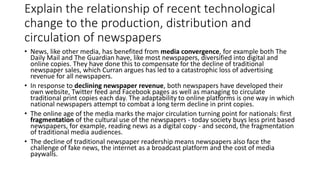
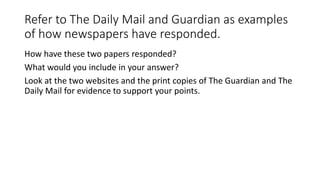
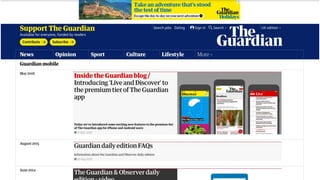
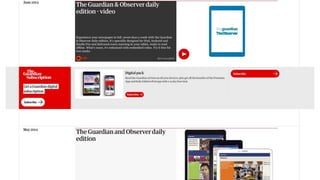
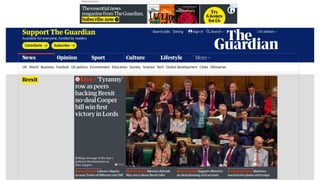
Look at the two websites and the print copies of The Guardian and The
Daily Mail for evidence to support your points.
Refer to The
Daily Mail and
Guardian as
examples of
how
newspapers
have
responded.
How have these two papers responded?
What would you include in your answer?
- The Guardian has kept with its progressive,
culturally informed, educated readers by
developing a strong online brand as well as the
traditional print product.
- The Guardian has developed the concept of the
supporters or ‘loyal reader’ and has boosted its
Twitter following substantially.
- The Daily Mail has continued selling print copies
to its older, more traditional audience, but
developed more tabloidisation of its content.
Online, the focus on soft news, celebrity gossip

Social contexts

  • 1.
    Changing social contexts,caused by technological advances, have created a long- term decline in the circulation of national newspapers. Explain how newspapers have responded to these changes. Refer to The Daily Mail and The Guardian newspapers you have studied to support your answer.
  • 2.
    What to includein your answer… • Consider relevant social contexts that influence newspaper circulation • Use your knowledge and understanding of relevant academic ideas and arguments • Explain the relationship of recent technological change to the production, distribution and circulation of newspapers • Refer to The Daily Mail and Guardian as examples of how newspapers have responded.
  • 3.
    Consider relevant socialcontexts that influence newspaper circulation • The internet is not the sole responsible factor for the decline in the circulation of national newspapers, it is also the audience desire for rolling news and the sense of breaking news on technology, like Twitter, which has lessened the impact of news in its print form – especially when traditional print news is released a day after the news events. • Newspapers in their sales heyday reflected the segmentation of society in terms of social class: the leftish working class masses bought the Daily Mirror while the rightward-leaning working class bought The Sun newspaper. Similarly, the middle class and elites in society choose the ‘quality’ news broadsheets the Times and The Telegraph. However, in the online age, audiences or markets cannot be clearly segmented and targeted as before, leading to the claim this is the end of the audience, because it is fragmented and divided in the online age and audiences have a burgeoning choice of news information in society. • This has led to the break-up of a mass newspaper audience and these audiences are increasingly placed into lifestyle segments and audiences. At the same time media audiences fall together in other ways such as multi-media platform and television, extending out into other media, such as Twitter newsfeeds and a Telegraph Facebook page. • Newspapers have coped with the changes of a digital savvy audience and focus on triggering engagement with a brand. Audiences now have much more choice from their news, and newspapers offer subscription benefits, cut-priced subscription costs offering the reader vlue for content or use paywalls providing unlimited access to paying customers for content in a fragmented and competitive market.
  • 4.
    Use your knowledgeand understanding of relevant academic ideas and arguments • Curran and Seaton • End of audience
  • 5.
    Explain the relationshipof recent technological change to the production, distribution and circulation of newspapers • News, like other media, has benefited from media convergence, for example both The Daily Mail and The Guardian have, like most newspapers, diversified into digital and online copies. They have done this to compensate for the decline of traditional newspaper sales, which Curran argues has led to a catastrophic loss of advertising revenue for all newspapers. • In response to declining newspaper revenue, both newspapers have developed their own website, Twitter feed and Facebook pages as well as managing to circulate traditional print copies each day. The adaptability to online platforms is one way in which national newspapers attempt to combat a long term decline in print copies. • The online age of the media marks the major circulation turning point for nationals: first fragmentation of the cultural use of the newspapers - today society buys less print based newspapers, for example, reading news as a digital copy - and second, the fragmentation of traditional media audiences. • The decline of traditional newspaper readership means newspapers also face the challenge of fake news, the internet as a broadcast platform and the cost of media paywalls.
  • 6.
    Refer to TheDaily Mail and Guardian as examples of how newspapers have responded. How have these two papers responded? What would you include in your answer? Look at the two websites and the print copies of The Guardian and The Daily Mail for evidence to support your points.
  • 13.
    Refer to The DailyMail and Guardian as examples of how newspapers have responded. How have these two papers responded? What would you include in your answer? - The Guardian has kept with its progressive, culturally informed, educated readers by developing a strong online brand as well as the traditional print product. - The Guardian has developed the concept of the supporters or ‘loyal reader’ and has boosted its Twitter following substantially. - The Daily Mail has continued selling print copies to its older, more traditional audience, but developed more tabloidisation of its content. Online, the focus on soft news, celebrity gossip