Assignment 4: Camera
shots, camera angles, camera
movement, composition
          By Nicole Lewis
           Level Yellow
Camera Shots
•   Establishing Shot
•   Wide Shot
•   Long Shot
•   Mid/Medium Shot
•   Close-Up Shot
•   Extreme Close-Up Shot
•   Point Of View
•   Over The Shoulder Shot
•   Two Shot
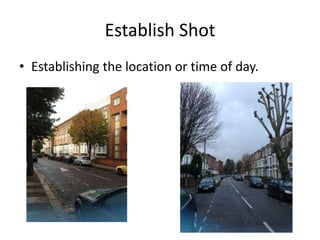
Establish Shot
• Establishing the location or time of day.
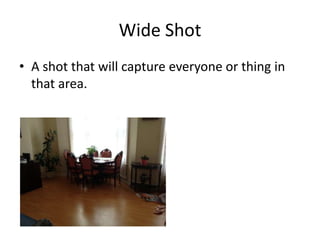
Wide Shot
• A shot that will capture everyone or thing in
  that area.
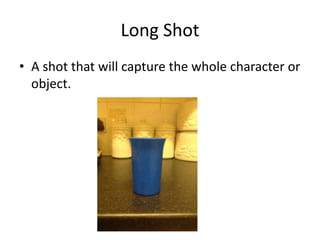
Long Shot
• A shot that will capture the whole character or
  object.
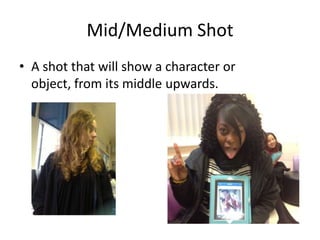
Mid/Medium Shot
• A shot that will show a character or
  object, from its middle upwards.
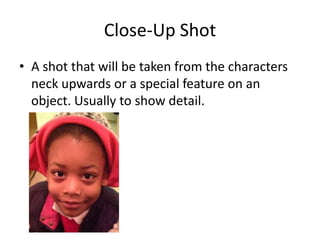
Close-Up Shot
• A shot that will be taken from the characters
  neck upwards or a special feature on an
  object. Usually to show detail.
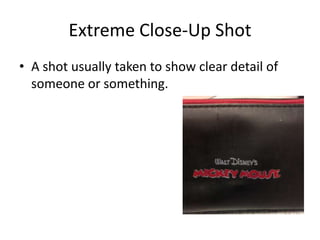
Extreme Close-Up Shot
• A shot usually taken to show clear detail of
  someone or something.
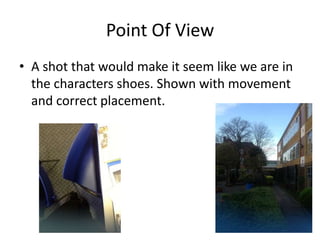
Point Of View
• A shot that would make it seem like we are in
  the characters shoes. Shown with movement
  and correct placement.
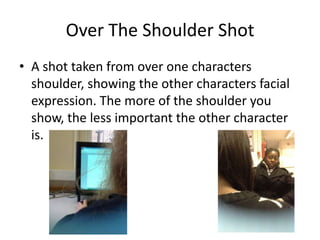
Over The Shoulder Shot
• A shot taken from over one characters
  shoulder, showing the other characters facial
  expression. The more of the shoulder you
  show, the less important the other character
  is.
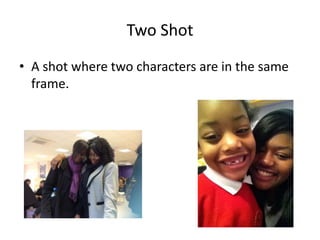
Two Shot
• A shot where two characters are in the same
  frame.
Camera Angles
• Low Angles
• High Angles
• Canted or Oblique Angle
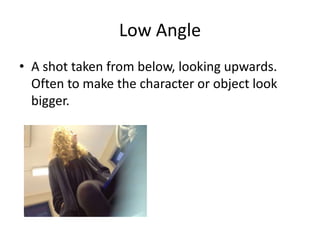
Low Angle
• A shot taken from below, looking upwards.
  Often to make the character or object look
  bigger.
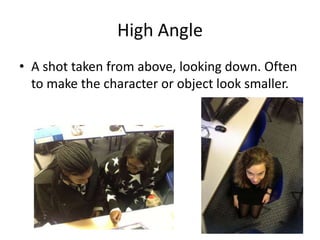
High Angle
• A shot taken from above, looking down. Often
  to make the character or object look smaller.
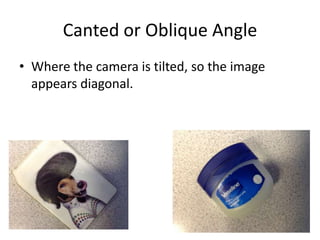
Canted or Oblique Angle
• Where the camera is tilted, so the image
  appears diagonal.
Camera Movement
•   Pan
•   Tilt
•   Track
•   Zoom
•   Reverse Zoom
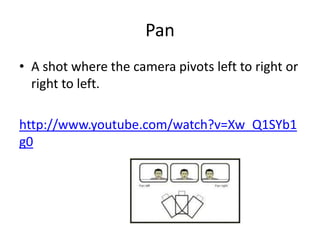
Pan
• A shot where the camera pivots left to right or
  right to left.

http://www.youtube.com/watch?v=Xw_Q1SYb1
g0
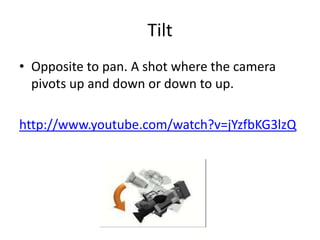
Tilt
• Opposite to pan. A shot where the camera
  pivots up and down or down to up.

http://www.youtube.com/watch?v=jYzfbKG3lzQ
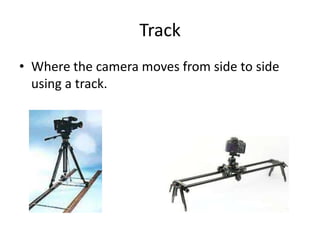
Track
• Where the camera moves from side to side
  using a track.
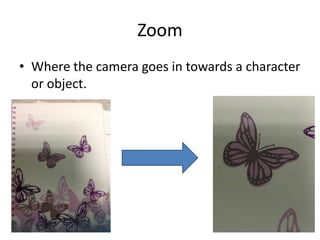
Zoom
• Where the camera goes in towards a character
  or object.
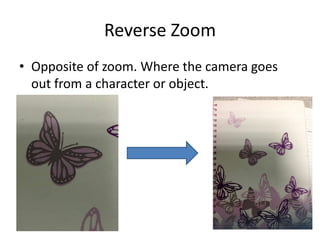
Reverse Zoom
• Opposite of zoom. Where the camera goes
  out from a character or object.
Composition
•   Balance
•   Symmetry
•   Asymmetry
•   Rule of Thirds
•   Depth of Field
•   Shallow Focus
•   Deep Focus
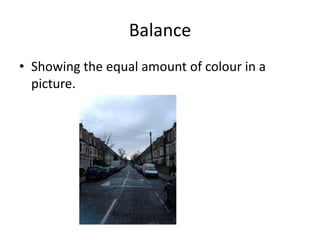
Balance
• Showing the equal amount of colour in a
  picture.
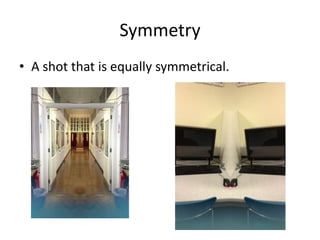
Symmetry
• A shot that is equally symmetrical.
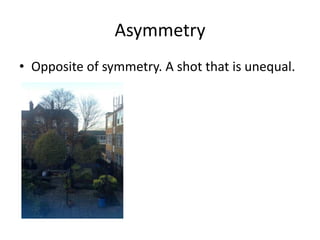
Asymmetry
• Opposite of symmetry. A shot that is unequal.
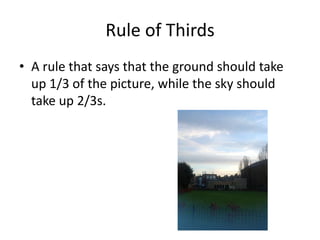
Rule of Thirds
• A rule that says that the ground should take
  up 1/3 of the picture, while the sky should
  take up 2/3s.
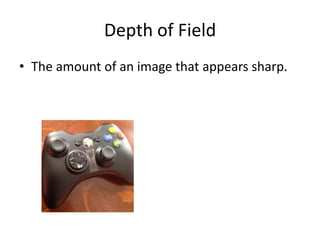
Depth of Field
• The amount of an image that appears sharp.
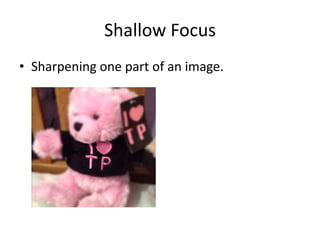
Shallow Focus
• Sharpening one part of an image.
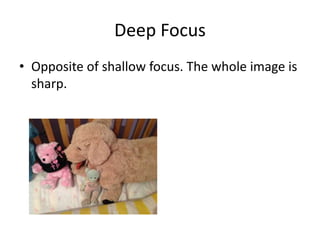
Deep Focus
• Opposite of shallow focus. The whole image is
  sharp.

Camera