Assignment 4- Camera
shots, camera angles, movement
        and composition
         Level Yellow
         Amy Cleary
Part A- Camera Shots
•   Establishing shot
•   Wide shot
•   Long shot
•   Mid/medium shot
•   Close up shot
•   Extreme close up shot
•   Over the shoulder shot
•   Two shot
•   POV(point of view)
Part B: Camera Angles
• Low
• High
• Canted/oblique
Part C- Camera Movement
•   Pan
•   Tilt
•   Track
•   Zoom/reverse zoom
•   Dolly
Part D: Composition
•   Balance
•   Depth of field
•   Shallow focus
•   Deep focus
•   Symmetry(symmetric balance)
•   Asymmetry( asymmetric balance)
Part A-Camera shots
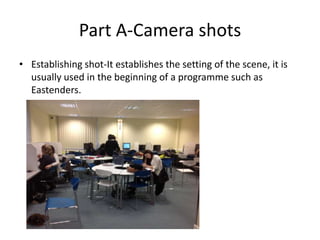
• Establishing shot-It establishes the setting of the scene, it is
  usually used in the beginning of a programme such as
  Eastenders.
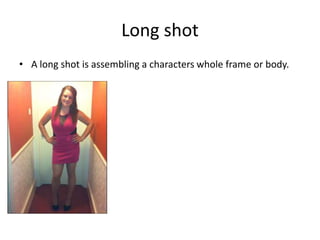
Long shot
• A long shot is assembling a characters whole frame or body.
Wide shot
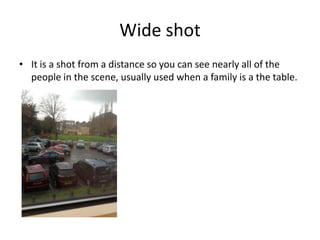
• It is a shot from a distance so you can see nearly all of the
  people in the scene, usually used when a family is a the table.
Mid/medium shot
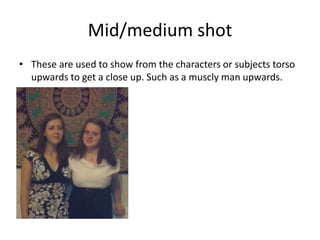
• These are used to show from the characters or subjects torso
  upwards to get a close up. Such as a muscly man upwards.
Close up shot
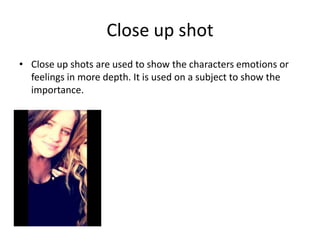
• Close up shots are used to show the characters emotions or
  feelings in more depth. It is used on a subject to show the
  importance.
Extreme close up
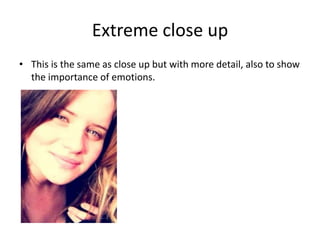
• This is the same as close up but with more detail, also to show
  the importance of emotions.
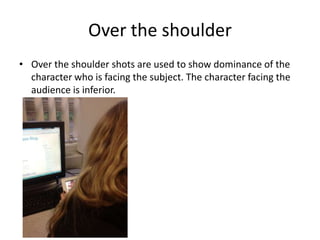
Over the shoulder
• Over the shoulder shots are used to show dominance of the
  character who is facing the subject. The character facing the
  audience is inferior.
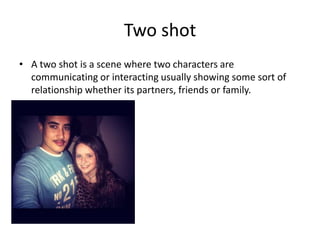
Two shot
• A two shot is a scene where two characters are
  communicating or interacting usually showing some sort of
  relationship whether its partners, friends or family.
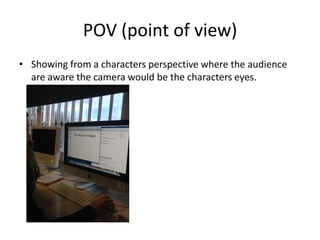
POV (point of view)
• Showing from a characters perspective where the audience
  are aware the camera would be the characters eyes.
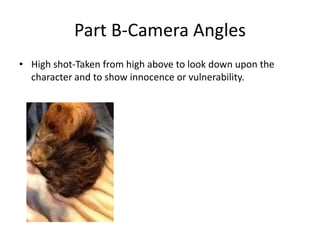
Part B-Camera Angles
• High shot-Taken from high above to look down upon the
  character and to show innocence or vulnerability.
Low Shot
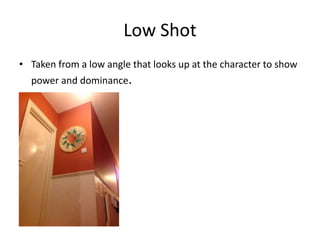
• Taken from a low angle that looks up at the character to show
  power and dominance.
Canted/Oblique
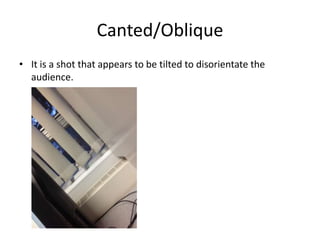
• It is a shot that appears to be tilted to disorientate the
  audience.
Part C-Camera Movement
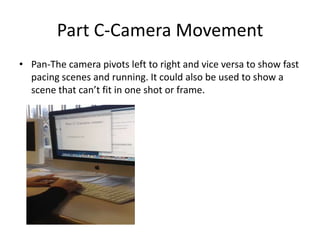
• Pan-The camera pivots left to right and vice versa to show fast
  pacing scenes and running. It could also be used to show a
  scene that can’t fit in one shot or frame.
Tilt
• When the camera moves up and down to show more detail of
  an object. If a hot guy stepped out a car and the camera
  would go from his shoes all the way up to show his outfit.
Track
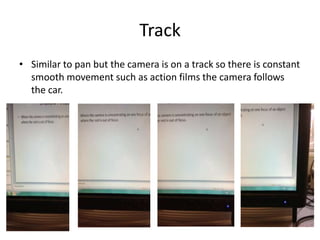
• Similar to pan but the camera is on a track so there is constant
  smooth movement such as action films the camera follows
  the car.
Zoom
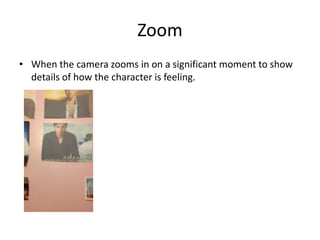
• When the camera zooms in on a significant moment to show
  details of how the character is feeling.
Reverse zoom
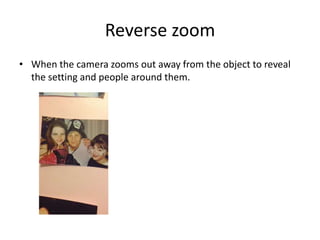
• When the camera zooms out away from the object to reveal
  the setting and people around them.
Dolly
• When the camera moves in a out and backwards and
  forwards on a tripod.
Part D- Composition
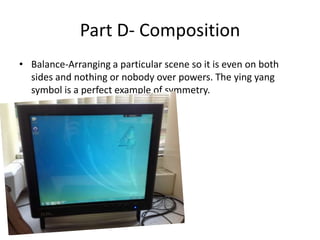
• Balance-Arranging a particular scene so it is even on both
  sides and nothing or nobody over powers. The ying yang
  symbol is a perfect example of symmetry.
Depth of field
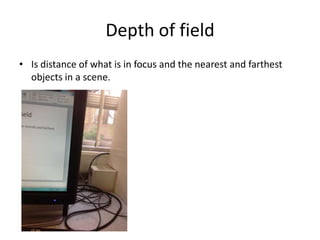
• Is distance of what is in focus and the nearest and farthest
  objects in a scene.
Shallow Focus
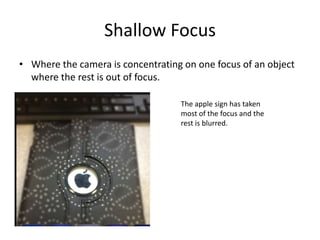
• Where the camera is concentrating on one focus of an object
  where the rest is out of focus.

                                   The apple sign has taken
                                   most of the focus and the
                                   rest is blurred.
Deep focus
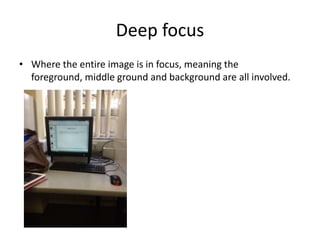
• Where the entire image is in focus, meaning the
  foreground, middle ground and background are all involved.
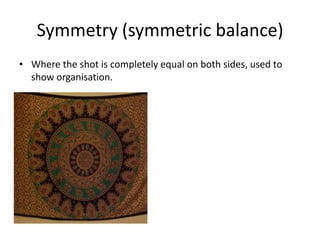
Symmetry (symmetric balance)
• Where the shot is completely equal on both sides, used to
  show organisation.
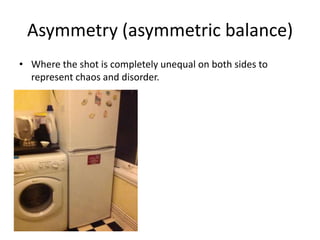
Asymmetry (asymmetric balance)
• Where the shot is completely unequal on both sides to
  represent chaos and disorder.
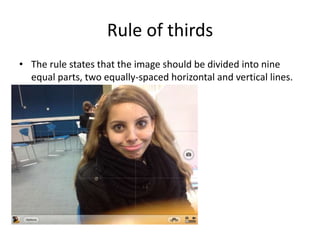
Rule of thirds
• The rule states that the image should be divided into nine
  equal parts, two equally-spaced horizontal and vertical lines.

Amy assignment 4

  • 1.
    Assignment 4- Camera shots,camera angles, movement and composition Level Yellow Amy Cleary
  • 2.
    Part A- CameraShots • Establishing shot • Wide shot • Long shot • Mid/medium shot • Close up shot • Extreme close up shot • Over the shoulder shot • Two shot • POV(point of view)
  • 3.
    Part B: CameraAngles • Low • High • Canted/oblique
  • 4.
    Part C- CameraMovement • Pan • Tilt • Track • Zoom/reverse zoom • Dolly
  • 5.
    Part D: Composition • Balance • Depth of field • Shallow focus • Deep focus • Symmetry(symmetric balance) • Asymmetry( asymmetric balance)
  • 6.
    Part A-Camera shots •Establishing shot-It establishes the setting of the scene, it is usually used in the beginning of a programme such as Eastenders.
  • 7.
    Long shot • Along shot is assembling a characters whole frame or body.
  • 8.
    Wide shot • Itis a shot from a distance so you can see nearly all of the people in the scene, usually used when a family is a the table.
  • 9.
    Mid/medium shot • Theseare used to show from the characters or subjects torso upwards to get a close up. Such as a muscly man upwards.
  • 10.
    Close up shot •Close up shots are used to show the characters emotions or feelings in more depth. It is used on a subject to show the importance.
  • 11.
    Extreme close up •This is the same as close up but with more detail, also to show the importance of emotions.
  • 12.
    Over the shoulder •Over the shoulder shots are used to show dominance of the character who is facing the subject. The character facing the audience is inferior.
  • 13.
    Two shot • Atwo shot is a scene where two characters are communicating or interacting usually showing some sort of relationship whether its partners, friends or family.
  • 14.
    POV (point ofview) • Showing from a characters perspective where the audience are aware the camera would be the characters eyes.
  • 15.
    Part B-Camera Angles •High shot-Taken from high above to look down upon the character and to show innocence or vulnerability.
  • 16.
    Low Shot • Takenfrom a low angle that looks up at the character to show power and dominance.
  • 17.
    Canted/Oblique • It isa shot that appears to be tilted to disorientate the audience.
  • 18.
    Part C-Camera Movement •Pan-The camera pivots left to right and vice versa to show fast pacing scenes and running. It could also be used to show a scene that can’t fit in one shot or frame.
  • 19.
    Tilt • When thecamera moves up and down to show more detail of an object. If a hot guy stepped out a car and the camera would go from his shoes all the way up to show his outfit.
  • 20.
    Track • Similar topan but the camera is on a track so there is constant smooth movement such as action films the camera follows the car.
  • 21.
    Zoom • When thecamera zooms in on a significant moment to show details of how the character is feeling.
  • 22.
    Reverse zoom • Whenthe camera zooms out away from the object to reveal the setting and people around them.
  • 23.
    Dolly • When thecamera moves in a out and backwards and forwards on a tripod.
  • 24.
    Part D- Composition •Balance-Arranging a particular scene so it is even on both sides and nothing or nobody over powers. The ying yang symbol is a perfect example of symmetry.
  • 25.
    Depth of field •Is distance of what is in focus and the nearest and farthest objects in a scene.
  • 26.
    Shallow Focus • Wherethe camera is concentrating on one focus of an object where the rest is out of focus. The apple sign has taken most of the focus and the rest is blurred.
  • 27.
    Deep focus • Wherethe entire image is in focus, meaning the foreground, middle ground and background are all involved.
  • 28.
    Symmetry (symmetric balance) •Where the shot is completely equal on both sides, used to show organisation.
  • 29.
    Asymmetry (asymmetric balance) •Where the shot is completely unequal on both sides to represent chaos and disorder.
  • 30.
    Rule of thirds •The rule states that the image should be divided into nine equal parts, two equally-spaced horizontal and vertical lines.