Camera Shots
• Extreme close up
• Close up
• Medium shot
• Long shot
• Two shot
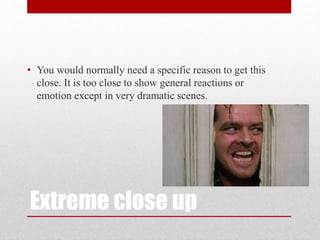
Extreme close up
• You would normally need a specific reason to get this
close. It is too close to show general reactions or
emotion except in very dramatic scenes.
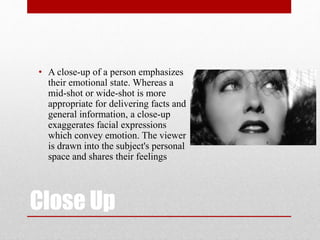
Close Up
• A close-up of a person emphasizes
their emotional state. Whereas a
mid-shot or wide-shot is more
appropriate for delivering facts and
general information, a close-up
exaggerates facial expressions
which convey emotion. The viewer
is drawn into the subject's personal
space and shares their feelings.
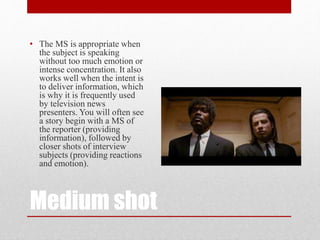
Medium shot
• The MS is appropriate when
the subject is speaking
without too much emotion or
intense concentration. It also
works well when the intent is
to deliver information, which
is why it is frequently used
by television news
presenters. You will often see
a story begin with a MS of
the reporter (providing
information), followed by
closer shots of interview
subjects (providing reactions
and emotion).
Camera angles
• High angle
• Low angle
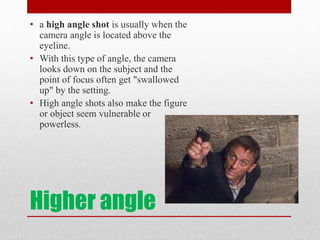
Higher angle
• a high angle shot is usually when the
camera angle is located above the
eyeline.
• With this type of angle, the camera
looks down on the subject and the
point of focus often get "swallowed
up" by the setting.
• High angle shots also make the figure
or object seem vulnerable or
powerless.
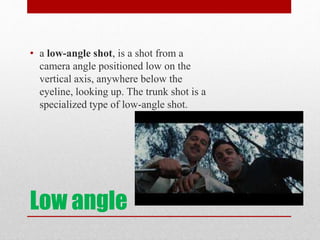
Low angle
• a low-angle shot, is a shot from a
camera angle positioned low on the
vertical axis, anywhere below the
eyeline, looking up. The trunk shot is a
specialized type of low-angle shot.
Camera movement
• Pan
• Track
• Crab
pan
• A pan is a horizontal camera movement in which the
camera moves left and right about a central axis. This is a
swiveling movement, i.e. mounted in a fixed location on a
tripod or shoulder, rather than a dolly-like movement in
which the entire mounting system moves.
• To create a smooth pan it's a good idea to practice the
movement first. If you need to move or stretch your body
during the move, it helps to position yourself so you end
up in the more comfortable position. In other words you
should become more comfortable as the move progresses
rather than less comfortable.
track
• Roughly synonymous with the dolly shot, but often
defined more specifically as movement which stays a
constant distance from the action, especially side-to-side
movement..
crab
• A less-common term for tracking or trucking.
Bits on edit
• Cut away
• Cut in
• Cut cross
Cross Cut
• Cross-cutting is an editing technique most often used in
films to establish action occurring at the same time in two
different locations. In a cross-cut, the camera will cut
away from one action to another action, which can
suggest the simultaneity of these two actions but this is
not always the case

Camera shots and angles

  • 1.
    Camera Shots • Extremeclose up • Close up • Medium shot • Long shot • Two shot
  • 2.
    Extreme close up •You would normally need a specific reason to get this close. It is too close to show general reactions or emotion except in very dramatic scenes.
  • 3.
    Close Up • Aclose-up of a person emphasizes their emotional state. Whereas a mid-shot or wide-shot is more appropriate for delivering facts and general information, a close-up exaggerates facial expressions which convey emotion. The viewer is drawn into the subject's personal space and shares their feelings.
  • 4.
    Medium shot • TheMS is appropriate when the subject is speaking without too much emotion or intense concentration. It also works well when the intent is to deliver information, which is why it is frequently used by television news presenters. You will often see a story begin with a MS of the reporter (providing information), followed by closer shots of interview subjects (providing reactions and emotion).
  • 5.
    Camera angles • Highangle • Low angle
  • 6.
    Higher angle • ahigh angle shot is usually when the camera angle is located above the eyeline. • With this type of angle, the camera looks down on the subject and the point of focus often get "swallowed up" by the setting. • High angle shots also make the figure or object seem vulnerable or powerless.
  • 7.
    Low angle • alow-angle shot, is a shot from a camera angle positioned low on the vertical axis, anywhere below the eyeline, looking up. The trunk shot is a specialized type of low-angle shot.
  • 8.
  • 9.
    pan • A panis a horizontal camera movement in which the camera moves left and right about a central axis. This is a swiveling movement, i.e. mounted in a fixed location on a tripod or shoulder, rather than a dolly-like movement in which the entire mounting system moves. • To create a smooth pan it's a good idea to practice the movement first. If you need to move or stretch your body during the move, it helps to position yourself so you end up in the more comfortable position. In other words you should become more comfortable as the move progresses rather than less comfortable.
  • 10.
    track • Roughly synonymouswith the dolly shot, but often defined more specifically as movement which stays a constant distance from the action, especially side-to-side movement..
  • 11.
    crab • A less-commonterm for tracking or trucking.
  • 12.
    Bits on edit •Cut away • Cut in • Cut cross
  • 13.
    Cross Cut • Cross-cuttingis an editing technique most often used in films to establish action occurring at the same time in two different locations. In a cross-cut, the camera will cut away from one action to another action, which can suggest the simultaneity of these two actions but this is not always the case