California
Psychological
Inventory
MAS, Pamela Bianca E.
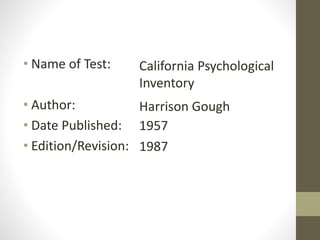
• Name of Test:
• Author:
• Date Published:
• Edition/Revision:
California Psychological
Inventory
Harrison Gough
1957
1987
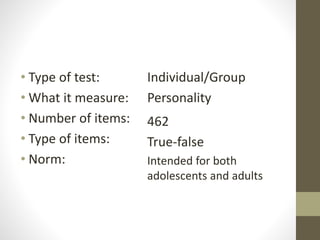
• Type of test:
• What it measure:
• Number of items:
• Type of items:
• Norm:
Individual/Group
Personality
462
True-false
Intended for both
adolescents and adults
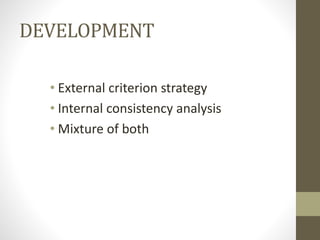
DEVELOPMENT
• External criterion strategy
• Internal consistency analysis
• Mixture of both
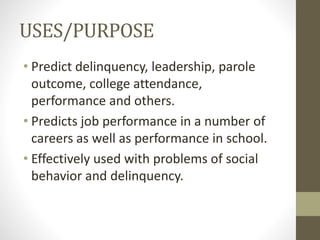
USES/PURPOSE
• Predict delinquency, leadership, parole
outcome, college attendance,
performance and others.
• Predicts job performance in a number of
careers as well as performance in school.
• Effectively used with problems of social
behavior and delinquency.
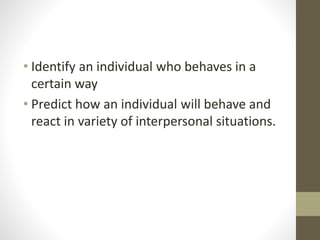
• Identify an individual who behaves in a
certain way
• Predict how an individual will behave and
react in variety of interpersonal situations.
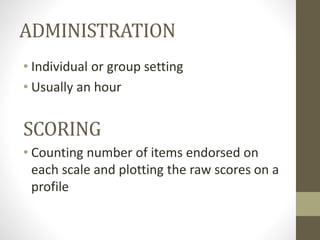
ADMINISTRATION
• Individual or group setting
• Usually an hour
SCORING
• Counting number of items endorsed on
each scale and plotting the raw scores on a
profile
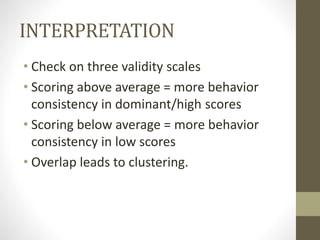
INTERPRETATION
• Check on three validity scales
• Scoring above average = more behavior
consistency in dominant/high scores
• Scoring below average = more behavior
consistency in low scores
• Overlap leads to clustering.
EVALUATION
Reliability
• test-retest approach
• .90
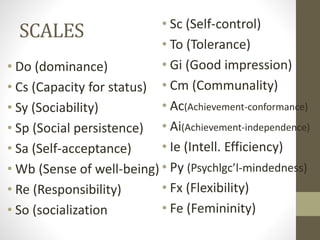
SCALES
• Do (dominance)
• Cs (Capacity for status)
• Sy (Sociability)
• Sp (Social persistence)
• Sa (Self-acceptance)
• Wb (Sense of well-being)
• Re (Responsibility)
• So (socialization
• Sc (Self-control)
• To (Tolerance)
• Gi (Good impression)
• Cm (Communality)
• Ac(Achievement-conformance)
• Ai(Achievement-independence)
• Ie (Intell. Efficiency)
• Py (Psychlgc’l-mindedness)
• Fx (Flexibility)
• Fe (Femininity)

California Psychological Inventory

  • 1.
  • 2.
    • Name ofTest: • Author: • Date Published: • Edition/Revision: California Psychological Inventory Harrison Gough 1957 1987
  • 3.
    • Type oftest: • What it measure: • Number of items: • Type of items: • Norm: Individual/Group Personality 462 True-false Intended for both adolescents and adults
  • 4.
    DEVELOPMENT • External criterionstrategy • Internal consistency analysis • Mixture of both
  • 5.
    USES/PURPOSE • Predict delinquency,leadership, parole outcome, college attendance, performance and others. • Predicts job performance in a number of careers as well as performance in school. • Effectively used with problems of social behavior and delinquency.
  • 6.
    • Identify anindividual who behaves in a certain way • Predict how an individual will behave and react in variety of interpersonal situations.
  • 7.
    ADMINISTRATION • Individual orgroup setting • Usually an hour SCORING • Counting number of items endorsed on each scale and plotting the raw scores on a profile
  • 8.
    INTERPRETATION • Check onthree validity scales • Scoring above average = more behavior consistency in dominant/high scores • Scoring below average = more behavior consistency in low scores • Overlap leads to clustering.
  • 9.
  • 10.
    SCALES • Do (dominance) •Cs (Capacity for status) • Sy (Sociability) • Sp (Social persistence) • Sa (Self-acceptance) • Wb (Sense of well-being) • Re (Responsibility) • So (socialization • Sc (Self-control) • To (Tolerance) • Gi (Good impression) • Cm (Communality) • Ac(Achievement-conformance) • Ai(Achievement-independence) • Ie (Intell. Efficiency) • Py (Psychlgc’l-mindedness) • Fx (Flexibility) • Fe (Femininity)