California Personality Inventory
And Wechsler Adult Intelligence
Scale
 The California Psychological Inventory (CPI) is
a Self-reported Inventory created by Harrison G.
Gough and currently published by Consulting
Psychologists Press.The test was first published in
1956, and the most recent revision was published in
1987. It was created in a similar manner to
the Minnesota Multiphasic Personality Inventory
(MMPI)—with which it shares 194 items. But unlike
the MMPI, which focuses on maladjustment or clinical
diagnosis, the CPI was created to assess the everyday
"folk-concepts" that ordinary people use to describe
the behavior of the people around them
 It is a true- false test, which measure normal
personality. It is available in two forms such
as:
1. CPI- 434
2. CPI-260
 It is easy to administer and the immediacy of
computer generated reports
 California personality InventoryAvailable in
two versions they both are identical in the
component and interpretive strategies of the
scale but the only difference is its number of
items one consist of 434 and the other one
have 260 items
 The purpose of the California Personality
Inventory to evaluate interpersonal behavior
and social interactions within normal
individuals. It is applicable for the population
of age 13 and above.
 There are 20 folk measures of personality
such as:
 7 work related scales
 3 broad vectors
 3 basic personality scales
a. Good Impression (GI)
b. Communality (Cm)
c. Well- Being (WB)
 These scales provide information on test –
taking attitudes and therefore function as
validity scales.
 Item-endorsement frequencies were
contrasted to ferret out the best statement
for each scale.
 Persons who reported many social activities
Vs those reporting few of no social activities.
 There areThreeVectors:
 Vector 1 which is also calledV.1. It has two
polarities towards people or toward one’s
inner life and similar to the extraversion-
introversion dimension
 Vector 2 which is also calledV.2. It has two
polarities they are rule favoring or rule
questioning and reflects a conventional or
unconventional dimension
 These two vectors provided four lifestyles
such as:
1. Implementer Lifestyle
2. Supporter Lifestyle
3. Innovator Lifestyle
4. Visualizer Lifestyle
 Implementers are extroverted and rule
favoring.
 Supporters are introverted and also rule
favoring
 Innovators are extroverted and rule
questioning
 Visualizers are introverted and also rule
quesioning
 Vector three assessed a 7- point continuum
variously referred to as:
1. Self realization
2. Psychological competence
3. Ego integration
 The manual of CPI provides information
about each lifestyle, including adjective
correlates obtained from spouses, peers,
and professional evaluators.
 The CPI is useful for predictions of the
following:
 Psychological and physical health
 High school and college achievement
 Effectiveness of police and military personnel
 Leadership and management success
 The CPI is particularly effective at identifying
adolescents or adults who follow a delinquent
or criminal lifestyle.
THE WECHSLER
ADULT
INTELLIGENCE
SCALE
 The firstWechsler intelligence scale known as
theWechsler Bellevue intelligence scale, was
developed in 1939, two years after the 1937
version of stanford-Binet
 WAIS developed in reaction to problems with
the 1937 stanford- Binet
 SB items had been selected for use with
children and were not really appropriate for
adults and it also had lots of timed tests,
which made it difficult for older adults
 TheWechsler-Bellevue tests were innovative
in the 1930s because they:
 gathered tasks created for nonclinical
purposes for administration as a "clinical test
battery",
 used the point scale concept instead of the
age scale, and included a non-verbal
performance scale.
 With earlier SB tests, there were a number of
different kinds of tasks and items at different
age levels, more verbal at older ages.
 InWechsler Intelligence Scale , all items of
the particular type are grouped together, and
presented in order of increasing difficulty .
 Points are assigned to each item, allowing for
a calculation of a score for each type of task,
or for each content area.
 Earlier forms of SB largely dependent on
verbal ability, especially in the test for the
older age ranges
 Wechsler Scale include measures of
performance, as well as scales reflecting
verbal ability
 Comparison of verbal and nonverbal scores
provides a great deal of information, for
example, in identifying children with learning
disabilities
 performance scale is less affected by
language and cultural factors
 TheWAIS-R, a revised form of theWAIS, was
released in 1981 and consisted of six verbal and
five performance subtests.The verbal tests
were:
 Information,
 Comprehension,
 Arithmetic,
 Digit Span,
 Similarities,
 Vocabulary.
 The Performance subtests were:
 Picture Arrangement,
 Picture Completion,
 Block Design,
 ObjectAssembly,
 Digit Symbol.
 A verbal IQ, performance IQ and full scale IQ
were obtained.
 This revised edition did not provide new
validity data, but used the data from the
originalWAIS; however new norms were
provided, carefully stratified
 TheWAIS-III, a subsequent revision of the
WAIS and theWAIS-R. Published in 1997
developed for use with individuals aged 16
through 89. It provided scores for
 Verbal IQ,
 Performance IQ,
 Full Scale IQ,
 along with four secondary indices (Verbal
Comprehension,Working Memory,
Perceptual Organization, and Processing
Speed).
 takes 60 to 90 minutes to administer
 Wechsler believed in a single factor of
intelligence, but thought that it consisted of
specific, interrelated elements
 to get a measure of overall intelligence,
simply aggregate the capabilities on each of
the separate elements
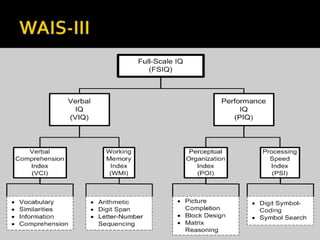
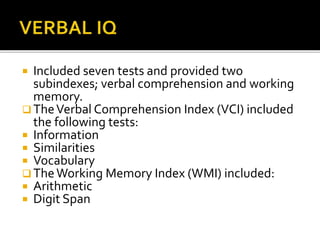
 Included seven tests and provided two
subindexes; verbal comprehension and working
memory.
 TheVerbal Comprehension Index (VCI) included
the following tests:
 Information
 Similarities
 Vocabulary
 TheWorking Memory Index (WMI) included:
 Arithmetic
 Digit Span
 Included six tests and it also provided two
subindexes; perceptual organization and
processing speed.
 The Perceptual Organization Index (POI)
included:
 Block Design
 Matrix Reasoning
 Picture Completion
 The Processing Speed Index (PSI) included:
 Digit Symbol-Coding
 Symbol Search
 The current version of the test, theWAIS-IV,
which was released in 2008, is composed of
10 core subtests and five supplemental
subtests, with the 10 core subtests
comprising the Full Scale IQ.With the new
WAIS-IV, the verbal/performance subscales
from previous versions were removed and
replaced by the index scores.
 The GeneralAbility Index (GAI) was included,
which consists of the
 Similarities,
 Vocabulary
 Information subtests from theVerbal
Comprehension Index and the Block Design,
Matrix Reasoning andVisual Puzzles subtests
from the Perceptual Reasoning Index.
 The GAI is clinically useful because it can be
used as a measure of cognitive abilities that
are less vulnerable to impairments of
processing and working memory.
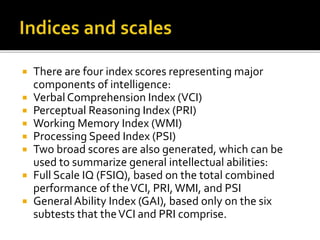
 There are four index scores representing major
components of intelligence:
 Verbal Comprehension Index (VCI)
 Perceptual Reasoning Index (PRI)
 Working Memory Index (WMI)
 Processing Speed Index (PSI)
 Two broad scores are also generated, which can be
used to summarize general intellectual abilities:
 Full Scale IQ (FSIQ), based on the total combined
performance of theVCI, PRI,WMI, and PSI
 GeneralAbility Index (GAI), based only on the six
subtests that theVCI and PRI comprise.
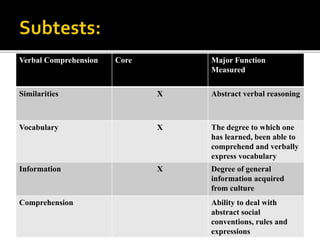
Verbal Comprehension Core Major Function
Measured
Similarities X Abstract verbal reasoning
Vocabulary X The degree to which one
has learned, been able to
comprehend and verbally
express vocabulary
Information X Degree of general
information acquired
from culture
Comprehension Ability to deal with
abstract social
conventions, rules and
expressions
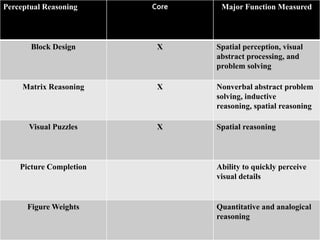
Perceptual Reasoning Core Major Function Measured
Block Design X Spatial perception, visual
abstract processing, and
problem solving
Matrix Reasoning X Nonverbal abstract problem
solving, inductive
reasoning, spatial reasoning
Visual Puzzles X Spatial reasoning
Picture Completion Ability to quickly perceive
visual details
Figure Weights Quantitative and analogical
reasoning
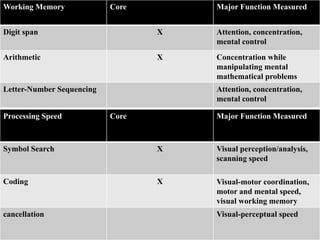
Working Memory Core Major Function Measured
Digit span X Attention, concentration,
mental control
Arithmetic X Concentration while
manipulating mental
mathematical problems
Letter-Number Sequencing Attention, concentration,
mental control
Processing Speed Core Major Function Measured
Symbol Search X Visual perception/analysis,
scanning speed
Coding X Visual-motor coordination,
motor and mental speed,
visual working memory
cancellation Visual-perceptual speed
 TheWAIS-IV was standardized on a sample of
2,200 people in the United States ranging in
age from 16 to 90. An extension of the
standardization has been conducted with 688
Canadians in the same age range.
 For individuals under 16 years, theWechsler
Intelligence Scale for Children (WISC, 6–16 years) and
theWechsler Preschool and Primary Scale of
Intelligence (WPPSI, 2½–7 years, 3 months) are used.
 Intelligence tests may also be utilized in populations
with psychiatric illness or brain injury, in order to
assess level of cognitive functioning, though some
regard this use as controversial. Rehabilitation
psychologists and neuropsychologists use theWAIS-
IV and other neuropsychological tests to assess how
the brain is functioning after injury.
 Specific subtests provide information on a specific
cognitive function. For example, digit span may be
used to get a sense of attentional difficulties. Others
employ the WAIS-R NI (Wechsler Adult Intelligence
Scale-Revised as a Neuropsychological Instrument),
another measure published by Harcourt. Each subtest
score is tallied and calculated with respect to
neurotypical or brain-injury norms. As theWAIS is
developed for the average, non-injured individual,
separate norms were developed for appropriate
comparison among similar functioning individuals.
CPI And WAIS

CPI And WAIS

  • 1.
    California Personality Inventory AndWechsler Adult Intelligence Scale
  • 2.
     The CaliforniaPsychological Inventory (CPI) is a Self-reported Inventory created by Harrison G. Gough and currently published by Consulting Psychologists Press.The test was first published in 1956, and the most recent revision was published in 1987. It was created in a similar manner to the Minnesota Multiphasic Personality Inventory (MMPI)—with which it shares 194 items. But unlike the MMPI, which focuses on maladjustment or clinical diagnosis, the CPI was created to assess the everyday "folk-concepts" that ordinary people use to describe the behavior of the people around them
  • 3.
     It isa true- false test, which measure normal personality. It is available in two forms such as: 1. CPI- 434 2. CPI-260  It is easy to administer and the immediacy of computer generated reports
  • 4.
     California personalityInventoryAvailable in two versions they both are identical in the component and interpretive strategies of the scale but the only difference is its number of items one consist of 434 and the other one have 260 items
  • 5.
     The purposeof the California Personality Inventory to evaluate interpersonal behavior and social interactions within normal individuals. It is applicable for the population of age 13 and above.
  • 6.
     There are20 folk measures of personality such as:  7 work related scales  3 broad vectors  3 basic personality scales a. Good Impression (GI) b. Communality (Cm) c. Well- Being (WB)
  • 7.
     These scalesprovide information on test – taking attitudes and therefore function as validity scales.  Item-endorsement frequencies were contrasted to ferret out the best statement for each scale.  Persons who reported many social activities Vs those reporting few of no social activities.
  • 8.

     There areThreeVectors: Vector 1 which is also calledV.1. It has two polarities towards people or toward one’s inner life and similar to the extraversion- introversion dimension  Vector 2 which is also calledV.2. It has two polarities they are rule favoring or rule questioning and reflects a conventional or unconventional dimension
  • 9.
     These twovectors provided four lifestyles such as: 1. Implementer Lifestyle 2. Supporter Lifestyle 3. Innovator Lifestyle 4. Visualizer Lifestyle
  • 10.
     Implementers areextroverted and rule favoring.  Supporters are introverted and also rule favoring  Innovators are extroverted and rule questioning  Visualizers are introverted and also rule quesioning
  • 11.
     Vector threeassessed a 7- point continuum variously referred to as: 1. Self realization 2. Psychological competence 3. Ego integration  The manual of CPI provides information about each lifestyle, including adjective correlates obtained from spouses, peers, and professional evaluators.
  • 12.
     The CPIis useful for predictions of the following:  Psychological and physical health  High school and college achievement  Effectiveness of police and military personnel  Leadership and management success
  • 13.
     The CPIis particularly effective at identifying adolescents or adults who follow a delinquent or criminal lifestyle.
  • 14.
  • 15.
     The firstWechslerintelligence scale known as theWechsler Bellevue intelligence scale, was developed in 1939, two years after the 1937 version of stanford-Binet  WAIS developed in reaction to problems with the 1937 stanford- Binet  SB items had been selected for use with children and were not really appropriate for adults and it also had lots of timed tests, which made it difficult for older adults
  • 16.
     TheWechsler-Bellevue testswere innovative in the 1930s because they:  gathered tasks created for nonclinical purposes for administration as a "clinical test battery",  used the point scale concept instead of the age scale, and included a non-verbal performance scale.
  • 17.
     With earlierSB tests, there were a number of different kinds of tasks and items at different age levels, more verbal at older ages.  InWechsler Intelligence Scale , all items of the particular type are grouped together, and presented in order of increasing difficulty .  Points are assigned to each item, allowing for a calculation of a score for each type of task, or for each content area.
  • 18.
     Earlier formsof SB largely dependent on verbal ability, especially in the test for the older age ranges  Wechsler Scale include measures of performance, as well as scales reflecting verbal ability  Comparison of verbal and nonverbal scores provides a great deal of information, for example, in identifying children with learning disabilities  performance scale is less affected by language and cultural factors
  • 19.
     TheWAIS-R, arevised form of theWAIS, was released in 1981 and consisted of six verbal and five performance subtests.The verbal tests were:  Information,  Comprehension,  Arithmetic,  Digit Span,  Similarities,  Vocabulary.
  • 20.
     The Performancesubtests were:  Picture Arrangement,  Picture Completion,  Block Design,  ObjectAssembly,  Digit Symbol.  A verbal IQ, performance IQ and full scale IQ were obtained.
  • 21.
     This revisededition did not provide new validity data, but used the data from the originalWAIS; however new norms were provided, carefully stratified
  • 22.
     TheWAIS-III, asubsequent revision of the WAIS and theWAIS-R. Published in 1997 developed for use with individuals aged 16 through 89. It provided scores for  Verbal IQ,  Performance IQ,  Full Scale IQ,  along with four secondary indices (Verbal Comprehension,Working Memory, Perceptual Organization, and Processing Speed).
  • 23.
     takes 60to 90 minutes to administer  Wechsler believed in a single factor of intelligence, but thought that it consisted of specific, interrelated elements  to get a measure of overall intelligence, simply aggregate the capabilities on each of the separate elements
  • 25.
     Included seventests and provided two subindexes; verbal comprehension and working memory.  TheVerbal Comprehension Index (VCI) included the following tests:  Information  Similarities  Vocabulary  TheWorking Memory Index (WMI) included:  Arithmetic  Digit Span
  • 26.
     Included sixtests and it also provided two subindexes; perceptual organization and processing speed.  The Perceptual Organization Index (POI) included:  Block Design  Matrix Reasoning  Picture Completion  The Processing Speed Index (PSI) included:  Digit Symbol-Coding  Symbol Search
  • 27.
     The currentversion of the test, theWAIS-IV, which was released in 2008, is composed of 10 core subtests and five supplemental subtests, with the 10 core subtests comprising the Full Scale IQ.With the new WAIS-IV, the verbal/performance subscales from previous versions were removed and replaced by the index scores.
  • 28.
     The GeneralAbilityIndex (GAI) was included, which consists of the  Similarities,  Vocabulary  Information subtests from theVerbal Comprehension Index and the Block Design, Matrix Reasoning andVisual Puzzles subtests from the Perceptual Reasoning Index.
  • 29.
     The GAIis clinically useful because it can be used as a measure of cognitive abilities that are less vulnerable to impairments of processing and working memory.
  • 30.
     There arefour index scores representing major components of intelligence:  Verbal Comprehension Index (VCI)  Perceptual Reasoning Index (PRI)  Working Memory Index (WMI)  Processing Speed Index (PSI)  Two broad scores are also generated, which can be used to summarize general intellectual abilities:  Full Scale IQ (FSIQ), based on the total combined performance of theVCI, PRI,WMI, and PSI  GeneralAbility Index (GAI), based only on the six subtests that theVCI and PRI comprise.
  • 31.
    Verbal Comprehension CoreMajor Function Measured Similarities X Abstract verbal reasoning Vocabulary X The degree to which one has learned, been able to comprehend and verbally express vocabulary Information X Degree of general information acquired from culture Comprehension Ability to deal with abstract social conventions, rules and expressions
  • 32.
    Perceptual Reasoning CoreMajor Function Measured Block Design X Spatial perception, visual abstract processing, and problem solving Matrix Reasoning X Nonverbal abstract problem solving, inductive reasoning, spatial reasoning Visual Puzzles X Spatial reasoning Picture Completion Ability to quickly perceive visual details Figure Weights Quantitative and analogical reasoning
  • 33.
    Working Memory CoreMajor Function Measured Digit span X Attention, concentration, mental control Arithmetic X Concentration while manipulating mental mathematical problems Letter-Number Sequencing Attention, concentration, mental control Processing Speed Core Major Function Measured Symbol Search X Visual perception/analysis, scanning speed Coding X Visual-motor coordination, motor and mental speed, visual working memory cancellation Visual-perceptual speed
  • 34.
     TheWAIS-IV wasstandardized on a sample of 2,200 people in the United States ranging in age from 16 to 90. An extension of the standardization has been conducted with 688 Canadians in the same age range.
  • 35.
     For individualsunder 16 years, theWechsler Intelligence Scale for Children (WISC, 6–16 years) and theWechsler Preschool and Primary Scale of Intelligence (WPPSI, 2½–7 years, 3 months) are used.  Intelligence tests may also be utilized in populations with psychiatric illness or brain injury, in order to assess level of cognitive functioning, though some regard this use as controversial. Rehabilitation psychologists and neuropsychologists use theWAIS- IV and other neuropsychological tests to assess how the brain is functioning after injury.
  • 36.
     Specific subtestsprovide information on a specific cognitive function. For example, digit span may be used to get a sense of attentional difficulties. Others employ the WAIS-R NI (Wechsler Adult Intelligence Scale-Revised as a Neuropsychological Instrument), another measure published by Harcourt. Each subtest score is tallied and calculated with respect to neurotypical or brain-injury norms. As theWAIS is developed for the average, non-injured individual, separate norms were developed for appropriate comparison among similar functioning individuals.