MMPI-2 Dale Pietrzak,  Ed.D., LPC-MH, NCC, CCMHC   Counseling & Psychology in Education University of South Dakota
MMPI: General 1st published in 1943 (Stark Hathaway, Ph.D, & J. Chaney McKinley, M.D.) Group administered procedure to reliably diagnose Used Empirical keying approach (new at time) Graham (2000)  MMPI-2: Assessing Personality & Psychopathology (3 rd  ed) Butcher, Et. Al   (1989)  MMPI-2: Manual for Admin & Scoring
MMPI: Development About 1000 potential items were collected Hathaway & McKinley selected 504 believed to be relatively novel from each other Appropriate criterion groups were selected “ Minnesota Normals” “ Clinical Subjects” 504 items administered to groups
MMPI: Development Con’t Item Analysis (Discrimination Index) used to determine items Selected items were cross validated Later 5 (Mf) and 0 (Si) were added
MMPI Validity Scale Development 3 scales (?, L & F) were originally intended with K added shortly thereafter ? (Cannot Say):  Number of omitted and double marked items L (Lie): Unsophisticated attempts to present oneself in an overly favorable light F (Infrequency):  Designed to detect deviant test taking behaviors (<10% of normals)
MMPI Validity Scale Development K (Defensiveness):  Meehl & Hathaway (1945) to identify defensiveness Clinical subjects who scored low for level of pathology were contrasted with “normals” to select items Later incorporated as a correction factor for basic scales Con’t I think my hand is broken!
MMPI Validity Scale Development F(p): Infrequency-Psychopathology:  Try to reduce impact of pathology on F scale. Although officially no cut score set, scores of 100 are seen as cutoff.
Changes Due to Use 10 years  saw MMPI could not do intend job of independent classification accurately Too many normals scored high Scales Highly inter-correlated Approach from pure classification to locating empirical correlates of scales and code types Scale names dropped in favor of numbers
Need for Revision of MMPI (MMPI-2) MMPI was consistently ranked as one of the most used instruments Clinicians (not just “testers”) found it valuable Several weakness were Identified
MMPI Weaknesses No revision since 1943 Representativness of standardization sample Non-Normal distributions of scales scores Item content dated, bias, or objectionable Insufficient coverage of pathology (drug use, relationships, suicide, etc.) 1982 U of M Press appoints restandardization committee (Graham, Butcher, Dalstrom)
Revision Process Form AX (Adults) 704 total items 550 original items maintained 82 were rewritten and 15 reworded 154 new items tried National Solicitation of Sample Phone Books, etc. Paid $15 individual and $40 couple Emphasis on special populations 2900  subjects tested 2600 retained About time
Standardization Sample Characteristics Under represents the below HS educated (little statistical impact) 81% Cauc., 12% Black, 3% Hispanic, 3% Native Am., 1% Asian Am. Age:  18-85 (Mean 41; SD 15) Education: 3 years to 20+ (Mean 15; SD 2) Mostly Married I can’t take anymore!
Final MMPI-2 Booklet 567 Items Objectionable Items & Bias removed New Scales Developed  Most Supplemental and All Clinical Scales Retained Ta  Da!
Comparability of MMPI & MMPI-2 The results of the 2 tests have proven to be generally comparable The less defined the profile the less reliable the comparison Greene (1991) suggests conversion to MMPI scores with table K-1 from Manual Graham says to use individual scales when not clear code type
Administration & Scoring Advanced degree in mental health, supervised testing (25) and Psychopathology 1 to 1.5 hours to take 8th grade reading level Supervised administration (No TV or movies, etc.) 200+ scales, VRIN/TRIN May the force be with you !
Distributions and T-Scores Non-normal distributions Uniform T-Scores (Averaged distribution) Clinical Scales, Content Scales  & MDS use Uniform Supplemental, Harris-Lingoes, Mf and Si use Linear T of 30 = 99%, T of 50 = 45%, T of 65 = 8%, T of 80 = 1% I’m Back!
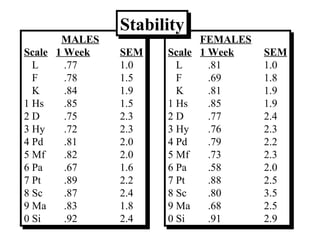
Stability of Basic Scales   MALES Scale 1 Week   SEM L   .77 1.0 F   .78 1.5 K   .84 1.9 1 Hs   .85 1.5 2 D   .75 2.3 3 Hy    .72 2.3 4 Pd   .81 2.0 5 Mf   .82 2.0 6 Pa   .67 1.6 7 Pt   .89 2.2 8 Sc   .87 2.4 9 Ma   .83 1.8 0 Si   .92 2.4 FEMALES Scale 1 Week   SEM L   .81 1.0 F   .69 1.8 K   .81 1.9 1 Hs   .85 1.9 2 D   .77 2.4 3 Hy    .76 2.3 4 Pd   .79 2.2 5 Mf   .73 2.3 6 Pa   .58 2.0 7 Pt   .88 2.5 8 Sc   .80 3.5 9 Ma   .68 2.5 0 Si   .91 2.9 Stability
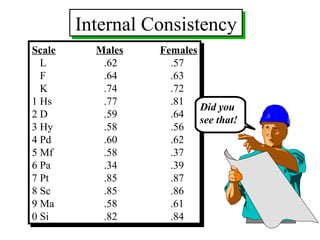
Internal Consistency Scale Males Females L   .62   .57 F   .64   .63 K   .74   .72 1 Hs   .77   .81 2 D   .59   .64 3 Hy    .58   .56 4 Pd   .60   .62 5 Mf   .58   .37 6 Pa   .34   .39 7 Pt     .85   .87 8 Sc   .85   .86 9 Ma   .58   .61 0 Si   .82   .84 Did you  see that!
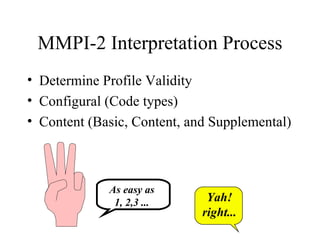
MMPI-2 Interpretation Process Determine Profile Validity Configural (Code types) Content (Basic, Content, and Supplemental) As easy as 1, 2,3 ... Yah! right...
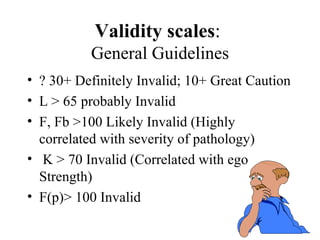
Validity scales :  General Guidelines ? 30+ Definitely Invalid; 10+ Great Caution L > 65 probably Invalid F, Fb >100 Likely Invalid (Highly correlated with severity of pathology) K > 70 Invalid (Correlated with ego Strength) F(p)> 100 Invalid
Validity scales :  General Guidelines VRIN > 80 Invalid TRIN > 80 Invalid Con’t I think I would rather be home.
Deviant Response Sets :  General Random :  F >100, Fb >100, F(p)> 100 VRIN >80 All True :  F > 100, Fb > 100, TRIN > 80 All False :  L > 65, F > 100, Fb > 100, TRIN > 80 Negative Impression :  F > 100, F(p) < 100, K Low, VRIN & TRIN Acceptable;  Exaggeration :  Clinical Judgment Positive Impression :  L > 65, K > 65, Low F  Defensiveness :  K & L 10 points higher than F;  either F or K elevated (experimental: S [superlative] greater than 29).
Interpretation Examples Random VRIN=98, F=103 and F(p)=99 Fake Good K=70, L=67 and S=68 Fake Bad F=110, F(p)=78 often L,K & S are very low
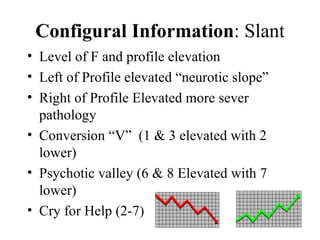
Configural Information : Slant Level of F and profile elevation Left of Profile elevated “neurotic slope” Right of Profile Elevated more sever pathology Conversion “V”  (1 & 3 elevated with 2 lower) Psychotic valley (6 & 8 Elevated with 7 lower) Cry for Help (2-7)
Configural Information :  Code Types Use the highest 2 or 3 scales (NOT including 5 or 0) If over 65 think more pathology, if under think more “normal” expression of configuration Highest scale determines but all scales within 5 to 7 points are interchangeable Most codes order is not vital
Basic Clinical Scales 1:  Hypocondrical complaints 2:  subjective depression, psychomotor retardation, physical symptoms, mental dullness & brooding 3:  denial of social anxiety, need for affection, general icky feelings, somatic complaints, inhibition of anger
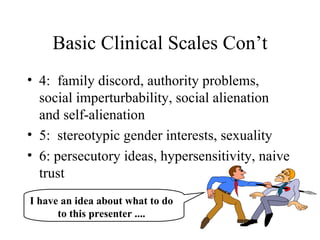
Basic Clinical Scales Con’t 4:  family discord, authority problems, social imperturbability, social alienation and self-alienation 5:  stereotypic gender interests, sexuality 6: persecutory ideas, hypersensitivity, naive trust I have an idea about what to do to this presenter ....
Basic Clinical Scales Con’t 7: anxiety and compulsivity 8: concentration, thought disorders, creativity, social alienation, apathy, depression, lack of emotional control & hallucinations 9: manipulative, distrust, Over activity, imperturbability & ego inflation
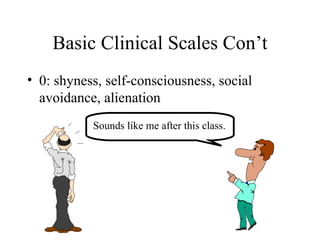
Basic Clinical Scales Con’t 0: shyness, self-consciousness, social avoidance, alienation Sounds like me after this class.
Content Scales: General More stable and consistent than clinical scales Graham see these scales as more meaningful than the clinical scales in many ways (“T” greater than 65) Good validity for the scales Content is obvious and so can be manipulated
Content Scales Anx  General Anxiety FRS  Specific fears OBS  Compulsive, problems with decisions, rigidity, ruminate DEP  Down, fatigued, pessimistic HEA  Feel unhealthy, health preoccupation I think the rust is out.
Content Scales Con’t BIZ  psychotic thinking, hallucinations, paranoia ANG  anger, hostility, grouchy, easily frustrated CYN  sees others as selfish & self-centered, guarded, hostile, resent mild demands ASP  legal/school trouble, believe breaking law is acceptable, resent authority, anger
Content Scales Con’t TPA :  hard-driven, work-oriented, sees more to be done, impatient, irritable, critical, hold grudges LSE  poor self-concept, expect to fail, quit, hypersensitive, passive, poor at making decisions SOD :  shy, rather be alone
Content Scales Con’t FAM :  family discord, resent or angry at family WRK :  poor work attitudes and behaviors TRT :  negative attitudes towards mental health treatment & doctors, give up easily I hate them...
Supplemental Scales: General Each tends to have been developed independently using various methods Generally use linear T-scores (MDS uses uniform) Generally good reliability and validity I surrender!
Supplemental Scales Anxiety (A) and Repression (R)   Developed using factor analysis.  These are the 2 strongest factors. A- thinking & thought processes, negative emotional tone, pessimism & lack of energy R-health, emotionality, violence, activity, reactivity, dominance, adequacy Quadrant interpretation
Supplemental Scales Con’t Ego Strength (Es)  :  When defensive artificially high improvement of neurotics but fail cross validation Seems to be general emotional stability I’ll show you ego strength!
Supplemental Scales Con’t MacAndrew Alcoholism Scale  (MAC-R): 28+ substance abuse problems (24-27 suggestive), 24 or less not likely Addiction Acknowledgment Scale  (AAS): T > 60 openly acknowledge substance abuse problems
Supplemental Scales Con’t Addiction Potential Scale  (APS): T > 60 possible substance abuse Marital Distress Scale  (MDS): T > 60 indicate possible marital discord Overcontrolled-Hostility  (O-H): Theory of overcontrol and hostility (prison) T > 70 intrapunative, repress, self-depreciative
Supplemental Scales Con’t Dominance  (Do):  T > 70 tend to be confident in self to dominant Social Responsibility  (Re):  T > 70 willing to accept personal responsibility, ethical, even rule bound College Maladjustment  (Mt): T > 70 pessimistic, procrastinate, ineffectual
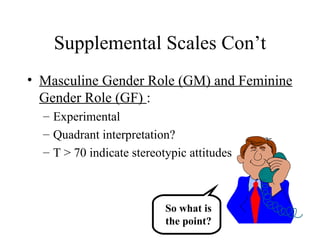
Supplemental Scales Con’t Masculine Gender Role (GM) and Feminine Gender Role (GF)  : Experimental Quadrant interpretation? T > 70 indicate stereotypic attitudes So what is the point?
Supplemental Scales Con’t Post-traumatic Stress Disorder Scale  (PK): T > 70 many PTSD symptoms Post-Traumatic Stress Disorder Scale  (PS) Experimental Fire one!
Other Scales Subtle-Obvious Harris-Lingoes Content Component Subscales Personality Disorder scales Over 300 other scales Doesn’t he ever stop?!
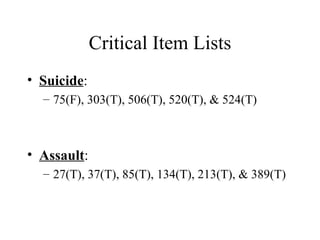
Critical Item Lists Suicide :  75(F), 303(T), 506(T), 520(T), & 524(T) Assault :  27(T), 37(T), 85(T), 134(T), 213(T), & 389(T)
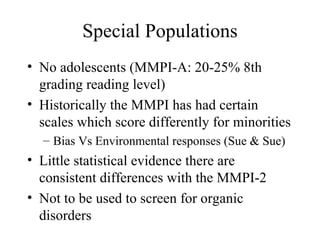
Special Populations No adolescents (MMPI-A: 20-25% 8th grading reading level) Historically the MMPI has had certain scales which score differently for minorities Bias Vs Environmental responses (Sue & Sue) Little statistical evidence there are consistent differences with the MMPI-2 Not to be used to screen for organic disorders
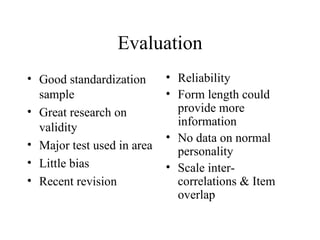
Evaluation Good standardization sample Great research on validity Major test used in area Little bias Recent revision Reliability Form length could provide more information No data on normal personality Scale inter-correlations & Item overlap
I survived the MMPI-2!

Mmpi

  • 1.
    MMPI-2 Dale Pietrzak, Ed.D., LPC-MH, NCC, CCMHC Counseling & Psychology in Education University of South Dakota
  • 2.
    MMPI: General 1stpublished in 1943 (Stark Hathaway, Ph.D, & J. Chaney McKinley, M.D.) Group administered procedure to reliably diagnose Used Empirical keying approach (new at time) Graham (2000) MMPI-2: Assessing Personality & Psychopathology (3 rd ed) Butcher, Et. Al (1989) MMPI-2: Manual for Admin & Scoring
  • 3.
    MMPI: Development About1000 potential items were collected Hathaway & McKinley selected 504 believed to be relatively novel from each other Appropriate criterion groups were selected “ Minnesota Normals” “ Clinical Subjects” 504 items administered to groups
  • 4.
    MMPI: Development Con’tItem Analysis (Discrimination Index) used to determine items Selected items were cross validated Later 5 (Mf) and 0 (Si) were added
  • 5.
    MMPI Validity ScaleDevelopment 3 scales (?, L & F) were originally intended with K added shortly thereafter ? (Cannot Say): Number of omitted and double marked items L (Lie): Unsophisticated attempts to present oneself in an overly favorable light F (Infrequency): Designed to detect deviant test taking behaviors (<10% of normals)
  • 6.
    MMPI Validity ScaleDevelopment K (Defensiveness): Meehl & Hathaway (1945) to identify defensiveness Clinical subjects who scored low for level of pathology were contrasted with “normals” to select items Later incorporated as a correction factor for basic scales Con’t I think my hand is broken!
  • 7.
    MMPI Validity ScaleDevelopment F(p): Infrequency-Psychopathology: Try to reduce impact of pathology on F scale. Although officially no cut score set, scores of 100 are seen as cutoff.
  • 8.
    Changes Due toUse 10 years saw MMPI could not do intend job of independent classification accurately Too many normals scored high Scales Highly inter-correlated Approach from pure classification to locating empirical correlates of scales and code types Scale names dropped in favor of numbers
  • 9.
    Need for Revisionof MMPI (MMPI-2) MMPI was consistently ranked as one of the most used instruments Clinicians (not just “testers”) found it valuable Several weakness were Identified
  • 10.
    MMPI Weaknesses Norevision since 1943 Representativness of standardization sample Non-Normal distributions of scales scores Item content dated, bias, or objectionable Insufficient coverage of pathology (drug use, relationships, suicide, etc.) 1982 U of M Press appoints restandardization committee (Graham, Butcher, Dalstrom)
  • 11.
    Revision Process FormAX (Adults) 704 total items 550 original items maintained 82 were rewritten and 15 reworded 154 new items tried National Solicitation of Sample Phone Books, etc. Paid $15 individual and $40 couple Emphasis on special populations 2900 subjects tested 2600 retained About time
  • 12.
    Standardization Sample CharacteristicsUnder represents the below HS educated (little statistical impact) 81% Cauc., 12% Black, 3% Hispanic, 3% Native Am., 1% Asian Am. Age: 18-85 (Mean 41; SD 15) Education: 3 years to 20+ (Mean 15; SD 2) Mostly Married I can’t take anymore!
  • 13.
    Final MMPI-2 Booklet567 Items Objectionable Items & Bias removed New Scales Developed Most Supplemental and All Clinical Scales Retained Ta Da!
  • 14.
    Comparability of MMPI& MMPI-2 The results of the 2 tests have proven to be generally comparable The less defined the profile the less reliable the comparison Greene (1991) suggests conversion to MMPI scores with table K-1 from Manual Graham says to use individual scales when not clear code type
  • 15.
    Administration & ScoringAdvanced degree in mental health, supervised testing (25) and Psychopathology 1 to 1.5 hours to take 8th grade reading level Supervised administration (No TV or movies, etc.) 200+ scales, VRIN/TRIN May the force be with you !
  • 16.
    Distributions and T-ScoresNon-normal distributions Uniform T-Scores (Averaged distribution) Clinical Scales, Content Scales & MDS use Uniform Supplemental, Harris-Lingoes, Mf and Si use Linear T of 30 = 99%, T of 50 = 45%, T of 65 = 8%, T of 80 = 1% I’m Back!
  • 17.
    Stability of BasicScales MALES Scale 1 Week SEM L .77 1.0 F .78 1.5 K .84 1.9 1 Hs .85 1.5 2 D .75 2.3 3 Hy .72 2.3 4 Pd .81 2.0 5 Mf .82 2.0 6 Pa .67 1.6 7 Pt .89 2.2 8 Sc .87 2.4 9 Ma .83 1.8 0 Si .92 2.4 FEMALES Scale 1 Week SEM L .81 1.0 F .69 1.8 K .81 1.9 1 Hs .85 1.9 2 D .77 2.4 3 Hy .76 2.3 4 Pd .79 2.2 5 Mf .73 2.3 6 Pa .58 2.0 7 Pt .88 2.5 8 Sc .80 3.5 9 Ma .68 2.5 0 Si .91 2.9 Stability
  • 18.
    Internal Consistency ScaleMales Females L .62 .57 F .64 .63 K .74 .72 1 Hs .77 .81 2 D .59 .64 3 Hy .58 .56 4 Pd .60 .62 5 Mf .58 .37 6 Pa .34 .39 7 Pt .85 .87 8 Sc .85 .86 9 Ma .58 .61 0 Si .82 .84 Did you see that!
  • 19.
    MMPI-2 Interpretation ProcessDetermine Profile Validity Configural (Code types) Content (Basic, Content, and Supplemental) As easy as 1, 2,3 ... Yah! right...
  • 20.
    Validity scales : General Guidelines ? 30+ Definitely Invalid; 10+ Great Caution L > 65 probably Invalid F, Fb >100 Likely Invalid (Highly correlated with severity of pathology) K > 70 Invalid (Correlated with ego Strength) F(p)> 100 Invalid
  • 21.
    Validity scales : General Guidelines VRIN > 80 Invalid TRIN > 80 Invalid Con’t I think I would rather be home.
  • 22.
    Deviant Response Sets: General Random : F >100, Fb >100, F(p)> 100 VRIN >80 All True : F > 100, Fb > 100, TRIN > 80 All False : L > 65, F > 100, Fb > 100, TRIN > 80 Negative Impression : F > 100, F(p) < 100, K Low, VRIN & TRIN Acceptable; Exaggeration : Clinical Judgment Positive Impression : L > 65, K > 65, Low F Defensiveness : K & L 10 points higher than F; either F or K elevated (experimental: S [superlative] greater than 29).
  • 23.
    Interpretation Examples RandomVRIN=98, F=103 and F(p)=99 Fake Good K=70, L=67 and S=68 Fake Bad F=110, F(p)=78 often L,K & S are very low
  • 24.
    Configural Information :Slant Level of F and profile elevation Left of Profile elevated “neurotic slope” Right of Profile Elevated more sever pathology Conversion “V” (1 & 3 elevated with 2 lower) Psychotic valley (6 & 8 Elevated with 7 lower) Cry for Help (2-7)
  • 25.
    Configural Information : Code Types Use the highest 2 or 3 scales (NOT including 5 or 0) If over 65 think more pathology, if under think more “normal” expression of configuration Highest scale determines but all scales within 5 to 7 points are interchangeable Most codes order is not vital
  • 26.
    Basic Clinical Scales1: Hypocondrical complaints 2: subjective depression, psychomotor retardation, physical symptoms, mental dullness & brooding 3: denial of social anxiety, need for affection, general icky feelings, somatic complaints, inhibition of anger
  • 27.
    Basic Clinical ScalesCon’t 4: family discord, authority problems, social imperturbability, social alienation and self-alienation 5: stereotypic gender interests, sexuality 6: persecutory ideas, hypersensitivity, naive trust I have an idea about what to do to this presenter ....
  • 28.
    Basic Clinical ScalesCon’t 7: anxiety and compulsivity 8: concentration, thought disorders, creativity, social alienation, apathy, depression, lack of emotional control & hallucinations 9: manipulative, distrust, Over activity, imperturbability & ego inflation
  • 29.
    Basic Clinical ScalesCon’t 0: shyness, self-consciousness, social avoidance, alienation Sounds like me after this class.
  • 30.
    Content Scales: GeneralMore stable and consistent than clinical scales Graham see these scales as more meaningful than the clinical scales in many ways (“T” greater than 65) Good validity for the scales Content is obvious and so can be manipulated
  • 31.
    Content Scales Anx General Anxiety FRS Specific fears OBS Compulsive, problems with decisions, rigidity, ruminate DEP Down, fatigued, pessimistic HEA Feel unhealthy, health preoccupation I think the rust is out.
  • 32.
    Content Scales Con’tBIZ psychotic thinking, hallucinations, paranoia ANG anger, hostility, grouchy, easily frustrated CYN sees others as selfish & self-centered, guarded, hostile, resent mild demands ASP legal/school trouble, believe breaking law is acceptable, resent authority, anger
  • 33.
    Content Scales Con’tTPA : hard-driven, work-oriented, sees more to be done, impatient, irritable, critical, hold grudges LSE poor self-concept, expect to fail, quit, hypersensitive, passive, poor at making decisions SOD : shy, rather be alone
  • 34.
    Content Scales Con’tFAM : family discord, resent or angry at family WRK : poor work attitudes and behaviors TRT : negative attitudes towards mental health treatment & doctors, give up easily I hate them...
  • 35.
    Supplemental Scales: GeneralEach tends to have been developed independently using various methods Generally use linear T-scores (MDS uses uniform) Generally good reliability and validity I surrender!
  • 36.
    Supplemental Scales Anxiety(A) and Repression (R) Developed using factor analysis. These are the 2 strongest factors. A- thinking & thought processes, negative emotional tone, pessimism & lack of energy R-health, emotionality, violence, activity, reactivity, dominance, adequacy Quadrant interpretation
  • 37.
    Supplemental Scales Con’tEgo Strength (Es) : When defensive artificially high improvement of neurotics but fail cross validation Seems to be general emotional stability I’ll show you ego strength!
  • 38.
    Supplemental Scales Con’tMacAndrew Alcoholism Scale (MAC-R): 28+ substance abuse problems (24-27 suggestive), 24 or less not likely Addiction Acknowledgment Scale (AAS): T > 60 openly acknowledge substance abuse problems
  • 39.
    Supplemental Scales Con’tAddiction Potential Scale (APS): T > 60 possible substance abuse Marital Distress Scale (MDS): T > 60 indicate possible marital discord Overcontrolled-Hostility (O-H): Theory of overcontrol and hostility (prison) T > 70 intrapunative, repress, self-depreciative
  • 40.
    Supplemental Scales Con’tDominance (Do): T > 70 tend to be confident in self to dominant Social Responsibility (Re): T > 70 willing to accept personal responsibility, ethical, even rule bound College Maladjustment (Mt): T > 70 pessimistic, procrastinate, ineffectual
  • 41.
    Supplemental Scales Con’tMasculine Gender Role (GM) and Feminine Gender Role (GF) : Experimental Quadrant interpretation? T > 70 indicate stereotypic attitudes So what is the point?
  • 42.
    Supplemental Scales Con’tPost-traumatic Stress Disorder Scale (PK): T > 70 many PTSD symptoms Post-Traumatic Stress Disorder Scale (PS) Experimental Fire one!
  • 43.
    Other Scales Subtle-ObviousHarris-Lingoes Content Component Subscales Personality Disorder scales Over 300 other scales Doesn’t he ever stop?!
  • 44.
    Critical Item ListsSuicide : 75(F), 303(T), 506(T), 520(T), & 524(T) Assault : 27(T), 37(T), 85(T), 134(T), 213(T), & 389(T)
  • 45.
    Special Populations Noadolescents (MMPI-A: 20-25% 8th grading reading level) Historically the MMPI has had certain scales which score differently for minorities Bias Vs Environmental responses (Sue & Sue) Little statistical evidence there are consistent differences with the MMPI-2 Not to be used to screen for organic disorders
  • 46.
    Evaluation Good standardizationsample Great research on validity Major test used in area Little bias Recent revision Reliability Form length could provide more information No data on normal personality Scale inter-correlations & Item overlap
  • 47.