Chapter 9 Clinical Assessment:  Objective and Projective Personality Tests
Defining Clinical Assessment   T he process of assessing the client through multiple methods, including: the clinical interview (see Chapter 12) the administration of informal assessment techniques (Chapter 10), and  the administration of objective and projective tests (this chapter)
Defining Clinical Assessment (Cont’d) Clinical assessment can do the following: Helps client gain greater insight Aid in case conceptualization and diagnostic formulations Assist in the decision-making concerning psychotropic medications Assist in treatment planning Assist in court decisions (e.g., custody decisions; testing a defendant in a child molestation case) Assist in job placement decisions (e.g., high security jobs) Aid in diagnostic decisions for health related problems (e.g., Alzheimer’s) Identify individuals at risk (e.g., to identify students at risk for suicide or students with low self-esteem)
Objective Personality Testing   Definition: A type of personality assessment that uses paper-and-pencil tests, often in multiple-choice or true/false formats, to assess various aspects of personality Each objective personality test measures different aspects of personality based on the specific constructs defined by the test developer
Common Objective Personality Tests Many of the tests we will examine were identified as one of the most frequently used tests (see Table 1, p. 106, Intro to Section III). For a list of the tests we will review, and their general purpose see Table 9.1, p. 188
(MMPI-2)  Minnesota Multiphasic Personality Inventory - 2 Most widely used personality test Developed in 1942, revised in 1989 90 minutes to take the 567 items Interpretation requires grad testing and  psychopathology courses Provides six validity scales, ten basic (clinical) scales, and fifteen content scales Most commonly used scales: 3 validity scales and ten basic scales (Figures 9.1 and Table 9.2, pp. 189-190) Adolescent version also exists: MMPI-A Important to understand the meaning of each scale
MMPI-2 (Cont’d) A high L (Lie) score: Not necessarily lying; means client has trouble admitting faults--makes test suspect Basic Scales useful in diagnosis and treatment planning Patterns of responses, as opposed to specific scales, often used in making decisions “ Clinical significance” is a T score of 65 or greater. The Content Scales: 15 specific traits such as anxiety, fears, anger, cynicism, low self-esteem useful in creating more detailed perspective Reliability estimates on different scales: .37 to .92 High intercorrelations among some scales (shared items?)
(MCMI-III)  Millon Clinical Multiaxial Inventory (3 rd  ed.) Second most used objective personality test Designed to assess DSM-IV-TR personality disorders and clinical symptomatology (axis II) Adolescent version also exists 175 true/false items take 25 minutes Has six different major scales (Table 9.3, p. 192)  Clinical Personality Pattern Scales Severe Personality Pathology Scales Clinical Syndrome Scales Severe Clinical Syndrome Scales Modifying Indices Validity Index
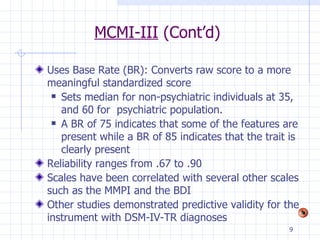
MCMI-III  (Cont’d) Uses Base Rate (BR): Converts raw score to a more meaningful standardized score  Sets median for non-psychiatric individuals at 35, and 60 for  psychiatric population. A BR of 75 indicates that some of the features are present while a BR of 85 indicates that the trait is clearly present Reliability ranges from .67 to .90 Scales have been correlated with several other scales such as the MMPI and the BDI Other studies demonstrated predictive validity for the instrument with DSM-IV-TR diagnoses
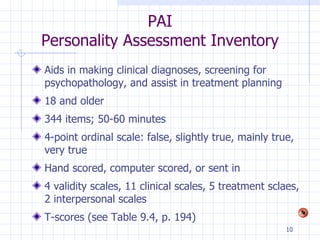
PAI Personality Assessment Inventory Aids in making clinical diagnoses, screening for psychopathology, and assist in treatment planning 18 and older 344 items; 50-60 minutes 4-point ordinal scale: false, slightly true, mainly true, very true Hand scored, computer scored, or sent in 4 validity scales, 11 clinical scales, 5 treatment sclaes, 2 interpersonal scales T-scores (see Table 9.4, p. 194)
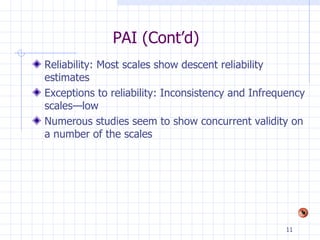
PAI (Cont’d) Reliability: Most scales show descent reliability estimates Exceptions to reliability: Inconsistency and Infrequency scales—low Numerous studies seem to show concurrent validity on a number of the scales
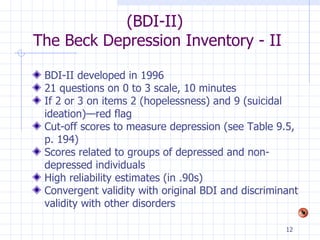
(BDI-II)  The Beck Depression Inventory - II BDI-II developed in 1996 21 questions on 0 to 3 scale, 10 minutes If 2 or 3 on items 2 (hopelessness) and 9 (suicidal ideation)—red flag Cut-off scores to measure depression (see Table 9.5, p. 194) Scores related to groups of depressed and non-depressed individuals High reliability estimates (in .90s) Convergent validity with original BDI and discriminant validity with other disorders
(MBTI)  Myers-Briggs Type Indicator Most widely used personality assessment for normal functioning (for adolescent through adults) Based on Jung’s work, following characteristics were derived: extroverted or introverted, sensing or intuiting, thinking or feeling. Myers and Briggs added judging or perceiving See Figures 9.2 and 9.3 (pp. 196 and 197) Evidence for validity of separate scales, but weaker for synergistic combination of four scales 90% of people agree with the results
(16PF)  16 Personality Factors Questionnaire Based on Raymond Cattell’s 16 primary personality components Not pathology, describes human behavior 185 items, 45 minutes 16 Primary Factors on bipolar scale (see Table 9.6, p. 198) Uses sten scores (average: 4-7) 1-3 left of bipolar scale, 8-10 right of bipolar scale 5 Global Factors are combinations of the primary factors (see Table 9.7, p. 199)
16PF (Cont’d) 3 Validity Scales Impression management:  measures social desirability and faking good (high score) or faking bad (low score) Infrequency scale: responding unusually (problems with reading comprehension, random responding, or making “right” impression Acquiescence: random responding, misunderstanding items, difficulty evaluating self Reliability: ranges from .60s to mid .80s Validity: Factor analysis confirms items Validity: Convergent and other validity shown
Big Five Personality Traits  and the NEO-PI-R & NEO-FFI Research by Thurstone and many others suggest a five-factor model of personality Openness, Conscientiousness, Extraversion, Agreeableness, Neuroticism (see pp. 199-200) NEO Personality Inventory measures these 5 factors each of which has 6 facets (see Table 9.8, p. 201) 240 items, 17 years and older 5 point Likert-type scale: strongly disagree to strongly agree Uses T-Scores Narrative describing personality style
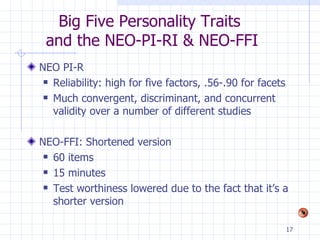
Big Five Personality Traits  and the NEO-PI-RI & NEO-FFI NEO PI-R Reliability: high for five factors, .56-.90 for facets Much convergent, discriminant, and concurrent validity over a number of different studies NEO-FFI: Shortened version 60 items 15 minutes Test worthiness lowered due to the fact that it’s a shorter version
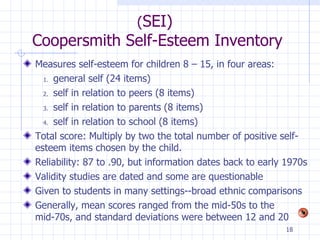
( SEI)  Coopersmith Self-Esteem Inventory Measures self-esteem for children 8 – 15, in four areas: general self (24 items) self in relation to peers (8 items) self in relation to parents (8 items) self in relation to school (8 items) Total score: Multiply by two the total number of positive self-esteem items chosen by the child. Reliability: 87 to .90, but information dates back to early 1970s Validity studies are dated and some are questionable Given to students in many settings--broad ethnic comparisons Generally, mean scores ranged from the mid-50s to the mid-70s, and standard deviations were between 12 and 20
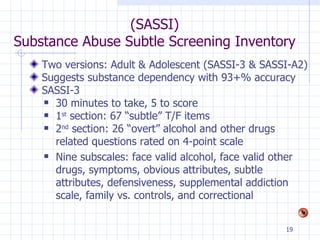
(SASSI) Substance Abuse Subtle Screening Inventory Two versions: Adult & Adolescent (SASSI-3 & SASSI-A2) Suggests substance dependency with 93+% accuracy SASSI-3 30 minutes to take, 5 to score 1 st  section: 67 “subtle” T/F items 2 nd  section: 26 “overt” alcohol and other drugs related questions rated on 4-point scale Nine subscales: face valid alcohol, face valid other drugs, symptoms, obvious attributes, subtle attributes, defensiveness, supplemental addiction scale, family vs. controls, and correctional
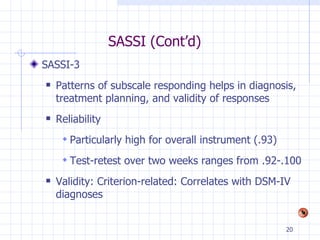
SASSI (Cont’d) SASSI-3 Patterns of subscale responding helps in diagnosis, treatment planning, and validity of responses Reliability Particularly high for overall instrument (.93) Test-retest over two weeks ranges from .92-.100 Validity: Criterion-related: Correlates with DSM-IV diagnoses
Other Common  Objective Personality Tests There are dozens of common objective personality tests. Naming just a couple more: Taylor-Johnson Temperament Analysis Assesses personality variables that effect social, family, marital, work, and other environments The Marital Satisfaction Inventory Assesses the severity and nature of conflict in a relationship
Projective Testing Defined: Type of personality assessment where a client is presented a stimuli and personality factors are interpreted Often used to identify psychopathology and to assist in treatment planning Much more difficult to measure validity when one is dealing with abstract responses to vague stimuli, such as those in projective tests
(TAT)  Thematic Apperception Test Developed in 1938 Henry Murray  Series of 31 cards with vague pictures on them (see Figure 9.4, p. 205) 8 to 12 cards generally used during an assessment  Ask client to create and describe story that has a beginning, middle and end Based on Murray's need-press theory: People driven by internal desires, such as attitudes, values, goals, etc. (needs), or external stimuli (press) from the environment No universally agreed upon scoring and interpretation method
TAT (Cont’d) Most clinicians use qualitative process of interpretation Controversy over reliability and validity of instrument Controlled setting interscorer reliability .82 Due to age of cards, and because figures are almost exclusively white, many cards seem biased and dated To counter some of TAT problems Southern Mississippi’s TAT (SM-TAT) Apperceptive Personality Test (APT) For children: CAT (animals) and CAT-H (humans) Many still use TAT. argue that cross-cultural issues not as critical (you project yourself onto whatever you see)
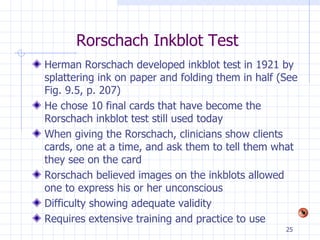
Rorschach Inkblot Test Herman Rorschach developed inkblot test in 1921 by splattering ink on paper and folding them in half (See Fig. 9.5, p. 207) He chose 10 final cards that have become the Rorschach inkblot test still used today When giving the Rorschach, clinicians show clients cards, one at a time, and ask them to tell them what they see on the card Rorschach believed images on the inkblots allowed one to express his or her unconscious Difficulty showing adequate validity Requires extensive training and practice to use
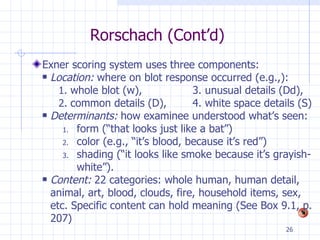
Rorschach (Cont’d) Exner scoring system uses three components: Location:  where on blot response occurred (e.g.,): whole blot (w),  3. unusual details (Dd),  common details (D),  4. white space details (S) Determinants:  how examinee understood what’s seen: form (“that looks just like a bat”) color (e.g., “it’s blood, because it’s red”) shading (“it looks like smoke because it’s grayish-white”). Content:  22 categories: whole human, human detail, animal, art, blood, clouds, fire, household items, sex, etc. Specific content can hold meaning (See Box 9.1, p. 207)
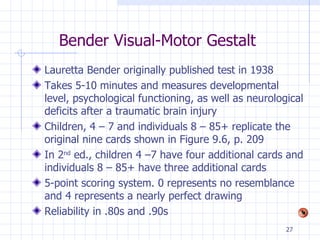
Bender Visual-Motor Gestalt Lauretta Bender originally published test in 1938 Takes 5-10 minutes and measures developmental level, psychological functioning, as well as neurological deficits after a traumatic brain injury Children, 4 – 7 and individuals 8 – 85+ replicate the original nine cards shown in Figure 9.6, p. 209 In 2 nd  ed., children 4 –7 have four additional cards and individuals 8 – 85+ have three additional cards 5-point scoring system. 0 represents no resemblance and 4 represents a nearly perfect drawing Reliability in .80s and .90s
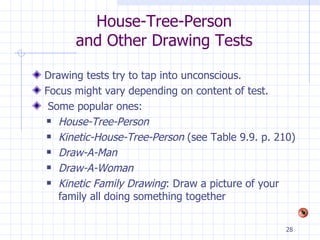
House-Tree-Person  and Other Drawing Tests  Drawing tests try to tap into unconscious.  Focus might vary depending on content of test. Some popular ones: House-Tree-Person Kinetic-House-Tree-Person  (see Table 9.9. p. 210) Draw-A-Man Draw-A-Woman Kinetic Family Drawing : Draw a picture of your family all doing something together
Sentence Completion Tests A sentence stem is given to client for client to respond to Gather important content information and possible unconscious issues Some common tests: The Sentence Completion Series EPS Sentence Completion Technique.  Questions about the validity and reliability of sentence completion tests remain, but can be quick and useful way of gathering info
Role of Helpers in Clinical Assessment Helpers should conduct clinical assessment: Elementary school counselor uses self-esteem inventory when working with young children High school counselor might use objective personality measures to identify concerns and aid in treatment planning College counselors, agency clinicians, social workers, and private practice professionals use clinical assessment tools to help identify issues and devise strategies for problem solving All clinicians should consider clinical assessment tools and whether they have the appropriate training to administer and interpret instruments
Final Thoughts On Clinical Assessment Clinical assessment results in making decisions for clients that will critically affect their lives Such decisions can result in a person being labeled, institutionalized, incarcerated, stigmatized, placed on medication, lose or gain a job, have access to their children, and more Examiners must remember the impact that their decisions will have on clients and monitor: the quality of the tests they use their level of competence to administer tests, their ability at making accurate interpretations of client material.

Chapter 9

  • 1.
    Chapter 9 ClinicalAssessment: Objective and Projective Personality Tests
  • 2.
    Defining Clinical Assessment T he process of assessing the client through multiple methods, including: the clinical interview (see Chapter 12) the administration of informal assessment techniques (Chapter 10), and the administration of objective and projective tests (this chapter)
  • 3.
    Defining Clinical Assessment(Cont’d) Clinical assessment can do the following: Helps client gain greater insight Aid in case conceptualization and diagnostic formulations Assist in the decision-making concerning psychotropic medications Assist in treatment planning Assist in court decisions (e.g., custody decisions; testing a defendant in a child molestation case) Assist in job placement decisions (e.g., high security jobs) Aid in diagnostic decisions for health related problems (e.g., Alzheimer’s) Identify individuals at risk (e.g., to identify students at risk for suicide or students with low self-esteem)
  • 4.
    Objective Personality Testing Definition: A type of personality assessment that uses paper-and-pencil tests, often in multiple-choice or true/false formats, to assess various aspects of personality Each objective personality test measures different aspects of personality based on the specific constructs defined by the test developer
  • 5.
    Common Objective PersonalityTests Many of the tests we will examine were identified as one of the most frequently used tests (see Table 1, p. 106, Intro to Section III). For a list of the tests we will review, and their general purpose see Table 9.1, p. 188
  • 6.
    (MMPI-2) MinnesotaMultiphasic Personality Inventory - 2 Most widely used personality test Developed in 1942, revised in 1989 90 minutes to take the 567 items Interpretation requires grad testing and psychopathology courses Provides six validity scales, ten basic (clinical) scales, and fifteen content scales Most commonly used scales: 3 validity scales and ten basic scales (Figures 9.1 and Table 9.2, pp. 189-190) Adolescent version also exists: MMPI-A Important to understand the meaning of each scale
  • 7.
    MMPI-2 (Cont’d) Ahigh L (Lie) score: Not necessarily lying; means client has trouble admitting faults--makes test suspect Basic Scales useful in diagnosis and treatment planning Patterns of responses, as opposed to specific scales, often used in making decisions “ Clinical significance” is a T score of 65 or greater. The Content Scales: 15 specific traits such as anxiety, fears, anger, cynicism, low self-esteem useful in creating more detailed perspective Reliability estimates on different scales: .37 to .92 High intercorrelations among some scales (shared items?)
  • 8.
    (MCMI-III) MillonClinical Multiaxial Inventory (3 rd ed.) Second most used objective personality test Designed to assess DSM-IV-TR personality disorders and clinical symptomatology (axis II) Adolescent version also exists 175 true/false items take 25 minutes Has six different major scales (Table 9.3, p. 192) Clinical Personality Pattern Scales Severe Personality Pathology Scales Clinical Syndrome Scales Severe Clinical Syndrome Scales Modifying Indices Validity Index
  • 9.
    MCMI-III (Cont’d)Uses Base Rate (BR): Converts raw score to a more meaningful standardized score Sets median for non-psychiatric individuals at 35, and 60 for psychiatric population. A BR of 75 indicates that some of the features are present while a BR of 85 indicates that the trait is clearly present Reliability ranges from .67 to .90 Scales have been correlated with several other scales such as the MMPI and the BDI Other studies demonstrated predictive validity for the instrument with DSM-IV-TR diagnoses
  • 10.
    PAI Personality AssessmentInventory Aids in making clinical diagnoses, screening for psychopathology, and assist in treatment planning 18 and older 344 items; 50-60 minutes 4-point ordinal scale: false, slightly true, mainly true, very true Hand scored, computer scored, or sent in 4 validity scales, 11 clinical scales, 5 treatment sclaes, 2 interpersonal scales T-scores (see Table 9.4, p. 194)
  • 11.
    PAI (Cont’d) Reliability:Most scales show descent reliability estimates Exceptions to reliability: Inconsistency and Infrequency scales—low Numerous studies seem to show concurrent validity on a number of the scales
  • 12.
    (BDI-II) TheBeck Depression Inventory - II BDI-II developed in 1996 21 questions on 0 to 3 scale, 10 minutes If 2 or 3 on items 2 (hopelessness) and 9 (suicidal ideation)—red flag Cut-off scores to measure depression (see Table 9.5, p. 194) Scores related to groups of depressed and non-depressed individuals High reliability estimates (in .90s) Convergent validity with original BDI and discriminant validity with other disorders
  • 13.
    (MBTI) Myers-BriggsType Indicator Most widely used personality assessment for normal functioning (for adolescent through adults) Based on Jung’s work, following characteristics were derived: extroverted or introverted, sensing or intuiting, thinking or feeling. Myers and Briggs added judging or perceiving See Figures 9.2 and 9.3 (pp. 196 and 197) Evidence for validity of separate scales, but weaker for synergistic combination of four scales 90% of people agree with the results
  • 14.
    (16PF) 16Personality Factors Questionnaire Based on Raymond Cattell’s 16 primary personality components Not pathology, describes human behavior 185 items, 45 minutes 16 Primary Factors on bipolar scale (see Table 9.6, p. 198) Uses sten scores (average: 4-7) 1-3 left of bipolar scale, 8-10 right of bipolar scale 5 Global Factors are combinations of the primary factors (see Table 9.7, p. 199)
  • 15.
    16PF (Cont’d) 3Validity Scales Impression management: measures social desirability and faking good (high score) or faking bad (low score) Infrequency scale: responding unusually (problems with reading comprehension, random responding, or making “right” impression Acquiescence: random responding, misunderstanding items, difficulty evaluating self Reliability: ranges from .60s to mid .80s Validity: Factor analysis confirms items Validity: Convergent and other validity shown
  • 16.
    Big Five PersonalityTraits and the NEO-PI-R & NEO-FFI Research by Thurstone and many others suggest a five-factor model of personality Openness, Conscientiousness, Extraversion, Agreeableness, Neuroticism (see pp. 199-200) NEO Personality Inventory measures these 5 factors each of which has 6 facets (see Table 9.8, p. 201) 240 items, 17 years and older 5 point Likert-type scale: strongly disagree to strongly agree Uses T-Scores Narrative describing personality style
  • 17.
    Big Five PersonalityTraits and the NEO-PI-RI & NEO-FFI NEO PI-R Reliability: high for five factors, .56-.90 for facets Much convergent, discriminant, and concurrent validity over a number of different studies NEO-FFI: Shortened version 60 items 15 minutes Test worthiness lowered due to the fact that it’s a shorter version
  • 18.
    ( SEI) Coopersmith Self-Esteem Inventory Measures self-esteem for children 8 – 15, in four areas: general self (24 items) self in relation to peers (8 items) self in relation to parents (8 items) self in relation to school (8 items) Total score: Multiply by two the total number of positive self-esteem items chosen by the child. Reliability: 87 to .90, but information dates back to early 1970s Validity studies are dated and some are questionable Given to students in many settings--broad ethnic comparisons Generally, mean scores ranged from the mid-50s to the mid-70s, and standard deviations were between 12 and 20
  • 19.
    (SASSI) Substance AbuseSubtle Screening Inventory Two versions: Adult & Adolescent (SASSI-3 & SASSI-A2) Suggests substance dependency with 93+% accuracy SASSI-3 30 minutes to take, 5 to score 1 st section: 67 “subtle” T/F items 2 nd section: 26 “overt” alcohol and other drugs related questions rated on 4-point scale Nine subscales: face valid alcohol, face valid other drugs, symptoms, obvious attributes, subtle attributes, defensiveness, supplemental addiction scale, family vs. controls, and correctional
  • 20.
    SASSI (Cont’d) SASSI-3Patterns of subscale responding helps in diagnosis, treatment planning, and validity of responses Reliability Particularly high for overall instrument (.93) Test-retest over two weeks ranges from .92-.100 Validity: Criterion-related: Correlates with DSM-IV diagnoses
  • 21.
    Other Common Objective Personality Tests There are dozens of common objective personality tests. Naming just a couple more: Taylor-Johnson Temperament Analysis Assesses personality variables that effect social, family, marital, work, and other environments The Marital Satisfaction Inventory Assesses the severity and nature of conflict in a relationship
  • 22.
    Projective Testing Defined:Type of personality assessment where a client is presented a stimuli and personality factors are interpreted Often used to identify psychopathology and to assist in treatment planning Much more difficult to measure validity when one is dealing with abstract responses to vague stimuli, such as those in projective tests
  • 23.
    (TAT) ThematicApperception Test Developed in 1938 Henry Murray Series of 31 cards with vague pictures on them (see Figure 9.4, p. 205) 8 to 12 cards generally used during an assessment Ask client to create and describe story that has a beginning, middle and end Based on Murray's need-press theory: People driven by internal desires, such as attitudes, values, goals, etc. (needs), or external stimuli (press) from the environment No universally agreed upon scoring and interpretation method
  • 24.
    TAT (Cont’d) Mostclinicians use qualitative process of interpretation Controversy over reliability and validity of instrument Controlled setting interscorer reliability .82 Due to age of cards, and because figures are almost exclusively white, many cards seem biased and dated To counter some of TAT problems Southern Mississippi’s TAT (SM-TAT) Apperceptive Personality Test (APT) For children: CAT (animals) and CAT-H (humans) Many still use TAT. argue that cross-cultural issues not as critical (you project yourself onto whatever you see)
  • 25.
    Rorschach Inkblot TestHerman Rorschach developed inkblot test in 1921 by splattering ink on paper and folding them in half (See Fig. 9.5, p. 207) He chose 10 final cards that have become the Rorschach inkblot test still used today When giving the Rorschach, clinicians show clients cards, one at a time, and ask them to tell them what they see on the card Rorschach believed images on the inkblots allowed one to express his or her unconscious Difficulty showing adequate validity Requires extensive training and practice to use
  • 26.
    Rorschach (Cont’d) Exnerscoring system uses three components: Location: where on blot response occurred (e.g.,): whole blot (w), 3. unusual details (Dd), common details (D), 4. white space details (S) Determinants: how examinee understood what’s seen: form (“that looks just like a bat”) color (e.g., “it’s blood, because it’s red”) shading (“it looks like smoke because it’s grayish-white”). Content: 22 categories: whole human, human detail, animal, art, blood, clouds, fire, household items, sex, etc. Specific content can hold meaning (See Box 9.1, p. 207)
  • 27.
    Bender Visual-Motor GestaltLauretta Bender originally published test in 1938 Takes 5-10 minutes and measures developmental level, psychological functioning, as well as neurological deficits after a traumatic brain injury Children, 4 – 7 and individuals 8 – 85+ replicate the original nine cards shown in Figure 9.6, p. 209 In 2 nd ed., children 4 –7 have four additional cards and individuals 8 – 85+ have three additional cards 5-point scoring system. 0 represents no resemblance and 4 represents a nearly perfect drawing Reliability in .80s and .90s
  • 28.
    House-Tree-Person andOther Drawing Tests Drawing tests try to tap into unconscious. Focus might vary depending on content of test. Some popular ones: House-Tree-Person Kinetic-House-Tree-Person (see Table 9.9. p. 210) Draw-A-Man Draw-A-Woman Kinetic Family Drawing : Draw a picture of your family all doing something together
  • 29.
    Sentence Completion TestsA sentence stem is given to client for client to respond to Gather important content information and possible unconscious issues Some common tests: The Sentence Completion Series EPS Sentence Completion Technique. Questions about the validity and reliability of sentence completion tests remain, but can be quick and useful way of gathering info
  • 30.
    Role of Helpersin Clinical Assessment Helpers should conduct clinical assessment: Elementary school counselor uses self-esteem inventory when working with young children High school counselor might use objective personality measures to identify concerns and aid in treatment planning College counselors, agency clinicians, social workers, and private practice professionals use clinical assessment tools to help identify issues and devise strategies for problem solving All clinicians should consider clinical assessment tools and whether they have the appropriate training to administer and interpret instruments
  • 31.
    Final Thoughts OnClinical Assessment Clinical assessment results in making decisions for clients that will critically affect their lives Such decisions can result in a person being labeled, institutionalized, incarcerated, stigmatized, placed on medication, lose or gain a job, have access to their children, and more Examiners must remember the impact that their decisions will have on clients and monitor: the quality of the tests they use their level of competence to administer tests, their ability at making accurate interpretations of client material.