1
Calibration of pH meters, glass electrodes
and conductometers at INPL
Dr. Elena Kardash, Supervisor of the Project
Address: The National Physical
Laboratory of Israel (INPL),
Givat Ram, Jerusalem 91904, Israel
tel.: +972-2-6536-534
fax: +972-2-6520-797
e-mail: lena.ka@moital.gov.il
Dr. Elena Kardash - Calibration of pH meters, glass electrodes and conductometers at INPL
2
pH is defined as the negative decimal logarithm of the
hydrogen ion activity aH.
pH scale is based on the pH values of a series of standard
buffer solutions determined by the potentiometric
technique.
Routine potentiometric measurements of pH are carried
out by means of a pH meter equipped by a pH-indicator
glass electrode, a reference electrode and an automatic
temperature compensator.
Dr. Elena Kardash - Calibration of pH meters, glass electrodes and conductometers at INPL
3
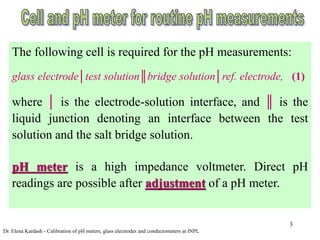
The following cell is required for the pH measurements:
glass electrode│test solution║bridge solution│ref. electrode, (1)
where │ is the electrode-solution interface, and ║ is the
liquid junction denoting an interface between the test
solution and the salt bridge solution.
pH meter is a high impedance voltmeter. Direct pH
readings are possible after adjustment of a pH meter.
Dr. Elena Kardash - Calibration of pH meters, glass electrodes and conductometers at INPL
4
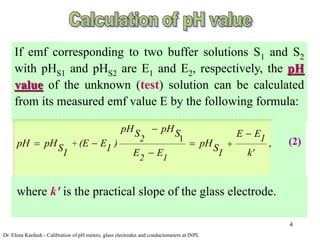
If emf corresponding to two buffer solutions S1 and S2
with pHS1 and pHS2 are E1 and E2, respectively, the pH
value of the unknown (test) solution can be calculated
from its measured emf value E by the following formula:
1
,
2
+
2 1
pH pH
S S E E1
pH pH (E E ) pH
S 1 S
E E k'
1 1

 
  

where k' is the practical slope of the glass electrode.
Dr. Elena Kardash - Calibration of pH meters, glass electrodes and conductometers at INPL
(2)
5
The practical slope k' usually differs from the theoretical
slope - Nernst coefficient - k = 2.3026 RT/F (R is the
universal gas constant 8.31451 J·mol-1·K-1, T is the
Kelvin temperature, F is the Faraday constant, 96485.309
Coulombs·mol-1).
The pH value to be determined should lie between the
pH values of the two adjacent buffer solutions.
Dr. Elena Kardash - Calibration of pH meters, glass electrodes and conductometers at INPL
6
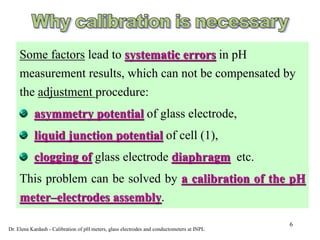
Some factors lead to systematic errors in pH
measurement results, which can not be compensated by
the adjustment procedure:
asymmetry potential of glass electrode,
liquid junction potential of cell (1),
clogging of glass electrode diaphragm etc.
This problem can be solved by a calibration of the pH
meter–electrodes assembly.
Dr. Elena Kardash - Calibration of pH meters, glass electrodes and conductometers at INPL
7
The IUPAC recommendations of the year 2002 require at
establishing a traceability chain of the pH measurement
results from the national metrological institution level
down to field, laboratory and industry measurements.
Dr. Elena Kardash - Calibration of pH meters, glass electrodes and conductometers at INPL
8
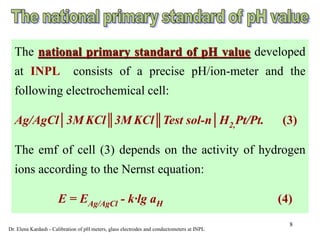
The national primary standard of pH value developed
at INPL consists of a precise pH/ion-meter and the
following electrochemical cell:
Ag/AgCl│3M KCl║3M KCl║Test sol-n│H2,Pt/Pt. (3)
The emf of cell (3) depends on the activity of hydrogen
ions according to the Nernst equation:
E = EAg/AgCl - k·lg aH (4)
Dr. Elena Kardash - Calibration of pH meters, glass electrodes and conductometers at INPL
9
Calibration of cell (3) is carried out using six primary
pH buffers at 25°C. These buffers are prepared from the
NIST standard reference materials with expanded
uncertainties of ± 0.005 pH.
The national pH value standard have participated
successfully in two interlaboratory international key
comparisons in the years 2002 and 2004 organized by
the CCQM.
Dr. Elena Kardash - Calibration of pH meters, glass electrodes and conductometers at INPL
10
Calibration of a pH-meter (as a voltmeter).
Calibration of an automatic temperature
compensator (as a thermometer).
Calibration of a glass electrode.
Certification of buffers for pH- measurements.
These calibrations assure the shortest unbroken
traceability chain to the national measurement
standards of Israel.
Dr. Elena Kardash - Calibration of pH meters, glass electrodes and conductometers at INPL
11
Electrolytic conductivity () is the measure of a solution’s
ability to conduct current. Reliable conductivity
measurements require traceability to national or
international measurement standards.
INPL has developed the such Israeli standard.
Dr. Elena Kardash - Calibration of pH meters, glass electrodes and conductometers at INPL
12
The standard is developed using the direct current
method and includes conductivity cell. This standard
allows to determine  values from 5ּ10-4 up to 10 S·m-1.
Calibration of the conductivity cell at fixed temperature
is carried out using five standard conductivity
solutions from NIST.
Dr. Elena Kardash - Calibration of pH meters, glass electrodes and conductometers at INPL
13
Dr. Elena Kardash - Calibration of pH meters, glass electrodes and conductometers at INPL
Conductometer calibration is based on the comparison
of the measuring results obtained by the tested
conductometer and by INPL electrolytic conductivity
standard.
In the year 2003 INPL took part in the interlaboratory
key comparison organized by the CCQM for solutions
with low conductivity levels. 0.005 S·m-1. The results
obtained were in good agreement with the assigned
values.
14
Calibration of a conductometer.
Calibration of a conductivity cell.
These calibrations assure the shortest unbroken
traceability chain to the national measurement
standards of Israel.
15
The national standards of pH and electrolytic
conductivity values have been developed and passed
successfully interlaboratory key comparisons.
INPL proposes calibration of corresponding
equipment based on these standards.
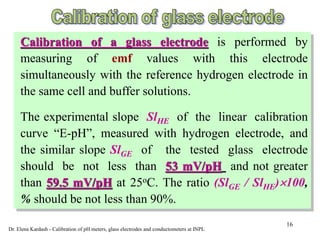
16
Calibration of a glass electrode is performed by
measuring of emf values with this electrode
simultaneously with the reference hydrogen electrode in
the same cell and buffer solutions.
The experimental slope SlHE of the linear calibration
curve “E-pH”, measured with hydrogen electrode, and
the similar slope SlGE of the tested glass electrode
should be not less than 53 mV/pH and not greater
than 59.5 mV/pH at 25oC. The ratio (SlGE / SlHE)100,
% should be not less than 90%.
Dr. Elena Kardash - Calibration of pH meters, glass electrodes and conductometers at INPL
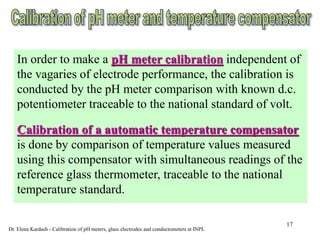
17
In order to make a pH meter calibration independent of
the vagaries of electrode performance, the calibration is
conducted by the pH meter comparison with known d.c.
potentiometer traceable to the national standard of volt.
Calibration of a automatic temperature compensator
is done by comparison of temperature values measured
using this compensator with simultaneous readings of the
reference glass thermometer, traceable to the national
temperature standard.
Dr. Elena Kardash - Calibration of pH meters, glass electrodes and conductometers at INPL

Calibration-pH-meter.ppt

  • 1.
    1 Calibration of pHmeters, glass electrodes and conductometers at INPL Dr. Elena Kardash, Supervisor of the Project Address: The National Physical Laboratory of Israel (INPL), Givat Ram, Jerusalem 91904, Israel tel.: +972-2-6536-534 fax: +972-2-6520-797 e-mail: lena.ka@moital.gov.il Dr. Elena Kardash - Calibration of pH meters, glass electrodes and conductometers at INPL
  • 2.
    2 pH is definedas the negative decimal logarithm of the hydrogen ion activity aH. pH scale is based on the pH values of a series of standard buffer solutions determined by the potentiometric technique. Routine potentiometric measurements of pH are carried out by means of a pH meter equipped by a pH-indicator glass electrode, a reference electrode and an automatic temperature compensator. Dr. Elena Kardash - Calibration of pH meters, glass electrodes and conductometers at INPL
  • 3.
    3 The following cellis required for the pH measurements: glass electrode│test solution║bridge solution│ref. electrode, (1) where │ is the electrode-solution interface, and ║ is the liquid junction denoting an interface between the test solution and the salt bridge solution. pH meter is a high impedance voltmeter. Direct pH readings are possible after adjustment of a pH meter. Dr. Elena Kardash - Calibration of pH meters, glass electrodes and conductometers at INPL
  • 4.
    4 If emf correspondingto two buffer solutions S1 and S2 with pHS1 and pHS2 are E1 and E2, respectively, the pH value of the unknown (test) solution can be calculated from its measured emf value E by the following formula: 1 , 2 + 2 1 pH pH S S E E1 pH pH (E E ) pH S 1 S E E k' 1 1        where k' is the practical slope of the glass electrode. Dr. Elena Kardash - Calibration of pH meters, glass electrodes and conductometers at INPL (2)
  • 5.
    5 The practical slopek' usually differs from the theoretical slope - Nernst coefficient - k = 2.3026 RT/F (R is the universal gas constant 8.31451 J·mol-1·K-1, T is the Kelvin temperature, F is the Faraday constant, 96485.309 Coulombs·mol-1). The pH value to be determined should lie between the pH values of the two adjacent buffer solutions. Dr. Elena Kardash - Calibration of pH meters, glass electrodes and conductometers at INPL
  • 6.
    6 Some factors leadto systematic errors in pH measurement results, which can not be compensated by the adjustment procedure: asymmetry potential of glass electrode, liquid junction potential of cell (1), clogging of glass electrode diaphragm etc. This problem can be solved by a calibration of the pH meter–electrodes assembly. Dr. Elena Kardash - Calibration of pH meters, glass electrodes and conductometers at INPL
  • 7.
    7 The IUPAC recommendationsof the year 2002 require at establishing a traceability chain of the pH measurement results from the national metrological institution level down to field, laboratory and industry measurements. Dr. Elena Kardash - Calibration of pH meters, glass electrodes and conductometers at INPL
  • 8.
    8 The national primarystandard of pH value developed at INPL consists of a precise pH/ion-meter and the following electrochemical cell: Ag/AgCl│3M KCl║3M KCl║Test sol-n│H2,Pt/Pt. (3) The emf of cell (3) depends on the activity of hydrogen ions according to the Nernst equation: E = EAg/AgCl - k·lg aH (4) Dr. Elena Kardash - Calibration of pH meters, glass electrodes and conductometers at INPL
  • 9.
    9 Calibration of cell(3) is carried out using six primary pH buffers at 25°C. These buffers are prepared from the NIST standard reference materials with expanded uncertainties of ± 0.005 pH. The national pH value standard have participated successfully in two interlaboratory international key comparisons in the years 2002 and 2004 organized by the CCQM. Dr. Elena Kardash - Calibration of pH meters, glass electrodes and conductometers at INPL
  • 10.
    10 Calibration of apH-meter (as a voltmeter). Calibration of an automatic temperature compensator (as a thermometer). Calibration of a glass electrode. Certification of buffers for pH- measurements. These calibrations assure the shortest unbroken traceability chain to the national measurement standards of Israel. Dr. Elena Kardash - Calibration of pH meters, glass electrodes and conductometers at INPL
  • 11.
    11 Electrolytic conductivity ()is the measure of a solution’s ability to conduct current. Reliable conductivity measurements require traceability to national or international measurement standards. INPL has developed the such Israeli standard. Dr. Elena Kardash - Calibration of pH meters, glass electrodes and conductometers at INPL
  • 12.
    12 The standard isdeveloped using the direct current method and includes conductivity cell. This standard allows to determine  values from 5ּ10-4 up to 10 S·m-1. Calibration of the conductivity cell at fixed temperature is carried out using five standard conductivity solutions from NIST. Dr. Elena Kardash - Calibration of pH meters, glass electrodes and conductometers at INPL
  • 13.
    13 Dr. Elena Kardash- Calibration of pH meters, glass electrodes and conductometers at INPL Conductometer calibration is based on the comparison of the measuring results obtained by the tested conductometer and by INPL electrolytic conductivity standard. In the year 2003 INPL took part in the interlaboratory key comparison organized by the CCQM for solutions with low conductivity levels. 0.005 S·m-1. The results obtained were in good agreement with the assigned values.
  • 14.
    14 Calibration of aconductometer. Calibration of a conductivity cell. These calibrations assure the shortest unbroken traceability chain to the national measurement standards of Israel.
  • 15.
    15 The national standardsof pH and electrolytic conductivity values have been developed and passed successfully interlaboratory key comparisons. INPL proposes calibration of corresponding equipment based on these standards.
  • 16.
    16 Calibration of aglass electrode is performed by measuring of emf values with this electrode simultaneously with the reference hydrogen electrode in the same cell and buffer solutions. The experimental slope SlHE of the linear calibration curve “E-pH”, measured with hydrogen electrode, and the similar slope SlGE of the tested glass electrode should be not less than 53 mV/pH and not greater than 59.5 mV/pH at 25oC. The ratio (SlGE / SlHE)100, % should be not less than 90%. Dr. Elena Kardash - Calibration of pH meters, glass electrodes and conductometers at INPL
  • 17.
    17 In order tomake a pH meter calibration independent of the vagaries of electrode performance, the calibration is conducted by the pH meter comparison with known d.c. potentiometer traceable to the national standard of volt. Calibration of a automatic temperature compensator is done by comparison of temperature values measured using this compensator with simultaneous readings of the reference glass thermometer, traceable to the national temperature standard. Dr. Elena Kardash - Calibration of pH meters, glass electrodes and conductometers at INPL

Editor's Notes