INTRODUCTIONINTRODUCTION
• During gestation the average foetus
requires about 30 g of calcium to mineralize
its skeleton and maintain normal
physiological processes.
• The suckling neonate requires more than
this amount in breast milk during six
months of exclusive lactation
• Although pregnant and lactating women
face a comparable demand in the amount of
calcium
• During pregnancy and lactation, 200–300
mg Ca/d is eithertransferred via the
placenta to the foetus or excreted in breast
milk.
• The provision of calcium during pregnancy
and lactationrequires
– Physiologic adaptation of calcium homeostatic
mechanisms.
– Including
1. intestinal calcium absorption
2. urinary calcium excretion
3. maternal bone calcium turnover
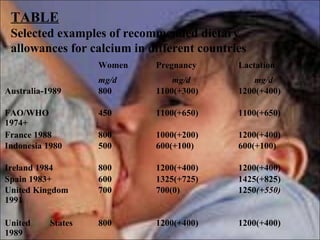
TABLE
Selected examples of recommended dietary
allowances for calcium in different countries
Women Pregnancy Lactation
mg/d mg/d mg/d
Australia-1989 800 1100(+300) 1200(+400)
FAO/WHO
1974+
450 1100(+650) 1100(+650)
France 1988 800 1000(+200) 1200(+400)
Indonesia 1980 500 600(+100) 600(+100)
Ireland 1984 800 1200(+400) 1200(+400)
Spain 1983+ 600 1325(+725) 1425(+825)
United Kingdom
1991
700 700(0) 1250(+550)
United States
1989
800 1200(+400) 1200(+400)
• Calcium stress of pregnancy is
relatively similar among women
• The amount of calcium secreted
during lactation can be highly
variable, depending on
1. Amount of breast-milk produced
2. Breast-milk calcium concentration
3. Length of the lactation period
Calcium
• Calcium is important for a number of
functions in the body
• It is essential for
1. Growth
2. Maintenance of bones and teeth
3. Nerve transmission
4. Muscle contraction
5. Number of other cell processes
• The body has increased calcium needs
during growth spurts, pregnancy and
lactation
• An inadequate calcium intake can therefore
cause a number of problems
• In growing children and adolescents, this
can lead to stunted growth, and a reduced
peak bone density increasing the risk of
osteoporosis later in life
• In pregnancy, the unborn child will draw on
the mother’s calcium stores to meet its
needs, putting the condition of the mother’s
bones and teeth at risk
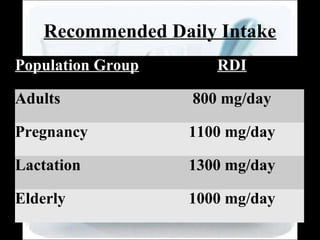
Recommended Daily Intake
Population Group RDI
Adults 800 mg/day
Pregnancy 1100 mg/day
Lactation 1300 mg/day
Elderly 1000 mg/day
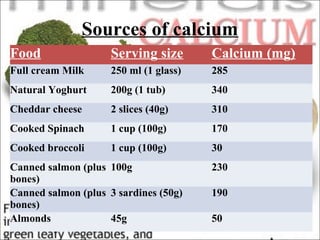
Sources of calcium
Food Serving size Calcium (mg)
Full cream Milk 250 ml (1 glass) 285
Natural Yoghurt 200g (1 tub) 340
Cheddar cheese 2 slices (40g) 310
Cooked Spinach 1 cup (100g) 170
Cooked broccoli 1 cup (100g) 30
Canned salmon (plus
bones)
100g 230
Canned salmon (plus
bones)
3 sardines (50g) 190
Almonds 45g 50
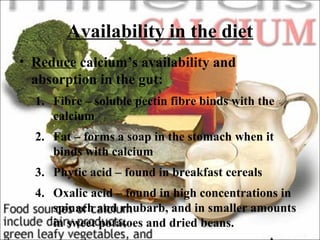
Availability in the diet
• Reduce calcium’s availability and
absorption in the gut:
1. Fibre – soluble pectin fibre binds with the
calcium
2. Fat – forms a soap in the stomach when it
binds with calcium
3. Phytic acid – found in breakfast cereals
4. Oxalic acid – found in high concentrations in
spinach and rhubarb, and in smaller amounts
in sweet potatoes and dried beans.
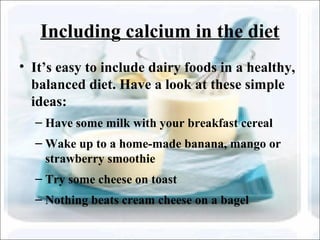
Including calcium in the diet
• It’s easy to include dairy foods in a healthy,
balanced diet. Have a look at these simple
ideas:
– Have some milk with your breakfast cereal
– Wake up to a home-made banana, mango or
strawberry smoothie
– Try some cheese on toast
– Nothing beats cream cheese on a bagel
–Try yoghurt at morning tea to keep you
going until lunch
–Sprinkle some cheese on your potato
–Have some fresh fruit and yoghurt for
dessert
–Enjoy a warm cup of milk before bed
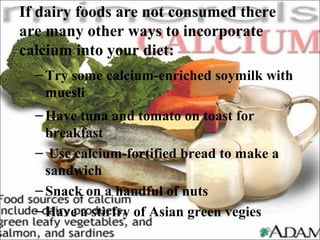
If dairy foods are not consumed there
are many other ways to incorporate
calcium into your diet:
–Try some calcium-enriched soymilk with
muesli
–Have tuna and tomato on toast for
breakfast
– Use calcium-fortified bread to make a
sandwich
–Snack on a handful of nuts
–Have a stirfry of Asian green vegies
Pregnancy
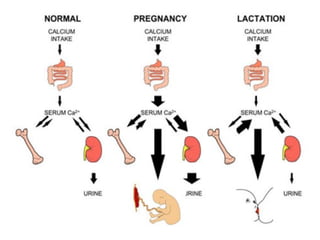
• The normal foetal skeleton has accreted
about 30 g calcium by theend of gestation
• About 80% of the accretion occurs rapidly
duringthe third trimester
• Daily accretion rate ofabout 250–300 mg
calcium by the foetal skeleton duringthe
third trimester
The mother could theoretically
meet this demand by
Increasing the intestinal absorption
Decreasingrenal calcium losses
Increasing the resorption of calciumfrom
the maternal skeleton
Minerals and hormones
• Earliest apparent changes in calcium
balance in pregnancyis a fall in total serum
calcium
• Serum calcitoninlevels are increased during
pregnancy
• PTHrP levels have been increased during
pregnancy
• Other hormones are clearly in flux during
pregnancy
Intestinal calcium absorption
• Intestinal absorption of calcium is doubled
during pregnancy
• The increase inintestinal calcium
absorption is associated with
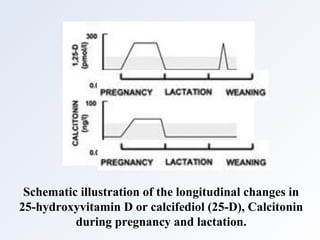
– Doublingof 1,25-dihydroxyvitamin D levels
– Increased intestinal expressionof the vitamin D-
dependent calcium-binding protein calbindin-D
Renal calcium excretion
• The 24-h urine calcium excretion is
typically increased as early asthe 12th week
of gestation
• This increaseis likely a consequence of
– Increased intestinal absorptionof calcium
– Increased renal filtered load of calcium
– Increased glomerular filtration rate
• In the fasted state, the calcium excretionis
normal or even low.
Osteoporosis in pregnancy
• Occasionally, a woman will suffer an
apparent fragility fracture during
pregnancy or in the first few weeks after
delivery
• low bonemineral density reading will be
obtained
• Focal, transient osteoporosis of the hip is a
rare
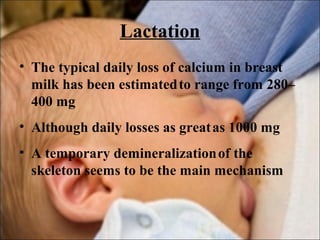
Lactation
• The typical daily loss of calcium in breast
milk has been estimatedto range from 280–
400 mg
• Although daily losses as greatas 1000 mg
• A temporary demineralizationof the
skeleton seems to be the main mechanism
Again, the mother could
theoretically meet this demand by
• increasing the intestinal absorption of
calcium
• decreasing renal calcium losses
• increasing the resorptionof calcium from
the maternal skeleton
Minerals and hormones
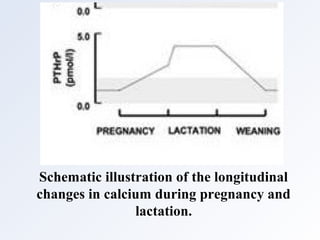
• The mean ionized calcium level of
exclusively lactating womenis increased,
although it remains in the normal range
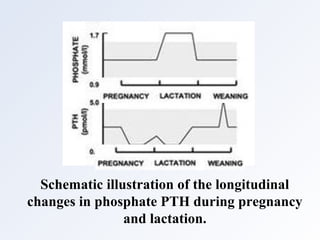
• Serumphosphate levels are also increased
and may exceed the normalrange
• Intact PTH,as determined by a two-site
IRMA, has been found to be reduced50%
or more in lactating women in the first
several months postpartum
Intestinal calcium absorption
• The intestinal absorption of calcium is
equal to the no pregnant state
–Decreased from pregnancy
• This change coincides with thefall in 1,25-
dihydroxyvitamin D levels to normal.
Renal calcium excretion
• The GFR falls during lactation to a level
below the pregnantand pre pregnant value
• Tubular reabsorption of calcium must be
increased
• Renal excretion of calcium is typically
reduced to levels as low as 50 mg/24 h
• increased serum calcium
• Acute estrogen deficiency (e.g. GnRH
analog therapy)
→increases skeletal resorption and
→raises the blood calcium;
→in turn, PTH is suppressed and
→renal calcium losses are increased.
• During lactation, the combined effects of
PTHrP (secreted by the breast) and
estrogen deficiency
→increase skeletal resorption
→reduce renal calcium losses, and
→raise the blood calcium,
→but calcium is directed into breast milk.
  
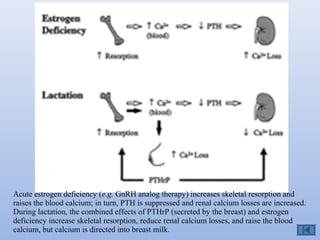
Acute estrogen deficiency (e.g. GnRH analog therapy) increases skeletal resorption and 
raises the blood calcium; in turn, PTH is suppressed and renal calcium losses are increased. 
During lactation, the combined effects of PTHrP (secreted by the breast) and estrogen 
deficiency increase skeletal resorption, reduce renal calcium losses, and raise the blood 
calcium, but calcium is directed into breast milk.
Osteoporosis of lactation
• Like osteoporosis inpregnancy
• Woman may have had low bone density
before conception
• PTHrP levels were high in one case of
lactational osteoporosis
CALCIUM PHYSIOLOGY
DURING PREGNANCY
• Calcium provided from the maternal
deciduas aids in fertilization of the egg and
implantation of the blastocyst
• About 80% of the calcium present in the
foetal skeleton at the end of gestation
crossed the placenta during the third
trimester
• Intestinal calcium absorption doubles
during pregnancy
Bone mobilization
• Investigated changes in bone mineral
content during pregnancy and lactation
• Bone loss at certain skeletal sites, such as
the lumbar spine and femoral neck
Mineral Ions
• Several characteristic changes in maternal
serum chemistries and calciotropic
hormones during pregnancy
• Serum albumin and hemoglobin fall during
pregnancy due to hemodilution
• Serum phosphate and magnesium levels
remain normal during pregnancy.
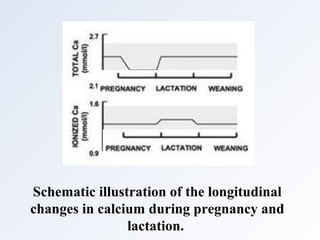
Schematic illustration of the longitudinal
changes in calcium during pregnancy and
lactation.
Schematic illustration of the longitudinal
changes in phosphate PTH during pregnancy
and lactation.
Schematic illustration of the longitudinal changes in
25-hydroxyvitamin D or calcifediol (25-D), Calcitonin
during pregnancy and lactation.
Schematic illustration of the longitudinal
changes in calcium during pregnancy and
lactation.
Parathyroid Hormone
• Parathyroid hormone (PTH) was first
measured with assays that reported high
circulating levels during pregnancy
• Those early-generation PTH assays
measured many biologically inactive
fragments of PTH
• In contrast, in women from Asia and Gambia
who have very low dietary calcium intakes
Vitamin D Metabolites
• A common concern is that the placenta and
fetus will deplete maternal 25-D stores, but
this does not appear to be the case
• Even in severely vitamin D deficient women
there was either no change or at most a
nonsignificant decline in maternal 25-D
levels during pregnancy.
Calcitonin
• Serum calcitonin levels are increased
during pregnancy and may derive from
– Maternal Thyroid
– Breast
– Decidua
– Placenta
• Calcitonin plays an important role in the
physiological responses to the calcium
demands of pregnancy
PTHrP
• PTHrP levels are increased during the third
trimester
– but whether this occurs earlier in pregnancy
• PTHrP is produced by many tissues in the
fetus and mother and it is unknown which
source(s) account for the rise in PTHrP 1-86
detected in the maternal circulation
Other Hormones
• Calciotropic hormones
–Response to challenges such as
hypocalcemia
• Steroids
• Prolactin
• Placental lactogen
• IGF-1
Renal Handling of Calcium
• Renal calcium excretion is increased as
early as the 12th week of gestation and 24
hour urine values (corrected for creatinine
excretion) can exceed the normal range.
• Conversely, fasting urine calcium values are
normal or low, confirming that the
hypercalciuria is a consequence of the
enhanced intestinal calcium absorption.
Consequences of bone loss during
pregnancy and Lactation
• Maternal bone loss during pregnancy or
lactation might lead to osteoporosis and
fracture either contemporaneously or, by
reducing peak bone mass, in later life.
• Severe bone loss leading to osteoporosis and
fracture is a well recognized but rare
complication of pregnancy and lactation
Influence of calcium intakes on
breast-milk calcium secretion
• Breast-milk calcium secretion is known to
be independent of recent maternal calcium
intake
• No relationships between breast-milk
calcium concentrations and maternal
calcium intakes
• However, there have been no definitive
investigations in women with low calcium
intakes.
Effect of maternal calcium intake
on foetal and infant growth
• Marginal calcium deficiency may be
associated with reduced bone mineral
content
• The influence of maternal calcium intakes
during pregnancy and lactation on the
growth and bone development of the foetus
and breast-fed baby is not known
Calcium intakes and hypertensive
disorders of pregnancy
• A potential connection between low calcium
intakes and hypertensive disorders in
pregnancy was suggested by the fact that
the incidence of eclampsia is highest in
countries where calcium intakes are low.
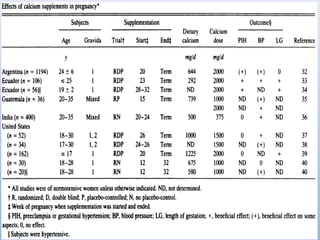
• Several well-conducted trials have studied
the efficacy of calcium supplements in
preventing preeclampsia, gestational
hypertension, and premature delivery, as
summarized in Table
Biochemical changes during
pregnancy and lactation
• Calcium absorption is increased in
pregnant women.
• The role of parathyroid hormone is unclear,
since recent use of a more specific
radioimmunoassay has cast doubt on
previous reports of increased parathyroid
hormone concentrations in pregnancy
During lactation………….
• Urinary calcium excretion is generally
decreased.
• Increased calcium absorption may occur.
• No differences in fractional absorption have
been found during established lactation
between breast-feeding mothers and control
subjects
Adverse effects of increases in
calcium intakes
• Very high calcium intakes are believed to
increase the risk of kidney stones
• Renal calculi occur in 1/1500 pregnancies
• The potential for urinary tract infection
may be increased when urinary calcium
excretion rises as a result of calcium
supplementation
• In addition, increases in dietary
calcium consumption have been
associated with reduced absorption
of other minerals
• such as
–Iron
–Zinc
–Magnesium
DISORDERS OF
CALCIUM AND BONE
METABOLISM
DURING PREGNANCY
&
LACTATION
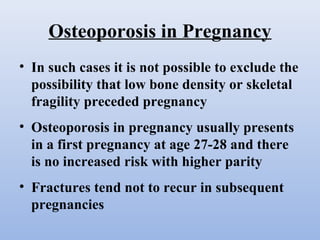
Osteoporosis in Pregnancy
• In such cases it is not possible to exclude the
possibility that low bone density or skeletal
fragility preceded pregnancy
• Osteoporosis in pregnancy usually presents
in a first pregnancy at age 27-28 and there
is no increased risk with higher parity
• Fractures tend not to recur in subsequent
pregnancies
Other disorders
• Low Calcium Intake
• Hypoparathyroidism
• Primary Hyperparathyroidism
Why you need calcium during
pregnancy
• Baby needs calcium to build strong
bones and teeth
• Grow a healthy heart, nerves, and
muscles
• Develop a normal heart rhythm and
blood-clotting abilities
• Reduce bone resorption
Calcium in pregnancy & lactation.

Calcium in pregnancy & lactation.

  • 2.
    INTRODUCTIONINTRODUCTION • During gestationthe average foetus requires about 30 g of calcium to mineralize its skeleton and maintain normal physiological processes. • The suckling neonate requires more than this amount in breast milk during six months of exclusive lactation • Although pregnant and lactating women face a comparable demand in the amount of calcium
  • 3.
    • During pregnancyand lactation, 200–300 mg Ca/d is eithertransferred via the placenta to the foetus or excreted in breast milk. • The provision of calcium during pregnancy and lactationrequires – Physiologic adaptation of calcium homeostatic mechanisms. – Including 1. intestinal calcium absorption 2. urinary calcium excretion 3. maternal bone calcium turnover
  • 5.
    TABLE Selected examples ofrecommended dietary allowances for calcium in different countries Women Pregnancy Lactation mg/d mg/d mg/d Australia-1989 800 1100(+300) 1200(+400) FAO/WHO 1974+ 450 1100(+650) 1100(+650) France 1988 800 1000(+200) 1200(+400) Indonesia 1980 500 600(+100) 600(+100) Ireland 1984 800 1200(+400) 1200(+400) Spain 1983+ 600 1325(+725) 1425(+825) United Kingdom 1991 700 700(0) 1250(+550) United States 1989 800 1200(+400) 1200(+400)
  • 6.
    • Calcium stressof pregnancy is relatively similar among women • The amount of calcium secreted during lactation can be highly variable, depending on 1. Amount of breast-milk produced 2. Breast-milk calcium concentration 3. Length of the lactation period
  • 7.
    Calcium • Calcium isimportant for a number of functions in the body • It is essential for 1. Growth 2. Maintenance of bones and teeth 3. Nerve transmission 4. Muscle contraction 5. Number of other cell processes
  • 8.
    • The bodyhas increased calcium needs during growth spurts, pregnancy and lactation • An inadequate calcium intake can therefore cause a number of problems • In growing children and adolescents, this can lead to stunted growth, and a reduced peak bone density increasing the risk of osteoporosis later in life • In pregnancy, the unborn child will draw on the mother’s calcium stores to meet its needs, putting the condition of the mother’s bones and teeth at risk
  • 9.
    Recommended Daily Intake PopulationGroup RDI Adults 800 mg/day Pregnancy 1100 mg/day Lactation 1300 mg/day Elderly 1000 mg/day
  • 10.
    Sources of calcium FoodServing size Calcium (mg) Full cream Milk 250 ml (1 glass) 285 Natural Yoghurt 200g (1 tub) 340 Cheddar cheese 2 slices (40g) 310 Cooked Spinach 1 cup (100g) 170 Cooked broccoli 1 cup (100g) 30 Canned salmon (plus bones) 100g 230 Canned salmon (plus bones) 3 sardines (50g) 190 Almonds 45g 50
  • 11.
    Availability in thediet • Reduce calcium’s availability and absorption in the gut: 1. Fibre – soluble pectin fibre binds with the calcium 2. Fat – forms a soap in the stomach when it binds with calcium 3. Phytic acid – found in breakfast cereals 4. Oxalic acid – found in high concentrations in spinach and rhubarb, and in smaller amounts in sweet potatoes and dried beans.
  • 12.
    Including calcium inthe diet • It’s easy to include dairy foods in a healthy, balanced diet. Have a look at these simple ideas: – Have some milk with your breakfast cereal – Wake up to a home-made banana, mango or strawberry smoothie – Try some cheese on toast – Nothing beats cream cheese on a bagel
  • 13.
    –Try yoghurt atmorning tea to keep you going until lunch –Sprinkle some cheese on your potato –Have some fresh fruit and yoghurt for dessert –Enjoy a warm cup of milk before bed
  • 14.
    If dairy foodsare not consumed there are many other ways to incorporate calcium into your diet: –Try some calcium-enriched soymilk with muesli –Have tuna and tomato on toast for breakfast – Use calcium-fortified bread to make a sandwich –Snack on a handful of nuts –Have a stirfry of Asian green vegies
  • 15.
    Pregnancy • The normalfoetal skeleton has accreted about 30 g calcium by theend of gestation • About 80% of the accretion occurs rapidly duringthe third trimester • Daily accretion rate ofabout 250–300 mg calcium by the foetal skeleton duringthe third trimester
  • 16.
    The mother couldtheoretically meet this demand by Increasing the intestinal absorption Decreasingrenal calcium losses Increasing the resorption of calciumfrom the maternal skeleton
  • 17.
    Minerals and hormones •Earliest apparent changes in calcium balance in pregnancyis a fall in total serum calcium • Serum calcitoninlevels are increased during pregnancy • PTHrP levels have been increased during pregnancy • Other hormones are clearly in flux during pregnancy
  • 18.
    Intestinal calcium absorption •Intestinal absorption of calcium is doubled during pregnancy • The increase inintestinal calcium absorption is associated with – Doublingof 1,25-dihydroxyvitamin D levels – Increased intestinal expressionof the vitamin D- dependent calcium-binding protein calbindin-D
  • 19.
    Renal calcium excretion •The 24-h urine calcium excretion is typically increased as early asthe 12th week of gestation • This increaseis likely a consequence of – Increased intestinal absorptionof calcium – Increased renal filtered load of calcium – Increased glomerular filtration rate • In the fasted state, the calcium excretionis normal or even low.
  • 20.
    Osteoporosis in pregnancy •Occasionally, a woman will suffer an apparent fragility fracture during pregnancy or in the first few weeks after delivery • low bonemineral density reading will be obtained • Focal, transient osteoporosis of the hip is a rare
  • 21.
    Lactation • The typicaldaily loss of calcium in breast milk has been estimatedto range from 280– 400 mg • Although daily losses as greatas 1000 mg • A temporary demineralizationof the skeleton seems to be the main mechanism
  • 22.
    Again, the mothercould theoretically meet this demand by • increasing the intestinal absorption of calcium • decreasing renal calcium losses • increasing the resorptionof calcium from the maternal skeleton
  • 23.
    Minerals and hormones •The mean ionized calcium level of exclusively lactating womenis increased, although it remains in the normal range • Serumphosphate levels are also increased and may exceed the normalrange • Intact PTH,as determined by a two-site IRMA, has been found to be reduced50% or more in lactating women in the first several months postpartum
  • 24.
    Intestinal calcium absorption •The intestinal absorption of calcium is equal to the no pregnant state –Decreased from pregnancy • This change coincides with thefall in 1,25- dihydroxyvitamin D levels to normal.
  • 25.
    Renal calcium excretion •The GFR falls during lactation to a level below the pregnantand pre pregnant value • Tubular reabsorption of calcium must be increased • Renal excretion of calcium is typically reduced to levels as low as 50 mg/24 h • increased serum calcium
  • 26.
    • Acute estrogendeficiency (e.g. GnRH analog therapy) →increases skeletal resorption and →raises the blood calcium; →in turn, PTH is suppressed and →renal calcium losses are increased.
  • 27.
    • During lactation,the combined effects of PTHrP (secreted by the breast) and estrogen deficiency →increase skeletal resorption →reduce renal calcium losses, and →raise the blood calcium, →but calcium is directed into breast milk.
  • 28.
  • 29.
    Osteoporosis of lactation •Like osteoporosis inpregnancy • Woman may have had low bone density before conception • PTHrP levels were high in one case of lactational osteoporosis
  • 30.
    CALCIUM PHYSIOLOGY DURING PREGNANCY •Calcium provided from the maternal deciduas aids in fertilization of the egg and implantation of the blastocyst • About 80% of the calcium present in the foetal skeleton at the end of gestation crossed the placenta during the third trimester • Intestinal calcium absorption doubles during pregnancy
  • 31.
    Bone mobilization • Investigatedchanges in bone mineral content during pregnancy and lactation • Bone loss at certain skeletal sites, such as the lumbar spine and femoral neck
  • 32.
    Mineral Ions • Severalcharacteristic changes in maternal serum chemistries and calciotropic hormones during pregnancy • Serum albumin and hemoglobin fall during pregnancy due to hemodilution • Serum phosphate and magnesium levels remain normal during pregnancy.
  • 33.
    Schematic illustration ofthe longitudinal changes in calcium during pregnancy and lactation.
  • 34.
    Schematic illustration ofthe longitudinal changes in phosphate PTH during pregnancy and lactation.
  • 35.
    Schematic illustration ofthe longitudinal changes in 25-hydroxyvitamin D or calcifediol (25-D), Calcitonin during pregnancy and lactation.
  • 36.
    Schematic illustration ofthe longitudinal changes in calcium during pregnancy and lactation.
  • 37.
    Parathyroid Hormone • Parathyroidhormone (PTH) was first measured with assays that reported high circulating levels during pregnancy • Those early-generation PTH assays measured many biologically inactive fragments of PTH • In contrast, in women from Asia and Gambia who have very low dietary calcium intakes
  • 38.
    Vitamin D Metabolites •A common concern is that the placenta and fetus will deplete maternal 25-D stores, but this does not appear to be the case • Even in severely vitamin D deficient women there was either no change or at most a nonsignificant decline in maternal 25-D levels during pregnancy.
  • 39.
    Calcitonin • Serum calcitoninlevels are increased during pregnancy and may derive from – Maternal Thyroid – Breast – Decidua – Placenta • Calcitonin plays an important role in the physiological responses to the calcium demands of pregnancy
  • 40.
    PTHrP • PTHrP levelsare increased during the third trimester – but whether this occurs earlier in pregnancy • PTHrP is produced by many tissues in the fetus and mother and it is unknown which source(s) account for the rise in PTHrP 1-86 detected in the maternal circulation
  • 41.
    Other Hormones • Calciotropichormones –Response to challenges such as hypocalcemia • Steroids • Prolactin • Placental lactogen • IGF-1
  • 42.
    Renal Handling ofCalcium • Renal calcium excretion is increased as early as the 12th week of gestation and 24 hour urine values (corrected for creatinine excretion) can exceed the normal range. • Conversely, fasting urine calcium values are normal or low, confirming that the hypercalciuria is a consequence of the enhanced intestinal calcium absorption.
  • 43.
    Consequences of boneloss during pregnancy and Lactation • Maternal bone loss during pregnancy or lactation might lead to osteoporosis and fracture either contemporaneously or, by reducing peak bone mass, in later life. • Severe bone loss leading to osteoporosis and fracture is a well recognized but rare complication of pregnancy and lactation
  • 44.
    Influence of calciumintakes on breast-milk calcium secretion • Breast-milk calcium secretion is known to be independent of recent maternal calcium intake • No relationships between breast-milk calcium concentrations and maternal calcium intakes • However, there have been no definitive investigations in women with low calcium intakes.
  • 45.
    Effect of maternalcalcium intake on foetal and infant growth • Marginal calcium deficiency may be associated with reduced bone mineral content • The influence of maternal calcium intakes during pregnancy and lactation on the growth and bone development of the foetus and breast-fed baby is not known
  • 46.
    Calcium intakes andhypertensive disorders of pregnancy • A potential connection between low calcium intakes and hypertensive disorders in pregnancy was suggested by the fact that the incidence of eclampsia is highest in countries where calcium intakes are low. • Several well-conducted trials have studied the efficacy of calcium supplements in preventing preeclampsia, gestational hypertension, and premature delivery, as summarized in Table
  • 48.
    Biochemical changes during pregnancyand lactation • Calcium absorption is increased in pregnant women. • The role of parathyroid hormone is unclear, since recent use of a more specific radioimmunoassay has cast doubt on previous reports of increased parathyroid hormone concentrations in pregnancy
  • 49.
    During lactation…………. • Urinarycalcium excretion is generally decreased. • Increased calcium absorption may occur. • No differences in fractional absorption have been found during established lactation between breast-feeding mothers and control subjects
  • 50.
    Adverse effects ofincreases in calcium intakes • Very high calcium intakes are believed to increase the risk of kidney stones • Renal calculi occur in 1/1500 pregnancies • The potential for urinary tract infection may be increased when urinary calcium excretion rises as a result of calcium supplementation
  • 51.
    • In addition,increases in dietary calcium consumption have been associated with reduced absorption of other minerals • such as –Iron –Zinc –Magnesium
  • 52.
    DISORDERS OF CALCIUM ANDBONE METABOLISM DURING PREGNANCY & LACTATION
  • 53.
    Osteoporosis in Pregnancy •In such cases it is not possible to exclude the possibility that low bone density or skeletal fragility preceded pregnancy • Osteoporosis in pregnancy usually presents in a first pregnancy at age 27-28 and there is no increased risk with higher parity • Fractures tend not to recur in subsequent pregnancies
  • 54.
    Other disorders • LowCalcium Intake • Hypoparathyroidism • Primary Hyperparathyroidism
  • 56.
    Why you needcalcium during pregnancy • Baby needs calcium to build strong bones and teeth • Grow a healthy heart, nerves, and muscles • Develop a normal heart rhythm and blood-clotting abilities • Reduce bone resorption