NUTRITION IN PREGNANCY
Professor and Unit Chief, L.T.M.M.C & L.T.M.G.H, Sion Hospital
President, MOGS (2022-2023)
Joint Treasurer, FOGSI (2021-2025)
Organising Secretary, AICOG Mumbai 2025
Treasurer, AFG (2023-2024)
Member Oncology Committee, SAFOG (2021-2023)
Dean AGOG & Chief Content Director, HIGHGRAD & FEMAS Courses
Editor-in-Chief, FEMAS, JGOG & TOA Journal
67 publications in International and National Journals with 166 Citations
National Coordinator, FOGSI Medical Disorders in Pregnancy Committee (2019-2022)
Chair & Convener, FOGSI Cell Violence Against Doctors (2015-16)
Member, Oncology Committee AOFOG (2013-2015)
Coordinator of 11 batches of MUHS recognized Certificate Course of B.I.M.I.E at
L.T.M.G.H (2010-16)
Member, Managing Committee IAGE (2013-17), (2018-20), (2022-2023)
Editorial Board, European Journal of Gynaec. Oncology (Italy)
Course Coordinator of 3 batches of Advanced Minimal Access Gynaec Surgery (AMAS)
at LTMGH (2018-19)
DR. NIRANJAN CHAVAN
MD, FCPS, DGO, MICOG, DICOG, FICOG, DFP,
DIPLOMA IN ENDOSCOPY (USA)
INTRODUCTION
• The intense fetal growth and development during pregnancy requires
maternal physiologic adaptation and a change in nutritional needs.
• Adequate maternal intake of macronutrients and micronutrients promotes
normal embryonic and fetal development.
• While undernutrition and overnutrition (eg, an obesogenic
environment) may be associated with
• adverse maternal pregnancy and newborn outcomes
• including miscarriage
• some congenital anomalies
• hypertensive disorders of pregnancy
• gestational diabetes
• preterm birth
• small for gestational age newborn and
• suboptimal neurocognitive development
• Importantly, maternal nutritional status is a modifiable risk factor that can
be evaluated, monitored, and, when appropriate, improved.
• Beginning this process before conception is important since addressing
diet during pregnancy can impact some outcomes (eg, gestational weight
gain), but may not be sufficiently early to affect others, such as the
occurrence of gestational diabetes related to obesity .
DIETARY REQUIREMENTS
• Protein - The fetal/placental unit utilizes approximately 1000 g of protein, with
most of this requirement in the last six months.
• Recommended intake – The Dietary Guidelines for Americans recommend a
minimum daily nutritional goal of 71 g/day (1.1 g/kg/day)
Carbohydrates -
• Recommended intake – Carbohydrate requirements
increase to 175 g/day in pregnancy, up from 130
g/day in non pregnant females.
• Highly processed carbohydrates should be
minimized to help manage weight gain.
• Avoid high postprandial blood glucose levels,
particularly among those with or at high risk of
diabetes.
Fiber -
• Intake of 28 to 36 g/day is recommended in
pregnancy, which, along with adequate fluid intake,
may help prevent or reduce constipation.
• High fiber consumption prior to conception was
associated with a decreased risk of preeclampsia
and dyslipidemia in an observational study.
• High fiber intake may also have favourable effects
on blood glucose.
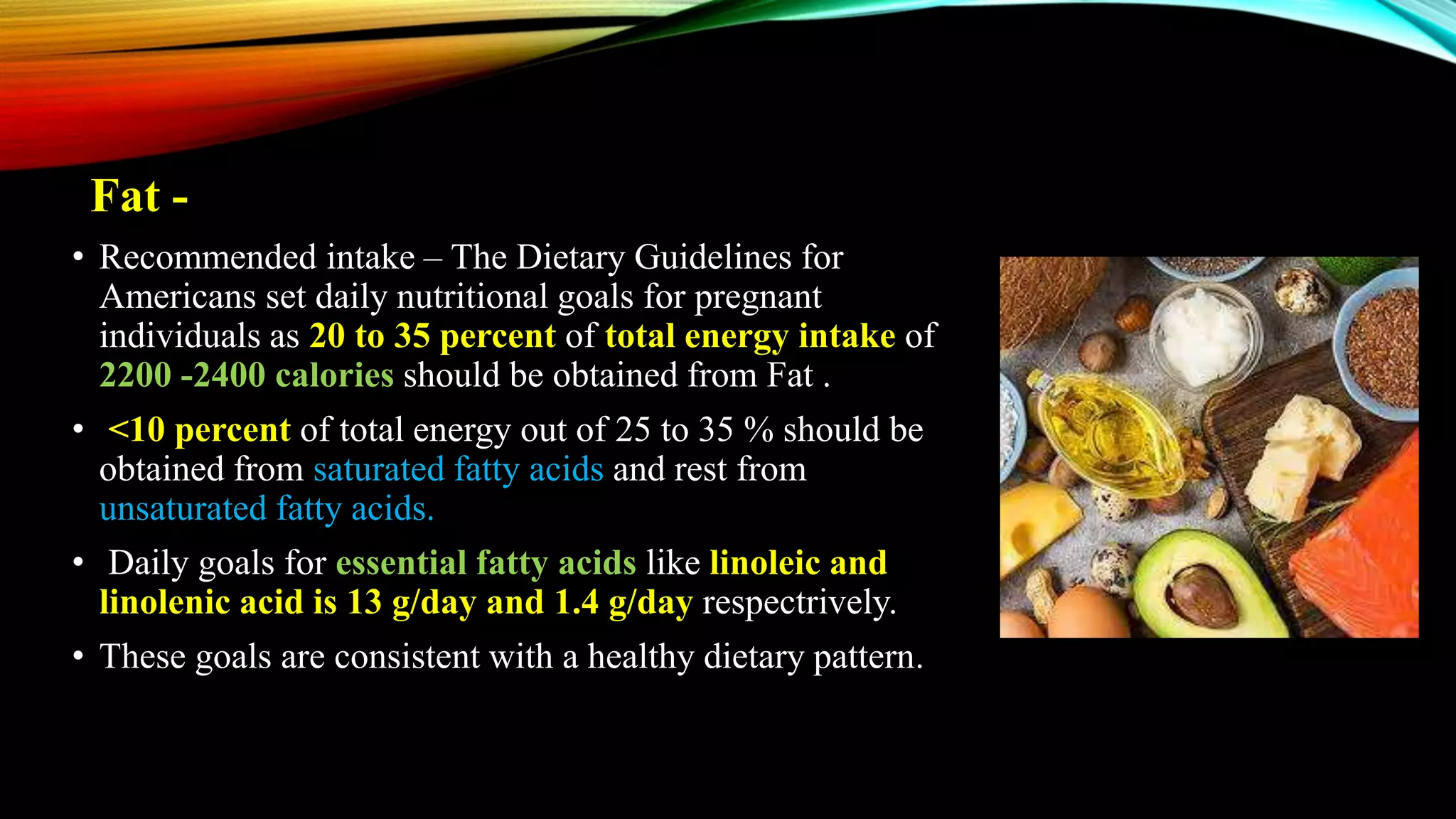
Fat -
• Recommended intake – The Dietary Guidelines for
Americans set daily nutritional goals for pregnant
individuals as 20 to 35 percent of total energy intake of
2200 -2400 calories should be obtained from Fat .
• <10 percent of total energy out of 25 to 35 % should be
obtained from saturated fatty acids and rest from
unsaturated fatty acids.
• Daily goals for essential fatty acids like linoleic and
linolenic acid is 13 g/day and 1.4 g/day respectrively.
• These goals are consistent with a healthy dietary pattern.
Long-chain polyunsaturated fatty acids -
• Docosahexaenoic acid (DHA) and eicosapentaenoic acid (EPA) are two n-3
(also known as omega-3) long-chain polyunsaturated fatty acids (n-3
LCPUFAs) derived primarily from fish or marine-based sources.
• DHA is necessary for normal development of the fetal brain and retina, and
seafood consumption during pregnancy has also been associated with favorable
cognitive development in offspring.
MICRONUTRIENTS
• Iron - is necessary for fetal brain and placental
development and to expand the maternal red cell mass.
Iron deficiency, which is the most prevalent single-
nutrient deficiency worldwide.
• Dietary reference values for iron in pregnancy vary
worldwide.
• The CDC recommends iron intake of 27 mg/day during
pregnancy (up from 18 mg/day in nonpregnant/non-
lactating people) to prevent iron deficiency anemia.
• For pregnant women with first or third trimester
hemoglobin [Hb] <11 g/dL or second-trimester Hb
<10.5 g/dL and low serum ferritin [<40 ng/mL]), an
additional iron supplement (30 to 120 mg/day) is
required until the anemia is corrected .
Calcium and Vitamin D -
• Fetal skeletal development requires approximately 30g
of calcium across pregnancy, primarily in the last
trimester.
• This total is a relatively small percentage of total
maternal body calcium and is easily mobilized from
maternal stores, if necessary.
• Intestinal absorption and renal retention of calcium
increase progressively throughout gestation.
• Average calcium consumption among pregnant people
is 1090 mg/day from foods and 1300 mg/day from
foods plus supplements.
• Folic Acid / Folate - The body of evidence supports
the efficacy of Folic acid supplementation and dietary
fortification to decrease the occurrence and
recurrence of neural tube defects (NTDs) by at least
70 percent.
• A supplement containing 0.4 to 0.8 mg of folic
acid one month before and for the first two to
three months after conception to reduce the risk of
open NTDs.
• An RDA of 0.6 mg is recommended
thereafter to meet the growing needs of
the fetus and placenta.
• Vitamin B12 functions closely with
folate and homocysteine and is involved
in DNA synthesis and cellular
metabolism.
FLUID REQUIREMENTS
• During pregnancy, adequate fluid intake
from the consumption of beverages (water and
other liquids) is estimated to be approximately
2.3 L/day (76 fluid ounces or approximately
10 cups) .
• Additional water is consumed in foods other
than beverages to meet the total adequate
intake of 3 L/day.
• Numerous factors (eg, ambient temperature,
humidity, physical activity, exercise influence)
also influence total water needs.
SPECIAL POPULATIONS
Pregnancy and diabetes mellitus -
• The goal of medical management of pregnant
patients with pregestational diabetes is to maintain
blood glucose concentration at or near
normoglycemic levels at the time of conception
and throughout the entire pregnancy.
• Taking into account that "normoglycemia" in
pregnant patients without diabetes is lower than in
the nonpregnant state.
• Good glycemic control during pregnancy
decreases the likelihood of adverse maternal, fetal,
and newborn outcomes (eg, congenital anomalies,
preeclampsia, macrosomia, neonatal
hypoglycemia).
Postpartum and breastfeeding -
An adequate, balanced diet is believed to be
important for the replenishment of maternal stores
that are expended during the pregnancy, for
promoting loss of excess weight, and for
nourishing the breastfed infant.
Multiple gestations -
• Nutritional requirements and weight
gain recommendations are higher in
multiple gestations.
FENZA
Fenza is a motherhood supplement with DHA.
• Fish across the globe are living in polluted waters and are the
source of carcinogens - Pb, As, Cd, Hg, and microplastics.
They are harmful to both mother and child.
• Our Fish oil complies with US and EU guidelines.
• Our source of fish is from Iceland waters where the waters
are relatively less polluted.
• The supplier from Iceland has 80 years of experience in processing fish oil and is
one of the best fish oil producers in the world. The manufacturer is Lysi.
• https://www.youtube.com/watch?v=jz6a5jFUFVo
• Our fish oil has no taste or smell of fish.
• Thus doesn't trigger burping, nausea, and vomiting.
• Liquid inside the capsule, so no GI irritation and better absorption of the nutrients.
FENZA IS UNIQUE
 The benefits of Tuna oil for baby are well know
 Significant care is taken in choosing and processing of Tuna oil
https://www.youtube.com/watch?v=jz6a5jFUFVo
 No fish smell and taste that triggers nausea.
 No loss of nutrients in processing.
 Free from contaminants.
 Meets international standards.
 Natural carotenoids as source of Vitamin A
 Natural Vitamin E as source of Vitamin E
 Ferrous Fumerate as source of Iron
 Calcium Carbonate as source of Ca
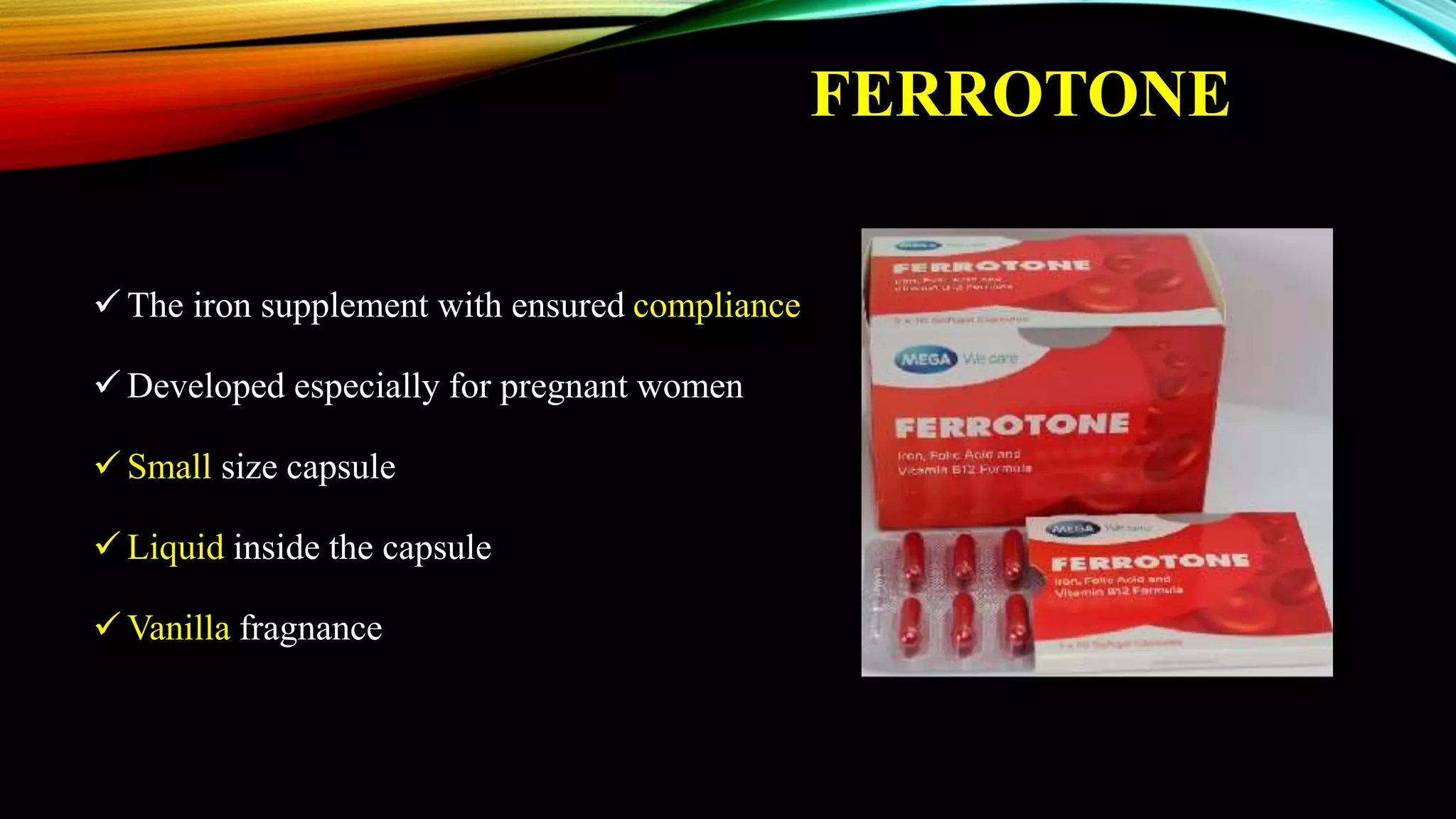
FERROTONE
 The iron supplement with ensured compliance
 Developed especially for pregnant women
 Small size capsule
 Liquid inside the capsule
 Vanilla fragnance
PRENATAL
 Trusted supplement by prescribers
 Widely prescribed motherhood supplement across
Ethiopia.
 Has 11 Vitamins and 8 Minerals which are vital in
pregnancy for mother and baby to improve overall
nutrition
 Complementary combinations ex: Iron/ Vit.c and
• Vit D/Ca
 Trusted motherhood supplement by mothers
a) Softgel capsules – No taste inconvenience
- Doesn’t trigger nausea
b) Liquid inside the capsule – Faster absorption
with minimal/no gastric irritation.
c) Better compliance
REFERENCES
• Finnell RH, Shaw GM, Lammer EJ, et al. Gene-nutrient interactions: importance of
folates and retinoids during early embryogenesis. Toxicol Appl Pharmacol 2004;
198:75.
• Feodor Nilsson S, Andersen PK, Strandberg-Larsen K, Nybo Andersen AM. Risk
factors for miscarriage from a prevention perspective: a nationwide follow-up study.
BJOG 2014; 121:1375.
• Shaw GM, Wise PH, Mayo J, et al. Maternal prepregnancy body mass index and risk
of spontaneous preterm birth. Paediatr Perinat Epidemiol 2014; 28:302.
• Ramakrishnan U, Grant F, Goldenberg T, et al. Effect of women's nutrition before
and during early pregnancy on maternal and infant outcomes: a systematic review.
Paediatr Perinat Epidemiol 2012; 26 Suppl 1:285.
NUTRITION IN PREGNANCY.pptx

NUTRITION IN PREGNANCY.pptx

  • 1.
  • 3.
    Professor and UnitChief, L.T.M.M.C & L.T.M.G.H, Sion Hospital President, MOGS (2022-2023) Joint Treasurer, FOGSI (2021-2025) Organising Secretary, AICOG Mumbai 2025 Treasurer, AFG (2023-2024) Member Oncology Committee, SAFOG (2021-2023) Dean AGOG & Chief Content Director, HIGHGRAD & FEMAS Courses Editor-in-Chief, FEMAS, JGOG & TOA Journal 67 publications in International and National Journals with 166 Citations National Coordinator, FOGSI Medical Disorders in Pregnancy Committee (2019-2022) Chair & Convener, FOGSI Cell Violence Against Doctors (2015-16) Member, Oncology Committee AOFOG (2013-2015) Coordinator of 11 batches of MUHS recognized Certificate Course of B.I.M.I.E at L.T.M.G.H (2010-16) Member, Managing Committee IAGE (2013-17), (2018-20), (2022-2023) Editorial Board, European Journal of Gynaec. Oncology (Italy) Course Coordinator of 3 batches of Advanced Minimal Access Gynaec Surgery (AMAS) at LTMGH (2018-19) DR. NIRANJAN CHAVAN MD, FCPS, DGO, MICOG, DICOG, FICOG, DFP, DIPLOMA IN ENDOSCOPY (USA)
  • 4.
    INTRODUCTION • The intensefetal growth and development during pregnancy requires maternal physiologic adaptation and a change in nutritional needs. • Adequate maternal intake of macronutrients and micronutrients promotes normal embryonic and fetal development.
  • 5.
    • While undernutritionand overnutrition (eg, an obesogenic environment) may be associated with • adverse maternal pregnancy and newborn outcomes • including miscarriage • some congenital anomalies • hypertensive disorders of pregnancy • gestational diabetes • preterm birth • small for gestational age newborn and • suboptimal neurocognitive development
  • 6.
    • Importantly, maternalnutritional status is a modifiable risk factor that can be evaluated, monitored, and, when appropriate, improved. • Beginning this process before conception is important since addressing diet during pregnancy can impact some outcomes (eg, gestational weight gain), but may not be sufficiently early to affect others, such as the occurrence of gestational diabetes related to obesity .
  • 7.
    DIETARY REQUIREMENTS • Protein- The fetal/placental unit utilizes approximately 1000 g of protein, with most of this requirement in the last six months. • Recommended intake – The Dietary Guidelines for Americans recommend a minimum daily nutritional goal of 71 g/day (1.1 g/kg/day)
  • 8.
    Carbohydrates - • Recommendedintake – Carbohydrate requirements increase to 175 g/day in pregnancy, up from 130 g/day in non pregnant females. • Highly processed carbohydrates should be minimized to help manage weight gain. • Avoid high postprandial blood glucose levels, particularly among those with or at high risk of diabetes.
  • 9.
    Fiber - • Intakeof 28 to 36 g/day is recommended in pregnancy, which, along with adequate fluid intake, may help prevent or reduce constipation. • High fiber consumption prior to conception was associated with a decreased risk of preeclampsia and dyslipidemia in an observational study. • High fiber intake may also have favourable effects on blood glucose.
  • 10.
    Fat - • Recommendedintake – The Dietary Guidelines for Americans set daily nutritional goals for pregnant individuals as 20 to 35 percent of total energy intake of 2200 -2400 calories should be obtained from Fat . • <10 percent of total energy out of 25 to 35 % should be obtained from saturated fatty acids and rest from unsaturated fatty acids. • Daily goals for essential fatty acids like linoleic and linolenic acid is 13 g/day and 1.4 g/day respectrively. • These goals are consistent with a healthy dietary pattern.
  • 11.
    Long-chain polyunsaturated fattyacids - • Docosahexaenoic acid (DHA) and eicosapentaenoic acid (EPA) are two n-3 (also known as omega-3) long-chain polyunsaturated fatty acids (n-3 LCPUFAs) derived primarily from fish or marine-based sources. • DHA is necessary for normal development of the fetal brain and retina, and seafood consumption during pregnancy has also been associated with favorable cognitive development in offspring.
  • 12.
    MICRONUTRIENTS • Iron -is necessary for fetal brain and placental development and to expand the maternal red cell mass. Iron deficiency, which is the most prevalent single- nutrient deficiency worldwide. • Dietary reference values for iron in pregnancy vary worldwide.
  • 13.
    • The CDCrecommends iron intake of 27 mg/day during pregnancy (up from 18 mg/day in nonpregnant/non- lactating people) to prevent iron deficiency anemia. • For pregnant women with first or third trimester hemoglobin [Hb] <11 g/dL or second-trimester Hb <10.5 g/dL and low serum ferritin [<40 ng/mL]), an additional iron supplement (30 to 120 mg/day) is required until the anemia is corrected .
  • 14.
    Calcium and VitaminD - • Fetal skeletal development requires approximately 30g of calcium across pregnancy, primarily in the last trimester. • This total is a relatively small percentage of total maternal body calcium and is easily mobilized from maternal stores, if necessary. • Intestinal absorption and renal retention of calcium increase progressively throughout gestation. • Average calcium consumption among pregnant people is 1090 mg/day from foods and 1300 mg/day from foods plus supplements.
  • 15.
    • Folic Acid/ Folate - The body of evidence supports the efficacy of Folic acid supplementation and dietary fortification to decrease the occurrence and recurrence of neural tube defects (NTDs) by at least 70 percent. • A supplement containing 0.4 to 0.8 mg of folic acid one month before and for the first two to three months after conception to reduce the risk of open NTDs.
  • 16.
    • An RDAof 0.6 mg is recommended thereafter to meet the growing needs of the fetus and placenta. • Vitamin B12 functions closely with folate and homocysteine and is involved in DNA synthesis and cellular metabolism.
  • 17.
    FLUID REQUIREMENTS • Duringpregnancy, adequate fluid intake from the consumption of beverages (water and other liquids) is estimated to be approximately 2.3 L/day (76 fluid ounces or approximately 10 cups) . • Additional water is consumed in foods other than beverages to meet the total adequate intake of 3 L/day. • Numerous factors (eg, ambient temperature, humidity, physical activity, exercise influence) also influence total water needs.
  • 18.
    SPECIAL POPULATIONS Pregnancy anddiabetes mellitus - • The goal of medical management of pregnant patients with pregestational diabetes is to maintain blood glucose concentration at or near normoglycemic levels at the time of conception and throughout the entire pregnancy. • Taking into account that "normoglycemia" in pregnant patients without diabetes is lower than in the nonpregnant state. • Good glycemic control during pregnancy decreases the likelihood of adverse maternal, fetal, and newborn outcomes (eg, congenital anomalies, preeclampsia, macrosomia, neonatal hypoglycemia).
  • 19.
    Postpartum and breastfeeding- An adequate, balanced diet is believed to be important for the replenishment of maternal stores that are expended during the pregnancy, for promoting loss of excess weight, and for nourishing the breastfed infant.
  • 20.
    Multiple gestations - •Nutritional requirements and weight gain recommendations are higher in multiple gestations.
  • 22.
    FENZA Fenza is amotherhood supplement with DHA. • Fish across the globe are living in polluted waters and are the source of carcinogens - Pb, As, Cd, Hg, and microplastics. They are harmful to both mother and child. • Our Fish oil complies with US and EU guidelines. • Our source of fish is from Iceland waters where the waters are relatively less polluted.
  • 23.
    • The supplierfrom Iceland has 80 years of experience in processing fish oil and is one of the best fish oil producers in the world. The manufacturer is Lysi. • https://www.youtube.com/watch?v=jz6a5jFUFVo • Our fish oil has no taste or smell of fish. • Thus doesn't trigger burping, nausea, and vomiting. • Liquid inside the capsule, so no GI irritation and better absorption of the nutrients.
  • 24.
    FENZA IS UNIQUE The benefits of Tuna oil for baby are well know  Significant care is taken in choosing and processing of Tuna oil https://www.youtube.com/watch?v=jz6a5jFUFVo  No fish smell and taste that triggers nausea.  No loss of nutrients in processing.  Free from contaminants.  Meets international standards.
  • 25.
     Natural carotenoidsas source of Vitamin A  Natural Vitamin E as source of Vitamin E  Ferrous Fumerate as source of Iron  Calcium Carbonate as source of Ca
  • 26.
    FERROTONE  The ironsupplement with ensured compliance  Developed especially for pregnant women  Small size capsule  Liquid inside the capsule  Vanilla fragnance
  • 27.
    PRENATAL  Trusted supplementby prescribers  Widely prescribed motherhood supplement across Ethiopia.  Has 11 Vitamins and 8 Minerals which are vital in pregnancy for mother and baby to improve overall nutrition  Complementary combinations ex: Iron/ Vit.c and • Vit D/Ca
  • 28.
     Trusted motherhoodsupplement by mothers a) Softgel capsules – No taste inconvenience - Doesn’t trigger nausea b) Liquid inside the capsule – Faster absorption with minimal/no gastric irritation. c) Better compliance
  • 29.
    REFERENCES • Finnell RH,Shaw GM, Lammer EJ, et al. Gene-nutrient interactions: importance of folates and retinoids during early embryogenesis. Toxicol Appl Pharmacol 2004; 198:75. • Feodor Nilsson S, Andersen PK, Strandberg-Larsen K, Nybo Andersen AM. Risk factors for miscarriage from a prevention perspective: a nationwide follow-up study. BJOG 2014; 121:1375. • Shaw GM, Wise PH, Mayo J, et al. Maternal prepregnancy body mass index and risk of spontaneous preterm birth. Paediatr Perinat Epidemiol 2014; 28:302. • Ramakrishnan U, Grant F, Goldenberg T, et al. Effect of women's nutrition before and during early pregnancy on maternal and infant outcomes: a systematic review. Paediatr Perinat Epidemiol 2012; 26 Suppl 1:285.