Dr Nur Karyatee bt Kassim
Mpath 4th yr
Hypercalcaemia
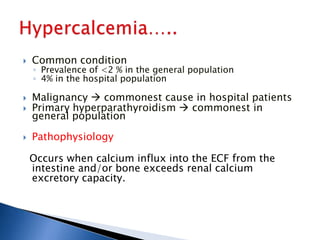
 Common condition
◦ Prevalence of <2 % in the general population
◦ 4% in the hospital population
 Malignancy  commonest cause in hospital patients
 Primary hyperparathyroidism  commonest in
general population
 Pathophysiology
Occurs when calcium influx into the ECF from the
intestine and/or bone exceeds renal calcium
excretory capacity.
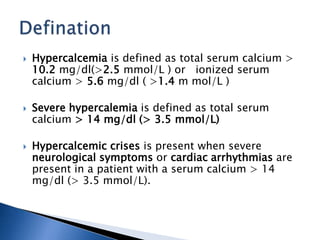
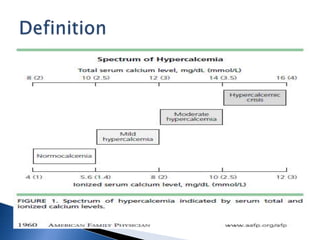
 Hypercalcemia is defined as total serum calcium >
10.2 mg/dl(>2.5 mmol/L ) or ionized serum
calcium > 5.6 mg/dl ( >1.4 m mol/L )
 Severe hypercalemia is defined as total serum
calcium > 14 mg/dl (> 3.5 mmol/L)
 Hypercalcemic crises is present when severe
neurological symptoms or cardiac arrhythmias are
present in a patient with a serum calcium > 14
mg/dl (> 3.5 mmol/L).
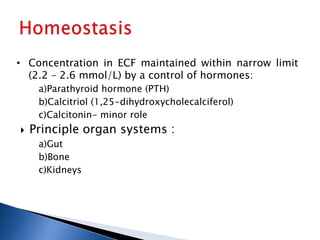
• Concentration in ECF maintained within narrow limit
(2.2 – 2.6 mmol/L) by a control of hormones:
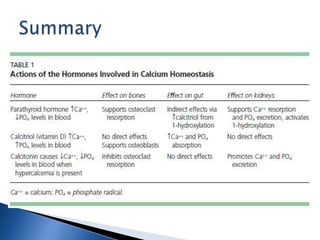
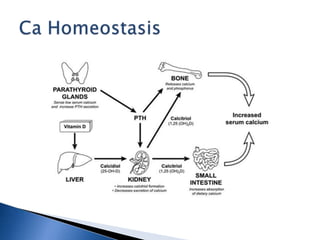
a)Parathyroid hormone (PTH)
b)Calcitriol (1,25-dihydroxycholecalciferol)
c)Calcitonin- minor role
 Principle organ systems :
a)Gut
b)Bone
c)Kidneys
 Bone
◦ Inhibits osteoblasts
◦ Accelerates osteoclastic bone resorption
 Kidneys
◦ Increases renal tubular reabsorption of Ca
◦ Increases PO4 excretion
◦ Increases calcitriol activity (1-hydroxylation)  indirectly
raises [Ca]
 Gut
◦ Does not directly affect GIT absorption of Ca
◦ Effects are mediated indirectly through regulation of
synthesis of calcitriol
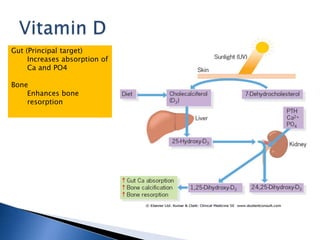
Gut (Principal target)
Increases absorption of
Ca and PO4
Bone
Enhances bone
resorption
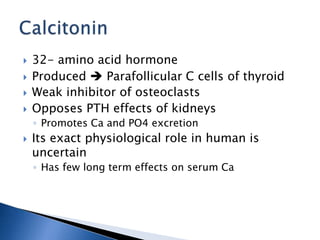
 32- amino acid hormone
 Produced  Parafollicular C cells of thyroid
 Weak inhibitor of osteoclasts
 Opposes PTH effects of kidneys
◦ Promotes Ca and PO4 excretion
 Its exact physiological role in human is
uncertain
◦ Has few long term effects on serum Ca
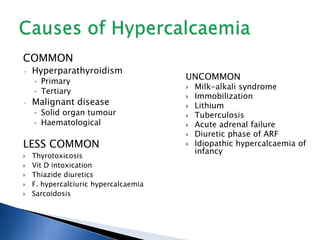
COMMON
• Hyperparathyroidism
• Primary
• Tertiary
• Malignant disease
• Solid organ tumour
• Haematological
LESS COMMON
 Thyrotoxicosis
 Vit D intoxication
 Thiazide diuretics
 F. hypercalciuric hypercalcaemia
 Sarcoidosis
UNCOMMON
 Milk-alkali syndrome
 Immobilization
 Lithium
 Tuberculosis
 Acute adrenal failure
 Diuretic phase of ARF
 Idiopathic hypercalcaemia of
infancy
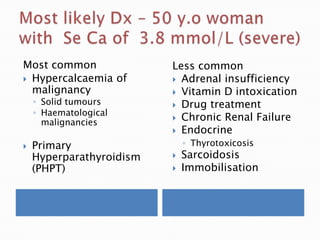
Most common
 Hypercalcaemia of
malignancy
◦ Solid tumours
◦ Haematological
malignancies
 Primary
Hyperparathyroidism
(PHPT)
Less common
 Adrenal insufficiency
 Vitamin D intoxication
 Drug treatment
 Chronic Renal Failure
 Endocrine
◦ Thyrotoxicosis
 Sarcoidosis
 Immobilisation
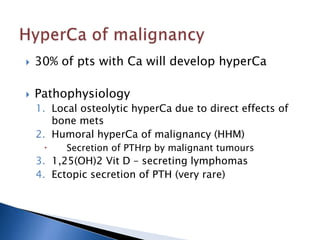
 30% of pts with Ca will develop hyperCa
 Pathophysiology
1. Local osteolytic hyperCa due to direct effects of
bone mets
2. Humoral hyperCa of malignancy (HHM)
 Secretion of PTHrp by malignant tumours
3. 1,25(OH)2 Vit D – secreting lymphomas
4. Ectopic secretion of PTH (very rare)
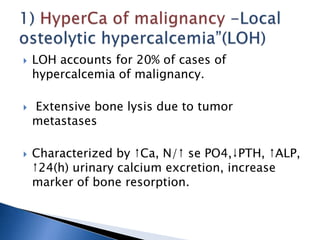
 LOH accounts for 20% of cases of
hypercalcemia of malignancy.
 Extensive bone lysis due to tumor
metastases
 Characterized by ↑Ca, N/↑ se PO4,↓PTH, ↑ALP,
↑24(h) urinary calcium excretion, increase
marker of bone resorption.
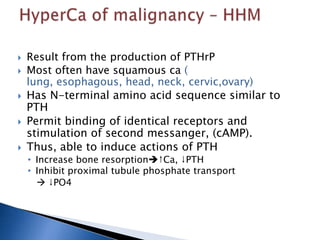
 Result from the production of PTHrP
 Most often have squamous ca (
lung, esophagous, head, neck, cervic,ovary)
 Has N-terminal amino acid sequence similar to
PTH
 Permit binding of identical receptors and
stimulation of second messanger, (cAMP).
 Thus, able to induce actions of PTH
• Increase bone resorption↑Ca, ↓PTH
• Inhibit proximal tubule phosphate transport
 ↓PO4
Multiple myeloma
◦ Release of osteoclast activating factors by the
tumour cells
◦ IL-1B, lymphotoxin, TNF, IL-6, macrophage
CSF, hepatocyte GF
◦ Actions: stimulates osteoclastic activity
In Hodgkin lymphoma,
◦ induced by production of 1,25(OH)2D
◦ Malignant lymphocyte & macrophage converting the
25(OH)D to 1,25(OH)D
 bone resorption and intestinal Ca2+ absorption
 1 HPTH is the leading cause of hyperCa.
 Often, pts are women in their 50s who have
parathyroid adenoma
 Incidence ; 1 in 500 to 1 in 1000
 Occur sporadically or assoc with MEN Type
1or 2
 In primary HPTH due to adenomas,
◦ PTH secretion is independent of the negative
feedback mechanism
◦ :. Secretion continues despite elevated Ca2+ level.
 Pathophysiology
◦ Excess PTH leads to
 Direct increase in renal Ca absorption
 Increase in serum Calcitriol  Increasing GIT Ca
absorption
 Increase bone turnover, resorption > formation
 Diagnosis = Hypercalcaemia + raised [iPTH]
 Additional lab findings
- ↓ serum phosphate
- urinary excretion of Ca2+ ( PTH  amount of filtered
Ca2+ > normal resorptive capacity of the kidney xs Ca2+
secreted in urine)
-↑ Se ALP (when bone disease present)
-↑ se Cl and ↓ se Bicarb
- ↑1,25 (OH)2D
-bone markers(↑bone specific ALP,osteocalcin)
 Other Ix
◦ Sestamibi scan of the Parathyroid
 Rare, life threathening cx of primary
hyperparathyroidism
 Sx: acutely ill wt profound dehydration,GIT
sx, urinary symptom,altered mental status&
cardiac arythmia.
 Lab ix;significantly ↑se Ca,↑PTH,↑ ALP.
 In ESRF, prolonged hypocalcaemia will cause
autonomous PTH secretion by parathyroid.
 This in turn will cause hypercalcaemia (Tertiary
hyperparathyroidism)
 Hypercalcaemia may manifest for the first time in
patient post renal transplant when there is
normalization of calcitriol production
 Increases the PTH effect on bone Directly enhances
intestinal Ca absorption
◦ Pt with sarcoidosis have increased sensitivity to
vitamin D.
◦ High Ca may develop in normocalcaemic pt after
minimal intake of vit D and sunlight exposure
◦ Caused by increase production of 1,25(OH)2D
from non-renal sites.
◦ Macrophage from sarcoid granuloma may cause
1-hydroxylation of 25-(OH)D to produce calcitriol
 Ca 2+
◦ High/inappropriately elevated se 1,25(OH)D
despite PTH level is suppressed and se PO4 is
relatively elevated.
 Thiazide diuretics:
◦ Enhance ca reabsorption in the distal tubule
↓urinary ca excretion.
• Rarely cause Ca in N persons, but lead to Ca in
pt with underlying bone resorption (eg in
hyperparathyroidism)
• Mild hypercalcaemia,↓/N PTH
 Lithium therapy:
◦ Increased PTH secretion  Increasing set point
of PTH, hence higher [Ca] to switch off PTH
◦ Lab ix: high Ca, PTH, low urinary 24(h) calcium
 The most commonly available vit D
supplement  25-(OH)Vit D
◦ Excess of VIT D 25000-50000 IU/week
◦ Resulting primarily from a combination of increase
bone resorption of calcium and increase bone
reabsortion
◦ Lab ix: ↑Ca, ↑Po4,↓/N PTH, ↑25(OH)D, N/slightly
25(OH)D
 In immobilization,
 Decreased stimulus to bone formation and
continued resorption rapid efflux of ca fr
bone suppresed PTH 1,25(OH) D  results in
hypercalciuria
 Hypercalcemia seen if there is pre-existing
increased bone turnover
 Paget’s disease
 Hyperparathyroid
 Malignancy associated hypercalcemia
 Prev – milk alkali syndrome
◦ Milk-alkali syndrome: ingestion of
milk/antacids(alkaline) for treatment of dyspepsia .
 Alkali increases renal reabsorption of filtered calcium.
 Precise mechanism unknown
 Calcium-alkali syndrome
◦ Due to Rx of osteoporosis
◦ Triad of hypercalcemia,systemic alkalosis and renal
insufficiency.
◦ Lab Ix: ↑ca,↓/ N PTH,↑/N PO4, ↓urinary 24 (h) Ca
 Hypercalcaemia seen in pt treated with
◦ Calcium carbonate or calcium acetate to bind
dietary phosphate
◦ Calcitriol ( to reverse hypocalcaemia and
secondary hyperparathyroidism)
 Endocrine
◦ Thyrotoxicosis-mild hypercalcemia
◦ Thyroid hormoneIncreased bone resorption
ratereleases ca into circulation suppress PTH
low 1,25(OH)D
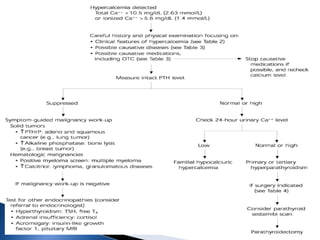
How to approach?
- Medical History
- Physical Examination
What Investigations?
 -Lab
 -Others
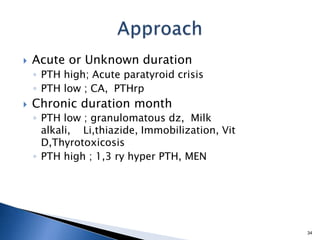
 Acute or Unknown duration
◦ PTH high; Acute paratyroid crisis
◦ PTH low ; CA, PTHrp
 Chronic duration month
◦ PTH low ; granulomatous dz, Milk
alkali, Li,thiazide, Immobilization, Vit
D,Thyrotoxicosis
◦ PTH high ; 1,3 ry hyper PTH, MEN
34
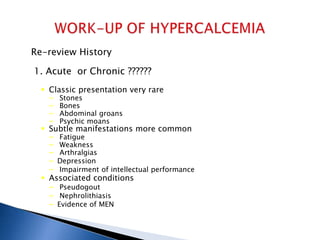
Re-review History
1. Acute or Chronic ??????
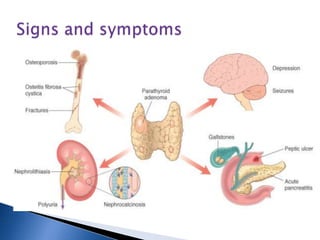
 Classic presentation very rare
– Stones
– Bones
– Abdominal groans
– Psychic moans
 Subtle manifestations more common
– Fatigue
– Weakness
– Arthralgias
– Depression
– Impairment of intellectual performance
 Associated conditions
– Pseudogout
– Nephrolithiasis
– Evidence of MEN
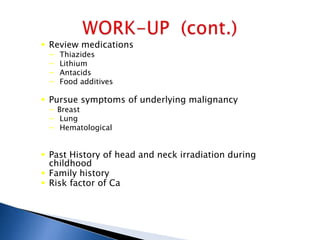
 Review medications
– Thiazides
– Lithium
– Antacids
– Food additives
 Pursue symptoms of underlying malignancy
– Breast
– Lung
– Hematological
 Past History of head and neck irradiation during
childhood
 Family history
 Risk factor of Ca
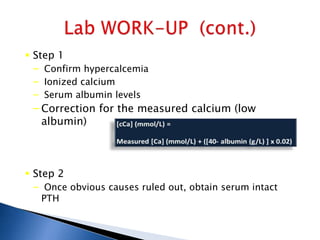
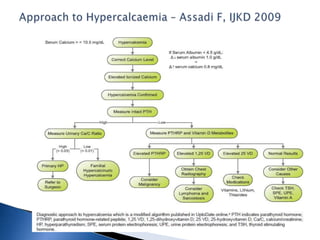
 Step 1
– Confirm hypercalcemia
– Ionized calcium
– Serum albumin levels
– Correction for the measured calcium (low
albumin)
 Step 2
– Once obvious causes ruled out, obtain serum intact
PTH
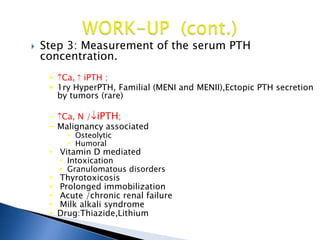
 Step 3: Measurement of the serum PTH
concentration.
 Ca, iPTH ;
 1ry HyperPTH, Familial (MENI and MENII),Ectopic PTH secretion
by tumors (rare)
– Ca, N / iPTH;
– Malignancy associated
• Osteolytic
• Humoral
• Vitamin D mediated
• Intoxication
• Granulomatous disorders
• Thyrotoxicosis
• Prolonged immobilization
• Acute /chronic renal failure
• Milk alkali syndrome
• Drug:Thiazide,Lithium
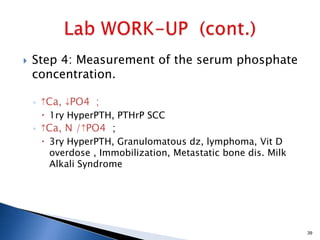
 Step 4: Measurement of the serum phosphate
concentration.
◦ Ca, PO4 ;
 1ry HyperPTH, PTHrP SCC
◦ Ca, N / PO4 ;
 3ry HyperPTH, Granulomatous dz, lymphoma, Vit D
overdose , Immobilization, Metastatic bone dis. Milk
Alkali Syndrome
39
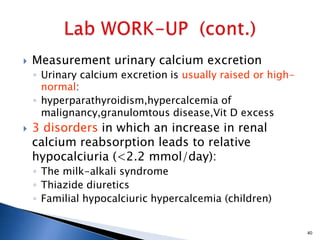
 Measurement urinary calcium excretion
◦ Urinary calcium excretion is usually raised or high-
normal:
◦ hyperparathyroidism,hypercalcemia of
malignancy,granulomtous disease,Vit D excess
 3 disorders in which an increase in renal
calcium reabsorption leads to relative
hypocalciuria (<2.2 mmol/day):
◦ The milk-alkali syndrome
◦ Thiazide diuretics
◦ Familial hypocalciuric hypercalcemia (children)
40
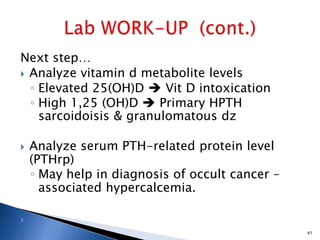
Next step…
 Analyze vitamin d metabolite levels
◦ Elevated 25(OH)D  Vit D intoxication
◦ High 1,25 (OH)D  Primary HPTH
sarcoidoisis & granulomatous dz
 Analyze serum PTH-related protein level
(PTHrp)
◦ May help in diagnosis of occult cancer –
associated hypercalcemia.

41
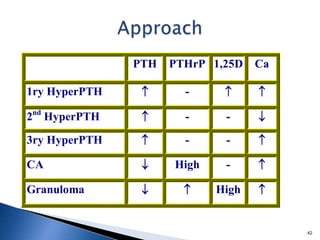
42
PTH PTHrP 1,25D Ca
1ry HyperPTH -
2nd
HyperPTH - -
3ry HyperPTH - -
CA High -
Granuloma High
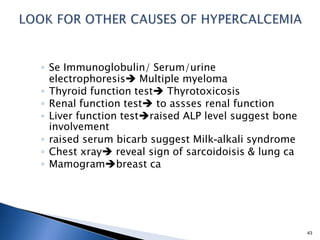
◦ Se Immunoglobulin/ Serum/urine
electrophoresis Multiple myeloma
◦ Thyroid function test Thyrotoxicosis
◦ Renal function test to assses renal function
◦ Liver function testraised ALP level suggest bone
involvement
◦ raised serum bicarb suggest Milk-alkali syndrome
◦ Chest xray reveal sign of sarcoidoisis & lung ca
◦ Mamogrambreast ca
43
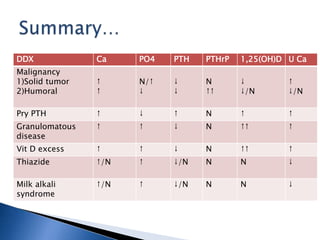
DDX Ca PO4 PTH PTHrP 1,25(OH)D U Ca
Malignancy
1)Solid tumor
2)Humoral
↑
↑
N/↑
↓
↓
↓
N
↑↑
↓
↓/N
↑
↓/N
Pry PTH ↑ ↓ ↑ N ↑ ↑
Granulomatous
disease
↑ ↑ ↓ N ↑↑ ↑
Vit D excess ↑ ↑ ↓ N ↑↑ ↑
Thiazide ↑/N ↑ ↓/N N N ↓
Milk alkali
syndrome
↑/N ↑ ↓/N N N ↓
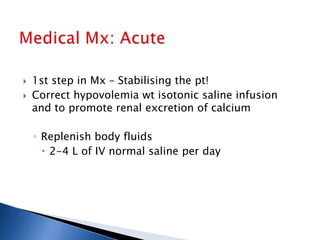
 1st step in Mx – Stabilising the pt!
 Correct hypovolemia wt isotonic saline infusion
and to promote renal excretion of calcium
◦ Replenish body fluids
 2-4 L of IV normal saline per day
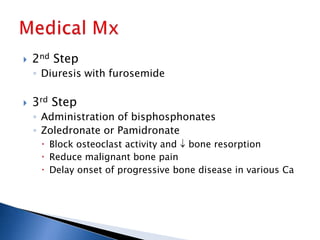
 2nd Step
◦ Diuresis with furosemide
 3rd Step
◦ Administration of bisphosphonates
◦ Zoledronate or Pamidronate
 Block osteoclast activity and bone resorption
 Reduce malignant bone pain
 Delay onset of progressive bone disease in various Ca
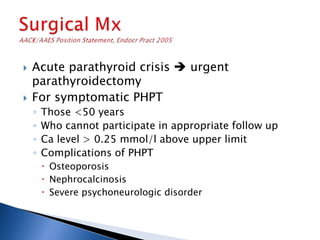
 Acute parathyroid crisis  urgent
parathyroidectomy
 For symptomatic PHPT
◦ Those <50 years
◦ Who cannot participate in appropriate follow up
◦ Ca level > 0.25 mmol/l above upper limit
◦ Complications of PHPT
 Osteoporosis
 Nephrocalcinosis
 Severe psychoneurologic disorder
 Review / remove any known agents that
cause / aggravate hypercalcaemia
◦ Medications
 Thiazide
 Lithium
 Over the counter supplements
 Hypercalcaemia has a wide differential diagnosis
and several investigations may be required to
determine the underlying cause.
 Clues pointing to the Dx of underlying disease
can be obtained from careful history taking and
physical examination.
 Lab tests should be requested based on clinical
suspicion.
 Long term control of hypercalcaemia is best
achieved by identifying and treating the
underlying disease.

Hypercalcemia atee

  • 1.
    Dr Nur Karyateebt Kassim Mpath 4th yr
  • 2.
  • 3.
     Common condition ◦Prevalence of <2 % in the general population ◦ 4% in the hospital population  Malignancy  commonest cause in hospital patients  Primary hyperparathyroidism  commonest in general population  Pathophysiology Occurs when calcium influx into the ECF from the intestine and/or bone exceeds renal calcium excretory capacity.
  • 4.
     Hypercalcemia isdefined as total serum calcium > 10.2 mg/dl(>2.5 mmol/L ) or ionized serum calcium > 5.6 mg/dl ( >1.4 m mol/L )  Severe hypercalemia is defined as total serum calcium > 14 mg/dl (> 3.5 mmol/L)  Hypercalcemic crises is present when severe neurological symptoms or cardiac arrhythmias are present in a patient with a serum calcium > 14 mg/dl (> 3.5 mmol/L).
  • 6.
    • Concentration inECF maintained within narrow limit (2.2 – 2.6 mmol/L) by a control of hormones: a)Parathyroid hormone (PTH) b)Calcitriol (1,25-dihydroxycholecalciferol) c)Calcitonin- minor role  Principle organ systems : a)Gut b)Bone c)Kidneys
  • 8.
     Bone ◦ Inhibitsosteoblasts ◦ Accelerates osteoclastic bone resorption  Kidneys ◦ Increases renal tubular reabsorption of Ca ◦ Increases PO4 excretion ◦ Increases calcitriol activity (1-hydroxylation)  indirectly raises [Ca]  Gut ◦ Does not directly affect GIT absorption of Ca ◦ Effects are mediated indirectly through regulation of synthesis of calcitriol
  • 9.
    Gut (Principal target) Increasesabsorption of Ca and PO4 Bone Enhances bone resorption
  • 10.
     32- aminoacid hormone  Produced  Parafollicular C cells of thyroid  Weak inhibitor of osteoclasts  Opposes PTH effects of kidneys ◦ Promotes Ca and PO4 excretion  Its exact physiological role in human is uncertain ◦ Has few long term effects on serum Ca
  • 12.
    COMMON • Hyperparathyroidism • Primary •Tertiary • Malignant disease • Solid organ tumour • Haematological LESS COMMON  Thyrotoxicosis  Vit D intoxication  Thiazide diuretics  F. hypercalciuric hypercalcaemia  Sarcoidosis UNCOMMON  Milk-alkali syndrome  Immobilization  Lithium  Tuberculosis  Acute adrenal failure  Diuretic phase of ARF  Idiopathic hypercalcaemia of infancy
  • 13.
    Most common  Hypercalcaemiaof malignancy ◦ Solid tumours ◦ Haematological malignancies  Primary Hyperparathyroidism (PHPT) Less common  Adrenal insufficiency  Vitamin D intoxication  Drug treatment  Chronic Renal Failure  Endocrine ◦ Thyrotoxicosis  Sarcoidosis  Immobilisation
  • 14.
     30% ofpts with Ca will develop hyperCa  Pathophysiology 1. Local osteolytic hyperCa due to direct effects of bone mets 2. Humoral hyperCa of malignancy (HHM)  Secretion of PTHrp by malignant tumours 3. 1,25(OH)2 Vit D – secreting lymphomas 4. Ectopic secretion of PTH (very rare)
  • 15.
     LOH accountsfor 20% of cases of hypercalcemia of malignancy.  Extensive bone lysis due to tumor metastases  Characterized by ↑Ca, N/↑ se PO4,↓PTH, ↑ALP, ↑24(h) urinary calcium excretion, increase marker of bone resorption.
  • 16.
     Result fromthe production of PTHrP  Most often have squamous ca ( lung, esophagous, head, neck, cervic,ovary)  Has N-terminal amino acid sequence similar to PTH  Permit binding of identical receptors and stimulation of second messanger, (cAMP).  Thus, able to induce actions of PTH • Increase bone resorption↑Ca, ↓PTH • Inhibit proximal tubule phosphate transport  ↓PO4
  • 17.
    Multiple myeloma ◦ Releaseof osteoclast activating factors by the tumour cells ◦ IL-1B, lymphotoxin, TNF, IL-6, macrophage CSF, hepatocyte GF ◦ Actions: stimulates osteoclastic activity In Hodgkin lymphoma, ◦ induced by production of 1,25(OH)2D ◦ Malignant lymphocyte & macrophage converting the 25(OH)D to 1,25(OH)D  bone resorption and intestinal Ca2+ absorption
  • 18.
     1 HPTHis the leading cause of hyperCa.  Often, pts are women in their 50s who have parathyroid adenoma  Incidence ; 1 in 500 to 1 in 1000  Occur sporadically or assoc with MEN Type 1or 2
  • 19.
     In primaryHPTH due to adenomas, ◦ PTH secretion is independent of the negative feedback mechanism ◦ :. Secretion continues despite elevated Ca2+ level.  Pathophysiology ◦ Excess PTH leads to  Direct increase in renal Ca absorption  Increase in serum Calcitriol  Increasing GIT Ca absorption  Increase bone turnover, resorption > formation
  • 21.
     Diagnosis =Hypercalcaemia + raised [iPTH]  Additional lab findings - ↓ serum phosphate - urinary excretion of Ca2+ ( PTH  amount of filtered Ca2+ > normal resorptive capacity of the kidney xs Ca2+ secreted in urine) -↑ Se ALP (when bone disease present) -↑ se Cl and ↓ se Bicarb - ↑1,25 (OH)2D -bone markers(↑bone specific ALP,osteocalcin)  Other Ix ◦ Sestamibi scan of the Parathyroid
  • 22.
     Rare, lifethreathening cx of primary hyperparathyroidism  Sx: acutely ill wt profound dehydration,GIT sx, urinary symptom,altered mental status& cardiac arythmia.  Lab ix;significantly ↑se Ca,↑PTH,↑ ALP.
  • 23.
     In ESRF,prolonged hypocalcaemia will cause autonomous PTH secretion by parathyroid.  This in turn will cause hypercalcaemia (Tertiary hyperparathyroidism)  Hypercalcaemia may manifest for the first time in patient post renal transplant when there is normalization of calcitriol production  Increases the PTH effect on bone Directly enhances intestinal Ca absorption
  • 24.
    ◦ Pt withsarcoidosis have increased sensitivity to vitamin D. ◦ High Ca may develop in normocalcaemic pt after minimal intake of vit D and sunlight exposure ◦ Caused by increase production of 1,25(OH)2D from non-renal sites. ◦ Macrophage from sarcoid granuloma may cause 1-hydroxylation of 25-(OH)D to produce calcitriol  Ca 2+ ◦ High/inappropriately elevated se 1,25(OH)D despite PTH level is suppressed and se PO4 is relatively elevated.
  • 25.
     Thiazide diuretics: ◦Enhance ca reabsorption in the distal tubule ↓urinary ca excretion. • Rarely cause Ca in N persons, but lead to Ca in pt with underlying bone resorption (eg in hyperparathyroidism) • Mild hypercalcaemia,↓/N PTH  Lithium therapy: ◦ Increased PTH secretion  Increasing set point of PTH, hence higher [Ca] to switch off PTH ◦ Lab ix: high Ca, PTH, low urinary 24(h) calcium
  • 26.
     The mostcommonly available vit D supplement  25-(OH)Vit D ◦ Excess of VIT D 25000-50000 IU/week ◦ Resulting primarily from a combination of increase bone resorption of calcium and increase bone reabsortion ◦ Lab ix: ↑Ca, ↑Po4,↓/N PTH, ↑25(OH)D, N/slightly 25(OH)D
  • 27.
     In immobilization, Decreased stimulus to bone formation and continued resorption rapid efflux of ca fr bone suppresed PTH 1,25(OH) D  results in hypercalciuria  Hypercalcemia seen if there is pre-existing increased bone turnover  Paget’s disease  Hyperparathyroid  Malignancy associated hypercalcemia
  • 28.
     Prev –milk alkali syndrome ◦ Milk-alkali syndrome: ingestion of milk/antacids(alkaline) for treatment of dyspepsia .  Alkali increases renal reabsorption of filtered calcium.  Precise mechanism unknown  Calcium-alkali syndrome ◦ Due to Rx of osteoporosis ◦ Triad of hypercalcemia,systemic alkalosis and renal insufficiency. ◦ Lab Ix: ↑ca,↓/ N PTH,↑/N PO4, ↓urinary 24 (h) Ca
  • 29.
     Hypercalcaemia seenin pt treated with ◦ Calcium carbonate or calcium acetate to bind dietary phosphate ◦ Calcitriol ( to reverse hypocalcaemia and secondary hyperparathyroidism)  Endocrine ◦ Thyrotoxicosis-mild hypercalcemia ◦ Thyroid hormoneIncreased bone resorption ratereleases ca into circulation suppress PTH low 1,25(OH)D
  • 30.
    How to approach? -Medical History - Physical Examination What Investigations?  -Lab  -Others
  • 31.
     Acute orUnknown duration ◦ PTH high; Acute paratyroid crisis ◦ PTH low ; CA, PTHrp  Chronic duration month ◦ PTH low ; granulomatous dz, Milk alkali, Li,thiazide, Immobilization, Vit D,Thyrotoxicosis ◦ PTH high ; 1,3 ry hyper PTH, MEN 34
  • 32.
    Re-review History 1. Acuteor Chronic ??????  Classic presentation very rare – Stones – Bones – Abdominal groans – Psychic moans  Subtle manifestations more common – Fatigue – Weakness – Arthralgias – Depression – Impairment of intellectual performance  Associated conditions – Pseudogout – Nephrolithiasis – Evidence of MEN
  • 33.
     Review medications –Thiazides – Lithium – Antacids – Food additives  Pursue symptoms of underlying malignancy – Breast – Lung – Hematological  Past History of head and neck irradiation during childhood  Family history  Risk factor of Ca
  • 34.
     Step 1 –Confirm hypercalcemia – Ionized calcium – Serum albumin levels – Correction for the measured calcium (low albumin)  Step 2 – Once obvious causes ruled out, obtain serum intact PTH
  • 35.
     Step 3:Measurement of the serum PTH concentration.  Ca, iPTH ;  1ry HyperPTH, Familial (MENI and MENII),Ectopic PTH secretion by tumors (rare) – Ca, N / iPTH; – Malignancy associated • Osteolytic • Humoral • Vitamin D mediated • Intoxication • Granulomatous disorders • Thyrotoxicosis • Prolonged immobilization • Acute /chronic renal failure • Milk alkali syndrome • Drug:Thiazide,Lithium
  • 36.
     Step 4:Measurement of the serum phosphate concentration. ◦ Ca, PO4 ;  1ry HyperPTH, PTHrP SCC ◦ Ca, N / PO4 ;  3ry HyperPTH, Granulomatous dz, lymphoma, Vit D overdose , Immobilization, Metastatic bone dis. Milk Alkali Syndrome 39
  • 37.
     Measurement urinarycalcium excretion ◦ Urinary calcium excretion is usually raised or high- normal: ◦ hyperparathyroidism,hypercalcemia of malignancy,granulomtous disease,Vit D excess  3 disorders in which an increase in renal calcium reabsorption leads to relative hypocalciuria (<2.2 mmol/day): ◦ The milk-alkali syndrome ◦ Thiazide diuretics ◦ Familial hypocalciuric hypercalcemia (children) 40
  • 38.
    Next step…  Analyzevitamin d metabolite levels ◦ Elevated 25(OH)D  Vit D intoxication ◦ High 1,25 (OH)D  Primary HPTH sarcoidoisis & granulomatous dz  Analyze serum PTH-related protein level (PTHrp) ◦ May help in diagnosis of occult cancer – associated hypercalcemia.  41
  • 39.
    42 PTH PTHrP 1,25DCa 1ry HyperPTH - 2nd HyperPTH - - 3ry HyperPTH - - CA High - Granuloma High
  • 40.
    ◦ Se Immunoglobulin/Serum/urine electrophoresis Multiple myeloma ◦ Thyroid function test Thyrotoxicosis ◦ Renal function test to assses renal function ◦ Liver function testraised ALP level suggest bone involvement ◦ raised serum bicarb suggest Milk-alkali syndrome ◦ Chest xray reveal sign of sarcoidoisis & lung ca ◦ Mamogrambreast ca 43
  • 41.
    DDX Ca PO4PTH PTHrP 1,25(OH)D U Ca Malignancy 1)Solid tumor 2)Humoral ↑ ↑ N/↑ ↓ ↓ ↓ N ↑↑ ↓ ↓/N ↑ ↓/N Pry PTH ↑ ↓ ↑ N ↑ ↑ Granulomatous disease ↑ ↑ ↓ N ↑↑ ↑ Vit D excess ↑ ↑ ↓ N ↑↑ ↑ Thiazide ↑/N ↑ ↓/N N N ↓ Milk alkali syndrome ↑/N ↑ ↓/N N N ↓
  • 44.
     1st stepin Mx – Stabilising the pt!  Correct hypovolemia wt isotonic saline infusion and to promote renal excretion of calcium ◦ Replenish body fluids  2-4 L of IV normal saline per day
  • 45.
     2nd Step ◦Diuresis with furosemide  3rd Step ◦ Administration of bisphosphonates ◦ Zoledronate or Pamidronate  Block osteoclast activity and bone resorption  Reduce malignant bone pain  Delay onset of progressive bone disease in various Ca
  • 46.
     Acute parathyroidcrisis  urgent parathyroidectomy  For symptomatic PHPT ◦ Those <50 years ◦ Who cannot participate in appropriate follow up ◦ Ca level > 0.25 mmol/l above upper limit ◦ Complications of PHPT  Osteoporosis  Nephrocalcinosis  Severe psychoneurologic disorder
  • 47.
     Review /remove any known agents that cause / aggravate hypercalcaemia ◦ Medications  Thiazide  Lithium  Over the counter supplements
  • 48.
     Hypercalcaemia hasa wide differential diagnosis and several investigations may be required to determine the underlying cause.  Clues pointing to the Dx of underlying disease can be obtained from careful history taking and physical examination.  Lab tests should be requested based on clinical suspicion.  Long term control of hypercalcaemia is best achieved by identifying and treating the underlying disease.