Hormonal Regulation Of
Calcium Homeostasis
Department of Zoology, TD PG College, Jaunpur
Presented By:
Adarsh Maurya
MSc Previous Year
Roll no: 05
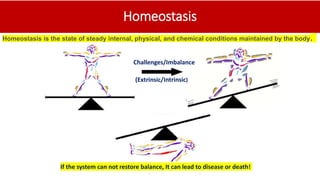
Homeostasis
If the system can not restore balance, It can lead to disease or death!
Homeostasis is the state of steady internal, physical, and chemical conditions maintained by the body.
Challenges/Imbalance
(Extrinsic/Intrinsic)
Function of Calcium
• Major structural element in the bones and teeth.
• Essential for several physiological processes such as neuromuscular
transmission, muscle contractions, nerve function, cell division.
• Co-factor in Blood coagulation.
• Plays an important role in cell signaling. e.g. cAMP pathway
• Release of neurotransmitters and hormones.
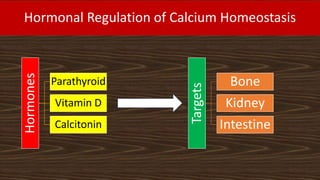
Hormonal Regulation of Calcium Homeostasis
Hormones
Parathyroid
Vitamin D
Calcitonin
Targets
Bone
Kidney
Intestine
Role of Parathyroid Hormone (PTH)
• 84 amino acids residues.
• Secreted by the chief cells of 4 parathyroid glands.
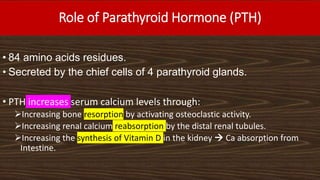
• PTH increases serum calcium levels through:
Increasing bone resorption by activating osteoclastic activity.
Increasing renal calcium reabsorption by the distal renal tubules.
Increasing the synthesis of Vitamin D in the kidney  Ca absorption from
Intestine.
Role of Vitamin D (Calcitriol)
• Vitamin D is a group of fat-soluble steroids in humans, the most important
compounds in this group are vitamin D3 (cholecalciferol) and vitamin
D2 (ergocalciferol).
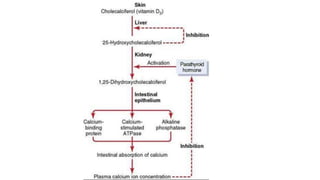
• Calcitriol's formation is facilitated by PTH.
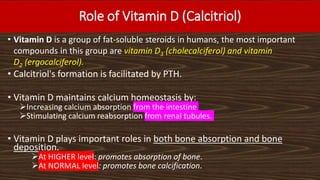
• Vitamin D maintains calcium homeostasis by:
Increasing calcium absorption from the intestine
Stimulating calcium reabsorption from renal tubules.
• Vitamin D plays important roles in both bone absorption and bone
deposition.
At HIGHER level: promotes absorption of bone.
At NORMAL level: promotes bone calcification.
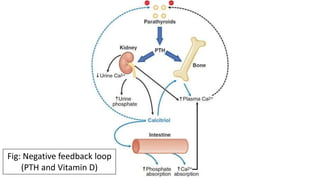
Fig: Negative feedback loop
(PTH and Vitamin D)
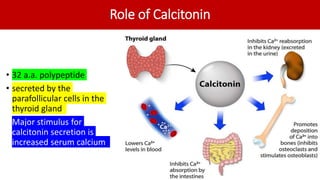
Role of Calcitonin
• 32 a.a. polypeptide
• secreted by the
parafollicular cells in the
thyroid gland.
• Major stimulus for
calcitonin secretion is
increased serum calcium.
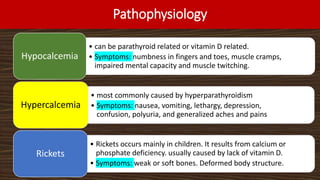
Pathophysiology
• can be parathyroid related or vitamin D related.
• Symptoms: numbness in fingers and toes, muscle cramps,
impaired mental capacity and muscle twitching.
Hypocalcemia
• most commonly caused by hyperparathyroidism
• Symptoms: nausea, vomiting, lethargy, depression,
confusion, polyuria, and generalized aches and pains
Hypercalcemia
• Rickets occurs mainly in children. It results from calcium or
phosphate deficiency. usually caused by lack of vitamin D.
• Symptoms: weak or soft bones. Deformed body structure.
Rickets
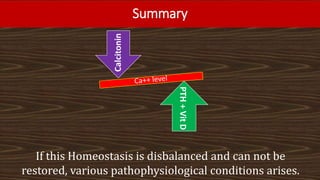
Summary
Calcitonin
PTH
+
Vit
D
If this Homeostasis is disbalanced and can not be
restored, various pathophysiological conditions arises.
References
1. Hadley M.E., Levine L.E., Hormonal control of calcium and phosphate
metabolism & physiology of bone (Page 369-376), Endocrinology, 6th edition.
2. Ganong W. F., Hormonal control of calcium homeostasis (Page 189-210),
Review of Medical Physiology, 23rd edition.
3. Guyton C., Hall E.J., Parathyroid Hormone, Calcitonin, Calcium and Phosphate
Metabolism, Vitamin D, Bone, and Teeth (Page 978-995), Textbook of Medical
Physiology, 11th edition.
4. Kumar Pranav, Meena Usha, Endocrine System: Thyroid & Parathyroid glands
(Page 453-454), Life Sciences (Part-II), 6th edition.
5. Internet Sources: Miscellaneous.
Thank You…..

Calcium homeostasis

  • 1.
    Hormonal Regulation Of CalciumHomeostasis Department of Zoology, TD PG College, Jaunpur Presented By: Adarsh Maurya MSc Previous Year Roll no: 05
  • 2.
    Homeostasis If the systemcan not restore balance, It can lead to disease or death! Homeostasis is the state of steady internal, physical, and chemical conditions maintained by the body. Challenges/Imbalance (Extrinsic/Intrinsic)
  • 3.
    Function of Calcium •Major structural element in the bones and teeth. • Essential for several physiological processes such as neuromuscular transmission, muscle contractions, nerve function, cell division. • Co-factor in Blood coagulation. • Plays an important role in cell signaling. e.g. cAMP pathway • Release of neurotransmitters and hormones.
  • 4.
    Hormonal Regulation ofCalcium Homeostasis Hormones Parathyroid Vitamin D Calcitonin Targets Bone Kidney Intestine
  • 5.
    Role of ParathyroidHormone (PTH) • 84 amino acids residues. • Secreted by the chief cells of 4 parathyroid glands. • PTH increases serum calcium levels through: Increasing bone resorption by activating osteoclastic activity. Increasing renal calcium reabsorption by the distal renal tubules. Increasing the synthesis of Vitamin D in the kidney  Ca absorption from Intestine.
  • 6.
    Role of VitaminD (Calcitriol) • Vitamin D is a group of fat-soluble steroids in humans, the most important compounds in this group are vitamin D3 (cholecalciferol) and vitamin D2 (ergocalciferol). • Calcitriol's formation is facilitated by PTH. • Vitamin D maintains calcium homeostasis by: Increasing calcium absorption from the intestine Stimulating calcium reabsorption from renal tubules. • Vitamin D plays important roles in both bone absorption and bone deposition. At HIGHER level: promotes absorption of bone. At NORMAL level: promotes bone calcification.
  • 8.
    Fig: Negative feedbackloop (PTH and Vitamin D)
  • 9.
    Role of Calcitonin •32 a.a. polypeptide • secreted by the parafollicular cells in the thyroid gland. • Major stimulus for calcitonin secretion is increased serum calcium.
  • 10.
    Pathophysiology • can beparathyroid related or vitamin D related. • Symptoms: numbness in fingers and toes, muscle cramps, impaired mental capacity and muscle twitching. Hypocalcemia • most commonly caused by hyperparathyroidism • Symptoms: nausea, vomiting, lethargy, depression, confusion, polyuria, and generalized aches and pains Hypercalcemia • Rickets occurs mainly in children. It results from calcium or phosphate deficiency. usually caused by lack of vitamin D. • Symptoms: weak or soft bones. Deformed body structure. Rickets
  • 11.
    Summary Calcitonin PTH + Vit D If this Homeostasisis disbalanced and can not be restored, various pathophysiological conditions arises.
  • 12.
    References 1. Hadley M.E.,Levine L.E., Hormonal control of calcium and phosphate metabolism & physiology of bone (Page 369-376), Endocrinology, 6th edition. 2. Ganong W. F., Hormonal control of calcium homeostasis (Page 189-210), Review of Medical Physiology, 23rd edition. 3. Guyton C., Hall E.J., Parathyroid Hormone, Calcitonin, Calcium and Phosphate Metabolism, Vitamin D, Bone, and Teeth (Page 978-995), Textbook of Medical Physiology, 11th edition. 4. Kumar Pranav, Meena Usha, Endocrine System: Thyroid & Parathyroid glands (Page 453-454), Life Sciences (Part-II), 6th edition. 5. Internet Sources: Miscellaneous.
  • 13.