
INDUSTRIAL PRODUCTION,
ESTIMATION AND UTILIZATION OF
PHYTOCONSTITUENTS
Presented By:
Mahewash Sana A. Pathan.
Department of Pharmaceutics,
R. P. College of Pharmacy, Osmanabad.
FORSKOLIN
Biological Source: Labdane diterpenoid
extracted from roots of Coleus forskohlii,
family- Lamiaceae.
2
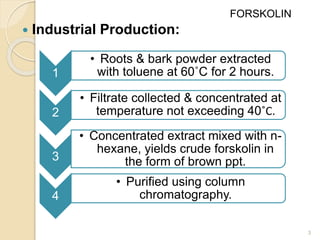
 Industrial Production:
3
1
• Roots & bark powder extracted
with toluene at 60˚C for 2 hours.
2
• Filtrate collected & concentrated at
temperature not exceeding 40˚C.
3
• Concentrated extract mixed with n-
hexane, yields crude forskolin in
the form of brown ppt.
4
• Purified using column
chromatography.
FORSKOLIN
 Estimation:
TLC & HPTLC
Mobile phase – Toluene: ethyl acetate ( 8.5:
1.5 v/v)
Stationary phase- Silica gel F254
Visualizing agent- 5% vanillin in glacial acetic
acid and 10% sulphuric acid in water.
 Utilization:
1. Antidepressant
2. Vasodilating
3. Antiobesity
4. In glaucoma
5. Antiasthmatic 4
FORSKOLIN
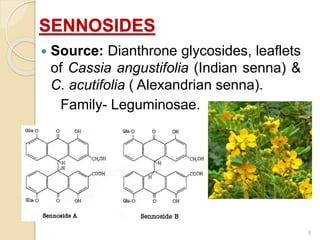
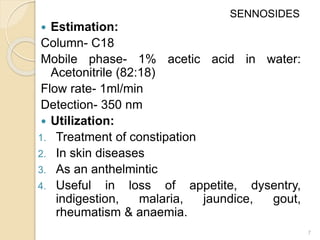
SENNOSIDES
 Source: Dianthrone glycosides, leaflets
of Cassia angustifolia (Indian senna) &
C. acutifolia ( Alexandrian senna).
Family- Leguminosae.
5
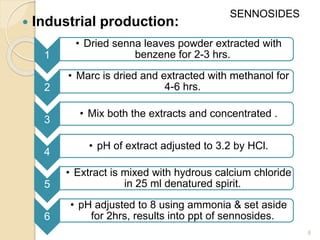
 Industrial production:
6
1
• Dried senna leaves powder extracted with
benzene for 2-3 hrs.
2
• Marc is dried and extracted with methanol for
4-6 hrs.
3
• Mix both the extracts and concentrated .
4
• pH of extract adjusted to 3.2 by HCl.
5
• Extract is mixed with hydrous calcium chloride
in 25 ml denatured spirit.
6
• pH adjusted to 8 using ammonia & set aside
for 2hrs, results into ppt of sennosides.
SENNOSIDES
 Estimation:
Column- C18
Mobile phase- 1% acetic acid in water:
Acetonitrile (82:18)
Flow rate- 1ml/min
Detection- 350 nm
 Utilization:
1. Treatment of constipation
2. In skin diseases
3. As an anthelmintic
4. Useful in loss of appetite, dysentry,
indigestion, malaria, jaundice, gout,
rheumatism & anaemia.
7
SENNOSIDES
ARTEMISININ
 Source: sesquiterpene lactone obtained
from the leaves & unexpanded flower heads
of Artemisia annua.
Family- Asteraceae.
8
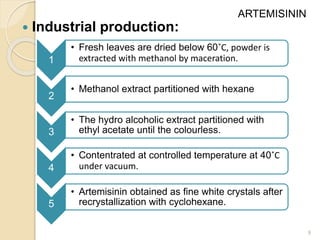
 Industrial production:
9
1
• Fresh leaves are dried below 60˚C, powder is
extracted with methanol by maceration.
2
• Methanol extract partitioned with hexane
3
• The hydro alcoholic extract partitioned with
ethyl acetate until the colourless.
4
• Contentrated at controlled temperature at 40˚C
under vacuum.
5
• Artemisinin obtained as fine white crystals after
recrystallization with cyclohexane.
ARTEMISININ
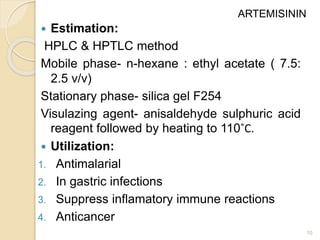
 Estimation:
HPLC & HPTLC method
Mobile phase- n-hexane : ethyl acetate ( 7.5:
2.5 v/v)
Stationary phase- silica gel F254
Visulazing agent- anisaldehyde sulphuric acid
reagent followed by heating to 110˚C.
 Utilization:
1. Antimalarial
2. In gastric infections
3. Suppress inflamatory immune reactions
4. Anticancer
10
ARTEMISININ
DIOSGENIN
 Source: Aglycone obtained after the
hydrolysis of steroidal saponin glycoside
dioscin present in Dioscorea deltoidea, D.
composite.
Family- Dioscoreaceae.
11
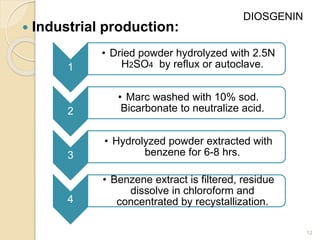
 Industrial production:
12
1
• Dried powder hydrolyzed with 2.5N
H2SO4 by reflux or autoclave.
2
• Marc washed with 10% sod.
Bicarbonate to neutralize acid.
3
• Hydrolyzed powder extracted with
benzene for 6-8 hrs.
4
• Benzene extract is filtered, residue
dissolve in chloroform and
concentrated by recystallization.
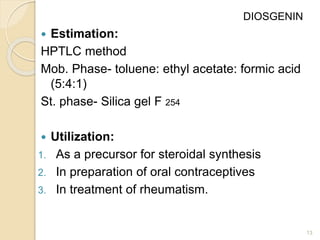
DIOSGENIN
 Estimation:
HPTLC method
Mob. Phase- toluene: ethyl acetate: formic acid
(5:4:1)
St. phase- Silica gel F 254
 Utilization:
1. As a precursor for steroidal synthesis
2. In preparation of oral contraceptives
3. In treatment of rheumatism.
13
DIOSGENIN
DIGOXIN
 Source: Cardiac glycoside obtained from
leaves of Digitalis lanata.
Family- Scrophulariaceae.
14
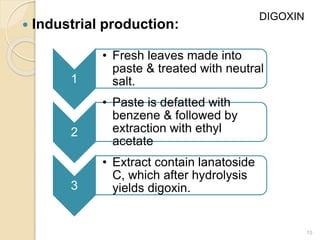
 Industrial production:
15
1
• Fresh leaves made into
paste & treated with neutral
salt.
2
• Paste is defatted with
benzene & followed by
extraction with ethyl
acetate
3
• Extract contain lanatoside
C, which after hydrolysis
yields digoxin.
DIGOXIN
DIGOXIN
 Estimation:
Assay- 40 mg test & std solution of digoxin
dissolve in sufficient ethanol.
5 ml of resulting solution, add 3ml picric acid
solution.
Measure absorbance at 495 nm.
 Utilization:
treatment of cardiac disorders.
16
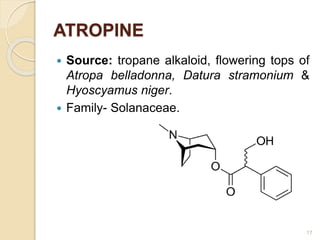
ATROPINE
 Source: tropane alkaloid, flowering tops of
Atropa belladonna, Datura stramonium &
Hyoscyamus niger.
 Family- Solanaceae.
17
ATROPINE
 Industrial production:
18
1
• Powdered drug extracted with
ether or benzene
2
• Concentrate the non-polar extract
& partitioned with acetic acid.
3
• Add sodium bicarbonate leading to
ppt alkaloid
4
• Dry the ppt & crystallized by
dissolving in solvent ether
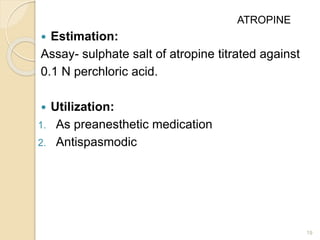
 Estimation:
Assay- sulphate salt of atropine titrated against
0.1 N perchloric acid.
 Utilization:
1. As preanesthetic medication
2. Antispasmodic
19
ATROPINE
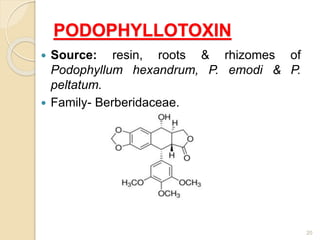
PODOPHYLLOTOXIN
 Source: resin, roots & rhizomes of
Podophyllum hexandrum, P. emodi & P.
peltatum.
 Family- Berberidaceae.
20
PODOPHYLLOTOXIN
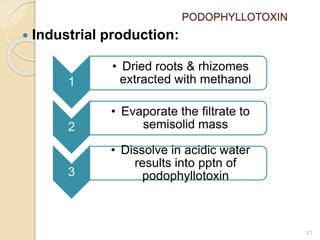
 Industrial production:
21
1
• Dried roots & rhizomes
extracted with methanol
2
• Evaporate the filtrate to
semisolid mass
3
• Dissolve in acidic water
results into pptn of
podophyllotoxin
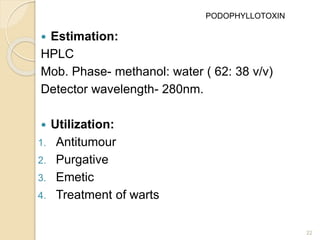
 Estimation:
HPLC
Mob. Phase- methanol: water ( 62: 38 v/v)
Detector wavelength- 280nm.
 Utilization:
1. Antitumour
2. Purgative
3. Emetic
4. Treatment of warts
22
PODOPHYLLOTOXIN
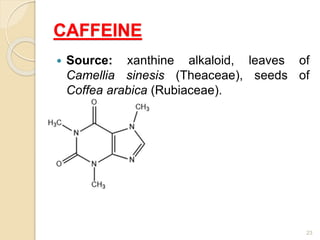
CAFFEINE
 Source: xanthine alkaloid, leaves of
Camellia sinesis (Theaceae), seeds of
Coffea arabica (Rubiaceae).
23
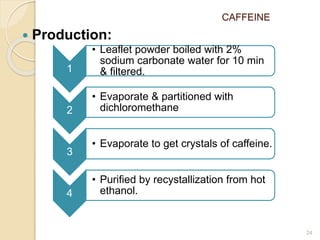
CAFFEINE
 Production:
24
1
• Leaflet powder boiled with 2%
sodium carbonate water for 10 min
& filtered.
2
• Evaporate & partitioned with
dichloromethane
3
• Evaporate to get crystals of caffeine.
4
• Purified by recystallization from hot
ethanol.
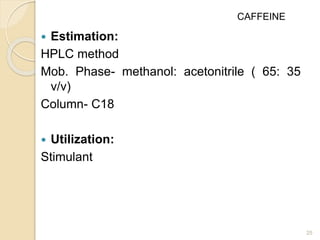
 Estimation:
HPLC method
Mob. Phase- methanol: acetonitrile ( 65: 35
v/v)
Column- C18
 Utilization:
Stimulant
25
CAFFEINE
TAXOL
 Source: nitrogen containing subs, bark of
Taxus brevifolia, fam- taxaceae.
26
TAXOL
 Production:
27
1
• Powdered bark extracted with
methanol, filtered & evaporated
to dryness.
2
• Partition with the mixture of
carbon tetrachloride & water,
filter & evaporated.
3
• Dried CCl4 fraction again
extracted with CCl4 : methanol,
evaporate to obtain crude taxol.
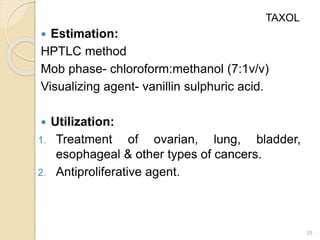
 Estimation:
HPTLC method
Mob phase- chloroform:methanol (7:1v/v)
Visualizing agent- vanillin sulphuric acid.
 Utilization:
1. Treatment of ovarian, lung, bladder,
esophageal & other types of cancers.
2. Antiproliferative agent.
28
TAXOL
VINCRISTINE & VINBLASTINE
 Source: Indole alkaloid, Vica rosea, family-
Apocynaceae.
29
VINCRISTINE &
VINBLASTINE
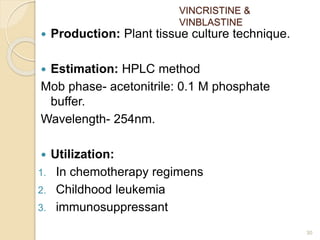
 Production: Plant tissue culture technique.
 Estimation: HPLC method
Mob phase- acetonitrile: 0.1 M phosphate
buffer.
Wavelength- 254nm.
 Utilization:
1. In chemotherapy regimens
2. Childhood leukemia
3. immunosuppressant
30
THANK YOU
31