Dr. Ahmed Mirza Al-Shammasi, MB ChB 2031040009 KFHU – Saudi Arabia
Outlines Object Introduction The SLIC system and Severity Score Components Interpretation Illustrative cases. Discussion ( Old vs. New )
Object The authors review a novel Subaxial Cervical trauma classification system and demonstrate its application through a series of cervical trauma cases.
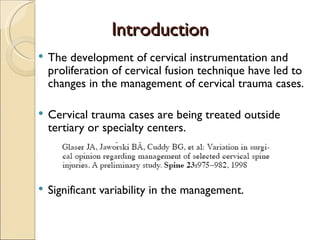
Introduction The development of cervical instrumentation and proliferation of cervical fusion technique have led to changes in the management of cervical trauma cases. Cervical trauma cases are being treated outside tertiary or specialty centers. Significant variability in the management.
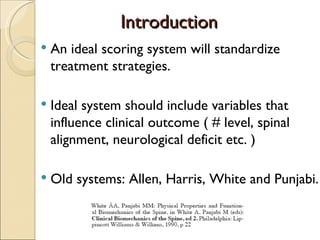
Introduction An ideal scoring system will standardize treatment strategies. Ideal system should include variables that influence clinical outcome ( # level, spinal alignment, neurological deficit etc. ) Old systems: Allen, Harris, White and Punjabi.
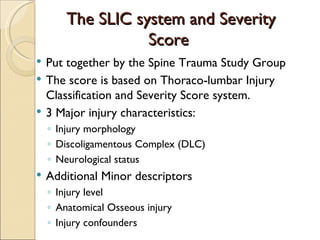
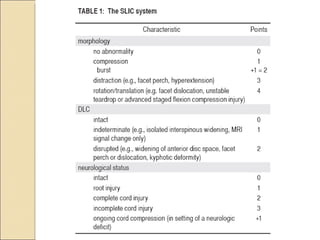
The SLIC system and Severity  Score Put together by the Spine Trauma Study Group The score is based on Thoraco-lumbar Injury Classification and Severity Score system. 3 Major injury characteristics: Injury morphology Discoligamentous Complex (DLC) Neurological status Additional Minor descriptors Injury level Anatomical Osseous injury Injury confounders
 
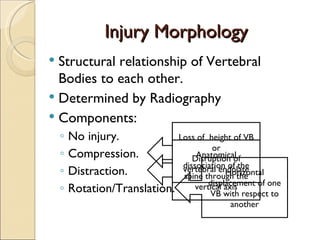
Injury Morphology Structural relationship of Vertebral Bodies to each other. Determined by Radiography Components: No injury. Compression. Distraction. Rotation/Translation. Loss of  height of VB or Disruption of vertebral endplate Anatomical dissociation of the spine through the vertical axis Horizontal displacement of one VB with respect to another
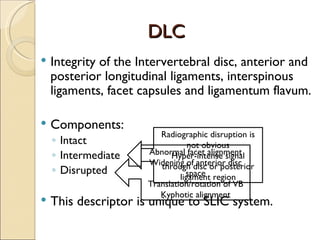
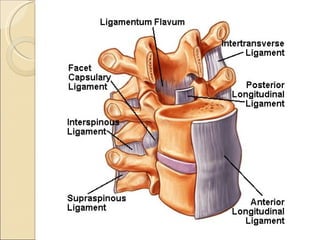
DLC Integrity of the Intervertebral disc, anterior and posterior longitudinal ligaments, interspinous ligaments, facet capsules and ligamentum flavum. Components: Intact Intermediate Disrupted This descriptor is unique to SLIC system. Abnormal facet alignment Widening of anterior disc space Translation/rotation of VB Kyphotic alignment Radiographic disruption is not obvious Hyper-intense signal through disc or posterior ligament region
 
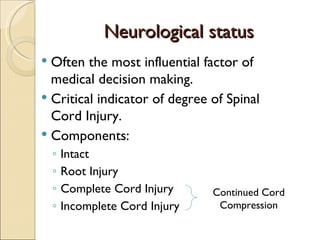
Neurological status Often the most influential factor of medical decision making. Critical indicator of degree of Spinal Cord Injury. Components: Intact Root Injury Complete Cord Injury Incomplete Cord Injury Continued Cord Compression
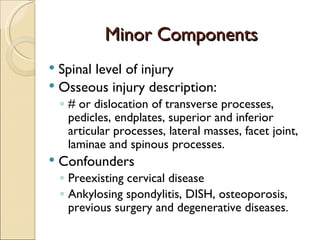
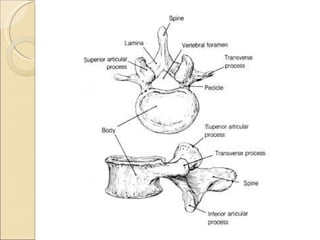
Minor Components Spinal level of injury Osseous injury description: # or dislocation of transverse processes, pedicles, endplates, superior and inferior articular processes, lateral masses, facet joint, laminae and spinous processes. Confounders Preexisting cervical disease Ankylosing spondylitis, DISH, osteoporosis, previous surgery and degenerative diseases.
 
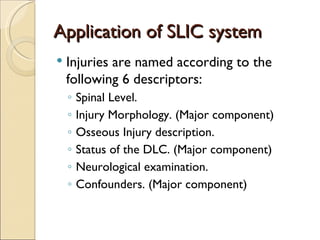
Application of SLIC system Injuries are named according to the following 6 descriptors: Spinal Level. Injury Morphology. (Major component) Osseous Injury description. Status of the DLC. (Major component) Neurological examination. Confounders. (Major component)
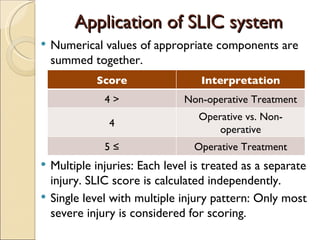
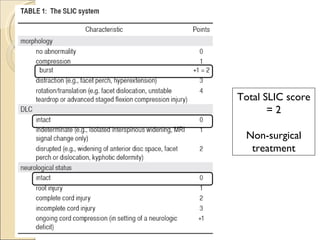
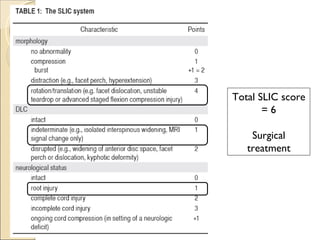
Application of SLIC system Numerical values of appropriate components are summed together. Multiple injuries: Each level is treated as a separate injury. SLIC score is calculated independently. Single level with multiple injury pattern: Only most severe injury is considered for scoring. Score Interpretation < 4 Non-operative Treatment 4 Operative vs. Non-operative ≥  5 Operative Treatment
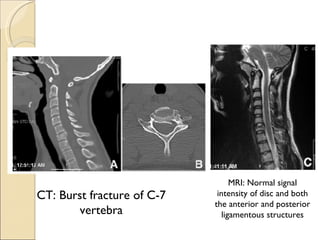
Illustrative Case No. 1 17 y/o female patient Presented after 30-foot-fall with severe neck pain. Neurological examination was normal.
CT: Burst fracture of C-7 vertebra MRI: Normal signal intensity of disc and both the anterior and posterior ligamentous structures
Total SLIC score = 2 Non-surgical treatment
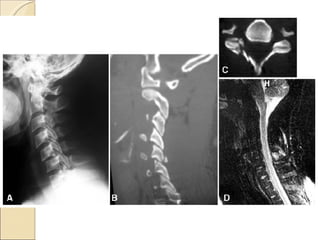
Illustrative Case No. 2 53 y/o presented with neck and left sided arm pain after motorcycle accident Neurological examination:  Left biceps weakness Decreased light-touch and pin-prick sensation in the index finger Imaging showed Anterior translation of C-5 on C-6 C-5 inferior articular facet and C-6 superior articular facet fractures Increased signal intensity in the posterior ligamentous structures
 
Total SLIC score = 6 Surgical treatment
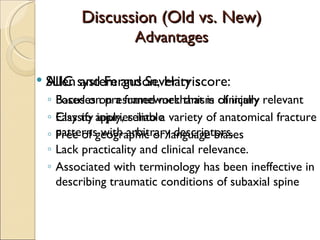
Discussion (Old vs. New) Advantages SLIC system and Severity score: Focuses on a framework that is clinically relevant Easy to apply, reliable Free of geographic or language biases Allen and Ferguson, Harris Based on presumed mechanism of injury Classify injuries into a variety of anatomical fracture patterns with arbitrary descriptors. Lack practicality and clinical relevance. Associated with terminology has been ineffective in describing traumatic conditions of subaxial spine
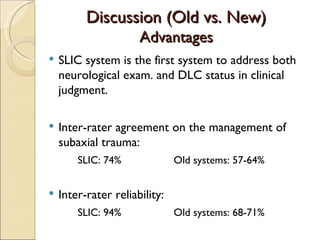
Discussion (Old vs. New) Advantages SLIC system is the first system to address both neurological exam. and DLC status in clinical judgment. Inter-rater agreement on the management of subaxial trauma: SLIC: 74% Old systems: 57-64% Inter-rater reliability: SLIC: 94% Old systems: 68-71%
Drawbacks Neurological examination Potential source of bias (subjective information). In state of spinal shock, it is difficult to differentiate between complete and incomplete SCI. MRI: There is no evidence, up to date, defining the specificity and sensitivity of MRI in the diagnosis of DLC disruption. Individual interpretation may result in variation (Inter-rater reliability).
Thank you for Listening

Slic System

  • 1.
    Dr. Ahmed MirzaAl-Shammasi, MB ChB 2031040009 KFHU – Saudi Arabia
  • 2.
    Outlines Object IntroductionThe SLIC system and Severity Score Components Interpretation Illustrative cases. Discussion ( Old vs. New )
  • 3.
    Object The authorsreview a novel Subaxial Cervical trauma classification system and demonstrate its application through a series of cervical trauma cases.
  • 4.
    Introduction The developmentof cervical instrumentation and proliferation of cervical fusion technique have led to changes in the management of cervical trauma cases. Cervical trauma cases are being treated outside tertiary or specialty centers. Significant variability in the management.
  • 5.
    Introduction An idealscoring system will standardize treatment strategies. Ideal system should include variables that influence clinical outcome ( # level, spinal alignment, neurological deficit etc. ) Old systems: Allen, Harris, White and Punjabi.
  • 6.
    The SLIC systemand Severity Score Put together by the Spine Trauma Study Group The score is based on Thoraco-lumbar Injury Classification and Severity Score system. 3 Major injury characteristics: Injury morphology Discoligamentous Complex (DLC) Neurological status Additional Minor descriptors Injury level Anatomical Osseous injury Injury confounders
  • 7.
  • 8.
    Injury Morphology Structuralrelationship of Vertebral Bodies to each other. Determined by Radiography Components: No injury. Compression. Distraction. Rotation/Translation. Loss of height of VB or Disruption of vertebral endplate Anatomical dissociation of the spine through the vertical axis Horizontal displacement of one VB with respect to another
  • 9.
    DLC Integrity ofthe Intervertebral disc, anterior and posterior longitudinal ligaments, interspinous ligaments, facet capsules and ligamentum flavum. Components: Intact Intermediate Disrupted This descriptor is unique to SLIC system. Abnormal facet alignment Widening of anterior disc space Translation/rotation of VB Kyphotic alignment Radiographic disruption is not obvious Hyper-intense signal through disc or posterior ligament region
  • 10.
  • 11.
    Neurological status Oftenthe most influential factor of medical decision making. Critical indicator of degree of Spinal Cord Injury. Components: Intact Root Injury Complete Cord Injury Incomplete Cord Injury Continued Cord Compression
  • 12.
    Minor Components Spinallevel of injury Osseous injury description: # or dislocation of transverse processes, pedicles, endplates, superior and inferior articular processes, lateral masses, facet joint, laminae and spinous processes. Confounders Preexisting cervical disease Ankylosing spondylitis, DISH, osteoporosis, previous surgery and degenerative diseases.
  • 13.
  • 14.
    Application of SLICsystem Injuries are named according to the following 6 descriptors: Spinal Level. Injury Morphology. (Major component) Osseous Injury description. Status of the DLC. (Major component) Neurological examination. Confounders. (Major component)
  • 15.
    Application of SLICsystem Numerical values of appropriate components are summed together. Multiple injuries: Each level is treated as a separate injury. SLIC score is calculated independently. Single level with multiple injury pattern: Only most severe injury is considered for scoring. Score Interpretation < 4 Non-operative Treatment 4 Operative vs. Non-operative ≥ 5 Operative Treatment
  • 16.
    Illustrative Case No.1 17 y/o female patient Presented after 30-foot-fall with severe neck pain. Neurological examination was normal.
  • 17.
    CT: Burst fractureof C-7 vertebra MRI: Normal signal intensity of disc and both the anterior and posterior ligamentous structures
  • 18.
    Total SLIC score= 2 Non-surgical treatment
  • 19.
    Illustrative Case No.2 53 y/o presented with neck and left sided arm pain after motorcycle accident Neurological examination: Left biceps weakness Decreased light-touch and pin-prick sensation in the index finger Imaging showed Anterior translation of C-5 on C-6 C-5 inferior articular facet and C-6 superior articular facet fractures Increased signal intensity in the posterior ligamentous structures
  • 20.
  • 21.
    Total SLIC score= 6 Surgical treatment
  • 22.
    Discussion (Old vs.New) Advantages SLIC system and Severity score: Focuses on a framework that is clinically relevant Easy to apply, reliable Free of geographic or language biases Allen and Ferguson, Harris Based on presumed mechanism of injury Classify injuries into a variety of anatomical fracture patterns with arbitrary descriptors. Lack practicality and clinical relevance. Associated with terminology has been ineffective in describing traumatic conditions of subaxial spine
  • 23.
    Discussion (Old vs.New) Advantages SLIC system is the first system to address both neurological exam. and DLC status in clinical judgment. Inter-rater agreement on the management of subaxial trauma: SLIC: 74% Old systems: 57-64% Inter-rater reliability: SLIC: 94% Old systems: 68-71%
  • 24.
    Drawbacks Neurological examinationPotential source of bias (subjective information). In state of spinal shock, it is difficult to differentiate between complete and incomplete SCI. MRI: There is no evidence, up to date, defining the specificity and sensitivity of MRI in the diagnosis of DLC disruption. Individual interpretation may result in variation (Inter-rater reliability).
  • 25.
    Thank you forListening