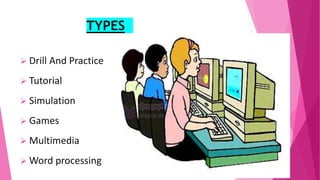
Computer-Assisted Learning (CAL) emerged in the 1980s, providing an effective educational tool for students and teachers through various methods such as drills, tutorials, and simulations. It enhances learning by making classes engaging and allowing for accurate assessments, while also facilitating distance education and reducing paperwork. However, it has drawbacks including high costs, reduced teacher involvement, and potential limitations on creativity.