COMPUTER AIDED
DESIGN AND
MANUFACTURING
7th Semester
Mechanical Engineering
Lecture #5Introduction to CAD/ CAM
Lecture #4Introduction to CAD/ CAM
In Lecture #3 we have discussed In Lecture #4
Unit- I – (A) Introduction
(B) Window and View
port
Unit- I – (A) Introduction
 List of computer aided
technologies
 Influence of computers in
manufacturing environment
 The Product Cycle with CAD/CAM
 The Product Cycle with
CAD/CAM
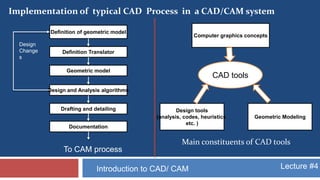
 Implementation of typical CAD
Process in a CAD/CAM system
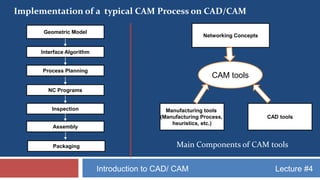
 Implementation of a typical CAM
Process on CAD/CAM
 Achievements in CAD/CAM
 Product Engineering
Lecture #4Introduction to CAD/ CAM7/23/2020
Product cycle and CAD/CAM
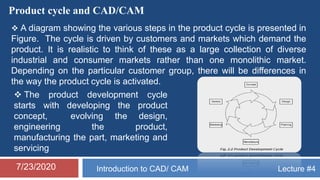
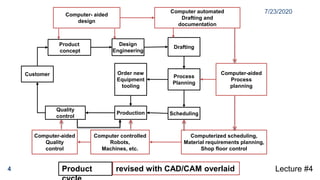
 A diagram showing the various steps in the product cycle is presented in
Figure. The cycle is driven by customers and markets which demand the
product. It is realistic to think of these as a large collection of diverse
industrial and consumer markets rather than one monolithic market.
Depending on the particular customer group, there will be differences in
the way the product cycle is activated.
 The product development cycle
starts with developing the product
concept, evolving the design,
engineering the product,
manufacturing the part, marketing and
servicing
7/23/2020
4 Lecture #4
Process
Planning
Production Scheduling
Quality
control
Drafting
Design
Engineering
Product
concept
Order new
Equipment
tooling
Customer
Computer- aided
design
Computer automated
Drafting and
documentation
Computer-aided
Process
planning
Computerized scheduling,
Material requirements planning,
Shop floor control
Computer controlled
Robots,
Machines, etc.
Computer-aided
Quality
control
Product revised with CAD/CAM overlaid
Manufacturing
Process
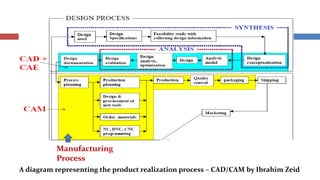
A diagram representing the product realization process – CAD/CAM by Ibrahim Zeid
6
D.R.Nishad,Dept.OfMechanical
Engg.
7
Lecture #4Introduction to CAD/ CAM
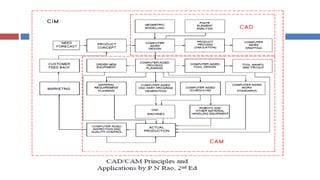
Implementation of typical CAD Process in a CAD/CAM system
Main constituents of CAD tools
Definition Translator
Geometric model
Definition of geometric model
Design and Analysis algorithms
Drafting and detailing
Documentation
To CAM process
Design
Change
s
Computer graphics concepts
Geometric Modeling
Design tools
(analysis, codes, heuristics
etc. )
CAD tools
Lecture #4Introduction to CAD/ CAM
Implementation of a typical CAM Process on CAD/CAM
Main Components of CAM tools
Interface Algorithm
Process Planning
Geometric Model
NC Programs
Inspection
Assembly
Packaging
Networking Concepts
CAD tools
Manufacturing tools
(Manufacturing Process,
heuristics, etc.)
CAM tools
Lecture #4Introduction to CAD/ CAM
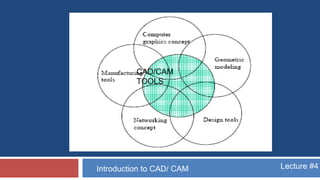
CAD/CAM
TOOLS
Achievements in CAD/CAM
 Interactive computer graphics
systems
 Color computer graphics
 Animated computer graphics
 Design engineering analysis
 Parts classification and coding
 Design retrieval systems
 Automated drafting
 Design and manufacturing database
 Computer assisted process planning
 Computerized machinability data
systems
 Computer generated work standards
 Computer assisted NC part
programming
 Finely tuned production scheduling
 Material requirement planning
 Shop floor control
 CNC, DNC
 Computer controlled robots
 Microprocessor control applications
 Computer aided inspection
 Computer aided quality testing
D.R.Nishad,Dept.OfMechanical
Engg.
Product engineering
 Definition of product - The end result of the manufacturing
process, to be offered to the marketplace to satisfy a need or
want.
 Product engineering refers to the process of designing and
developing a device, assembly, or system such that it be
produced as an item for sale through some production
manufacturing process.
 Product engineering usually entails activity dealing with issues of
cost, produce-ability, quality, performance, reliability, serviceability
and user features.
 Product engineering is an engineering discipline that deals with
both design and manufacturing aspects of a product.
D.R.Nishad,Dept.OfMechanical
Engg.
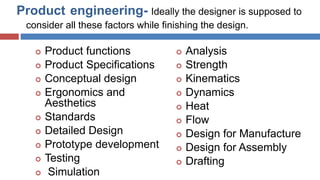
Product engineering- Ideally the designer is supposed to
consider all these factors while finishing the design.
 Product functions
 Product Specifications
 Conceptual design
 Ergonomics and
Aesthetics
 Standards
 Detailed Design
 Prototype development
 Testing
 Simulation
 Analysis
 Strength
 Kinematics
 Dynamics
 Heat
 Flow
 Design for Manufacture
 Design for Assembly
 Drafting
D.R.Nishad,Dept.OfMechanical
Engg.

CAD/CAM Lecture #4

  • 1.
    COMPUTER AIDED DESIGN AND MANUFACTURING 7thSemester Mechanical Engineering Lecture #5Introduction to CAD/ CAM
  • 2.
    Lecture #4Introduction toCAD/ CAM In Lecture #3 we have discussed In Lecture #4 Unit- I – (A) Introduction (B) Window and View port Unit- I – (A) Introduction  List of computer aided technologies  Influence of computers in manufacturing environment  The Product Cycle with CAD/CAM  The Product Cycle with CAD/CAM  Implementation of typical CAD Process in a CAD/CAM system  Implementation of a typical CAM Process on CAD/CAM  Achievements in CAD/CAM  Product Engineering
  • 3.
    Lecture #4Introduction toCAD/ CAM7/23/2020 Product cycle and CAD/CAM  A diagram showing the various steps in the product cycle is presented in Figure. The cycle is driven by customers and markets which demand the product. It is realistic to think of these as a large collection of diverse industrial and consumer markets rather than one monolithic market. Depending on the particular customer group, there will be differences in the way the product cycle is activated.  The product development cycle starts with developing the product concept, evolving the design, engineering the product, manufacturing the part, marketing and servicing
  • 4.
    7/23/2020 4 Lecture #4 Process Planning ProductionScheduling Quality control Drafting Design Engineering Product concept Order new Equipment tooling Customer Computer- aided design Computer automated Drafting and documentation Computer-aided Process planning Computerized scheduling, Material requirements planning, Shop floor control Computer controlled Robots, Machines, etc. Computer-aided Quality control Product revised with CAD/CAM overlaid
  • 5.
    Manufacturing Process A diagram representingthe product realization process – CAD/CAM by Ibrahim Zeid
  • 6.
  • 7.
  • 8.
    Lecture #4Introduction toCAD/ CAM Implementation of typical CAD Process in a CAD/CAM system Main constituents of CAD tools Definition Translator Geometric model Definition of geometric model Design and Analysis algorithms Drafting and detailing Documentation To CAM process Design Change s Computer graphics concepts Geometric Modeling Design tools (analysis, codes, heuristics etc. ) CAD tools
  • 9.
    Lecture #4Introduction toCAD/ CAM Implementation of a typical CAM Process on CAD/CAM Main Components of CAM tools Interface Algorithm Process Planning Geometric Model NC Programs Inspection Assembly Packaging Networking Concepts CAD tools Manufacturing tools (Manufacturing Process, heuristics, etc.) CAM tools
  • 10.
    Lecture #4Introduction toCAD/ CAM CAD/CAM TOOLS
  • 11.
    Achievements in CAD/CAM Interactive computer graphics systems  Color computer graphics  Animated computer graphics  Design engineering analysis  Parts classification and coding  Design retrieval systems  Automated drafting  Design and manufacturing database  Computer assisted process planning  Computerized machinability data systems  Computer generated work standards  Computer assisted NC part programming  Finely tuned production scheduling  Material requirement planning  Shop floor control  CNC, DNC  Computer controlled robots  Microprocessor control applications  Computer aided inspection  Computer aided quality testing D.R.Nishad,Dept.OfMechanical Engg.
  • 12.
    Product engineering  Definitionof product - The end result of the manufacturing process, to be offered to the marketplace to satisfy a need or want.  Product engineering refers to the process of designing and developing a device, assembly, or system such that it be produced as an item for sale through some production manufacturing process.  Product engineering usually entails activity dealing with issues of cost, produce-ability, quality, performance, reliability, serviceability and user features.  Product engineering is an engineering discipline that deals with both design and manufacturing aspects of a product. D.R.Nishad,Dept.OfMechanical Engg.
  • 13.
    Product engineering- Ideallythe designer is supposed to consider all these factors while finishing the design.  Product functions  Product Specifications  Conceptual design  Ergonomics and Aesthetics  Standards  Detailed Design  Prototype development  Testing  Simulation  Analysis  Strength  Kinematics  Dynamics  Heat  Flow  Design for Manufacture  Design for Assembly  Drafting D.R.Nishad,Dept.OfMechanical Engg.