COMPUTER AIDED
DESIGN AND
MANUFACTURING
7th Semester
Mechanical Engineering
Lecture #2Introduction to CAD/ CAM
Lecture #2Introduction to CAD/ CAM7/23/2020
2
In Lecture #1 we have discussed
 Course Objectives
 Syllabus
What is design?
 Difference between Drawing and Drafting
 What is computer –Aided design(CAD) ?
What is Computer Aided Manufacturing
(CAM)?
 Application of CAD in mechanical
engineering
In Lecture #2
Unit- I – (A) Introduction
(B) Window and View
port
 CAD/CAM Overview
 Introduction of CAD/CAM
 Benefits of CAD/CAM
 CAD systems Hard ware
 CAD systems Graphics
software
 The influence of computer
on manufacturing
environment
UNIT – I
Lecture #2Introduction to CAD/ CAM7/23/2020
Introduction: Introduction of CAD/CAM, Definition of CAD & CAM
tools, the influence of computers on manufacturing environment,
Benefits of CAD/CAM. The product cycle, product engineering,
concurrent engineering.
Window and View port: Window definitions, View port definitions,
Window and View port relationship; World co-ordinates; Normalized
device co-ordinates and Homogenous co-ordinates.
Lecture #2Introduction to CAD/ CAM7/23/2020
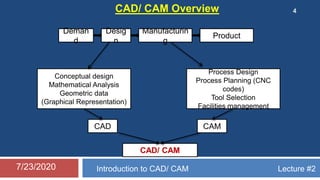
4CAD/ CAM Overview
Deman
d
Desig
n
Manufacturin
g
Product
Conceptual design
Mathematical Analysis
Geometric data
(Graphical Representation)
CAD
CAD/ CAM
Process Design
Process Planning (CNC
codes)
Tool Selection
Facilities management
CAM
7/23/2020
5
Lecture #2Introduction to CAD/ CAM
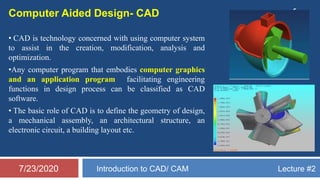
Computer Aided Design- CAD
• CAD is technology concerned with using computer system
to assist in the creation, modification, analysis and
optimization.
•Any computer program that embodies computer graphics
and an application program facilitating engineering
functions in design process can be classified as CAD
software.
• The basic role of CAD is to define the geometry of design,
a mechanical assembly, an architectural structure, an
electronic circuit, a building layout etc.
Lecture #2Introduction to CAD/ CAM7/23/2020
6
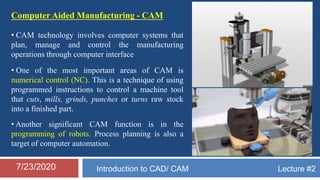
Computer Aided Manufacturing - CAM
• CAM technology involves computer systems that
plan, manage and control the manufacturing
operations through computer interface
• One of the most important areas of CAM is
numerical control (NC). This is a technique of using
programmed instructions to control a machine tool
that cuts, mills, grinds, punches or turns raw stock
into a finished part.
• Another significant CAM function is in the
programming of robots. Process planning is also a
target of computer automation.
Lecture #2Introduction to CAD/ CAM7/23/2020
7
• Easy to draw
• Less time consumption
• More accuracy and precision
• Quick access
• Easier modification
• Good appearance in output
• Storage facility
• Less prone error
• Easy to share accurate information
• Better communication between users
• Higher performance
• Increase efficiency of designers work
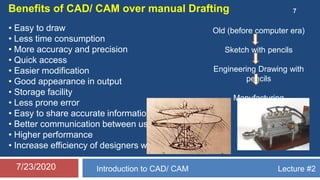
Benefits of CAD/ CAM over manual Drafting
Old (before computer era)
Sketch with pencils
Engineering Drawing with
pencils
Manufacturing
Lecture #2Introduction to CAD/ CAM7/23/2020
8
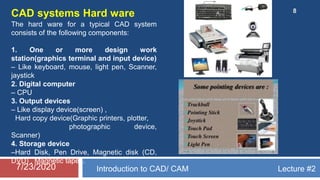
CAD systems Hard ware
The hard ware for a typical CAD system
consists of the following components:
1. One or more design work
station(graphics terminal and input device)
– Like keyboard, mouse, light pen, Scanner,
jaystick
2. Digital computer
– CPU
3. Output devices
– Like display device(screen) ,
Hard copy device(Graphic printers, plotter,
photographic device,
Scanner)
4. Storage device
–Hard Disk, Pen Drive, Magnetic disk (CD,
DVD) , Magnetic tapes.
Lecture #2Introduction to CAD/ CAM7/23/2020
9
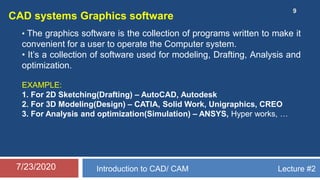
CAD systems Graphics software
• The graphics software is the collection of programs written to make it
convenient for a user to operate the Computer system.
• It’s a collection of software used for modeling, Drafting, Analysis and
optimization.
EXAMPLE:
1. For 2D Sketching(Drafting) – AutoCAD, Autodesk
2. For 3D Modeling(Design) – CATIA, Solid Work, Unigraphics, CREO
3. For Analysis and optimization(Simulation) – ANSYS, Hyper works, …
Computers in Industrial
Manufacturing10
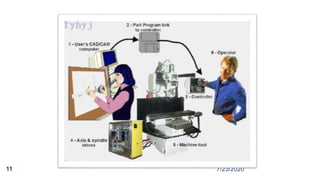
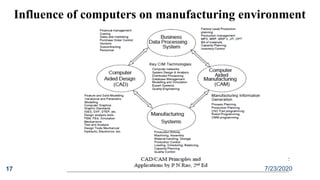
 The role of computer in manufacturing may be broadly
classified into two groups:
1) Computer monitoring and control of the manufacturing
process.
2) Manufacturing support applications, which deal essentially with
the preparations for actual manufacturing operations.
Lecture #2Introduction to CAD/ CAM7/23/2020
7/23/202011
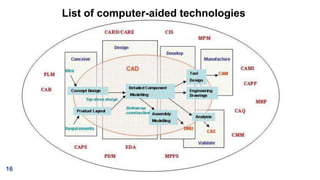
List of computer-aided
technologies12
 Computer-aided design (CAD)
 Computer-aided architectural design (CAAD) - software programs are the
repository of accurate and comprehensive records of buildings and are
used by architects and architectural companies.
 Computer-aided design and drafting (CADD)
 Computer-aided Engineering (CAE) The use of computer methods to
support basic error checking, analysis, optimization, manufacturability etc.
of a product design.
 Computer-aided Tool Design (CATD)
 Computer-aided process planning (CAPP) is the use of computer
technology to aid in the process planning of a part or product, in
manufacturing. CAPP is the link between CAD and CAM in that it provides
for the planning of the process to be used in producing a designed part.
Lecture #2Introduction to CAD/ CAM7/23/2020
Cont…
13
 Computer-aided quality assurance (CAQ) is the engineering
application of computers and computer controlled machines for the
definition and inspection of the quality of products.
 Computer-aided reporting (CAR)
 Computer-aided maths instruction (CAMI)
 Computer-aided requirements capture (CAR)
 Computer-aided rule definition (CARD)
 Computer-aided rule execution (CARE)
 Computer-aided software engineering (CASE) is the scientific
application of a set of tools and methods to a software system which
is meant to result in high-quality, defect-free, and maintainable
software products.
Lecture #2Introduction to CAD/ CAM7/23/2020
Cont…
14
 Component information system (CIS)
 Computer-integrated manufacturing (CIM) Computer-integrated manufacturing (CIM)
the manufacturing approach of using computers to control the entire production process
 Computer numerical controlled (CNC)
 Computational fluid dynamics (CFD) is one of the branches of fluid mechanics that uses
numerical methods and algorithms to solve and analyze problems that involve fluid flows.
 Electronic design automation (EDA)
 Enterprise resource planning (ERP) is an Integrated computer-based system used to
manage internal and external resources including tangible assets, financial resources,
materials, and human resources
 Knowledge-based engineering (KBE) is a discipline with roots in computer-aided design
(CAD) and knowledge-based systems but has several definitions and roles depending
upon the context.
Lecture #2Introduction to CAD/ CAM7/23/2020
Cont…
7/23/2020
15
 Manufacturing process management (MPM) is a collection of technologies and methods used
to define how products are to be manufactured.
 Manufacturing process planning (MPP)
 Material requirements planning (MRP) is a production planning and inventory control system
used to manage manufacturing processes.
 Manufacturing resource planning (MRP II) is defined by APICS as a method for the effective
planning of all resources of a manufacturing company.
 Product data management (PDM) is the business function often within product lifecycle
management that is responsible for the creation, management and publication of product data.
 Product lifecycle management (PLM) is the process of managing the entire lifecycle of a
product from its conception, through design and manufacture, to service and disposal
 Computer-aided manufacture (CAM) is the use of computer software to control machine tools
and related machinery in the manufacturing of workpieces.
7/23/202016
List of computer-aided technologies
7/23/202017
Influence of computers on manufacturing environment

CAD/CAM Lecture #2

  • 1.
    COMPUTER AIDED DESIGN AND MANUFACTURING 7thSemester Mechanical Engineering Lecture #2Introduction to CAD/ CAM
  • 2.
    Lecture #2Introduction toCAD/ CAM7/23/2020 2 In Lecture #1 we have discussed  Course Objectives  Syllabus What is design?  Difference between Drawing and Drafting  What is computer –Aided design(CAD) ? What is Computer Aided Manufacturing (CAM)?  Application of CAD in mechanical engineering In Lecture #2 Unit- I – (A) Introduction (B) Window and View port  CAD/CAM Overview  Introduction of CAD/CAM  Benefits of CAD/CAM  CAD systems Hard ware  CAD systems Graphics software  The influence of computer on manufacturing environment
  • 3.
    UNIT – I Lecture#2Introduction to CAD/ CAM7/23/2020 Introduction: Introduction of CAD/CAM, Definition of CAD & CAM tools, the influence of computers on manufacturing environment, Benefits of CAD/CAM. The product cycle, product engineering, concurrent engineering. Window and View port: Window definitions, View port definitions, Window and View port relationship; World co-ordinates; Normalized device co-ordinates and Homogenous co-ordinates.
  • 4.
    Lecture #2Introduction toCAD/ CAM7/23/2020 4CAD/ CAM Overview Deman d Desig n Manufacturin g Product Conceptual design Mathematical Analysis Geometric data (Graphical Representation) CAD CAD/ CAM Process Design Process Planning (CNC codes) Tool Selection Facilities management CAM
  • 5.
    7/23/2020 5 Lecture #2Introduction toCAD/ CAM Computer Aided Design- CAD • CAD is technology concerned with using computer system to assist in the creation, modification, analysis and optimization. •Any computer program that embodies computer graphics and an application program facilitating engineering functions in design process can be classified as CAD software. • The basic role of CAD is to define the geometry of design, a mechanical assembly, an architectural structure, an electronic circuit, a building layout etc.
  • 6.
    Lecture #2Introduction toCAD/ CAM7/23/2020 6 Computer Aided Manufacturing - CAM • CAM technology involves computer systems that plan, manage and control the manufacturing operations through computer interface • One of the most important areas of CAM is numerical control (NC). This is a technique of using programmed instructions to control a machine tool that cuts, mills, grinds, punches or turns raw stock into a finished part. • Another significant CAM function is in the programming of robots. Process planning is also a target of computer automation.
  • 7.
    Lecture #2Introduction toCAD/ CAM7/23/2020 7 • Easy to draw • Less time consumption • More accuracy and precision • Quick access • Easier modification • Good appearance in output • Storage facility • Less prone error • Easy to share accurate information • Better communication between users • Higher performance • Increase efficiency of designers work Benefits of CAD/ CAM over manual Drafting Old (before computer era) Sketch with pencils Engineering Drawing with pencils Manufacturing
  • 8.
    Lecture #2Introduction toCAD/ CAM7/23/2020 8 CAD systems Hard ware The hard ware for a typical CAD system consists of the following components: 1. One or more design work station(graphics terminal and input device) – Like keyboard, mouse, light pen, Scanner, jaystick 2. Digital computer – CPU 3. Output devices – Like display device(screen) , Hard copy device(Graphic printers, plotter, photographic device, Scanner) 4. Storage device –Hard Disk, Pen Drive, Magnetic disk (CD, DVD) , Magnetic tapes.
  • 9.
    Lecture #2Introduction toCAD/ CAM7/23/2020 9 CAD systems Graphics software • The graphics software is the collection of programs written to make it convenient for a user to operate the Computer system. • It’s a collection of software used for modeling, Drafting, Analysis and optimization. EXAMPLE: 1. For 2D Sketching(Drafting) – AutoCAD, Autodesk 2. For 3D Modeling(Design) – CATIA, Solid Work, Unigraphics, CREO 3. For Analysis and optimization(Simulation) – ANSYS, Hyper works, …
  • 10.
    Computers in Industrial Manufacturing10 The role of computer in manufacturing may be broadly classified into two groups: 1) Computer monitoring and control of the manufacturing process. 2) Manufacturing support applications, which deal essentially with the preparations for actual manufacturing operations. Lecture #2Introduction to CAD/ CAM7/23/2020
  • 11.
  • 12.
    List of computer-aided technologies12 Computer-aided design (CAD)  Computer-aided architectural design (CAAD) - software programs are the repository of accurate and comprehensive records of buildings and are used by architects and architectural companies.  Computer-aided design and drafting (CADD)  Computer-aided Engineering (CAE) The use of computer methods to support basic error checking, analysis, optimization, manufacturability etc. of a product design.  Computer-aided Tool Design (CATD)  Computer-aided process planning (CAPP) is the use of computer technology to aid in the process planning of a part or product, in manufacturing. CAPP is the link between CAD and CAM in that it provides for the planning of the process to be used in producing a designed part. Lecture #2Introduction to CAD/ CAM7/23/2020
  • 13.
    Cont… 13  Computer-aided qualityassurance (CAQ) is the engineering application of computers and computer controlled machines for the definition and inspection of the quality of products.  Computer-aided reporting (CAR)  Computer-aided maths instruction (CAMI)  Computer-aided requirements capture (CAR)  Computer-aided rule definition (CARD)  Computer-aided rule execution (CARE)  Computer-aided software engineering (CASE) is the scientific application of a set of tools and methods to a software system which is meant to result in high-quality, defect-free, and maintainable software products. Lecture #2Introduction to CAD/ CAM7/23/2020
  • 14.
    Cont… 14  Component informationsystem (CIS)  Computer-integrated manufacturing (CIM) Computer-integrated manufacturing (CIM) the manufacturing approach of using computers to control the entire production process  Computer numerical controlled (CNC)  Computational fluid dynamics (CFD) is one of the branches of fluid mechanics that uses numerical methods and algorithms to solve and analyze problems that involve fluid flows.  Electronic design automation (EDA)  Enterprise resource planning (ERP) is an Integrated computer-based system used to manage internal and external resources including tangible assets, financial resources, materials, and human resources  Knowledge-based engineering (KBE) is a discipline with roots in computer-aided design (CAD) and knowledge-based systems but has several definitions and roles depending upon the context. Lecture #2Introduction to CAD/ CAM7/23/2020
  • 15.
    Cont… 7/23/2020 15  Manufacturing processmanagement (MPM) is a collection of technologies and methods used to define how products are to be manufactured.  Manufacturing process planning (MPP)  Material requirements planning (MRP) is a production planning and inventory control system used to manage manufacturing processes.  Manufacturing resource planning (MRP II) is defined by APICS as a method for the effective planning of all resources of a manufacturing company.  Product data management (PDM) is the business function often within product lifecycle management that is responsible for the creation, management and publication of product data.  Product lifecycle management (PLM) is the process of managing the entire lifecycle of a product from its conception, through design and manufacture, to service and disposal  Computer-aided manufacture (CAM) is the use of computer software to control machine tools and related machinery in the manufacturing of workpieces.
  • 16.
  • 17.
    7/23/202017 Influence of computerson manufacturing environment