
Presented By: Umair Rajput
Reg# 2014-UETR-CS-29
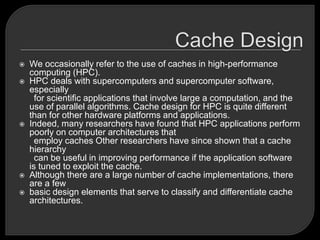
 We occasionally refer to the use of caches in high-performance
computing (HPC).
 HPC deals with supercomputers and supercomputer software,
especially
for scientific applications that involve large a computation, and the
use of parallel algorithms. Cache design for HPC is quite different
than for other hardware platforms and applications.
 Indeed, many researchers have found that HPC applications perform
poorly on computer architectures that
employ caches Other researchers have since shown that a cache
hierarchy
can be useful in improving performance if the application software
is tuned to exploit the cache.
 Although there are a large number of cache implementations, there
are a few
 basic design elements that serve to classify and differentiate cache
architectures.
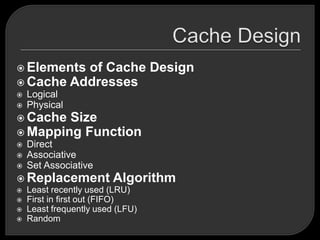
 Elements of Cache Design
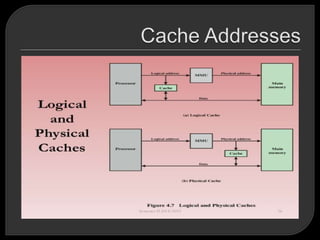
 Cache Addresses
 Logical
 Physical
 Cache Size
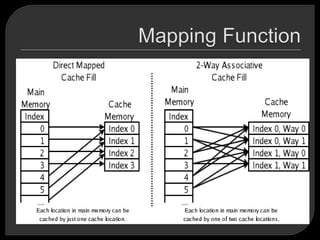
 Mapping Function
 Direct
 Associative
 Set Associative
 Replacement Algorithm
 Least recently used (LRU)
 First in first out (FIFO)
 Least frequently used (LFU)
 Random
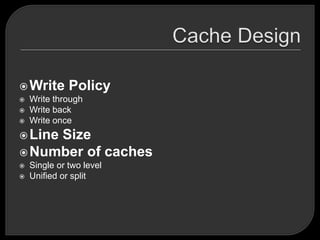
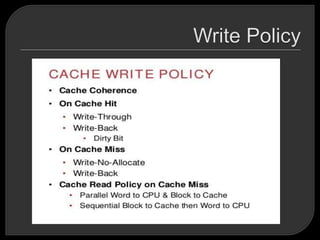
Write Policy
 Write through
 Write back
 Write once
Line Size
Number of caches
 Single or two level
 Unified or split
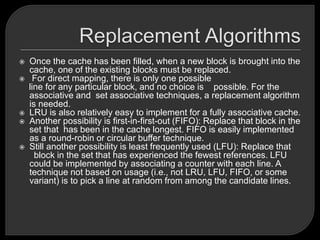
 Once the cache has been filled, when a new block is brought into the
cache, one of the existing blocks must be replaced.
 For direct mapping, there is only one possible
line for any particular block, and no choice is possible. For the
associative and set associative techniques, a replacement algorithm
is needed.
 LRU is also relatively easy to implement for a fully associative cache.
 Another possibility is first-in-first-out (FIFO): Replace that block in the
set that has been in the cache longest. FIFO is easily implemented
as a round-robin or circular buffer technique.
 Still another possibility is least frequently used (LFU): Replace that
block in the set that has experienced the fewest references. LFU
could be implemented by associating a counter with each line. A
technique not based on usage (i.e., not LRU, LFU, FIFO, or some
variant) is to pick a line at random from among the candidate lines.
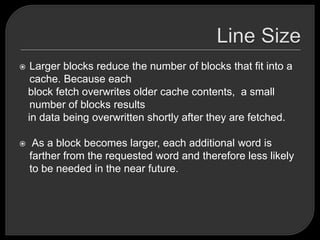
 Larger blocks reduce the number of blocks that fit into a
cache. Because each
block fetch overwrites older cache contents, a small
number of blocks results
in data being overwritten shortly after they are fetched.
 As a block becomes larger, each additional word is
farther from the requested word and therefore less likely
to be needed in the near future.
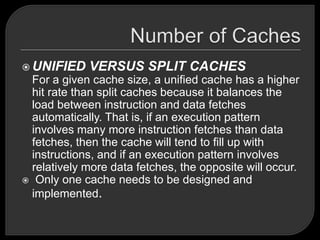
 UNIFIED VERSUS SPLIT CACHES
For a given cache size, a unified cache has a higher
hit rate than split caches because it balances the
load between instruction and data fetches
automatically. That is, if an execution pattern
involves many more instruction fetches than data
fetches, then the cache will tend to fill up with
instructions, and if an execution pattern involves
relatively more data fetches, the opposite will occur.
 Only one cache needs to be designed and
implemented.
Cache design
Cache design

Cache design

  • 1.
    Presented By: UmairRajput Reg# 2014-UETR-CS-29
  • 2.
     We occasionallyrefer to the use of caches in high-performance computing (HPC).  HPC deals with supercomputers and supercomputer software, especially for scientific applications that involve large a computation, and the use of parallel algorithms. Cache design for HPC is quite different than for other hardware platforms and applications.  Indeed, many researchers have found that HPC applications perform poorly on computer architectures that employ caches Other researchers have since shown that a cache hierarchy can be useful in improving performance if the application software is tuned to exploit the cache.  Although there are a large number of cache implementations, there are a few  basic design elements that serve to classify and differentiate cache architectures.
  • 3.
     Elements ofCache Design  Cache Addresses  Logical  Physical  Cache Size  Mapping Function  Direct  Associative  Set Associative  Replacement Algorithm  Least recently used (LRU)  First in first out (FIFO)  Least frequently used (LFU)  Random
  • 4.
    Write Policy  Writethrough  Write back  Write once Line Size Number of caches  Single or two level  Unified or split
  • 7.
     Once thecache has been filled, when a new block is brought into the cache, one of the existing blocks must be replaced.  For direct mapping, there is only one possible line for any particular block, and no choice is possible. For the associative and set associative techniques, a replacement algorithm is needed.  LRU is also relatively easy to implement for a fully associative cache.  Another possibility is first-in-first-out (FIFO): Replace that block in the set that has been in the cache longest. FIFO is easily implemented as a round-robin or circular buffer technique.  Still another possibility is least frequently used (LFU): Replace that block in the set that has experienced the fewest references. LFU could be implemented by associating a counter with each line. A technique not based on usage (i.e., not LRU, LFU, FIFO, or some variant) is to pick a line at random from among the candidate lines.
  • 9.
     Larger blocksreduce the number of blocks that fit into a cache. Because each block fetch overwrites older cache contents, a small number of blocks results in data being overwritten shortly after they are fetched.  As a block becomes larger, each additional word is farther from the requested word and therefore less likely to be needed in the near future.
  • 10.
     UNIFIED VERSUSSPLIT CACHES For a given cache size, a unified cache has a higher hit rate than split caches because it balances the load between instruction and data fetches automatically. That is, if an execution pattern involves many more instruction fetches than data fetches, then the cache will tend to fill up with instructions, and if an execution pattern involves relatively more data fetches, the opposite will occur.  Only one cache needs to be designed and implemented.