Unit VI Multiprocessors
by:
Er. Dipesh Vaya
Head & Asst. Prof.
Department of CSE
SSCE, Udaipur, Rajasthan
Contents
 Characteristics of Multiprocessors
 Interconnection Structure
 Interprocessor Arbitration
 Interprocessor Communication and Synchronization
Cache Coherence
 Shared Memory Multiprocessors
SS College of Engineering, Udaipur, Rajasthan 2
Cache Coherence
(Coherence : the quality of being logical and consistent.)
by:
Er. Dipesh Vaya
Head & Asst. Prof.
Department of CSE
SSCE, Udaipur, Rajasthan
SS College of Engineering, Udaipur, Rajasthan
3
Introduction
 The primary advantage of cache is its ability to reduce the average
access time in uniprocessors.
 When the processor finds a word in cache during a read operation, the
main memory is not involved in the transfer.
 If the operation is to write, there are two commonly used procedures to
update memory.
 In the write-through policy, both cache and main memory are updated with every
write operation.
 In the write-back policy, only the cache is updated and the location is marked so
that it can be copied later into main memory.
SS College of Engineering, Udaipur, Rajasthan 4
Introduction(cont.)
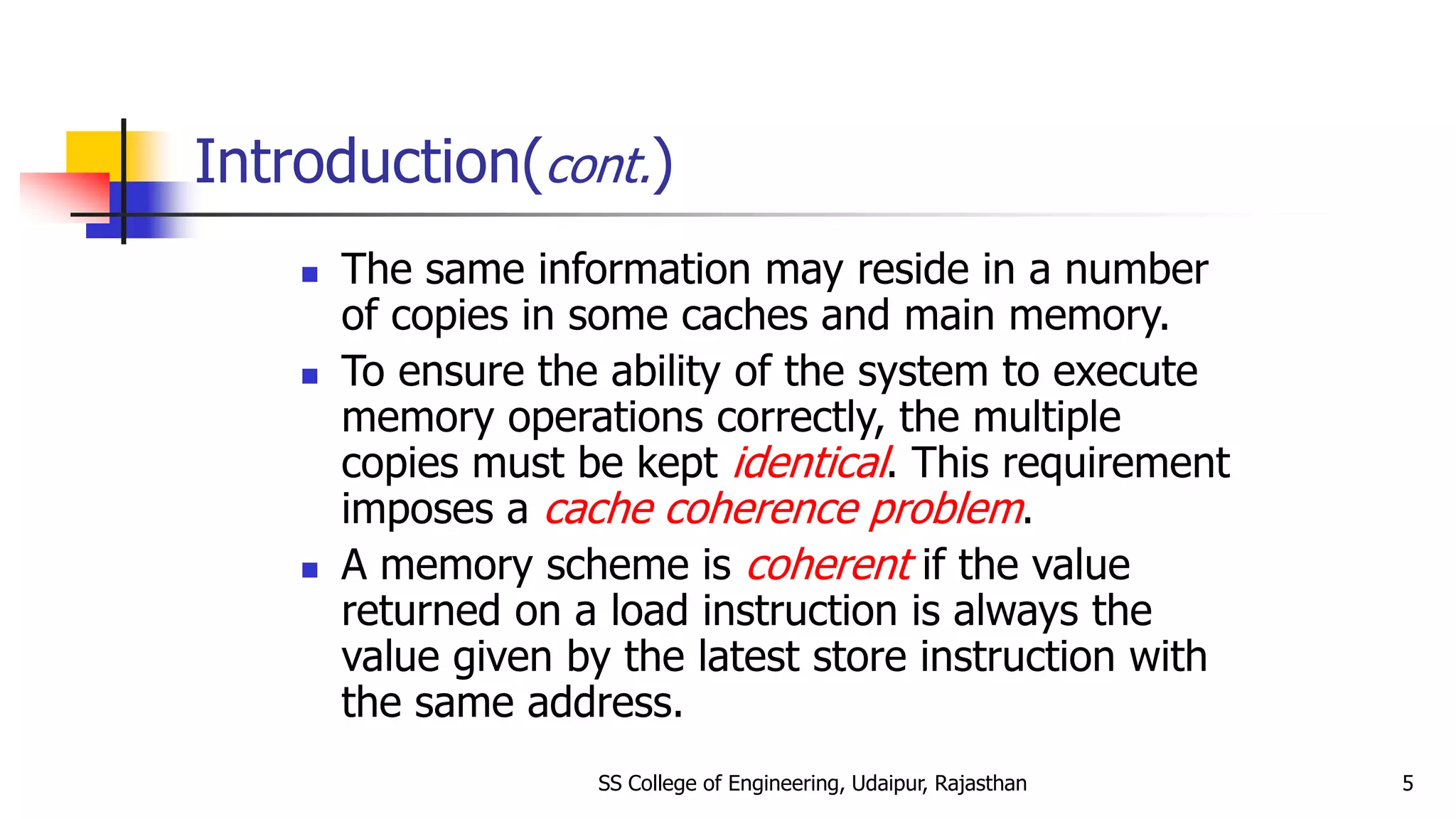
 The same information may reside in a number
of copies in some caches and main memory.
 To ensure the ability of the system to execute
memory operations correctly, the multiple
copies must be kept identical. This requirement
imposes a cache coherence problem.
 A memory scheme is coherent if the value
returned on a load instruction is always the
value given by the latest store instruction with
the same address.
SS College of Engineering, Udaipur, Rajasthan 5
Conditions for incoherence
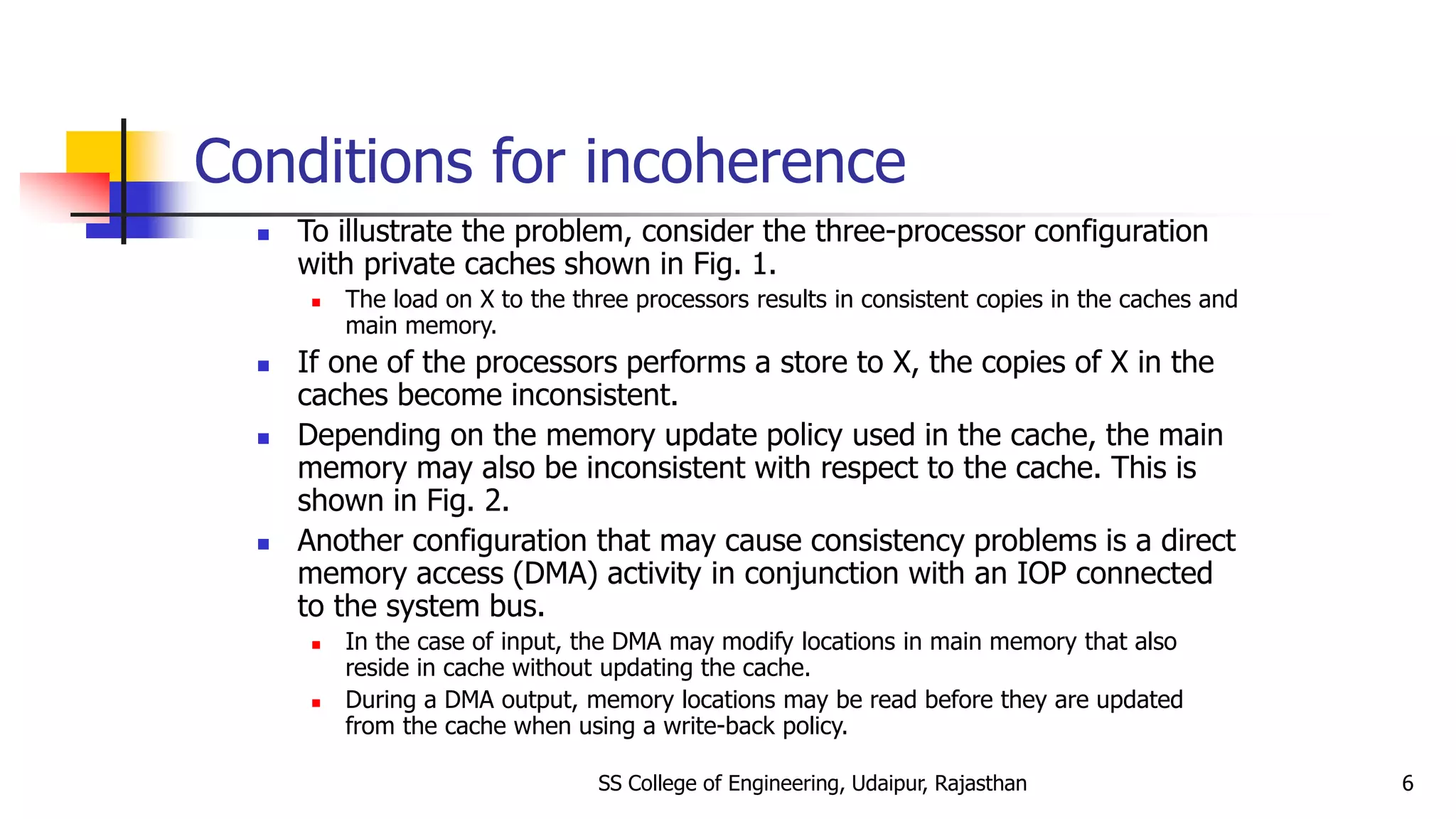
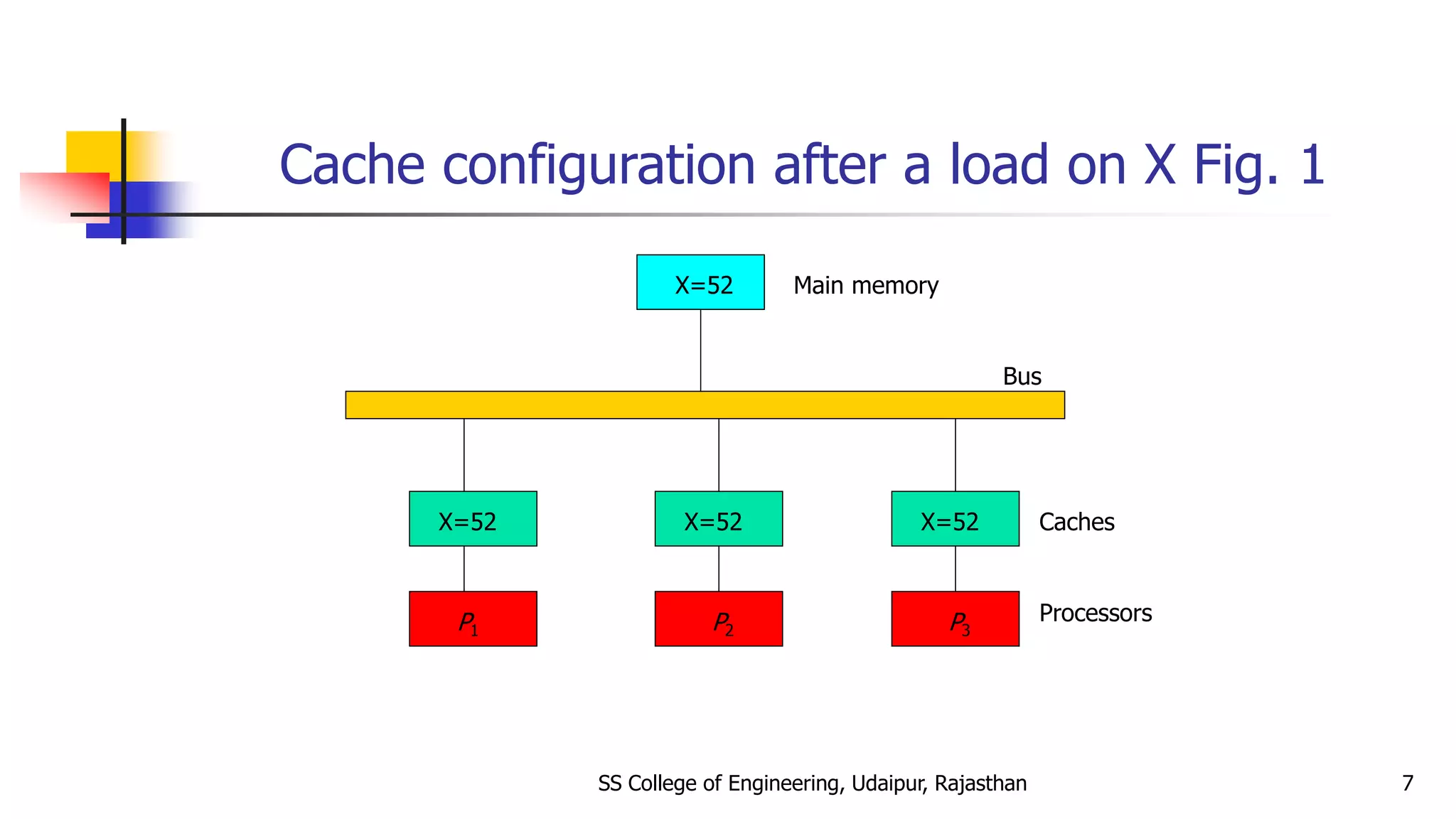
 To illustrate the problem, consider the three-processor configuration
with private caches shown in Fig. 1.
 The load on X to the three processors results in consistent copies in the caches and
main memory.
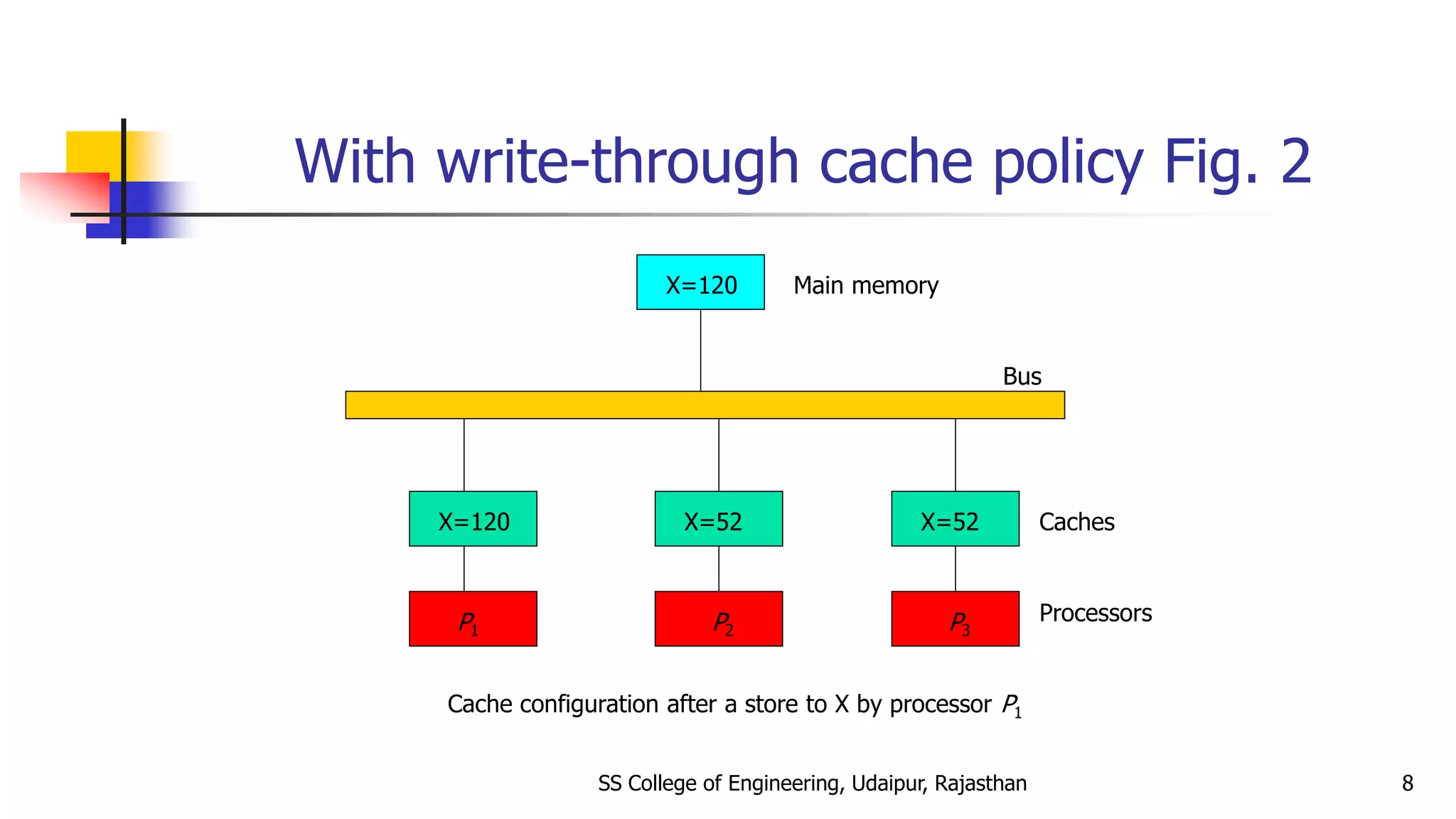
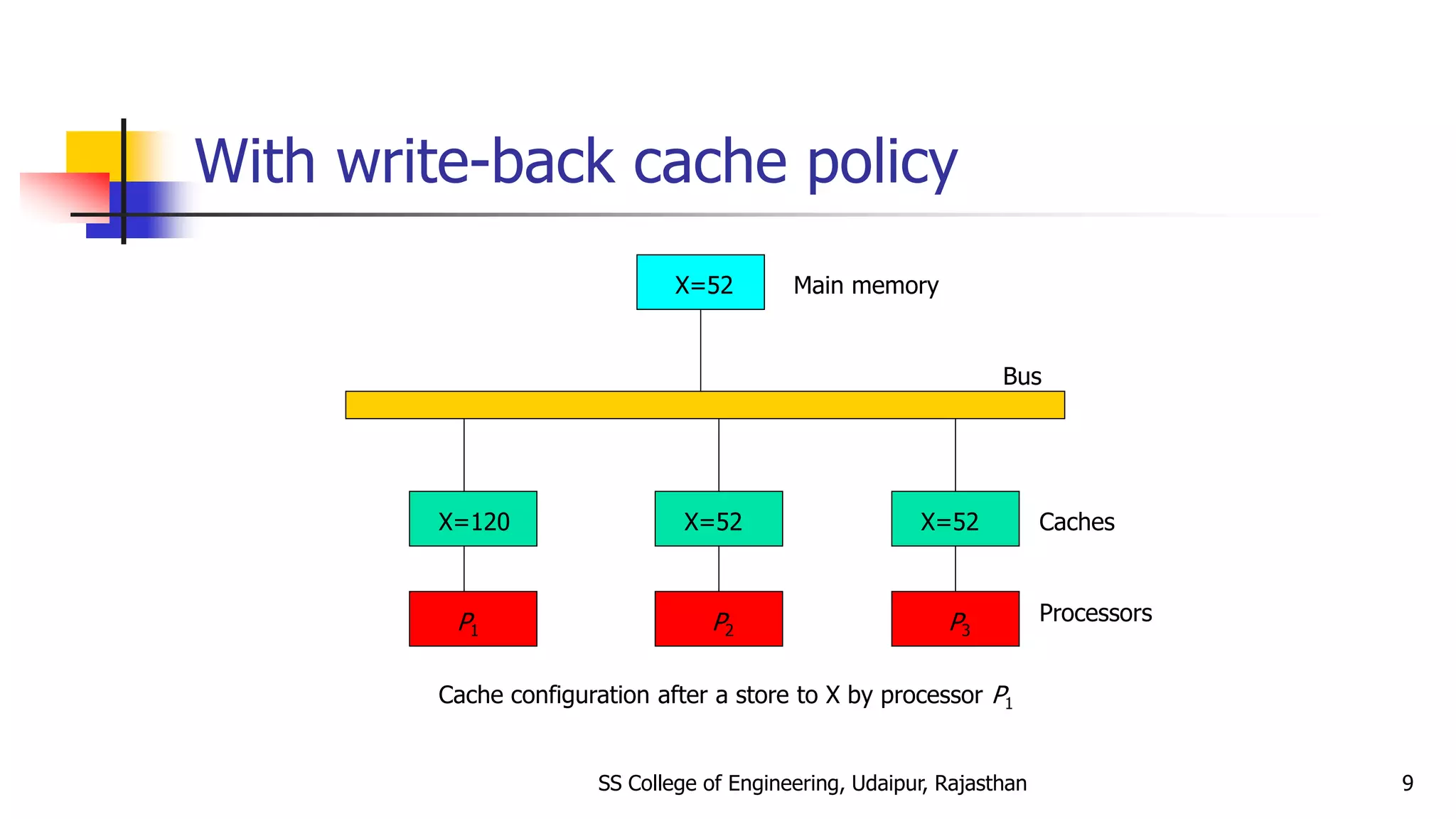
 If one of the processors performs a store to X, the copies of X in the
caches become inconsistent.
 Depending on the memory update policy used in the cache, the main
memory may also be inconsistent with respect to the cache. This is
shown in Fig. 2.
 Another configuration that may cause consistency problems is a direct
memory access (DMA) activity in conjunction with an IOP connected
to the system bus.
 In the case of input, the DMA may modify locations in main memory that also
reside in cache without updating the cache.
 During a DMA output, memory locations may be read before they are updated
from the cache when using a write-back policy.
SS College of Engineering, Udaipur, Rajasthan 6
Cache configuration after a load on X Fig. 1
X=52
X=52 X=52 X=52
P1 P2 P3
Bus
Main memory
Caches
Processors
SS College of Engineering, Udaipur, Rajasthan 7
With write-through cache policy Fig. 2
X=120
X=120 X=52 X=52
P1 P2 P3
Bus
Main memory
Caches
Processors
Cache configuration after a store to X by processor P1
SS College of Engineering, Udaipur, Rajasthan 8
With write-back cache policy
X=52
X=120 X=52 X=52
P1 P2 P3
Bus
Main memory
Caches
Processors
Cache configuration after a store to X by processor P1
SS College of Engineering, Udaipur, Rajasthan 9
Solutions to the cache coherence problem
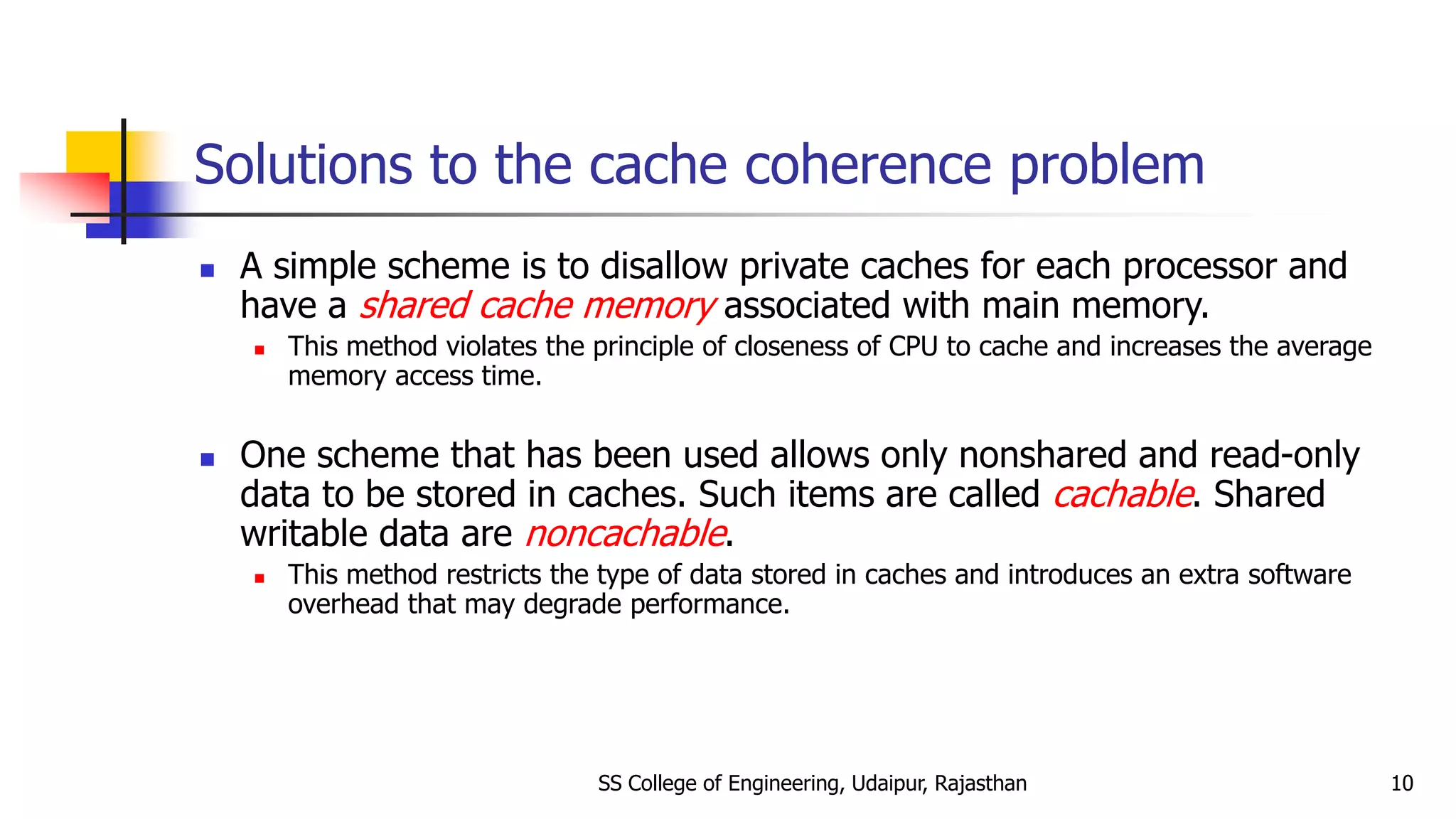
 A simple scheme is to disallow private caches for each processor and
have a shared cache memory associated with main memory.
 This method violates the principle of closeness of CPU to cache and increases the average
memory access time.
 One scheme that has been used allows only nonshared and read-only
data to be stored in caches. Such items are called cachable. Shared
writable data are noncachable.
 This method restricts the type of data stored in caches and introduces an extra software
overhead that may degrade performance.
SS College of Engineering, Udaipur, Rajasthan 10
Solutions to the cache coherence problem(cont.)
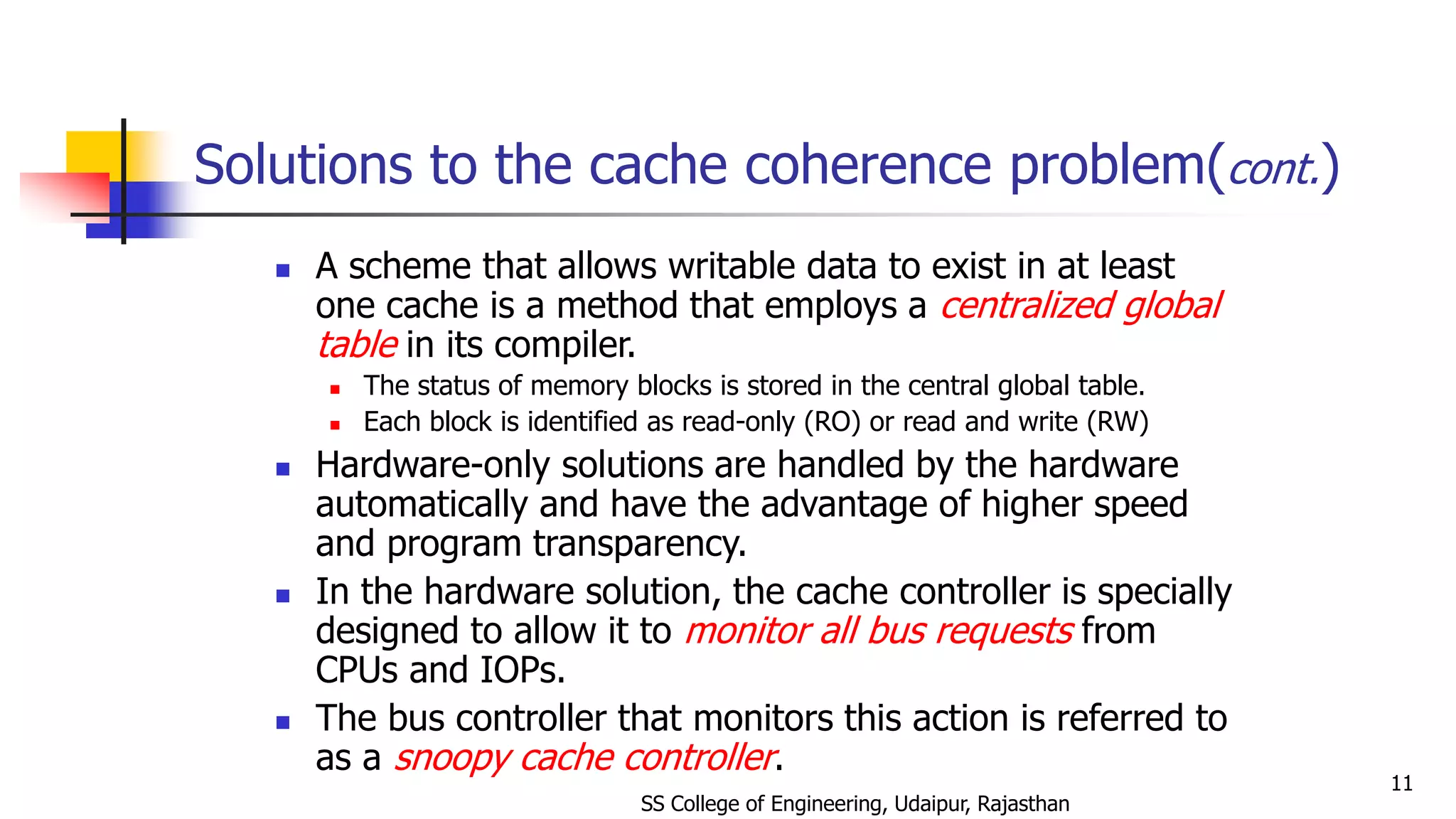
 A scheme that allows writable data to exist in at least
one cache is a method that employs a centralized global
table in its compiler.
 The status of memory blocks is stored in the central global table.
 Each block is identified as read-only (RO) or read and write (RW)
 Hardware-only solutions are handled by the hardware
automatically and have the advantage of higher speed
and program transparency.
 In the hardware solution, the cache controller is specially
designed to allow it to monitor all bus requests from
CPUs and IOPs.
 The bus controller that monitors this action is referred to
as a snoopy cache controller.
SS College of Engineering, Udaipur, Rajasthan
11
Solutions to the cache coherence
problem(cont.)
 The local snoopy controllers in all other caches check their memory to determine if
they have a copy of the word that has been overwritten.
 If a copy exists in a remote cache, that location is marked invalid.
SS College of Engineering, Udaipur, Rajasthan 12

Unit 6 cache coherence

  • 1.
    Unit VI Multiprocessors by: Er.Dipesh Vaya Head & Asst. Prof. Department of CSE SSCE, Udaipur, Rajasthan
  • 2.
    Contents  Characteristics ofMultiprocessors  Interconnection Structure  Interprocessor Arbitration  Interprocessor Communication and Synchronization Cache Coherence  Shared Memory Multiprocessors SS College of Engineering, Udaipur, Rajasthan 2
  • 3.
    Cache Coherence (Coherence :the quality of being logical and consistent.) by: Er. Dipesh Vaya Head & Asst. Prof. Department of CSE SSCE, Udaipur, Rajasthan SS College of Engineering, Udaipur, Rajasthan 3
  • 4.
    Introduction  The primaryadvantage of cache is its ability to reduce the average access time in uniprocessors.  When the processor finds a word in cache during a read operation, the main memory is not involved in the transfer.  If the operation is to write, there are two commonly used procedures to update memory.  In the write-through policy, both cache and main memory are updated with every write operation.  In the write-back policy, only the cache is updated and the location is marked so that it can be copied later into main memory. SS College of Engineering, Udaipur, Rajasthan 4
  • 5.
    Introduction(cont.)  The sameinformation may reside in a number of copies in some caches and main memory.  To ensure the ability of the system to execute memory operations correctly, the multiple copies must be kept identical. This requirement imposes a cache coherence problem.  A memory scheme is coherent if the value returned on a load instruction is always the value given by the latest store instruction with the same address. SS College of Engineering, Udaipur, Rajasthan 5
  • 6.
    Conditions for incoherence To illustrate the problem, consider the three-processor configuration with private caches shown in Fig. 1.  The load on X to the three processors results in consistent copies in the caches and main memory.  If one of the processors performs a store to X, the copies of X in the caches become inconsistent.  Depending on the memory update policy used in the cache, the main memory may also be inconsistent with respect to the cache. This is shown in Fig. 2.  Another configuration that may cause consistency problems is a direct memory access (DMA) activity in conjunction with an IOP connected to the system bus.  In the case of input, the DMA may modify locations in main memory that also reside in cache without updating the cache.  During a DMA output, memory locations may be read before they are updated from the cache when using a write-back policy. SS College of Engineering, Udaipur, Rajasthan 6
  • 7.
    Cache configuration aftera load on X Fig. 1 X=52 X=52 X=52 X=52 P1 P2 P3 Bus Main memory Caches Processors SS College of Engineering, Udaipur, Rajasthan 7
  • 8.
    With write-through cachepolicy Fig. 2 X=120 X=120 X=52 X=52 P1 P2 P3 Bus Main memory Caches Processors Cache configuration after a store to X by processor P1 SS College of Engineering, Udaipur, Rajasthan 8
  • 9.
    With write-back cachepolicy X=52 X=120 X=52 X=52 P1 P2 P3 Bus Main memory Caches Processors Cache configuration after a store to X by processor P1 SS College of Engineering, Udaipur, Rajasthan 9
  • 10.
    Solutions to thecache coherence problem  A simple scheme is to disallow private caches for each processor and have a shared cache memory associated with main memory.  This method violates the principle of closeness of CPU to cache and increases the average memory access time.  One scheme that has been used allows only nonshared and read-only data to be stored in caches. Such items are called cachable. Shared writable data are noncachable.  This method restricts the type of data stored in caches and introduces an extra software overhead that may degrade performance. SS College of Engineering, Udaipur, Rajasthan 10
  • 11.
    Solutions to thecache coherence problem(cont.)  A scheme that allows writable data to exist in at least one cache is a method that employs a centralized global table in its compiler.  The status of memory blocks is stored in the central global table.  Each block is identified as read-only (RO) or read and write (RW)  Hardware-only solutions are handled by the hardware automatically and have the advantage of higher speed and program transparency.  In the hardware solution, the cache controller is specially designed to allow it to monitor all bus requests from CPUs and IOPs.  The bus controller that monitors this action is referred to as a snoopy cache controller. SS College of Engineering, Udaipur, Rajasthan 11
  • 12.
    Solutions to thecache coherence problem(cont.)  The local snoopy controllers in all other caches check their memory to determine if they have a copy of the word that has been overwritten.  If a copy exists in a remote cache, that location is marked invalid. SS College of Engineering, Udaipur, Rajasthan 12