CARBOHYDRATES:
ORIGIN, FUNCTIONS AND
CLASSIFICATIONS
WHERE DO
CARBOHYDRATES
ORIGINATE?
WHAT ARE THE USES OF
CARBOHYDRATES IN PLANTS?
1. Carbohydrate oxidation provide energy.
2. Carbohydrate storage in the form of
glycogen provides a short-term energy
reserve.
3. Carbohydrates supply carbon atoms for the
synthesis of other biochemical
substances(proteins, lipids, and nucleic
acids).
4. Carbohydrates form part of the structure
framework of DNA and RNA molecules.
5. Carbohydrates linked to
lipids(Chapter19)are structural components
of cell membranes.
6. Carbohydrates linked to proteins
(Chapter20)function in a variety of cell-cell and
cell-molecule recognition processess.
 A polyhydroxy aldehyde, polyhydroxy
ketone or a compound that yields
polyhydroxy aldehyde or polyhydroxy
ketones upon hydrolysis.
 A carbohydrate glucose is a polyhydroxy
aldehyde and the carbohydrate fructose is a
polyhydroxy ketone.
 Carbohydrates are classified
base on their molecular size as
monosaccharides,
oligosaccharides and
polysaccharides.
• A carbohydrate that contains a single
polyhydroxy aldehyde or polyhydroxy ketone
units.
• It cannot be broken down into simpler units
by hydrolysis reactions.
• Pure monosaccharides are water soluble,
white, crystalline solids.
Examples: Glucose and Fructose
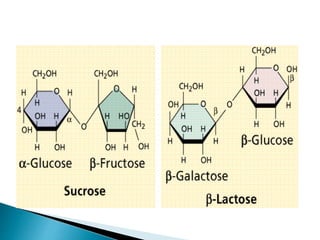
 A carbohydrate that contains two to ten
monosaccharide units covalently bonded to
each other.
 DISACCHARIDE is the common type of
oligosaccharide.
 crystalline, water soluble substances
 OLIGO is from the Greek word “oligos” which
means “small” or “few”.
Example: Sucrose (table sugar), Lactose (milk
sugar)
 Is a polymeric carbohydrate that contains
many monosaccharide units covalently
bonded to each other.
 Cellulose---- (book, cotton, wood) and
Starch ---- (bread, pasta, potatoes)
Cabohydrates
Cabohydrates

Cabohydrates

  • 1.
  • 2.
  • 4.
    WHAT ARE THEUSES OF CARBOHYDRATES IN PLANTS?
  • 5.
    1. Carbohydrate oxidationprovide energy. 2. Carbohydrate storage in the form of glycogen provides a short-term energy reserve. 3. Carbohydrates supply carbon atoms for the synthesis of other biochemical substances(proteins, lipids, and nucleic acids). 4. Carbohydrates form part of the structure framework of DNA and RNA molecules.
  • 6.
    5. Carbohydrates linkedto lipids(Chapter19)are structural components of cell membranes. 6. Carbohydrates linked to proteins (Chapter20)function in a variety of cell-cell and cell-molecule recognition processess.
  • 8.
     A polyhydroxyaldehyde, polyhydroxy ketone or a compound that yields polyhydroxy aldehyde or polyhydroxy ketones upon hydrolysis.  A carbohydrate glucose is a polyhydroxy aldehyde and the carbohydrate fructose is a polyhydroxy ketone.
  • 10.
     Carbohydrates areclassified base on their molecular size as monosaccharides, oligosaccharides and polysaccharides.
  • 11.
    • A carbohydratethat contains a single polyhydroxy aldehyde or polyhydroxy ketone units. • It cannot be broken down into simpler units by hydrolysis reactions. • Pure monosaccharides are water soluble, white, crystalline solids. Examples: Glucose and Fructose
  • 13.
     A carbohydratethat contains two to ten monosaccharide units covalently bonded to each other.  DISACCHARIDE is the common type of oligosaccharide.  crystalline, water soluble substances  OLIGO is from the Greek word “oligos” which means “small” or “few”. Example: Sucrose (table sugar), Lactose (milk sugar)
  • 15.
     Is apolymeric carbohydrate that contains many monosaccharide units covalently bonded to each other.  Cellulose---- (book, cotton, wood) and Starch ---- (bread, pasta, potatoes)