sOIL CORBOhYDRATEssOIL CORBOhYDRATEs
pREsENTATION
ON
Indira Gandhi Krishi Vishwavidyalaya, Raipur
(Chhattigarh), 492012
suBmITTED TO
Dr. R. N. SINGH pREsENTED BY
Professor & Course Teacher PARAMJEET SINGH KANWAR
Ph.D. Scholar
Department of Agronomy
COLLEGE OF AGRICuLTuRE , RAIpuR (C.G.)
Email id - paramjeetsinghkanwar@gmail.com, Mobile No.7828853820
CONTENTs
 INTRODuCTIONs
 FuNCTION OF CORBOhYDRATEs
 sOuRCE OF CORBOhYDRATEs
 CLAssIFICATION OF CORBOhYDRATEs
 mAjOR GROup OF CORBOhYDRATEs
 sIGNIFICANCE OF CORBOhYDRATEs
 CORBOhYDRATEs mATERIALs IN sOIL OCCuRs
 CONCLusION
CARBOHYDRATECARBOHYDRATE
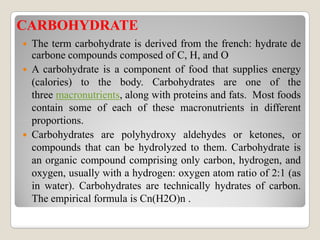
 The term carbohydrate is derived from the french: hydrate de
carbone compounds composed of C, H, and O
 A carbohydrate is a component of food that supplies energy
(calories) to the body. Carbohydrates are one of the
three macronutrients, along with proteins and fats. Most foods
contain some of each of these macronutrients in different
proportions.proportions.
 Carbohydrates are polyhydroxy aldehydes or ketones, or
compounds that can be hydrolyzed to them. Carbohydrate is
an organic compound comprising only carbon, hydrogen, and
oxygen, usually with a hydrogen: oxygen atom ratio of 2:1 (as
in water). Carbohydrates are technically hydrates of carbon.
The empirical formula is Cn(H2O)n .
FuNCTIONs OF CARBOhYDRATEsFuNCTIONs OF CARBOhYDRATEs
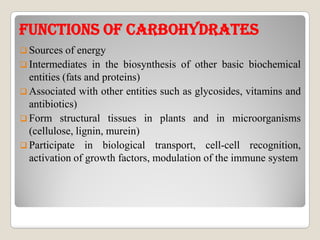
 Sources of energy
 Intermediates in the biosynthesis of other basic biochemical
entities (fats and proteins)
 Associated with other entities such as glycosides, vitamins and
antibiotics)
 Form structural tissues in plants and in microorganisms Form structural tissues in plants and in microorganisms
(cellulose, lignin, murein)
 Participate in biological transport, cell-cell recognition,
activation of growth factors, modulation of the immune system
Supply energy
Stored energy for future use
Structural constituents
Proteins sparing action
Necessary for oxidation of protein and fatNecessary for oxidation of protein and fat
Necessary for synthesis of nonessential amino acids
Conserve water and electrolyte
Beneficial effect on micro flora.
sOuRCEs OF CARBOhYDRATEssOuRCEs OF CARBOhYDRATEs
 Baked goods commonly contain dietary starch and added
sugar. Most dietary carbohydrates come from plants.
 Sugars and starches are nutritive carbohydrates, meaning
they are broken down and utilized by the body, primarily to
generate energy.generate energy.
 Although dietary fiber is also a carbohydrate, it contributes
no calories because it is not digested or absorbed.
CLAssIFICATION OF CARBOhYDRATEsCLAssIFICATION OF CARBOhYDRATEs
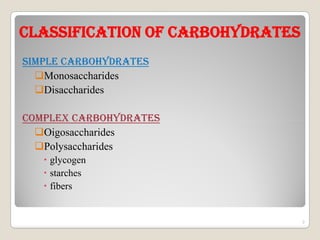
sImpLE CARBOhYDRATEs
Monosaccharides
Disaccharides
COmpLEx CARBOhYDRATEsCOmpLEx CARBOhYDRATEs
Oigosaccharides
Polysaccharides
 glycogen
 starches
 fibers
7
mONOsACChARIDEsmONOsACChARIDEs
Molecules having only one actual or potential sugar group
are called monosaccharides. They are simple carbohydrates
that cannot be hydrolyzed further into polyhydroxy aldehydes
or ketone unit.
 Ex. Glucose, Fructose, and Galactose
 Glucose :- Glucose serves as the essential energy
source, and is commonly known as blood sugar or
dextrose.
 Found in fruits, vegetables, honey
FRuCTOsE :-
 Also called levulose
• combines with glucose to form sucrose.
 Small amounts are converted into glycogen, lactic acid, or fat
 Found in fruit, honey, and high fructose corn syrup
GALACTOsEGALACTOsE
 Galactose rarely occurs naturally as a single sugar
 combines with glucose to form lactose, “milk sugar”
 Used as an immediate energy source or is stored as
glycoge
DIsACChARIDEs
 When two monosaccharides are combined together with
elimination of a water molecule it is called disaccharide.
Monosaccharides are combined by glycosidic bond.
 Examples are sucrose, lactose, and maltose.
suCROsE (TABLET suGAR)suCROsE (TABLET suGAR)
 Composed of one glucose and one fructose
 Purified to form brown, white, and powdered sugars
 commercially obtained from sugar cane or sugar beet
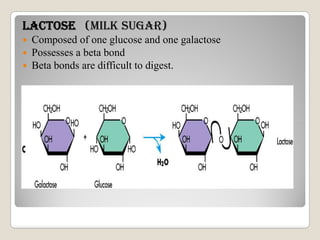
LACTOsE (mILk suGAR)
 Composed of one glucose and one galactose
 Possesses a beta bond
 Beta bonds are difficult to digest.
mALTOsE :- (mALT suGAR)
 Found in beer and malt liquors.
 used as a nutrient (malt extract; Hordeum vulgare); as a
sweetener and as a fermentative reagent.
 Constructed by a condensation reaction
 Composed of two glucose molecules
Possesses an alpha bond Possesses an alpha bond
 Most maltose digested is the result of starch digestion
COmpLEx CARBOhYDRATEsCOmpLEx CARBOhYDRATEs
 OLIGOsACChARIDEs :- Oligosaccharides are important
group of polymeric carbohydrates that are found in all living
organisms.
 Oligosaccharides composed of 2 to10 monosaccharide
residues.
 These monosaccharide's linked together by glycoside (α-1,4 or These monosaccharide's linked together by glycoside (α-1,4 or
α-1,6 ) bonds.
 The discovery of new enzymes helps in developing other
oligosaccharides of monosaccharide's with other linked bonds.
Trehalose (α,α 1,1), Gentio-oligosaccharides (β-1,6), Nigero-
oligosaccharides (α-1,3), Cyclodextrin (α-1-4).
OLIGOsACChARIDEs
◦ short carbohydrate chains of 3 - 10 monosaccharides
◦ found in legumes and human milk
◦ Examples:
 raffinose
 stachyose
cannot be broken down by human enzymes,
though can be digested by colonic bacteria
Complex CarbohydratesComplex Carbohydrates
14
though can be digested by colonic bacteria
OLIGOsACChARIDEsOLIGOsACChARIDEs
3-10 monosaccharides: raffinose and stachyose
Found in beans and legumes
Not digested by the body
Metabolized by bacteria in the large intestine
Raffinose=galactose+glucose+fructose
Stachyose=galactose+galactose+ glucose+fructose
OrOr
A carbohydrate that consists of a relatively small number of
monosaccharides. oligosaccharide in Science
Expand. oligosaccharide. Lactose, maltose, and sucrose
are oligosaccharides consisting of two simple sugars.
Raffinose is an oligosaccharide consisting of three simple
sugars.
pOLYsACChARIDEspOLYsACChARIDEs
 Long carbohydrate chains of monosaccharides linked
by glycosidic bonds
 Digestible polysaccharides:
 Amylose
Amylopectin
 Glycogen Glycogen
 Non-digestible polysaccharides: fibers
◦ Soluble fiber
◦ Insoluble fiber
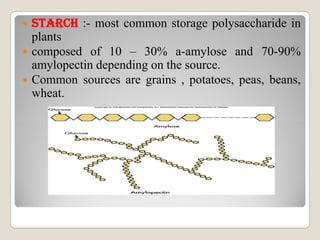
 sTARCh :- most common storage polysaccharide in
plants
 composed of 10 – 30% a-amylose and 70-90%
amylopectin depending on the source.
 Common sources are grains , potatoes, peas, beans,
wheat.
 Found in food derived from plants
 Includes polysaccharides such as cellulose, hemicellulose,
pectins, gums and mucilages
 Also includes non-polysaccharides such as lignin, cutins
and tannins
 Fibers are not a source of energy because Human digestive
enzymes cannot break down fibers
 The bacteria in human GI tract can breakdown some
fibers.
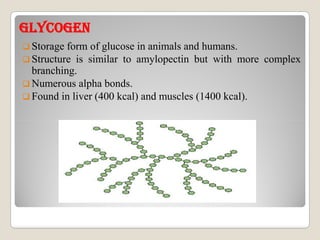
GLYCOGENGLYCOGEN
 Storage form of glucose in animals and humans.
 Structure is similar to amylopectin but with more complex
branching.
 Numerous alpha bonds.
 Found in liver (400 kcal) and muscles (1400 kcal).
(1)sOLuBLE FIBERs :- includes gum,pectin, some
hemicellulose and mucilages found in fruits, oats, barley and
legumes . Actions on body:
 Delay GI transit(benefits digestive disorders)
 Delay glucose absorption 9benefits diabetes)
 Lowers blood cholesterol(benefits heart disease)
(2) INsOLuBLE FIBERs :- includes cellulose, many
hemicellulose, lignin found in wheat bran , corn bran, wholehemicellulose, lignin found in wheat bran , corn bran, whole
grain bread, cereals and vegetables (carrot, cabbage).Actions in
body:
 Accelerates GI transit and increases fecal weight(promotes
bowel movement)
 Slows starch hydrolysis and delays glucose absorption(Benefits
diabetes)
 sOIL CARBOhYDRATEs.
 Contribute carbohydrates in the form of simple sugars,
hemicellulose, and cellulose, but these are more or less
decomposed by bacteria, actinomycetes and fungi, which in turn
synthesize polysaccharides and other carbohydrates of their
own.
or
 Carbohydrates consitute 5 to 25% of the organic matter in most
soils. Plant remains contribute carbohydrates in the form of
simple sugars, hemicellulose, and cellulose, but these are more or
less decomposed by bacteria, actinomycetes and fungi, which in
turn synthesize polysaccharides and other carbohydrates of their
own.
sIGNIFCANCEsIGNIFCANCE OF CARBOhYDRATEsOF CARBOhYDRATEs
 The significance of carbohydrates in soil arise largely from the
ability of complex polysaccharides to bind inorganic soil
particles into stable aggregates.
 Carbohydrates also form complexes with metal ions, and they
serve as building blocks for humus synthesis. Some sugars
may stimulate seed germination and root elongation.
 Other soil properties affected by polysaccharides include
cation exchange capacity (attributed to COOH groups of
uronic acids) , anion retention (occurrence of NH2groups), and
biological activity (energy source for microorganisms).
ThE mAjOR GROups OF CARBOhYDRATEsThE mAjOR GROups OF CARBOhYDRATEs
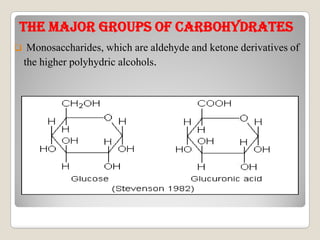
 Monosaccharides, which are aldehyde and ketone derivatives of
the higher polyhydric alcohols.
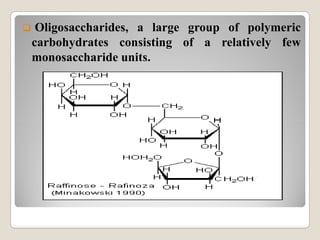
 Oligosaccharides, a large group of polymeric
carbohydrates consisting of a relatively few
monosaccharide units.
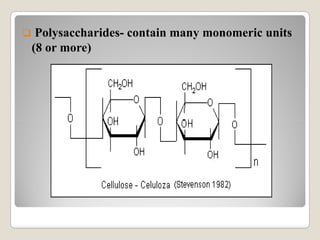
 Polysaccharides- contain many monomeric units
(8 or more)
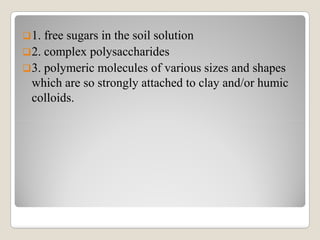
1. free sugars in the soil solution
2. complex polysaccharides
3. polymeric molecules of various sizes and shapes
which are so strongly attached to clay and/or humic
colloids.
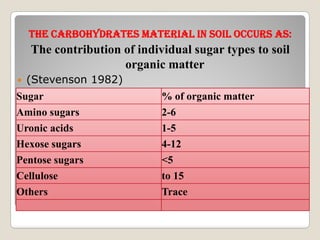
ThE CARBOhYDRATEs mATERIAL IN sOIL OCCuRs As:
The contribution of individual sugar types to soil
organic matter
 (Stevenson 1982)
Sugar % of organic matter
Amino sugars 2-6
Uronic acids 1-5
Hexose sugars 4-12
Pentose sugars <5
Cellulose to 15
Others Trace
CONCLusION
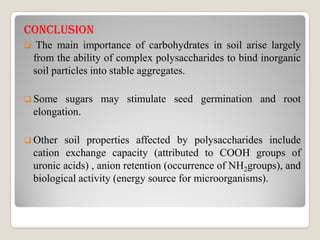
 The main importance of carbohydrates in soil arise largely
from the ability of complex polysaccharides to bind inorganic
soil particles into stable aggregates.
 Some sugars may stimulate seed germination and root
elongation.
 Other soil properties affected by polysaccharides include
cation exchange capacity (attributed to COOH groups of
uronic acids) , anion retention (occurrence of NH2groups), and
biological activity (energy source for microorganisms).
Soil biochemistry

Soil biochemistry

  • 1.
    sOIL CORBOhYDRATEssOIL CORBOhYDRATEs pREsENTATION ON IndiraGandhi Krishi Vishwavidyalaya, Raipur (Chhattigarh), 492012 suBmITTED TO Dr. R. N. SINGH pREsENTED BY Professor & Course Teacher PARAMJEET SINGH KANWAR Ph.D. Scholar Department of Agronomy COLLEGE OF AGRICuLTuRE , RAIpuR (C.G.) Email id - paramjeetsinghkanwar@gmail.com, Mobile No.7828853820
  • 2.
    CONTENTs  INTRODuCTIONs  FuNCTIONOF CORBOhYDRATEs  sOuRCE OF CORBOhYDRATEs  CLAssIFICATION OF CORBOhYDRATEs  mAjOR GROup OF CORBOhYDRATEs  sIGNIFICANCE OF CORBOhYDRATEs  CORBOhYDRATEs mATERIALs IN sOIL OCCuRs  CONCLusION
  • 3.
    CARBOHYDRATECARBOHYDRATE  The termcarbohydrate is derived from the french: hydrate de carbone compounds composed of C, H, and O  A carbohydrate is a component of food that supplies energy (calories) to the body. Carbohydrates are one of the three macronutrients, along with proteins and fats. Most foods contain some of each of these macronutrients in different proportions.proportions.  Carbohydrates are polyhydroxy aldehydes or ketones, or compounds that can be hydrolyzed to them. Carbohydrate is an organic compound comprising only carbon, hydrogen, and oxygen, usually with a hydrogen: oxygen atom ratio of 2:1 (as in water). Carbohydrates are technically hydrates of carbon. The empirical formula is Cn(H2O)n .
  • 4.
    FuNCTIONs OF CARBOhYDRATEsFuNCTIONsOF CARBOhYDRATEs  Sources of energy  Intermediates in the biosynthesis of other basic biochemical entities (fats and proteins)  Associated with other entities such as glycosides, vitamins and antibiotics)  Form structural tissues in plants and in microorganisms Form structural tissues in plants and in microorganisms (cellulose, lignin, murein)  Participate in biological transport, cell-cell recognition, activation of growth factors, modulation of the immune system
  • 5.
    Supply energy Stored energyfor future use Structural constituents Proteins sparing action Necessary for oxidation of protein and fatNecessary for oxidation of protein and fat Necessary for synthesis of nonessential amino acids Conserve water and electrolyte Beneficial effect on micro flora.
  • 6.
    sOuRCEs OF CARBOhYDRATEssOuRCEsOF CARBOhYDRATEs  Baked goods commonly contain dietary starch and added sugar. Most dietary carbohydrates come from plants.  Sugars and starches are nutritive carbohydrates, meaning they are broken down and utilized by the body, primarily to generate energy.generate energy.  Although dietary fiber is also a carbohydrate, it contributes no calories because it is not digested or absorbed.
  • 7.
    CLAssIFICATION OF CARBOhYDRATEsCLAssIFICATIONOF CARBOhYDRATEs sImpLE CARBOhYDRATEs Monosaccharides Disaccharides COmpLEx CARBOhYDRATEsCOmpLEx CARBOhYDRATEs Oigosaccharides Polysaccharides  glycogen  starches  fibers 7
  • 8.
    mONOsACChARIDEsmONOsACChARIDEs Molecules having onlyone actual or potential sugar group are called monosaccharides. They are simple carbohydrates that cannot be hydrolyzed further into polyhydroxy aldehydes or ketone unit.  Ex. Glucose, Fructose, and Galactose  Glucose :- Glucose serves as the essential energy source, and is commonly known as blood sugar or dextrose.  Found in fruits, vegetables, honey
  • 9.
    FRuCTOsE :-  Alsocalled levulose • combines with glucose to form sucrose.  Small amounts are converted into glycogen, lactic acid, or fat  Found in fruit, honey, and high fructose corn syrup GALACTOsEGALACTOsE  Galactose rarely occurs naturally as a single sugar  combines with glucose to form lactose, “milk sugar”  Used as an immediate energy source or is stored as glycoge
  • 10.
    DIsACChARIDEs  When twomonosaccharides are combined together with elimination of a water molecule it is called disaccharide. Monosaccharides are combined by glycosidic bond.  Examples are sucrose, lactose, and maltose. suCROsE (TABLET suGAR)suCROsE (TABLET suGAR)  Composed of one glucose and one fructose  Purified to form brown, white, and powdered sugars  commercially obtained from sugar cane or sugar beet
  • 11.
    LACTOsE (mILk suGAR) Composed of one glucose and one galactose  Possesses a beta bond  Beta bonds are difficult to digest.
  • 12.
    mALTOsE :- (mALTsuGAR)  Found in beer and malt liquors.  used as a nutrient (malt extract; Hordeum vulgare); as a sweetener and as a fermentative reagent.  Constructed by a condensation reaction  Composed of two glucose molecules Possesses an alpha bond Possesses an alpha bond  Most maltose digested is the result of starch digestion
  • 13.
    COmpLEx CARBOhYDRATEsCOmpLEx CARBOhYDRATEs OLIGOsACChARIDEs :- Oligosaccharides are important group of polymeric carbohydrates that are found in all living organisms.  Oligosaccharides composed of 2 to10 monosaccharide residues.  These monosaccharide's linked together by glycoside (α-1,4 or These monosaccharide's linked together by glycoside (α-1,4 or α-1,6 ) bonds.  The discovery of new enzymes helps in developing other oligosaccharides of monosaccharide's with other linked bonds. Trehalose (α,α 1,1), Gentio-oligosaccharides (β-1,6), Nigero- oligosaccharides (α-1,3), Cyclodextrin (α-1-4).
  • 14.
    OLIGOsACChARIDEs ◦ short carbohydratechains of 3 - 10 monosaccharides ◦ found in legumes and human milk ◦ Examples:  raffinose  stachyose cannot be broken down by human enzymes, though can be digested by colonic bacteria Complex CarbohydratesComplex Carbohydrates 14 though can be digested by colonic bacteria
  • 15.
    OLIGOsACChARIDEsOLIGOsACChARIDEs 3-10 monosaccharides: raffinoseand stachyose Found in beans and legumes Not digested by the body Metabolized by bacteria in the large intestine Raffinose=galactose+glucose+fructose Stachyose=galactose+galactose+ glucose+fructose OrOr A carbohydrate that consists of a relatively small number of monosaccharides. oligosaccharide in Science Expand. oligosaccharide. Lactose, maltose, and sucrose are oligosaccharides consisting of two simple sugars. Raffinose is an oligosaccharide consisting of three simple sugars.
  • 16.
    pOLYsACChARIDEspOLYsACChARIDEs  Long carbohydratechains of monosaccharides linked by glycosidic bonds  Digestible polysaccharides:  Amylose Amylopectin  Glycogen Glycogen  Non-digestible polysaccharides: fibers ◦ Soluble fiber ◦ Insoluble fiber
  • 17.
     sTARCh :-most common storage polysaccharide in plants  composed of 10 – 30% a-amylose and 70-90% amylopectin depending on the source.  Common sources are grains , potatoes, peas, beans, wheat.
  • 18.
     Found infood derived from plants  Includes polysaccharides such as cellulose, hemicellulose, pectins, gums and mucilages  Also includes non-polysaccharides such as lignin, cutins and tannins  Fibers are not a source of energy because Human digestive enzymes cannot break down fibers  The bacteria in human GI tract can breakdown some fibers.
  • 19.
    GLYCOGENGLYCOGEN  Storage formof glucose in animals and humans.  Structure is similar to amylopectin but with more complex branching.  Numerous alpha bonds.  Found in liver (400 kcal) and muscles (1400 kcal).
  • 20.
    (1)sOLuBLE FIBERs :-includes gum,pectin, some hemicellulose and mucilages found in fruits, oats, barley and legumes . Actions on body:  Delay GI transit(benefits digestive disorders)  Delay glucose absorption 9benefits diabetes)  Lowers blood cholesterol(benefits heart disease) (2) INsOLuBLE FIBERs :- includes cellulose, many hemicellulose, lignin found in wheat bran , corn bran, wholehemicellulose, lignin found in wheat bran , corn bran, whole grain bread, cereals and vegetables (carrot, cabbage).Actions in body:  Accelerates GI transit and increases fecal weight(promotes bowel movement)  Slows starch hydrolysis and delays glucose absorption(Benefits diabetes)
  • 21.
     sOIL CARBOhYDRATEs. Contribute carbohydrates in the form of simple sugars, hemicellulose, and cellulose, but these are more or less decomposed by bacteria, actinomycetes and fungi, which in turn synthesize polysaccharides and other carbohydrates of their own. or  Carbohydrates consitute 5 to 25% of the organic matter in most soils. Plant remains contribute carbohydrates in the form of simple sugars, hemicellulose, and cellulose, but these are more or less decomposed by bacteria, actinomycetes and fungi, which in turn synthesize polysaccharides and other carbohydrates of their own.
  • 22.
    sIGNIFCANCEsIGNIFCANCE OF CARBOhYDRATEsOFCARBOhYDRATEs  The significance of carbohydrates in soil arise largely from the ability of complex polysaccharides to bind inorganic soil particles into stable aggregates.  Carbohydrates also form complexes with metal ions, and they serve as building blocks for humus synthesis. Some sugars may stimulate seed germination and root elongation.  Other soil properties affected by polysaccharides include cation exchange capacity (attributed to COOH groups of uronic acids) , anion retention (occurrence of NH2groups), and biological activity (energy source for microorganisms).
  • 23.
    ThE mAjOR GROupsOF CARBOhYDRATEsThE mAjOR GROups OF CARBOhYDRATEs  Monosaccharides, which are aldehyde and ketone derivatives of the higher polyhydric alcohols.
  • 24.
     Oligosaccharides, alarge group of polymeric carbohydrates consisting of a relatively few monosaccharide units.
  • 25.
     Polysaccharides- containmany monomeric units (8 or more)
  • 26.
    1. free sugarsin the soil solution 2. complex polysaccharides 3. polymeric molecules of various sizes and shapes which are so strongly attached to clay and/or humic colloids.
  • 27.
    ThE CARBOhYDRATEs mATERIALIN sOIL OCCuRs As: The contribution of individual sugar types to soil organic matter  (Stevenson 1982) Sugar % of organic matter Amino sugars 2-6 Uronic acids 1-5 Hexose sugars 4-12 Pentose sugars <5 Cellulose to 15 Others Trace
  • 28.
    CONCLusION  The mainimportance of carbohydrates in soil arise largely from the ability of complex polysaccharides to bind inorganic soil particles into stable aggregates.  Some sugars may stimulate seed germination and root elongation.  Other soil properties affected by polysaccharides include cation exchange capacity (attributed to COOH groups of uronic acids) , anion retention (occurrence of NH2groups), and biological activity (energy source for microorganisms).