The Genetic Code
 The nucleotide (base) sequence of an
mRNA molecule is the informational part
of such a molecule.
 This base sequence in a given mRNA
determine the amino acid sequence for
the protein synthesized under that
mRNA’s direction.
 There are four nucleotides (base) in RNA:
Adenine, Guanine, Cytosine, Uracil.
 There are 20 amino acids that supports our
body.
 4X4X4=64 possible combinations.
 Codon= a three-nucleotide sequence in an
mRNA that codes for a specific amino acid.
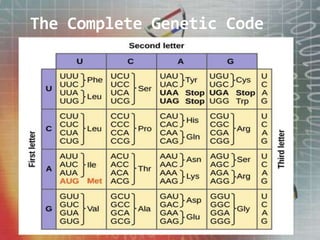
 Genetic Code= is the assignment of 64
mRNA codons to specific amino acids (or stop
signals).
 Marshall Nirenberg and Har Gobind Khorana.
The Complete Genetic Code
Remarkable features of
Genetic Codes
 The genetic code is highly degenerate.
 There is a pattern to the arrangement
of synonyms in the genetic code table.
 The genetic code is almost universal.
 An initiation codon exists.
Anticodons and tRNA
Molecules
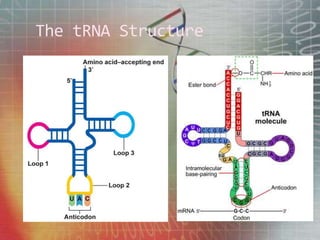
 All tRNA molecules have the same
general shape, and this shape is crucial
on how they function.
 The general two-dimensional
“cloverleaf” shape of tRNA by the
molecule’s folding and twisting into
regions of parallel strands and regions of
hairpin loops.
Two features of the tRNA structure
are of particular importance:
 The 3’ end of the open part of the cloverleaf
structure is where an amino acid becomes
covalently bonded to the tRNA molecule through
an ester bond.
 The loop opposite the open door of the
cloverleaf is the site for a sequence of three bases
called an anticodon– is a three-nucleotide sequence
on a tRNA molecule that is complementary to a
codon on an mRNA molecule.
The tRNA Structure
TRANSLATION: PROTEIN SYNTHESIS
 Translation– is the process by which
mRNA codons are deciphered and a
particular protein molecule is synthesized.
 The substances needed for the translation
phase of Protein synthesis are: mRNA
molecules, tRNA molecules, aamino acids,
ribosomes, and a number of enzymes.
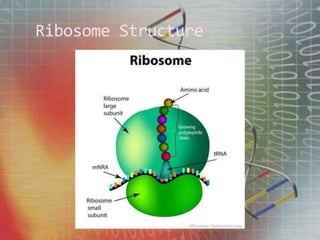
 Ribosomes is an rRNA that serves as
the site for translation phase of protein
synthesis.
 Ribosomes are composed of two
subunits called the small and large
subunits.
The smaller subunit--reads mRNA
codes.
The larger subunit--assembles the
polypeptide chain from amino acids.
Each subunits contains rRNA
The active site is the larger subunit.
The enzyme is ribozyme.
Ribosome Structure
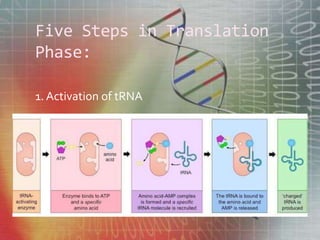
Five Steps in Translation
Phase:
1. Activation of tRNA
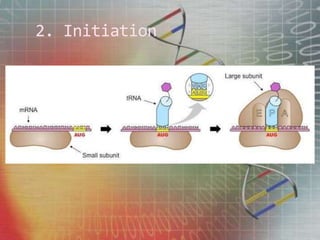
2. Initiation
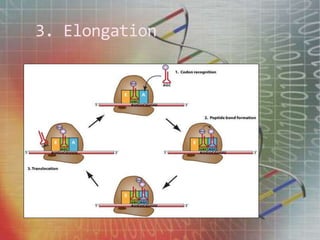
3. Elongation
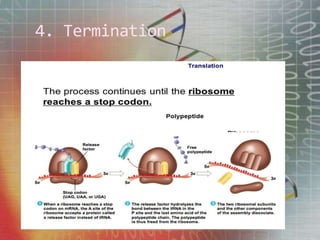
4. Termination
5. Post-Translation
Processes
 Gives the protein the final form it needs to
be fully functional.
 the second hydrolysis reaction releseas
the polypeptide chain to tRNA carrier.
 the formation of disulfide bridges may
occur.
The genetic code
The genetic code

The genetic code

  • 2.
    The Genetic Code The nucleotide (base) sequence of an mRNA molecule is the informational part of such a molecule.  This base sequence in a given mRNA determine the amino acid sequence for the protein synthesized under that mRNA’s direction.
  • 3.
     There arefour nucleotides (base) in RNA: Adenine, Guanine, Cytosine, Uracil.  There are 20 amino acids that supports our body.  4X4X4=64 possible combinations.  Codon= a three-nucleotide sequence in an mRNA that codes for a specific amino acid.  Genetic Code= is the assignment of 64 mRNA codons to specific amino acids (or stop signals).  Marshall Nirenberg and Har Gobind Khorana.
  • 4.
  • 5.
    Remarkable features of GeneticCodes  The genetic code is highly degenerate.  There is a pattern to the arrangement of synonyms in the genetic code table.  The genetic code is almost universal.  An initiation codon exists.
  • 6.
    Anticodons and tRNA Molecules All tRNA molecules have the same general shape, and this shape is crucial on how they function.  The general two-dimensional “cloverleaf” shape of tRNA by the molecule’s folding and twisting into regions of parallel strands and regions of hairpin loops.
  • 7.
    Two features ofthe tRNA structure are of particular importance:  The 3’ end of the open part of the cloverleaf structure is where an amino acid becomes covalently bonded to the tRNA molecule through an ester bond.  The loop opposite the open door of the cloverleaf is the site for a sequence of three bases called an anticodon– is a three-nucleotide sequence on a tRNA molecule that is complementary to a codon on an mRNA molecule.
  • 8.
  • 9.
    TRANSLATION: PROTEIN SYNTHESIS Translation– is the process by which mRNA codons are deciphered and a particular protein molecule is synthesized.  The substances needed for the translation phase of Protein synthesis are: mRNA molecules, tRNA molecules, aamino acids, ribosomes, and a number of enzymes.
  • 10.
     Ribosomes isan rRNA that serves as the site for translation phase of protein synthesis.  Ribosomes are composed of two subunits called the small and large subunits.
  • 11.
    The smaller subunit--readsmRNA codes. The larger subunit--assembles the polypeptide chain from amino acids. Each subunits contains rRNA The active site is the larger subunit. The enzyme is ribozyme.
  • 12.
  • 13.
    Five Steps inTranslation Phase: 1. Activation of tRNA
  • 14.
  • 15.
  • 16.
  • 17.
    5. Post-Translation Processes  Givesthe protein the final form it needs to be fully functional.  the second hydrolysis reaction releseas the polypeptide chain to tRNA carrier.  the formation of disulfide bridges may occur.