1
CONTENTS
• Abstract
• Introduction
• Literature survey
• Problem identification
• Existing System
• Our Proposed Concept
• Schematic diagram
• Flow of project
• Hardware Requirment
• Advantages
• conclusion
2
ABSTRACT
Underground cables are prone to a wide variety of faults due to underground conditions, wear and tear, rodents
etc. Diagnosing fault source is difficult and entire cable should be taken out from the ground to check and fix
faults. The project work is intended to detect the location of fault in underground cable lines from the base
station in km using a arduino controller.
To locate a fault in the cable, the cable must be tested for faults. This prototype uses the simple concept of Ohms
law. The current would vary depending upon the length of fault of the cable. In the urban areas, the electrical
cables run in underground instead of overhead lines.
Whenever the fault occurs in underground cable it is difficult to detect the exact location of the fault for process
of repairing that particular cable.
The proposed system finds the exact location of the fault. The prototype is modeled with a set of resistors
representing cable length in km and fault creation is made by a set of switches at every known distance to cross
check the accuracy of the same.
3
INTRODUCTION
Power supply networks are growing continuously and their reliability getting more important than ever. The
complexity of the whole network comprises numerous components that can fail and interrupt the power
supply for end user. For most of the worldwide operated low voltage and medium voltage distribution lines,
underground cables have been used for many decades.
Underground high voltage cables are used more and more because they are not influenced by weather
conditions, heavy rain, storm, snow and pollution. Even though the Cable manufacturing technology is
improving steadily; there are still influences which may cause cable to fail during test and operation.
A cable in good condition and installed correctly can last a lifetime of about 30 years. However cables can
be easily damaged by incorrect installation or poorly executed jointing, while subsequent third party damage
by civil works such as trenching or curb edging
4
EXISTING SYSTEM
• RF Communication
• proposes a home appliances controlling system through spoken commands using handheld devices
and ZigBee module.
• GSM-SIM900 _ Message Communication
• Presents home automation system using Bluetooth and android application. Low voltage activating
switches are used in input side. It send the control signal to the controller board which PIC
Microcontroller here.
5
PROBLEM IDENTIFICATION
• When there is a break in the conductor of the cable, it is called open circuit fault of the cable. The open circuit fault
can be checked by megger. For this purpose, the three conductors of the 3-core cable at the far end are shorted
and earthed. Then resistance between each conductor and earth is measured by a megger. The megger will
indicate zero resistance in the circuit of the conductor that is not broken. However, if the conductor is broken, the
megger will indicate infinite resistance in its circuit.
• When the conductor of the cable comes in contact with earth, it is called earth fault or ground fault. To identify this
fault, one terminal of the megger is connected to the conductor and the other terminal connected to earth. If
megger indicates zero reading, it means the conductor is earthed. The same procedure is repeated for other
conductors of the cable. This project is used to detect the location of fault in digital way. Locating the faulty point in
an underground cable helps to facilitate quicker repair, improve the system reliability and reduced outage period.
6
OUR PROPOSED CONCEPT
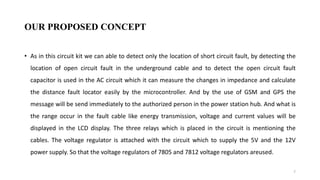
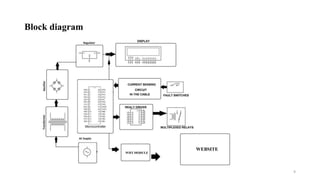
• As in this circuit kit we can able to detect only the location of short circuit fault, by detecting the
location of open circuit fault in the underground cable and to detect the open circuit fault
capacitor is used in the AC circuit which it can measure the changes in impedance and calculate
the distance fault locator easily by the microcontroller. And by the use of GSM and GPS the
message will be send immediately to the authorized person in the power station hub. And what is
the range occur in the fault cable like energy transmission, voltage and current values will be
displayed in the LCD display. The three relays which is placed in the circuit is mentioning the
cables. The voltage regulator is attached with the circuit which to supply the 5V and the 12V
power supply. So that the voltage regulators of 7805 and 7812 voltage regulators areused.
7
Proposed methodology
• This paper deals with the location of fault occurs in the cable by using the Arduino
board that gives us the fault distance from the station.
• In common, urban region practices the digging method to find the underground
cable fault which consume huge amount of time to find exact location of fault. The
method used by underground lines fault detection is a technique for locating the
fault.
• This paper shows us the way to find the fault location which helps in avoiding the
digging method for the whole line. This will save time and reduce human efforts
12-JUNE-20 GCE/19-20/PRJ09 8
Block diagram
9
Block diagram
12-JUNE-20 GCE/19-20/PRJ09 10
MODULES OF PROJECT
• 1. HARDAWARE DESIGN
• POWER SUPPLY DESIGN
• MICROCONTROLLER CITRCUIT
• DRIVER CIRCUIT
• SERIAL COMMUNICATION
• INPUT & OUTPUT INTERFACING-LCD & BUZZER
• 2. SOFTWARE DESIGN
FLOW OF PROJECT
• MODULE 1. POWER SUPPLY CIRCUIT
• MODULE 2. DRIVER CIRCUIR
• MODULE 3. INTERFACING
• MODULE 4. SERIAL PORT
• MODULE 5. PROGRAMMING
• MODULE 6. IMPLMENTATION & COMPLETION OF PROJECT
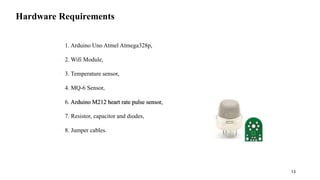
Hardware Requirements
• 1. Arduino Uno Atmel Atmega328p,
• 2. Wifi Module,
• 3. Temperature sensor,
• 4. MQ-6 Sensor,
• 6. Arduino M212 heart rate pulse sensor,
• 7. Resistor, capacitor and diodes,
• 8. Jumper cables.
13
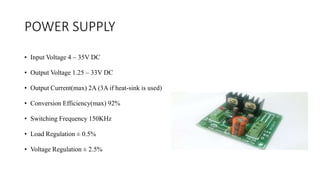
POWER SUPPLY
• Input Voltage 4 – 35V DC
• Output Voltage 1.25 – 33V DC
• Output Current(max) 2A (3A if heat-sink is used)
• Conversion Efficiency(max) 92%
• Switching Frequency 150KHz
• Load Regulation ± 0.5%
• Voltage Regulation ± 2.5%
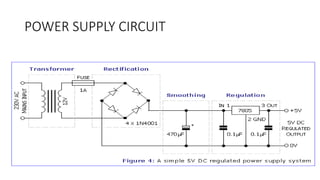
POWER SUPPLY CIRCUIT
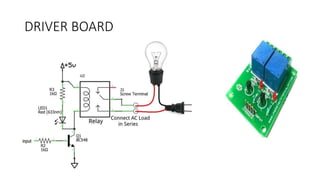
DRIVER CIRCUIT
• This Board can be used to Control Solonoids,Motors etc
• Input Logic -5v level from MUC
• Interfaced with Transister 547
• Input Pin connected to Burg stick
DRIVER BOARD
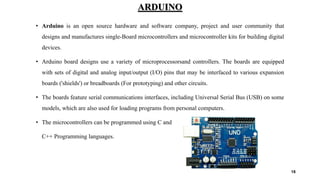
ARDUINO
• Arduino is an open source hardware and software company, project and user community that
designs and manufactures single-Board microcontrollers and microcontroller kits for building digital
devices.
• Arduino board designs use a variety of microprocessorsand controllers. The boards are equipped
with sets of digital and analog input/output (I/O) pins that may be interfaced to various expansion
boards ('shields') or breadboards (For prototyping) and other circuits.
• The boards feature serial communications interfaces, including Universal Serial Bus (USB) on some
models, which are also used for loading programs from personal computers.
• The microcontrollers can be programmed using C and
C++ Programming languages.
18
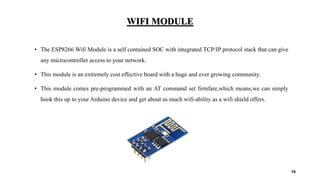
WIFI MODULE
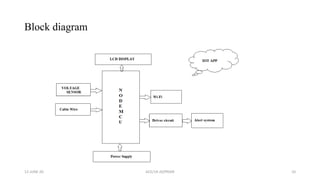
• The ESP8266 Wifi Module is a self contained SOC with integrated TCP/IP protocol stack that can give
any microcontroller access to your network.
• This module is an extremely cost effective board with a huge and ever growing community.
• This module comes pre-programmed with an AT command set firmfare,which means,we can simply
hook this up to your Arduino device and get about as much wifi-ability as a wifi shield offers.
19
ADVANTAGES
Easy to access IOT platform
High speed dual core processor IOT module
Low cost
Very low power consumption (3.3V)
High security.
20
CONCLUSION
• In this project we detect the exact location of short circuit fault in the underground cable from feeder
end in km by using arduino. In future, this project can be implemented to calculate the impedance by
using a capacitor in an AC circuit and thus measure the open circuit fault.
• This paper designed, implemented a microcontroller based underground cable fault detector. We have
successfully designed, implemented and tested a cheap underground cable fault detector. Our proposed
method can detect both open and short circuit in underground cables with a maximum distance of 2km.
In the future, effort will be concentrated to increase the maximum distance for fault detection to 3km or
more, and a graphical display monitor to improve on its information of the underground cable fault
could replace the LCD display.
21
REFERENCES:
1. Kumar Mandalu, RamuParupalli, CH.A.S.Murty, E. Mangesh, Rutul Lunagariya “Mobile based Home
Automation using Internet of Things (IoT)” International Conference on Control, Instrumentation,
Communication and Computational Technologies (ICCICCT), pp. 340-343, Dec 2015.
2. M.Tharaniyasoundhari, Ms.S.BrillySangeetha “Intelligent Interface Based Speech Recognition For Home
Automation using Android Application” IEEE Sponsored 2nd International Conference on Innovations in
Information Embedded and Communication Systems ICIIECS’15,pp 1-11,March 2015.
3. Gagan,”IOT based system for person with physical disability”, International Journal of Innovative Research in
Electrical, Electronics, Instrumentation and Control Engineering, pp 157-160, Vol. 4, Special Issue 2, April
2016.
4. Freddy K Santoso, and Nicholas C H Vun, “Securing IoT for Smart Home System”, 2015 IEEE International
Symposium on Consumer Electronics (ISCE)”, June 2015
5. Maradugu Anil Kumar, Y.RaviSekar, ”Android Based Health Care Monitoring System“, IEEE Sponsored 2nd
International Conference on Innovations in Information Embedded and Communication Systems ICIIECS'15,
March 2015.
22
THANK YOU …….
23

cable fault.pptx

  • 1.
  • 2.
    CONTENTS • Abstract • Introduction •Literature survey • Problem identification • Existing System • Our Proposed Concept • Schematic diagram • Flow of project • Hardware Requirment • Advantages • conclusion 2
  • 3.
    ABSTRACT Underground cables areprone to a wide variety of faults due to underground conditions, wear and tear, rodents etc. Diagnosing fault source is difficult and entire cable should be taken out from the ground to check and fix faults. The project work is intended to detect the location of fault in underground cable lines from the base station in km using a arduino controller. To locate a fault in the cable, the cable must be tested for faults. This prototype uses the simple concept of Ohms law. The current would vary depending upon the length of fault of the cable. In the urban areas, the electrical cables run in underground instead of overhead lines. Whenever the fault occurs in underground cable it is difficult to detect the exact location of the fault for process of repairing that particular cable. The proposed system finds the exact location of the fault. The prototype is modeled with a set of resistors representing cable length in km and fault creation is made by a set of switches at every known distance to cross check the accuracy of the same. 3
  • 4.
    INTRODUCTION Power supply networksare growing continuously and their reliability getting more important than ever. The complexity of the whole network comprises numerous components that can fail and interrupt the power supply for end user. For most of the worldwide operated low voltage and medium voltage distribution lines, underground cables have been used for many decades. Underground high voltage cables are used more and more because they are not influenced by weather conditions, heavy rain, storm, snow and pollution. Even though the Cable manufacturing technology is improving steadily; there are still influences which may cause cable to fail during test and operation. A cable in good condition and installed correctly can last a lifetime of about 30 years. However cables can be easily damaged by incorrect installation or poorly executed jointing, while subsequent third party damage by civil works such as trenching or curb edging 4
  • 5.
    EXISTING SYSTEM • RFCommunication • proposes a home appliances controlling system through spoken commands using handheld devices and ZigBee module. • GSM-SIM900 _ Message Communication • Presents home automation system using Bluetooth and android application. Low voltage activating switches are used in input side. It send the control signal to the controller board which PIC Microcontroller here. 5
  • 6.
    PROBLEM IDENTIFICATION • Whenthere is a break in the conductor of the cable, it is called open circuit fault of the cable. The open circuit fault can be checked by megger. For this purpose, the three conductors of the 3-core cable at the far end are shorted and earthed. Then resistance between each conductor and earth is measured by a megger. The megger will indicate zero resistance in the circuit of the conductor that is not broken. However, if the conductor is broken, the megger will indicate infinite resistance in its circuit. • When the conductor of the cable comes in contact with earth, it is called earth fault or ground fault. To identify this fault, one terminal of the megger is connected to the conductor and the other terminal connected to earth. If megger indicates zero reading, it means the conductor is earthed. The same procedure is repeated for other conductors of the cable. This project is used to detect the location of fault in digital way. Locating the faulty point in an underground cable helps to facilitate quicker repair, improve the system reliability and reduced outage period. 6
  • 7.
    OUR PROPOSED CONCEPT •As in this circuit kit we can able to detect only the location of short circuit fault, by detecting the location of open circuit fault in the underground cable and to detect the open circuit fault capacitor is used in the AC circuit which it can measure the changes in impedance and calculate the distance fault locator easily by the microcontroller. And by the use of GSM and GPS the message will be send immediately to the authorized person in the power station hub. And what is the range occur in the fault cable like energy transmission, voltage and current values will be displayed in the LCD display. The three relays which is placed in the circuit is mentioning the cables. The voltage regulator is attached with the circuit which to supply the 5V and the 12V power supply. So that the voltage regulators of 7805 and 7812 voltage regulators areused. 7
  • 8.
    Proposed methodology • Thispaper deals with the location of fault occurs in the cable by using the Arduino board that gives us the fault distance from the station. • In common, urban region practices the digging method to find the underground cable fault which consume huge amount of time to find exact location of fault. The method used by underground lines fault detection is a technique for locating the fault. • This paper shows us the way to find the fault location which helps in avoiding the digging method for the whole line. This will save time and reduce human efforts 12-JUNE-20 GCE/19-20/PRJ09 8
  • 9.
  • 10.
  • 11.
    MODULES OF PROJECT •1. HARDAWARE DESIGN • POWER SUPPLY DESIGN • MICROCONTROLLER CITRCUIT • DRIVER CIRCUIT • SERIAL COMMUNICATION • INPUT & OUTPUT INTERFACING-LCD & BUZZER • 2. SOFTWARE DESIGN
  • 12.
    FLOW OF PROJECT •MODULE 1. POWER SUPPLY CIRCUIT • MODULE 2. DRIVER CIRCUIR • MODULE 3. INTERFACING • MODULE 4. SERIAL PORT • MODULE 5. PROGRAMMING • MODULE 6. IMPLMENTATION & COMPLETION OF PROJECT
  • 13.
    Hardware Requirements • 1.Arduino Uno Atmel Atmega328p, • 2. Wifi Module, • 3. Temperature sensor, • 4. MQ-6 Sensor, • 6. Arduino M212 heart rate pulse sensor, • 7. Resistor, capacitor and diodes, • 8. Jumper cables. 13
  • 14.
    POWER SUPPLY • InputVoltage 4 – 35V DC • Output Voltage 1.25 – 33V DC • Output Current(max) 2A (3A if heat-sink is used) • Conversion Efficiency(max) 92% • Switching Frequency 150KHz • Load Regulation ± 0.5% • Voltage Regulation ± 2.5%
  • 15.
  • 16.
    DRIVER CIRCUIT • ThisBoard can be used to Control Solonoids,Motors etc • Input Logic -5v level from MUC • Interfaced with Transister 547 • Input Pin connected to Burg stick
  • 17.
  • 18.
    ARDUINO • Arduino isan open source hardware and software company, project and user community that designs and manufactures single-Board microcontrollers and microcontroller kits for building digital devices. • Arduino board designs use a variety of microprocessorsand controllers. The boards are equipped with sets of digital and analog input/output (I/O) pins that may be interfaced to various expansion boards ('shields') or breadboards (For prototyping) and other circuits. • The boards feature serial communications interfaces, including Universal Serial Bus (USB) on some models, which are also used for loading programs from personal computers. • The microcontrollers can be programmed using C and C++ Programming languages. 18
  • 19.
    WIFI MODULE • TheESP8266 Wifi Module is a self contained SOC with integrated TCP/IP protocol stack that can give any microcontroller access to your network. • This module is an extremely cost effective board with a huge and ever growing community. • This module comes pre-programmed with an AT command set firmfare,which means,we can simply hook this up to your Arduino device and get about as much wifi-ability as a wifi shield offers. 19
  • 20.
    ADVANTAGES Easy to accessIOT platform High speed dual core processor IOT module Low cost Very low power consumption (3.3V) High security. 20
  • 21.
    CONCLUSION • In thisproject we detect the exact location of short circuit fault in the underground cable from feeder end in km by using arduino. In future, this project can be implemented to calculate the impedance by using a capacitor in an AC circuit and thus measure the open circuit fault. • This paper designed, implemented a microcontroller based underground cable fault detector. We have successfully designed, implemented and tested a cheap underground cable fault detector. Our proposed method can detect both open and short circuit in underground cables with a maximum distance of 2km. In the future, effort will be concentrated to increase the maximum distance for fault detection to 3km or more, and a graphical display monitor to improve on its information of the underground cable fault could replace the LCD display. 21
  • 22.
    REFERENCES: 1. Kumar Mandalu,RamuParupalli, CH.A.S.Murty, E. Mangesh, Rutul Lunagariya “Mobile based Home Automation using Internet of Things (IoT)” International Conference on Control, Instrumentation, Communication and Computational Technologies (ICCICCT), pp. 340-343, Dec 2015. 2. M.Tharaniyasoundhari, Ms.S.BrillySangeetha “Intelligent Interface Based Speech Recognition For Home Automation using Android Application” IEEE Sponsored 2nd International Conference on Innovations in Information Embedded and Communication Systems ICIIECS’15,pp 1-11,March 2015. 3. Gagan,”IOT based system for person with physical disability”, International Journal of Innovative Research in Electrical, Electronics, Instrumentation and Control Engineering, pp 157-160, Vol. 4, Special Issue 2, April 2016. 4. Freddy K Santoso, and Nicholas C H Vun, “Securing IoT for Smart Home System”, 2015 IEEE International Symposium on Consumer Electronics (ISCE)”, June 2015 5. Maradugu Anil Kumar, Y.RaviSekar, ”Android Based Health Care Monitoring System“, IEEE Sponsored 2nd International Conference on Innovations in Information Embedded and Communication Systems ICIIECS'15, March 2015. 22
  • 23.