
Ajay J. Kirtane, MD, SM
Center for Interventional Vascular Therapy
Columbia University Medical Center /
New York Presbyterian Hospital
Drug-Eluting Stents for
Multivessel PCI:
Indications and Outcomes
Conflict of Interest Disclosure
• Ajay J. Kirtane
 None
 Off-label use will be discussed
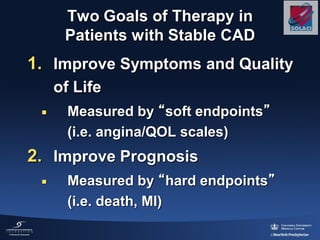
Two Goals of Therapy in
Patients with Stable CAD
1. Improve Symptoms and Quality
of Life
 Measured by “soft endpoints”
(i.e. angina/QOL scales)
2. Improve Prognosis
 Measured by “hard endpoints”
(i.e. death, MI)
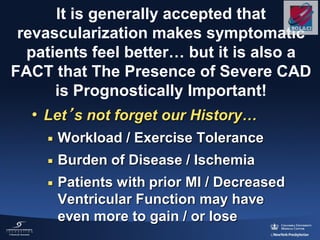
It is generally accepted that
revascularization makes symptomatic
patients feel better… but it is also a
FACT that The Presence of Severe CAD
is Prognostically Important!
• Let’s not forget our History…
 Workload / Exercise Tolerance
 Burden of Disease / Ischemia
 Patients with prior MI / Decreased
Ventricular Function may have
even more to gain / or lose
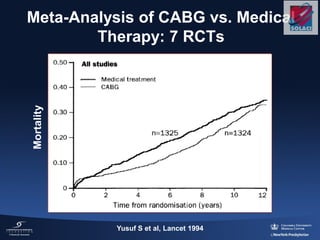
Meta-Analysis of CABG vs. Medical
Therapy: 7 RCTs
Yusuf S et al, Lancet 1994
Mortality
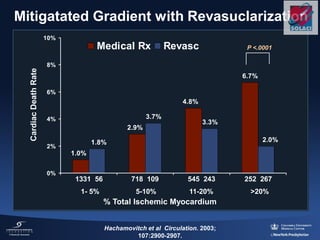
6.7%
3.7%
3.3%
1.0%
2.9%
4.8%
1.8% 2.0%
0%
2%
4%
6%
8%
10%
Medical Rx Revasc
Mitigatated Gradient with Revasuclarization
% Total Ischemic Myocardium
1- 5% 5-10% 11-20% >20%
CardiacDeathRate
1331 56 718 109 545 243 252 267
P <.0001
Hachamovitch et al Circulation. 2003;
107:2900-2907.
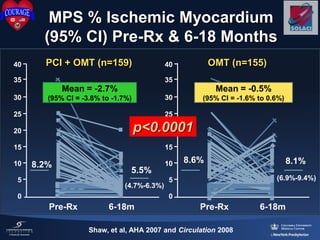
MPS % Ischemic Myocardium
(95% CI) Pre-Rx & 6-18 Months
0
40
5
10
15
20
25
35
30
Pre-Rx 6-18m
8.2%
5.5%
(4.7%-6.3%)
PCI + OMT (n=159) OMT (n=155)
0
40
5
10
15
20
25
35
30
Pre-Rx 6-18m
(6.9%-9.4%)
8.6% 8.1%
Mean = -2.7%
(95% CI = -3.8% to -1.7%)
Mean = -0.5%
(95% CI = -1.6% to 0.6%)
p<0.0001
Shaw, et al, AHA 2007 and Circulation 2008
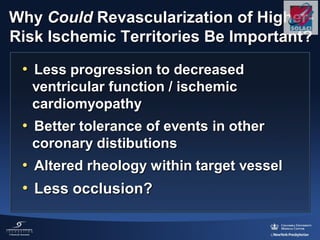
• Less progression to decreased
ventricular function / ischemic
cardiomyopathy
• Better tolerance of events in other
coronary distibutions
• Altered rheology within target vessel
• Less occlusion?
Why Could Revascularization of Higher-
Risk Ischemic Territories Be Important?
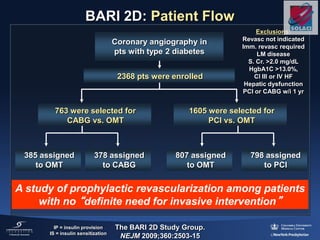
385 assigned
to OMT
BARI 2D: Patient Flow
378 assigned
to CABG
807 assigned
to OMT
798 assigned
to PCI
2368 pts were enrolled
763 were selected for
CABG vs. OMT
1605 were selected for
PCI vs. OMT
Coronary angiography in
pts with type 2 diabetes
IP = insulin provision
IS = insulin sensitization
Exclusions:
Revasc not indicated
Imm. revasc required
LM disease
S. Cr. >2.0 mg/dL
HgbA1C >13.0%,
Cl III or IV HF
Hepatic dysfunction
PCI or CABG w/i 1 yr
A study of prophylactic revascularization among patients
with no “definite need for invasive intervention”
The BARI 2D Study Group.
NEJM 2009;360:2503-15
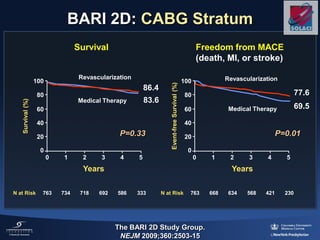
BARI 2D: CABG Stratum
Survival Freedom from MACE
(death, MI, or stroke)
Survival(%)
Years
Event-freeSurvival(%)
Years
P=0.33
0 1 2 3 4 5
0
20
40
60
80
Medical Therapy
Revascularization
83.6
86.4
N at Risk 763 734 718 692 586 333
100
P=0.01
0 1 2 3 4 5
0
20
40
60
80
Medical Therapy
Revascularization
69.5
77.6
N at Risk 763 668 634 568 421 230
100
The BARI 2D Study Group.
NEJM 2009;360:2503-15
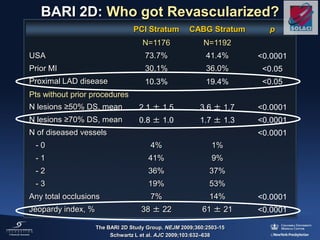
BARI 2D: Who got Revascularized?
PCI Stratum CABG Stratum p
N=1176 N=1192
USA 73.7% 41.4% <0.0001
Prior MI 30.1% 36.0% <0.05
Proximal LAD disease 10.3% 19.4% <0.05
Pts without prior procedures
N lesions ≥50% DS, mean 2.1 ± 1.5 3.6 ± 1.7 <0.0001
N lesions ≥70% DS, mean 0.8 ± 1.0 1.7 ± 1.3 <0.0001
N of diseased vessels <0.0001
- 0 4% 1%
- 1 41% 9%
- 2 36% 37%
- 3 19% 53%
Any total occlusions 7% 14% <0.0001
Jeopardy index, % 38 ± 22 61 ± 21 <0.0001
The BARI 2D Study Group. NEJM 2009;360:2503-15
Schwartz L et al. AJC 2009;103:632–638
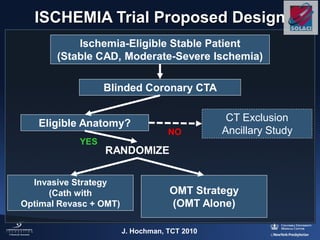
Ischemia-Eligible Stable Patient
(Stable CAD, Moderate-Severe Ischemia)
Blinded Coronary CTA
Eligible Anatomy?
RANDOMIZE
Invasive Strategy
(Cath with
Optimal Revasc + OMT)
CT Exclusion
Ancillary Study
OMT Strategy
(OMT Alone)
YES
NO
ISCHEMIA Trial Proposed Design
J. Hochman, TCT 2010
5-year D/MI/CVA PCI vs. CABG
16.7% vs. 16.9%, P=0.69
HR [95%CI] = 0.96 [0.79-1.16]
Days
FreedomfromDeath,
StrokeandMI(%)
100
90
80
70
60
50
0 365 730 1095 1460 1825
Daemen J et al. Circulation 2008;118:1146-1154
Bare Metal Stents vs. CABG
CABG 83.1%
PCI 83.3%
4 randomized trials, 3,051 randomized pts,
5-year follow-up (patient level pooled analysis)
PLR = 0.64
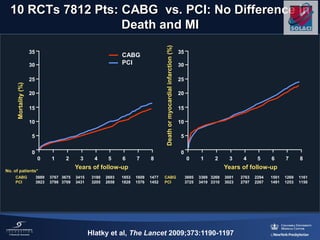
Hlatky et al, The Lancet 2009;373:1190-1197
10 RCTs 7812 Pts: CABG vs. PCI: No Difference in
Death and MI
CABG 3889 3767 3675 3415 3180 2693 1853 1609 1477
PCI 3923 3798 3709 3431 3205 2658 1828 1576 1452
Years of follow-up
Mortality(%)
CABG
PCI
35
30
25
20
15
10
5
0
0 1 2 3 4 5 6 7 8
No. of patients* Deathormyocardialinfarction(%)
CABG 3695 3369 3269 3001 2763 2294 1501 1269 1161
PCI 3725 3419 3310 3023 2797 2267 1491 1253 1150
Years of follow-up
35
30
25
20
15
10
5
0
0 1 2 3 4 5 6 7 8
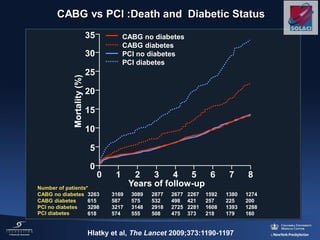
CABG vs PCI :Death and Diabetic Status
Number of patients*
CABG no diabetes 3263 3169 3089 2877 2677 2267 1592 1380 1274
CABG diabetes 615 587 575 532 498 421 257 225 200
PCI no diabetes 3298 3217 3148 2918 2725 2281 1608 1393 1288
618 574 555 508 475 373 218 179 160
Years of follow-up
Mortality(%)
CABG no diabetes
CABG diabetes
PCI no diabetes
PCI diabetes
35
30
25
20
15
10
5
0
0 1 2 3 4 5 6 7 8
PCI diabetes
Hlatky et al, The Lancet 2009;373:1190-1197
71% enrolled
(N=3,075)
All Pts with de novo 3VD and/or
LM disease (N=4,337)
Treatment preference (9.4%)
Referring MD or pts. refused
informed consent (7.0%)
Inclusion/exclusion (4.7%)
Withdrew before consent (4.3%)
Other (1.8%)
Medical treatment (1.2%)
TAXUS
n=903
PCI
n=198
CABG
n=1077
CABG
n=897
no f/u
n=428
5yr f/u
n=649
PCI
all captured w/
follow up
CABG
2500
750 w/ f/u
vs
Total enrollment
N=3075
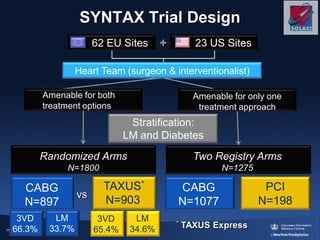
Stratification:
LM and Diabetes
Two Registry ArmsRandomized Arms
n=1800
Two Registry Arms
N=1275
Randomized Arms
N=1800
Heart Team (surgeon & interventionalist)
PCI
N=198
CABG
N=1077
Amenable for only one
treatment approach
TAXUS*
N=903
CABG
N=897
vs
Amenable for both
treatment options
Stratification:
LM and Diabetes
LM
33.7%
3VD
66.3%
LM
34.6%
3VD
65.4%
23 US Sites62 EU Sites +
SYNTAX Trial Design
*
TAXUS Express
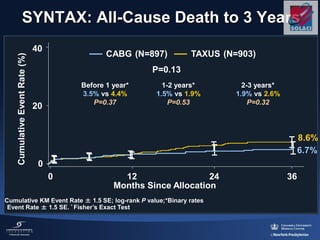
SYNTAX: All-Cause Death to 3 Years
Before 1 year*
3.5% vs 4.4%
P=0.37
TAXUS (N=903)CABG (N=897)
6.7%
8.6%
0 12 36
20
40
0
Months Since Allocation
CumulativeEventRate(%)
1-2 years*
1.5% vs 1.9%
P=0.53
2-3 years*
1.9% vs 2.6%
P=0.32
24
Cumulative KM Event Rate ± 1.5 SE; log-rank P value;*Binary rates
Event Rate ± 1.5 SE. * Fisher’s Exact Test
P=0.13
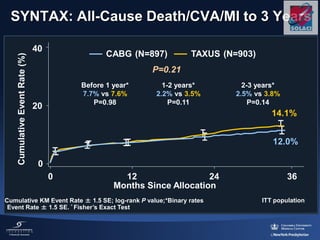
SYNTAX: All-Cause Death/CVA/MI to 3 Years
Before 1 year*
7.7% vs 7.6%
P=0.98
TAXUS (N=903)CABG (N=897)
12.0%
14.1%
0 12 36
20
40
0
Months Since Allocation
CumulativeEventRate(%)
1-2 years*
2.2% vs 3.5%
P=0.11
2-3 years*
2.5% vs 3.8%
P=0.14
24
Cumulative KM Event Rate ± 1.5 SE; log-rank P value;*Binary rates
Event Rate ± 1.5 SE. * Fisher’s Exact Test
P=0.21
ITT population
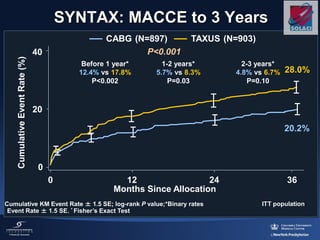
SYNTAX: MACCE to 3 Years
Before 1 year*
12.4% vs 17.8%
P<0.002
TAXUS (N=903)CABG (N=897)
20.2%
28.0%
0 12 36
20
40
0
Months Since Allocation
CumulativeEventRate(%)
1-2 years*
5.7% vs 8.3%
P=0.03
2-3 years*
4.8% vs 6.7%
P=0.10
24
Cumulative KM Event Rate ± 1.5 SE; log-rank P value;*Binary rates
Event Rate ± 1.5 SE. * Fisher’s Exact Test
P<0.001
ITT population
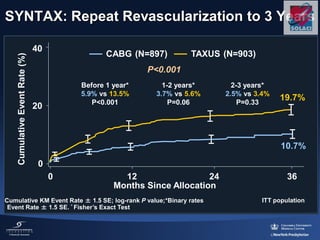
SYNTAX: Repeat Revascularization to 3 Years
Before 1 year*
5.9% vs 13.5%
P<0.001
TAXUS (N=903)CABG (N=897)
10.7%
19.7%
0 12 36
20
40
0
Months Since Allocation
CumulativeEventRate(%)
1-2 years*
3.7% vs 5.6%
P=0.06
2-3 years*
2.5% vs 3.4%
P=0.33
24
Cumulative KM Event Rate ± 1.5 SE; log-rank P value;*Binary rates
Event Rate ± 1.5 SE. * Fisher’s Exact Test
P<0.001
ITT population
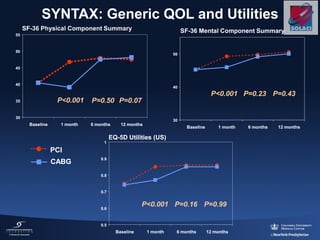
SYNTAX: Generic QOL and Utilities
0.5
0.6
0.7
0.8
0.9
1
Baseline 1 month 6 months 12 months
30
40
50
Baseline 1 month 6 months 12 months
SF-36 Mental Component Summary
P=0.23 P=0.43
30
35
40
45
50
55
Baseline 1 month 6 months 12 months
P=0.50 P=0.07
P=0.16 P=0.99
SF-36 Physical Component Summary
EQ-5D Utilities (US)
PCI
CABG
0.5
0.6
0.7
0.8
0.9
1
Baseline 1 month 6 months 12 months
30
40
50
Baseline 1 month 6 months 12 months
SF-36 Mental Component Summary
P<0.001
30
35
40
45
50
55
Baseline 1 month 6 months 12 months
P<0.001
P<0.001
SF-
EQ-5D Utilities (US)
PCI
CABG
PCI
CABG
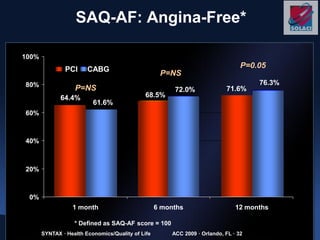
SAQ-AF: Angina-Free*
* Defined as SAQ-AF score = 100
SYNTAX · Health Economics/Quality of Life ACC 2009 · Orlando, FL · 32
71.6%
76.3%
0%
20%
40%
60%
80%
100%
1 month 6 months 12 months
PCI CABG
P=NS
P=NS
P=0.05
64.4%
61.6%
68.5%
72.0%
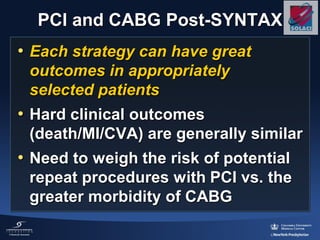
PCI and CABG Post-SYNTAX
• Each strategy can have great
outcomes in appropriately
selected patients
• Hard clinical outcomes
(death/MI/CVA) are generally similar
• Need to weigh the risk of potential
repeat procedures with PCI vs. the
greater morbidity of CABG
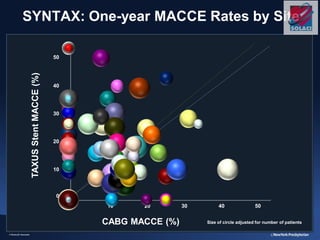
SYNTAX: One-year MACCE Rates by Site
CABG MACCE (%)
TAXUSStentMACCE(%)
50
30
40
20
10
0
10 20 30 40 50
Size of circle adjusted for number of patients
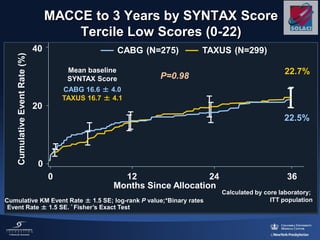
MACCE to 3 Years by SYNTAX Score
Tercile Low Scores (0-22)
Mean baseline
SYNTAX Score
CABG 16.6 ± 4.0
TAXUS 16.7 ± 4.1
TAXUS (N=299)CABG (N=275)
22.5%
22.7%
0 12 36
20
40
0
Months Since Allocation
CumulativeEventRate(%)
24
Cumulative KM Event Rate ± 1.5 SE; log-rank P value;*Binary rates
Event Rate ± 1.5 SE. * Fisher’s Exact Test
P=0.98
Calculated by core laboratory;
ITT population
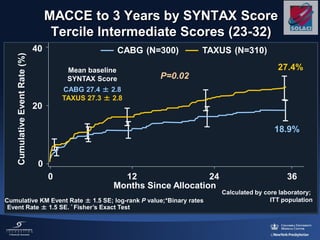
MACCE to 3 Years by SYNTAX Score
Tercile Intermediate Scores (23-32)
Mean baseline
SYNTAX Score
CABG 27.4 ± 2.8
TAXUS 27.3 ± 2.8
TAXUS (N=310)CABG (N=300)
18.9%
27.4%
0 12 36
20
40
0
Months Since Allocation
CumulativeEventRate(%)
24
Cumulative KM Event Rate ± 1.5 SE; log-rank P value;*Binary rates
Event Rate ± 1.5 SE. * Fisher’s Exact Test
P=0.02
Calculated by core laboratory;
ITT population
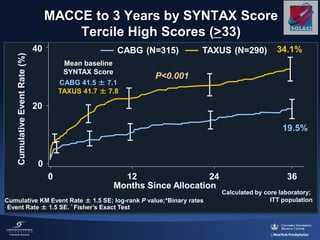
MACCE to 3 Years by SYNTAX Score
Tercile High Scores (>33)
Mean baseline
SYNTAX Score
CABG 41.5 ± 7.1
TAXUS 41.7 ± 7.8
TAXUS (N=290)CABG (N=315)
19.5%
34.1%
0 12 36
20
40
0
Months Since Allocation
CumulativeEventRate(%)
24
Cumulative KM Event Rate ± 1.5 SE; log-rank P value;*Binary rates
Event Rate ± 1.5 SE. * Fisher’s Exact Test
P<0.001
Calculated by core laboratory;
ITT population
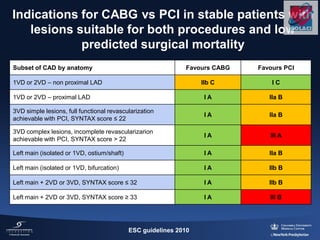
Indications for CABG vs PCI in stable patients with
lesions suitable for both procedures and low
predicted surgical mortality
Subset of CAD by anatomy Favours CABG Favours PCI
1VD or 2VD – non proximal LAD IIb C I C
1VD or 2VD – proximal LAD I A IIa B
3VD simple lesions, full functional revascularization
achievable with PCI, SYNTAX score ≤ 22
I A IIa B
3VD complex lesions, incomplete revascularizarion
achievable with PCI, SYNTAX score > 22
I A III A
Left main (isolated or 1VD, ostium/shaft) I A IIa B
Left main (isolated or 1VD, bifurcation) I A IIb B
Left main + 2VD or 3VD, SYNTAX score ≤ 32 I A IIb B
Left main + 2VD or 3VD, SYNTAX score ≥ 33 I A III B
ESC guidelines 2010
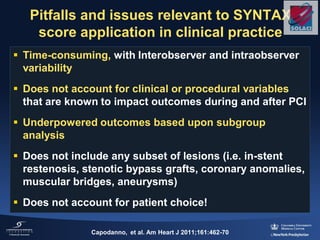
Pitfalls and issues relevant to SYNTAX
score application in clinical practice
 Time-consuming, with Interobserver and intraobserver
variability
 Does not account for clinical or procedural variables
that are known to impact outcomes during and after PCI
 Underpowered outcomes based upon subgroup
analysis
 Does not include any subset of lesions (i.e. in-stent
restenosis, stenotic bypass grafts, coronary anomalies,
muscular bridges, aneurysms)
 Does not account for patient choice!
Capodanno, et al. Am Heart J 2011;161:462-70
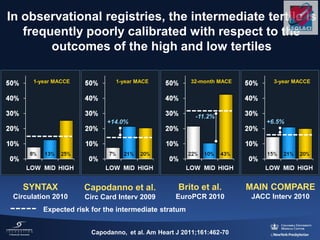
In observational registries, the intermediate tertile is
frequently poorly calibrated with respect to the
outcomes of the high and low tertiles
32-month MACE
Brito et al.
EuroPCR 2010
3-year MACCE
MAIN COMPARE
JACC Interv 2010
SYNTAX
Circulation 2010
1-year MACCE 1-year MACE
Capodanno et al.
Circ Card Interv 2009
Expected risk for the intermediate stratum
+14.0%
-11.2%
+6.5%
Capodanno, et al. Am Heart J 2011;161:462-70
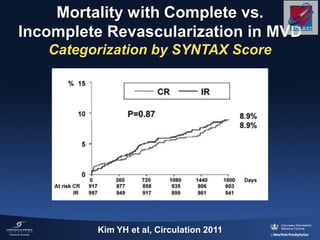
Mortality with Complete vs.
Incomplete Revascularization in MVD
Categorization by SYNTAX Score
Kim YH et al, Circulation 2011
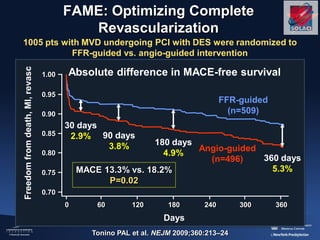
FAME: Optimizing Complete
Revascularization
Tonino PAL et al. NEJM 2009;360:213–24
FFR-guided
(n=509)
30 days
2.9% 90 days
3.8% 180 days
4.9%
360 days
5.3%
Angio-guided
(n=496)
Absolute difference in MACE-free survival
Days
Freedomfromdeath,MI,revasc
0 60 120 180 240 300 360
0.70
0.75
0.80
0.85
0.90
0.95
1.00
MACE 13.3% vs. 18.2%
P=0.02
1005 pts with MVD undergoing PCI with DES were randomized to
FFR-guided vs. angio-guided intervention
3056029-1
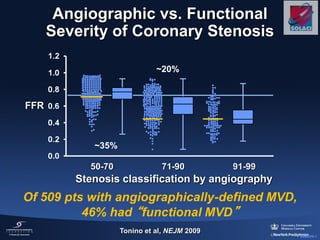
Angiographic vs. Functional
Severity of Coronary Stenosis
Of 509 pts with angiographically-defined MVD,
46% had “functional MVD”
FFR
50-70 71-90 91-99
Stenosis classification by angiography
~20%
~35%
Tonino et al, NEJM 2009
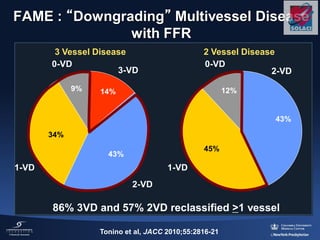
FAME : “Downgrading” Multivessel Disease
with FFR
9% 14%
43%
34%
3-VD
2-VD
1-VD
0-VD
43%
45%
12%
2-VD
1-VD
0-VD
3 Vessel Disease 2 Vessel Disease
Tonino et al, JACC 2010;55:2816-21
86% 3VD and 57% 2VD reclassified >1 vessel
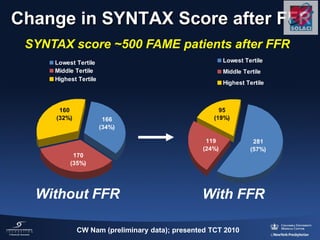
Change in SYNTAX Score after FFR
166
(34%)
170
(35%)
160
(32%)
Lowest Tertile
Middle Tertile
Highest Tertile
CW Nam (preliminary data); presented TCT 2010
Without FFR
SYNTAX score ~500 FAME patients after FFR
281
(57%)
119
(24%)
95
(19%)
Lowest Tertile
Middle Tertile
Highest Tertile
With FFR
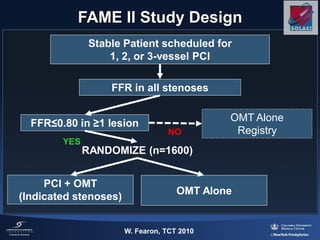
Stable Patient scheduled for
1, 2, or 3-vessel PCI
FFR in all stenoses
FFR≤0.80 in ≥1 lesion
RANDOMIZE (n=1600)
PCI + OMT
(Indicated stenoses)
OMT Alone
Registry
OMT Alone
YES
NO
FAME II Study Design
W. Fearon, TCT 2010
SPIRIT II, III, IV and COMPARE trials
Pooled database analysis (n=6,789)
Ischemic TLR
P<0.001
HR: 0.60 [0.48, 0.75]
EES (n=4,247)
PES (n=2,542)
4247 4143 4004 3363
2542 2416 2328 2018
Number at risk
XIENCE
TAXUS
6.6%
IschemicTLR(%)
0
10
Time in Months
0 3 6 9 12 15 18 21 24
3891
2260
4.1%
5 4.7%
2.3%
SPIRIT II, III, IV and COMPARE trials
Pooled database analysis (n=6,789)
Stent thrombosis (ARC definite/probable)
4247 4177 4082 3479
2542 2463 2408 2110
Number at risk
XIENCE
TAXUS
2.3%
Stentthrombosis
ARCdeforprob(%)
0
1
2
3
Time in Months
0 3 6 9 12 15 18 21 24
3998
2350
0.7%
p<0.001
HR: 0.30 [0.19, 0.47]EES (n=4,247)
PES (n=2,542)
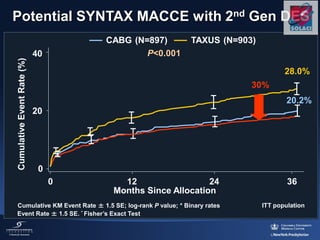
Potential SYNTAX MACCE with 2nd Gen DES
TAXUS (N=903)CABG (N=897)
20.2%
28.0%
0 12 36
20
40
0
Months Since Allocation
CumulativeEventRate(%)
24
Cumulative KM Event Rate ± 1.5 SE; log-rank P value; * Binary rates
Event Rate ± 1.5 SE. * Fisher’s Exact Test
P<0.001
ITT population
30%
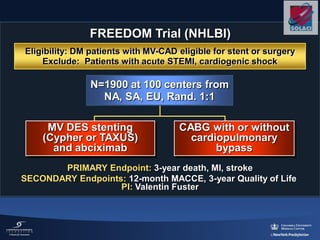
Eligibility: DM patients with MV-CAD eligible for stent or surgery
Exclude: Patients with acute STEMI, cardiogenic shock
MV DES stenting
(Cypher or TAXUS)
and abciximab
CABG with or without
cardiopulmonary
bypass
PRIMARY Endpoint: 3-year death, MI, stroke
SECONDARY Endpoints: 12-month MACCE, 3-year Quality of Life
N=1900 at 100 centers from
NA, SA, EU, Rand. 1:1
PI: Valentin Fuster
FREEDOM Trial (NHLBI)
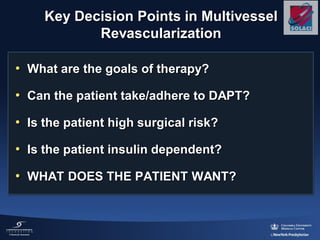
Key Decision Points in Multivessel
Revascularization
• What are the goals of therapy?
• Can the patient take/adhere to DAPT?
• Is the patient high surgical risk?
• Is the patient insulin dependent?
• WHAT DOES THE PATIENT WANT?
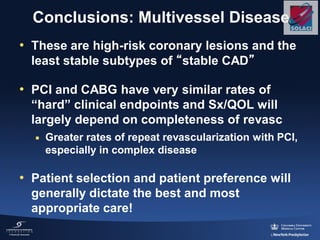
Conclusions: Multivessel Disease
• These are high-risk coronary lesions and the
least stable subtypes of “stable CAD”
• PCI and CABG have very similar rates of
“hard” clinical endpoints and Sx/QOL will
largely depend on completeness of revasc
 Greater rates of repeat revascularization with PCI,
especially in complex disease
• Patient selection and patient preference will
generally dictate the best and most
appropriate care!

Drug-Eluting Stents for Multivessel PCI

  • 1.
    Ajay J. Kirtane,MD, SM Center for Interventional Vascular Therapy Columbia University Medical Center / New York Presbyterian Hospital Drug-Eluting Stents for Multivessel PCI: Indications and Outcomes
  • 2.
    Conflict of InterestDisclosure • Ajay J. Kirtane  None  Off-label use will be discussed
  • 3.
    Two Goals ofTherapy in Patients with Stable CAD 1. Improve Symptoms and Quality of Life  Measured by “soft endpoints” (i.e. angina/QOL scales) 2. Improve Prognosis  Measured by “hard endpoints” (i.e. death, MI)
  • 4.
    It is generallyaccepted that revascularization makes symptomatic patients feel better… but it is also a FACT that The Presence of Severe CAD is Prognostically Important! • Let’s not forget our History…  Workload / Exercise Tolerance  Burden of Disease / Ischemia  Patients with prior MI / Decreased Ventricular Function may have even more to gain / or lose
  • 5.
    Meta-Analysis of CABGvs. Medical Therapy: 7 RCTs Yusuf S et al, Lancet 1994 Mortality
  • 6.
    6.7% 3.7% 3.3% 1.0% 2.9% 4.8% 1.8% 2.0% 0% 2% 4% 6% 8% 10% Medical RxRevasc Mitigatated Gradient with Revasuclarization % Total Ischemic Myocardium 1- 5% 5-10% 11-20% >20% CardiacDeathRate 1331 56 718 109 545 243 252 267 P <.0001 Hachamovitch et al Circulation. 2003; 107:2900-2907.
  • 7.
    MPS % IschemicMyocardium (95% CI) Pre-Rx & 6-18 Months 0 40 5 10 15 20 25 35 30 Pre-Rx 6-18m 8.2% 5.5% (4.7%-6.3%) PCI + OMT (n=159) OMT (n=155) 0 40 5 10 15 20 25 35 30 Pre-Rx 6-18m (6.9%-9.4%) 8.6% 8.1% Mean = -2.7% (95% CI = -3.8% to -1.7%) Mean = -0.5% (95% CI = -1.6% to 0.6%) p<0.0001 Shaw, et al, AHA 2007 and Circulation 2008
  • 8.
    • Less progressionto decreased ventricular function / ischemic cardiomyopathy • Better tolerance of events in other coronary distibutions • Altered rheology within target vessel • Less occlusion? Why Could Revascularization of Higher- Risk Ischemic Territories Be Important?
  • 9.
    385 assigned to OMT BARI2D: Patient Flow 378 assigned to CABG 807 assigned to OMT 798 assigned to PCI 2368 pts were enrolled 763 were selected for CABG vs. OMT 1605 were selected for PCI vs. OMT Coronary angiography in pts with type 2 diabetes IP = insulin provision IS = insulin sensitization Exclusions: Revasc not indicated Imm. revasc required LM disease S. Cr. >2.0 mg/dL HgbA1C >13.0%, Cl III or IV HF Hepatic dysfunction PCI or CABG w/i 1 yr A study of prophylactic revascularization among patients with no “definite need for invasive intervention” The BARI 2D Study Group. NEJM 2009;360:2503-15
  • 10.
    BARI 2D: CABGStratum Survival Freedom from MACE (death, MI, or stroke) Survival(%) Years Event-freeSurvival(%) Years P=0.33 0 1 2 3 4 5 0 20 40 60 80 Medical Therapy Revascularization 83.6 86.4 N at Risk 763 734 718 692 586 333 100 P=0.01 0 1 2 3 4 5 0 20 40 60 80 Medical Therapy Revascularization 69.5 77.6 N at Risk 763 668 634 568 421 230 100 The BARI 2D Study Group. NEJM 2009;360:2503-15
  • 11.
    BARI 2D: Whogot Revascularized? PCI Stratum CABG Stratum p N=1176 N=1192 USA 73.7% 41.4% <0.0001 Prior MI 30.1% 36.0% <0.05 Proximal LAD disease 10.3% 19.4% <0.05 Pts without prior procedures N lesions ≥50% DS, mean 2.1 ± 1.5 3.6 ± 1.7 <0.0001 N lesions ≥70% DS, mean 0.8 ± 1.0 1.7 ± 1.3 <0.0001 N of diseased vessels <0.0001 - 0 4% 1% - 1 41% 9% - 2 36% 37% - 3 19% 53% Any total occlusions 7% 14% <0.0001 Jeopardy index, % 38 ± 22 61 ± 21 <0.0001 The BARI 2D Study Group. NEJM 2009;360:2503-15 Schwartz L et al. AJC 2009;103:632–638
  • 12.
    Ischemia-Eligible Stable Patient (StableCAD, Moderate-Severe Ischemia) Blinded Coronary CTA Eligible Anatomy? RANDOMIZE Invasive Strategy (Cath with Optimal Revasc + OMT) CT Exclusion Ancillary Study OMT Strategy (OMT Alone) YES NO ISCHEMIA Trial Proposed Design J. Hochman, TCT 2010
  • 13.
    5-year D/MI/CVA PCIvs. CABG 16.7% vs. 16.9%, P=0.69 HR [95%CI] = 0.96 [0.79-1.16] Days FreedomfromDeath, StrokeandMI(%) 100 90 80 70 60 50 0 365 730 1095 1460 1825 Daemen J et al. Circulation 2008;118:1146-1154 Bare Metal Stents vs. CABG CABG 83.1% PCI 83.3% 4 randomized trials, 3,051 randomized pts, 5-year follow-up (patient level pooled analysis) PLR = 0.64
  • 14.
    Hlatky et al,The Lancet 2009;373:1190-1197 10 RCTs 7812 Pts: CABG vs. PCI: No Difference in Death and MI CABG 3889 3767 3675 3415 3180 2693 1853 1609 1477 PCI 3923 3798 3709 3431 3205 2658 1828 1576 1452 Years of follow-up Mortality(%) CABG PCI 35 30 25 20 15 10 5 0 0 1 2 3 4 5 6 7 8 No. of patients* Deathormyocardialinfarction(%) CABG 3695 3369 3269 3001 2763 2294 1501 1269 1161 PCI 3725 3419 3310 3023 2797 2267 1491 1253 1150 Years of follow-up 35 30 25 20 15 10 5 0 0 1 2 3 4 5 6 7 8
  • 15.
    CABG vs PCI:Death and Diabetic Status Number of patients* CABG no diabetes 3263 3169 3089 2877 2677 2267 1592 1380 1274 CABG diabetes 615 587 575 532 498 421 257 225 200 PCI no diabetes 3298 3217 3148 2918 2725 2281 1608 1393 1288 618 574 555 508 475 373 218 179 160 Years of follow-up Mortality(%) CABG no diabetes CABG diabetes PCI no diabetes PCI diabetes 35 30 25 20 15 10 5 0 0 1 2 3 4 5 6 7 8 PCI diabetes Hlatky et al, The Lancet 2009;373:1190-1197
  • 16.
    71% enrolled (N=3,075) All Ptswith de novo 3VD and/or LM disease (N=4,337) Treatment preference (9.4%) Referring MD or pts. refused informed consent (7.0%) Inclusion/exclusion (4.7%) Withdrew before consent (4.3%) Other (1.8%) Medical treatment (1.2%) TAXUS n=903 PCI n=198 CABG n=1077 CABG n=897 no f/u n=428 5yr f/u n=649 PCI all captured w/ follow up CABG 2500 750 w/ f/u vs Total enrollment N=3075 Stratification: LM and Diabetes Two Registry ArmsRandomized Arms n=1800 Two Registry Arms N=1275 Randomized Arms N=1800 Heart Team (surgeon & interventionalist) PCI N=198 CABG N=1077 Amenable for only one treatment approach TAXUS* N=903 CABG N=897 vs Amenable for both treatment options Stratification: LM and Diabetes LM 33.7% 3VD 66.3% LM 34.6% 3VD 65.4% 23 US Sites62 EU Sites + SYNTAX Trial Design * TAXUS Express
  • 17.
    SYNTAX: All-Cause Deathto 3 Years Before 1 year* 3.5% vs 4.4% P=0.37 TAXUS (N=903)CABG (N=897) 6.7% 8.6% 0 12 36 20 40 0 Months Since Allocation CumulativeEventRate(%) 1-2 years* 1.5% vs 1.9% P=0.53 2-3 years* 1.9% vs 2.6% P=0.32 24 Cumulative KM Event Rate ± 1.5 SE; log-rank P value;*Binary rates Event Rate ± 1.5 SE. * Fisher’s Exact Test P=0.13
  • 18.
    SYNTAX: All-Cause Death/CVA/MIto 3 Years Before 1 year* 7.7% vs 7.6% P=0.98 TAXUS (N=903)CABG (N=897) 12.0% 14.1% 0 12 36 20 40 0 Months Since Allocation CumulativeEventRate(%) 1-2 years* 2.2% vs 3.5% P=0.11 2-3 years* 2.5% vs 3.8% P=0.14 24 Cumulative KM Event Rate ± 1.5 SE; log-rank P value;*Binary rates Event Rate ± 1.5 SE. * Fisher’s Exact Test P=0.21 ITT population
  • 19.
    SYNTAX: MACCE to3 Years Before 1 year* 12.4% vs 17.8% P<0.002 TAXUS (N=903)CABG (N=897) 20.2% 28.0% 0 12 36 20 40 0 Months Since Allocation CumulativeEventRate(%) 1-2 years* 5.7% vs 8.3% P=0.03 2-3 years* 4.8% vs 6.7% P=0.10 24 Cumulative KM Event Rate ± 1.5 SE; log-rank P value;*Binary rates Event Rate ± 1.5 SE. * Fisher’s Exact Test P<0.001 ITT population
  • 20.
    SYNTAX: Repeat Revascularizationto 3 Years Before 1 year* 5.9% vs 13.5% P<0.001 TAXUS (N=903)CABG (N=897) 10.7% 19.7% 0 12 36 20 40 0 Months Since Allocation CumulativeEventRate(%) 1-2 years* 3.7% vs 5.6% P=0.06 2-3 years* 2.5% vs 3.4% P=0.33 24 Cumulative KM Event Rate ± 1.5 SE; log-rank P value;*Binary rates Event Rate ± 1.5 SE. * Fisher’s Exact Test P<0.001 ITT population
  • 21.
    SYNTAX: Generic QOLand Utilities 0.5 0.6 0.7 0.8 0.9 1 Baseline 1 month 6 months 12 months 30 40 50 Baseline 1 month 6 months 12 months SF-36 Mental Component Summary P=0.23 P=0.43 30 35 40 45 50 55 Baseline 1 month 6 months 12 months P=0.50 P=0.07 P=0.16 P=0.99 SF-36 Physical Component Summary EQ-5D Utilities (US) PCI CABG 0.5 0.6 0.7 0.8 0.9 1 Baseline 1 month 6 months 12 months 30 40 50 Baseline 1 month 6 months 12 months SF-36 Mental Component Summary P<0.001 30 35 40 45 50 55 Baseline 1 month 6 months 12 months P<0.001 P<0.001 SF- EQ-5D Utilities (US) PCI CABG PCI CABG
  • 22.
    SAQ-AF: Angina-Free* * Definedas SAQ-AF score = 100 SYNTAX · Health Economics/Quality of Life ACC 2009 · Orlando, FL · 32 71.6% 76.3% 0% 20% 40% 60% 80% 100% 1 month 6 months 12 months PCI CABG P=NS P=NS P=0.05 64.4% 61.6% 68.5% 72.0%
  • 23.
    PCI and CABGPost-SYNTAX • Each strategy can have great outcomes in appropriately selected patients • Hard clinical outcomes (death/MI/CVA) are generally similar • Need to weigh the risk of potential repeat procedures with PCI vs. the greater morbidity of CABG
  • 24.
    SYNTAX: One-year MACCERates by Site CABG MACCE (%) TAXUSStentMACCE(%) 50 30 40 20 10 0 10 20 30 40 50 Size of circle adjusted for number of patients
  • 25.
    MACCE to 3Years by SYNTAX Score Tercile Low Scores (0-22) Mean baseline SYNTAX Score CABG 16.6 ± 4.0 TAXUS 16.7 ± 4.1 TAXUS (N=299)CABG (N=275) 22.5% 22.7% 0 12 36 20 40 0 Months Since Allocation CumulativeEventRate(%) 24 Cumulative KM Event Rate ± 1.5 SE; log-rank P value;*Binary rates Event Rate ± 1.5 SE. * Fisher’s Exact Test P=0.98 Calculated by core laboratory; ITT population
  • 26.
    MACCE to 3Years by SYNTAX Score Tercile Intermediate Scores (23-32) Mean baseline SYNTAX Score CABG 27.4 ± 2.8 TAXUS 27.3 ± 2.8 TAXUS (N=310)CABG (N=300) 18.9% 27.4% 0 12 36 20 40 0 Months Since Allocation CumulativeEventRate(%) 24 Cumulative KM Event Rate ± 1.5 SE; log-rank P value;*Binary rates Event Rate ± 1.5 SE. * Fisher’s Exact Test P=0.02 Calculated by core laboratory; ITT population
  • 27.
    MACCE to 3Years by SYNTAX Score Tercile High Scores (>33) Mean baseline SYNTAX Score CABG 41.5 ± 7.1 TAXUS 41.7 ± 7.8 TAXUS (N=290)CABG (N=315) 19.5% 34.1% 0 12 36 20 40 0 Months Since Allocation CumulativeEventRate(%) 24 Cumulative KM Event Rate ± 1.5 SE; log-rank P value;*Binary rates Event Rate ± 1.5 SE. * Fisher’s Exact Test P<0.001 Calculated by core laboratory; ITT population
  • 28.
    Indications for CABGvs PCI in stable patients with lesions suitable for both procedures and low predicted surgical mortality Subset of CAD by anatomy Favours CABG Favours PCI 1VD or 2VD – non proximal LAD IIb C I C 1VD or 2VD – proximal LAD I A IIa B 3VD simple lesions, full functional revascularization achievable with PCI, SYNTAX score ≤ 22 I A IIa B 3VD complex lesions, incomplete revascularizarion achievable with PCI, SYNTAX score > 22 I A III A Left main (isolated or 1VD, ostium/shaft) I A IIa B Left main (isolated or 1VD, bifurcation) I A IIb B Left main + 2VD or 3VD, SYNTAX score ≤ 32 I A IIb B Left main + 2VD or 3VD, SYNTAX score ≥ 33 I A III B ESC guidelines 2010
  • 29.
    Pitfalls and issuesrelevant to SYNTAX score application in clinical practice  Time-consuming, with Interobserver and intraobserver variability  Does not account for clinical or procedural variables that are known to impact outcomes during and after PCI  Underpowered outcomes based upon subgroup analysis  Does not include any subset of lesions (i.e. in-stent restenosis, stenotic bypass grafts, coronary anomalies, muscular bridges, aneurysms)  Does not account for patient choice! Capodanno, et al. Am Heart J 2011;161:462-70
  • 30.
    In observational registries,the intermediate tertile is frequently poorly calibrated with respect to the outcomes of the high and low tertiles 32-month MACE Brito et al. EuroPCR 2010 3-year MACCE MAIN COMPARE JACC Interv 2010 SYNTAX Circulation 2010 1-year MACCE 1-year MACE Capodanno et al. Circ Card Interv 2009 Expected risk for the intermediate stratum +14.0% -11.2% +6.5% Capodanno, et al. Am Heart J 2011;161:462-70
  • 31.
    Mortality with Completevs. Incomplete Revascularization in MVD Categorization by SYNTAX Score Kim YH et al, Circulation 2011
  • 32.
    FAME: Optimizing Complete Revascularization ToninoPAL et al. NEJM 2009;360:213–24 FFR-guided (n=509) 30 days 2.9% 90 days 3.8% 180 days 4.9% 360 days 5.3% Angio-guided (n=496) Absolute difference in MACE-free survival Days Freedomfromdeath,MI,revasc 0 60 120 180 240 300 360 0.70 0.75 0.80 0.85 0.90 0.95 1.00 MACE 13.3% vs. 18.2% P=0.02 1005 pts with MVD undergoing PCI with DES were randomized to FFR-guided vs. angio-guided intervention
  • 33.
    3056029-1 Angiographic vs. Functional Severityof Coronary Stenosis Of 509 pts with angiographically-defined MVD, 46% had “functional MVD” FFR 50-70 71-90 91-99 Stenosis classification by angiography ~20% ~35% Tonino et al, NEJM 2009
  • 34.
    FAME : “Downgrading”Multivessel Disease with FFR 9% 14% 43% 34% 3-VD 2-VD 1-VD 0-VD 43% 45% 12% 2-VD 1-VD 0-VD 3 Vessel Disease 2 Vessel Disease Tonino et al, JACC 2010;55:2816-21 86% 3VD and 57% 2VD reclassified >1 vessel
  • 35.
    Change in SYNTAXScore after FFR 166 (34%) 170 (35%) 160 (32%) Lowest Tertile Middle Tertile Highest Tertile CW Nam (preliminary data); presented TCT 2010 Without FFR SYNTAX score ~500 FAME patients after FFR 281 (57%) 119 (24%) 95 (19%) Lowest Tertile Middle Tertile Highest Tertile With FFR
  • 36.
    Stable Patient scheduledfor 1, 2, or 3-vessel PCI FFR in all stenoses FFR≤0.80 in ≥1 lesion RANDOMIZE (n=1600) PCI + OMT (Indicated stenoses) OMT Alone Registry OMT Alone YES NO FAME II Study Design W. Fearon, TCT 2010
  • 37.
    SPIRIT II, III,IV and COMPARE trials Pooled database analysis (n=6,789) Ischemic TLR P<0.001 HR: 0.60 [0.48, 0.75] EES (n=4,247) PES (n=2,542) 4247 4143 4004 3363 2542 2416 2328 2018 Number at risk XIENCE TAXUS 6.6% IschemicTLR(%) 0 10 Time in Months 0 3 6 9 12 15 18 21 24 3891 2260 4.1% 5 4.7% 2.3%
  • 38.
    SPIRIT II, III,IV and COMPARE trials Pooled database analysis (n=6,789) Stent thrombosis (ARC definite/probable) 4247 4177 4082 3479 2542 2463 2408 2110 Number at risk XIENCE TAXUS 2.3% Stentthrombosis ARCdeforprob(%) 0 1 2 3 Time in Months 0 3 6 9 12 15 18 21 24 3998 2350 0.7% p<0.001 HR: 0.30 [0.19, 0.47]EES (n=4,247) PES (n=2,542)
  • 39.
    Potential SYNTAX MACCEwith 2nd Gen DES TAXUS (N=903)CABG (N=897) 20.2% 28.0% 0 12 36 20 40 0 Months Since Allocation CumulativeEventRate(%) 24 Cumulative KM Event Rate ± 1.5 SE; log-rank P value; * Binary rates Event Rate ± 1.5 SE. * Fisher’s Exact Test P<0.001 ITT population 30%
  • 40.
    Eligibility: DM patientswith MV-CAD eligible for stent or surgery Exclude: Patients with acute STEMI, cardiogenic shock MV DES stenting (Cypher or TAXUS) and abciximab CABG with or without cardiopulmonary bypass PRIMARY Endpoint: 3-year death, MI, stroke SECONDARY Endpoints: 12-month MACCE, 3-year Quality of Life N=1900 at 100 centers from NA, SA, EU, Rand. 1:1 PI: Valentin Fuster FREEDOM Trial (NHLBI)
  • 41.
    Key Decision Pointsin Multivessel Revascularization • What are the goals of therapy? • Can the patient take/adhere to DAPT? • Is the patient high surgical risk? • Is the patient insulin dependent? • WHAT DOES THE PATIENT WANT?
  • 42.
    Conclusions: Multivessel Disease •These are high-risk coronary lesions and the least stable subtypes of “stable CAD” • PCI and CABG have very similar rates of “hard” clinical endpoints and Sx/QOL will largely depend on completeness of revasc  Greater rates of repeat revascularization with PCI, especially in complex disease • Patient selection and patient preference will generally dictate the best and most appropriate care!