


•‫الرحيم‬ ‫الرحمن‬ ‫هللا‬ ‫بسم‬
Principles of cardiac surgery
Dr . Nadir Mehmood
Asstt Prof of Surgery
RMC
LEARNING OBJECTIVES
At the end of this discussion, a student will be able to;
• Tell why cardiac surgery is more difficult
• Enlist the historical technical milestones necessary for cardiac
surgery
• Enumerate the pre op preparation and assessment
parameters
• Enlist the Conduits used for bypass and type of incisions for
cardiac surgery
• Describe the steps of Conventional CABG procedure
• Summarize indications for cardiac surgery
• Enlist important factors in postoperative management of
cardiac surgery patients
• Prior to 1930’s, heart surgery seen as impossible, with high morbidity and
mortality
– “Surgery of the heart has probably reached the limits set by nature to all surgery”
–Stephen Paget, 1896, Surgery of the Chest
• 1937: Dr. John Gibbon designs heart-lung machine, which enables
cardiopulmonary bypass (CPB)
• 1955: Vineburg and Buller implant internal mammary artery into myocardium to
treat cardiac ischemia and angina
• 1958: Longmire, Cannon and Kattus at UCLA perform first open coronary artery
endarterectomy without CPB
• During 1960’s and 1970’s, CPB and cardioplegic arrest are adopted, allowing
Coronary Artery Bypass Graft (CABG) to emerge as a viable surgical treatment
RG Cohen, et al; Minimally Invasive Cardiac Surgery
INDICATIONS FOR
SURGERYERY
●CABG (coronary artery bypass grafting)
●Valve repair / replacement
●Thoracic aneaurysm repair
●Surgical management of arrhythmia
●Ventricular reconstruction
●Removal of myxoma
●Surgical correction for congenital heart diseases
●Insertion of ventricular assist device
●Chronic angina
●Unstable angina
●Acute myocardial infarction
●Acute failure of percutaneous transluminal coronary angioplasty
(PTCA)
●Cardiac transplantation
Why cardiac surgery is more difficult ?
• Moving organ
• Contains blood
• Vital, and no place for mistakes.
• Shared with anesthetist
• Very sensitive to electrolyte derangements
RATIONALE FOR CARDIAC SURGERY
SURGICAL MANAGEMENT OF HEART
DISEASES REQUIRES INFORMATION :
• OUTLOOK IF CONDITION IS UN-
OPERATED
• THE RISK OF OPERATION ITSELF
INCLUDING FAILURE TO DEAL WITH THE
DISEASE
• OUTLOOK FOLLOWING SUCCESSFUL
SURGERY
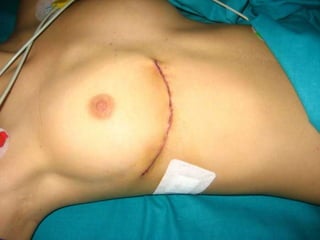
Approaches for cardiac surgery:
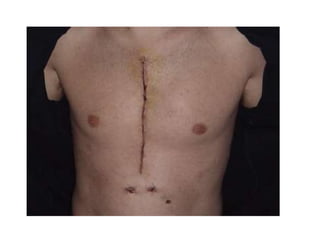
The main and the commonest incision for the
cardiac surgery is median sternotomy.
But others could be used like:
• Right anterolateral thoracotomy
• Left posterolateral thoracotomy
• Minimally invasives.
• Endoscopic approaches.
Preoperative Preparation of
the Patient
• Systems Approach to Preoperative
Evaluation
• Additional Preoperative Considerations
• Preoperative Checklist
Determining the Need for Surgery
• Patients are often referred to surgeons
with a suspected surgical diagnosis and
the results of supporting investigations
in hand. In this context, the surgeon's
initial encounter with the patient may
be largely directed toward confirmation
of relevant physical findings and review
of the clinical history and laboratory
and investigative tests that support the
diagnosis.
Perioperative Decision Making
• Once the decision has been made to
proceed with operative management, a
number of considerations must be
addressed regarding the timing and site
of surgery, the type of anesthesia, and
the preoperative preparation necessary
to understand the patient's risk and
optimize the outcome.
SYSTEMS APPROACH TO
PREOPERATIVE
EVALUATION
One of the first anesthesia risk categorization
systems was the ASA classification. It has
five stratifications:
I—Normal healthy patient
II—Patient with mild systemic disease
III—Patient with severe systemic disease that
limits activity but is not incapacitating
IV—Patient who has incapacitating disease that
is a constant threat to life
V—Moribund patient not expected to survive
24 hours with or without an operation
POTENTIAL RISKS
• Pulmonary
• Renal
• Endocrine
• Nutritional Status
• Obesity
• Antibiotic Prophylaxis
• Identification of coexisting
cardiovascular, circulatory, hematologic,
and metabolic derangements secondary
to renal dysfunction are the goals of
preoperative evaluation in these
patients
Adverse outcome indicators
70 years or older
self-reported alcohol abuse
poor cognitive status
poor functional status
markedly abnormal preoperative serum
sodium, potassium, albumin or glucose
level
Cardio pulmonary bypass (CPB)
Basic principle of CPB is:
• Bypass the right and left side of heart
• Thermal regulation
• Oxygenation
• Filtration
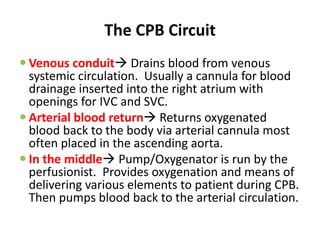
Rationale for the use of CPB
 During open heart surgery, CPB provides the
surgeon with a clear field for cardiac manipulation
and maintenance of pulmonary and
hemodynamic stability. The objective of heart-
lung pump is to provide enough flow to maintain
a sufficient cardiac index for tissue perfusion.
 The addition of cardioplegia allows the surgeon to
work in a motionless and bloodless field.
 The addition of hypothermia to CPB has been
standard practice since Bigelow demonstrated
improved tolerance of the entire organism to
ischemia accompanied by hypothermia.
The CPB Circuit
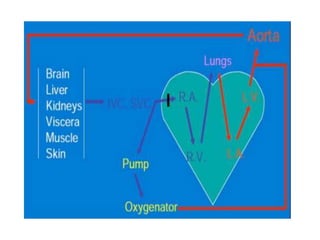
 Venous conduit Drains blood from venous
systemic circulation. Usually a cannula for blood
drainage inserted into the right atrium with
openings for IVC and SVC.
 Arterial blood return Returns oxygenated
blood back to the body via arterial cannula most
often placed in the ascending aorta.
 In the middle Pump/Oxygenator is run by the
perfusionist. Provides oxygenation and means of
delivering various elements to patient during CPB.
Then pumps blood back to the arterial circulation.
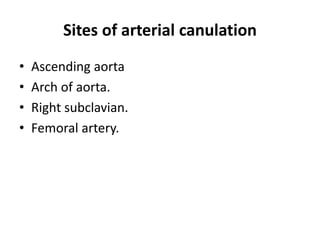
Sites of arterial canulation
• Ascending aorta
• Arch of aorta.
• Right subclavian.
• Femoral artery.
Steps of cardiac surgery with the use of
CPB, (simplified)
 Heparinize.
 Insert canulae
 Connect to lines already prepared.
 Go on bypass.
 Demand for the required temperature
 Cross clamp the aorta
 Give cardioplegia
 Do the procedure
 No more plegia
 Re-warm
 Stop CPB.
 Remove the cross clamp
 Remove the canulae
Monitoring during CPB
This will be done by the coordination between
perfusionist and anesthetist
Includes monitoring of :
• Perfusion pressure
• Venous return
• Urine output
• Temperature
• Blood gas
• Electrolytes
Monitoring during CPB
• ACT, (Clotting time)
• PCV
• PO2 and PCO2
• ECG activities if any
• Time for the plegia
• TEE and presence of air in the heart.
• EEG in some cases of circulatory arrest.
• Need for medications
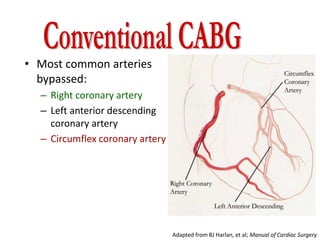
• Most common arteries
bypassed:
– Right coronary artery
– Left anterior descending
coronary artery
– Circumflex coronary artery
Adapted from BJ Harlan, et al; Manual of Cardiac Surgery
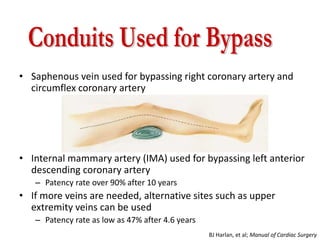
• Saphenous vein used for bypassing right coronary artery and
circumflex coronary artery
• Internal mammary artery (IMA) used for bypassing left anterior
descending coronary artery
– Patency rate over 90% after 10 years
• If more veins are needed, alternative sites such as upper
extremity veins can be used
– Patency rate as low as 47% after 4.6 years
BJ Harlan, et al; Manual of Cardiac Surgery
• Positive:
– Relief of angina in 90% of patients
– 80% angina free after 5 years
– Survival about 95% after 1 year
– Low chance of restenosis
• Negative:
– 2-3 days in ICU, 7-10 day total hospital stay
– 3-6 month full recovery time
– 5-10% have post-op complications
– High cost ($25,000-$30,000)
– Long time on CPB
• Depression of the patient's immune system
• Postoperative bleeding from inactivation of the blood clotting system
• Hypotension
BJ Harlan, et al; Manual of Cardiac Surgery, WebMD.com, American College of Cardiology Foundation
• CABG results in a lower restenosis rate as compared with
stenting
– Drug-eluting stents will narrow this difference
• Due to repeat treatment, costs for stents and surgery are
approximately equal after 2 years
• Minimally invasive surgeries will result in fewer complications
from surgery and a shorter hospital stay
– This leads to lower costs for surgery, essentially removing the cost
advantage of stenting
• Diabetics have a substantially better response to CABG than
to angioplasty and stenting
Current Controlled Trials in Cardiovascular Medicine
CARDIAC SURGERY
VALVULAR HEART DISEASES
a. CONGENITAL
b. AQUIRED
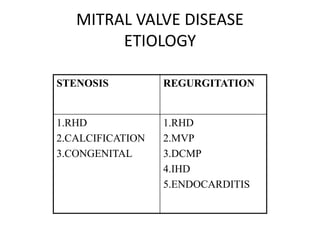
MITRAL VALVE DISEASE
ETIOLOGY
STENOSIS REGURGITATION
1.RHD
2.CALCIFICATION
3.CONGENITAL
1.RHD
2.MVP
3.DCMP
4.IHD
5.ENDOCARDITIS
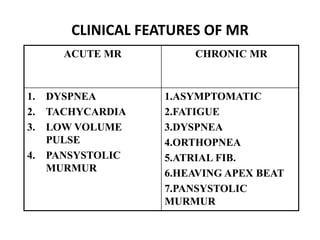
CLINICAL FEATURES OF MR
ACUTE MR CHRONIC MR
1. DYSPNEA
2. TACHYCARDIA
3. LOW VOLUME
PULSE
4. PANSYSTOLIC
MURMUR
1.ASYMPTOMATIC
2.FATIGUE
3.DYSPNEA
4.ORTHOPNEA
5.ATRIAL FIB.
6.HEAVING APEX BEAT
7.PANSYSTOLIC
MURMUR
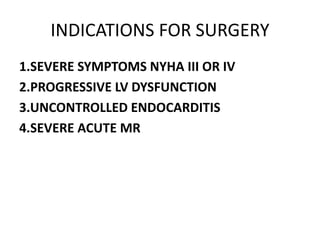
INDICATIONS FOR SURGERY
1.SEVERE SYMPTOMS NYHA III OR IV
2.PROGRESSIVE LV DYSFUNCTION
3.UNCONTROLLED ENDOCARDITIS
4.SEVERE ACUTE MR
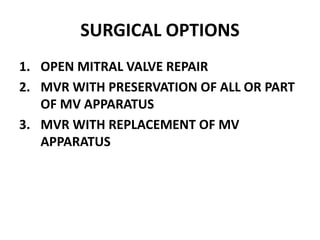
SURGICAL OPTIONS
1. OPEN MITRAL VALVE REPAIR
2. MVR WITH PRESERVATION OF ALL OR PART
OF MV APPARATUS
3. MVR WITH REPLACEMENT OF MV
APPARATUS
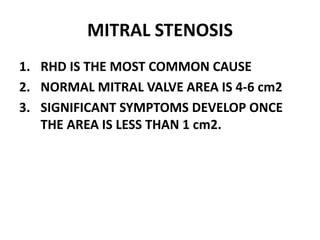
MITRAL STENOSIS
1. RHD IS THE MOST COMMON CAUSE
2. NORMAL MITRAL VALVE AREA IS 4-6 cm2
3. SIGNIFICANT SYMPTOMS DEVELOP ONCE
THE AREA IS LESS THAN 1 cm2.
CLINICAL FEATURES OF MITRAL
STENOSIS
1. ASYMPTOMATIC
2. FATIGUE
3. DYSPNEA
4. COUGH AND HEMOPTTYSIS
5. IRREGULAR PULSE
6. TAPING APEX BEAT
7. LOUD S 1
8. OPENING SNAP, MID-DIASTOLIC MURMUR
9. PATIENTS IN SINUS RHYTHM –PRE SYSTOLIC
ACCENTUATION
INDICATIONS FOR SURGERY
1. SEVERE SYMPTOMS NYHA III OR IV
2. MODERATE OR SEVERE STENOSIS MITRAL
VALVE AREA  1.5cm2
3. SYSTEMIC EMBOLI
TYPES OF PROSTHETIC VALVES
1.MECHANICAL
a. BALL AND CAGE VALVE
b. TILTING DISC VALVE
c. BILEAFLET VALVE
2.BIOLOGICAL
a. ALLOGRAFTS
b. AUTOGRAFTS
c. HETEROGRAFTS
I.STENTED
II. STENTLESS
POSTAOP CARE
5 “headaches”
● Hypothermia
● Hypovolemia
● Hypotension
● Hypertension
● Hemorrhage
• Improvements in postoperative care
have centered on decreasing the
adrenergic surge associated with
surgery and halting platelet activation
and microvascular thrombosis
Princip cardsurg lect   copy

Princip cardsurg lect copy

  • 1.
  • 2.
    Principles of cardiacsurgery Dr . Nadir Mehmood Asstt Prof of Surgery RMC
  • 3.
    LEARNING OBJECTIVES At theend of this discussion, a student will be able to; • Tell why cardiac surgery is more difficult • Enlist the historical technical milestones necessary for cardiac surgery • Enumerate the pre op preparation and assessment parameters • Enlist the Conduits used for bypass and type of incisions for cardiac surgery • Describe the steps of Conventional CABG procedure • Summarize indications for cardiac surgery • Enlist important factors in postoperative management of cardiac surgery patients
  • 4.
    • Prior to1930’s, heart surgery seen as impossible, with high morbidity and mortality – “Surgery of the heart has probably reached the limits set by nature to all surgery” –Stephen Paget, 1896, Surgery of the Chest • 1937: Dr. John Gibbon designs heart-lung machine, which enables cardiopulmonary bypass (CPB) • 1955: Vineburg and Buller implant internal mammary artery into myocardium to treat cardiac ischemia and angina • 1958: Longmire, Cannon and Kattus at UCLA perform first open coronary artery endarterectomy without CPB • During 1960’s and 1970’s, CPB and cardioplegic arrest are adopted, allowing Coronary Artery Bypass Graft (CABG) to emerge as a viable surgical treatment RG Cohen, et al; Minimally Invasive Cardiac Surgery
  • 5.
    INDICATIONS FOR SURGERYERY ●CABG (coronaryartery bypass grafting) ●Valve repair / replacement ●Thoracic aneaurysm repair ●Surgical management of arrhythmia ●Ventricular reconstruction ●Removal of myxoma ●Surgical correction for congenital heart diseases ●Insertion of ventricular assist device ●Chronic angina ●Unstable angina ●Acute myocardial infarction ●Acute failure of percutaneous transluminal coronary angioplasty (PTCA) ●Cardiac transplantation
  • 6.
    Why cardiac surgeryis more difficult ? • Moving organ • Contains blood • Vital, and no place for mistakes. • Shared with anesthetist • Very sensitive to electrolyte derangements
  • 7.
    RATIONALE FOR CARDIACSURGERY SURGICAL MANAGEMENT OF HEART DISEASES REQUIRES INFORMATION : • OUTLOOK IF CONDITION IS UN- OPERATED • THE RISK OF OPERATION ITSELF INCLUDING FAILURE TO DEAL WITH THE DISEASE • OUTLOOK FOLLOWING SUCCESSFUL SURGERY
  • 8.
    Approaches for cardiacsurgery: The main and the commonest incision for the cardiac surgery is median sternotomy. But others could be used like: • Right anterolateral thoracotomy • Left posterolateral thoracotomy • Minimally invasives. • Endoscopic approaches.
  • 12.
    Preoperative Preparation of thePatient • Systems Approach to Preoperative Evaluation • Additional Preoperative Considerations • Preoperative Checklist
  • 13.
    Determining the Needfor Surgery • Patients are often referred to surgeons with a suspected surgical diagnosis and the results of supporting investigations in hand. In this context, the surgeon's initial encounter with the patient may be largely directed toward confirmation of relevant physical findings and review of the clinical history and laboratory and investigative tests that support the diagnosis.
  • 14.
    Perioperative Decision Making •Once the decision has been made to proceed with operative management, a number of considerations must be addressed regarding the timing and site of surgery, the type of anesthesia, and the preoperative preparation necessary to understand the patient's risk and optimize the outcome.
  • 15.
  • 16.
    One of thefirst anesthesia risk categorization systems was the ASA classification. It has five stratifications: I—Normal healthy patient II—Patient with mild systemic disease III—Patient with severe systemic disease that limits activity but is not incapacitating IV—Patient who has incapacitating disease that is a constant threat to life V—Moribund patient not expected to survive 24 hours with or without an operation
  • 17.
    POTENTIAL RISKS • Pulmonary •Renal • Endocrine • Nutritional Status • Obesity • Antibiotic Prophylaxis
  • 18.
    • Identification ofcoexisting cardiovascular, circulatory, hematologic, and metabolic derangements secondary to renal dysfunction are the goals of preoperative evaluation in these patients
  • 19.
    Adverse outcome indicators 70years or older self-reported alcohol abuse poor cognitive status poor functional status markedly abnormal preoperative serum sodium, potassium, albumin or glucose level
  • 20.
    Cardio pulmonary bypass(CPB) Basic principle of CPB is: • Bypass the right and left side of heart • Thermal regulation • Oxygenation • Filtration
  • 21.
    Rationale for theuse of CPB  During open heart surgery, CPB provides the surgeon with a clear field for cardiac manipulation and maintenance of pulmonary and hemodynamic stability. The objective of heart- lung pump is to provide enough flow to maintain a sufficient cardiac index for tissue perfusion.  The addition of cardioplegia allows the surgeon to work in a motionless and bloodless field.  The addition of hypothermia to CPB has been standard practice since Bigelow demonstrated improved tolerance of the entire organism to ischemia accompanied by hypothermia.
  • 22.
    The CPB Circuit Venous conduit Drains blood from venous systemic circulation. Usually a cannula for blood drainage inserted into the right atrium with openings for IVC and SVC.  Arterial blood return Returns oxygenated blood back to the body via arterial cannula most often placed in the ascending aorta.  In the middle Pump/Oxygenator is run by the perfusionist. Provides oxygenation and means of delivering various elements to patient during CPB. Then pumps blood back to the arterial circulation.
  • 24.
    Sites of arterialcanulation • Ascending aorta • Arch of aorta. • Right subclavian. • Femoral artery.
  • 25.
    Steps of cardiacsurgery with the use of CPB, (simplified)  Heparinize.  Insert canulae  Connect to lines already prepared.  Go on bypass.  Demand for the required temperature  Cross clamp the aorta  Give cardioplegia  Do the procedure  No more plegia  Re-warm  Stop CPB.  Remove the cross clamp  Remove the canulae
  • 26.
    Monitoring during CPB Thiswill be done by the coordination between perfusionist and anesthetist Includes monitoring of : • Perfusion pressure • Venous return • Urine output • Temperature • Blood gas • Electrolytes
  • 27.
    Monitoring during CPB •ACT, (Clotting time) • PCV • PO2 and PCO2 • ECG activities if any • Time for the plegia • TEE and presence of air in the heart. • EEG in some cases of circulatory arrest. • Need for medications
  • 28.
    • Most commonarteries bypassed: – Right coronary artery – Left anterior descending coronary artery – Circumflex coronary artery Adapted from BJ Harlan, et al; Manual of Cardiac Surgery
  • 29.
    • Saphenous veinused for bypassing right coronary artery and circumflex coronary artery • Internal mammary artery (IMA) used for bypassing left anterior descending coronary artery – Patency rate over 90% after 10 years • If more veins are needed, alternative sites such as upper extremity veins can be used – Patency rate as low as 47% after 4.6 years BJ Harlan, et al; Manual of Cardiac Surgery
  • 30.
    • Positive: – Reliefof angina in 90% of patients – 80% angina free after 5 years – Survival about 95% after 1 year – Low chance of restenosis • Negative: – 2-3 days in ICU, 7-10 day total hospital stay – 3-6 month full recovery time – 5-10% have post-op complications – High cost ($25,000-$30,000) – Long time on CPB • Depression of the patient's immune system • Postoperative bleeding from inactivation of the blood clotting system • Hypotension BJ Harlan, et al; Manual of Cardiac Surgery, WebMD.com, American College of Cardiology Foundation
  • 31.
    • CABG resultsin a lower restenosis rate as compared with stenting – Drug-eluting stents will narrow this difference • Due to repeat treatment, costs for stents and surgery are approximately equal after 2 years • Minimally invasive surgeries will result in fewer complications from surgery and a shorter hospital stay – This leads to lower costs for surgery, essentially removing the cost advantage of stenting • Diabetics have a substantially better response to CABG than to angioplasty and stenting Current Controlled Trials in Cardiovascular Medicine
  • 32.
    CARDIAC SURGERY VALVULAR HEARTDISEASES a. CONGENITAL b. AQUIRED
  • 33.
    MITRAL VALVE DISEASE ETIOLOGY STENOSISREGURGITATION 1.RHD 2.CALCIFICATION 3.CONGENITAL 1.RHD 2.MVP 3.DCMP 4.IHD 5.ENDOCARDITIS
  • 34.
    CLINICAL FEATURES OFMR ACUTE MR CHRONIC MR 1. DYSPNEA 2. TACHYCARDIA 3. LOW VOLUME PULSE 4. PANSYSTOLIC MURMUR 1.ASYMPTOMATIC 2.FATIGUE 3.DYSPNEA 4.ORTHOPNEA 5.ATRIAL FIB. 6.HEAVING APEX BEAT 7.PANSYSTOLIC MURMUR
  • 35.
    INDICATIONS FOR SURGERY 1.SEVERESYMPTOMS NYHA III OR IV 2.PROGRESSIVE LV DYSFUNCTION 3.UNCONTROLLED ENDOCARDITIS 4.SEVERE ACUTE MR
  • 36.
    SURGICAL OPTIONS 1. OPENMITRAL VALVE REPAIR 2. MVR WITH PRESERVATION OF ALL OR PART OF MV APPARATUS 3. MVR WITH REPLACEMENT OF MV APPARATUS
  • 37.
    MITRAL STENOSIS 1. RHDIS THE MOST COMMON CAUSE 2. NORMAL MITRAL VALVE AREA IS 4-6 cm2 3. SIGNIFICANT SYMPTOMS DEVELOP ONCE THE AREA IS LESS THAN 1 cm2.
  • 38.
    CLINICAL FEATURES OFMITRAL STENOSIS 1. ASYMPTOMATIC 2. FATIGUE 3. DYSPNEA 4. COUGH AND HEMOPTTYSIS 5. IRREGULAR PULSE 6. TAPING APEX BEAT 7. LOUD S 1 8. OPENING SNAP, MID-DIASTOLIC MURMUR 9. PATIENTS IN SINUS RHYTHM –PRE SYSTOLIC ACCENTUATION
  • 39.
    INDICATIONS FOR SURGERY 1.SEVERE SYMPTOMS NYHA III OR IV 2. MODERATE OR SEVERE STENOSIS MITRAL VALVE AREA  1.5cm2 3. SYSTEMIC EMBOLI
  • 40.
    TYPES OF PROSTHETICVALVES 1.MECHANICAL a. BALL AND CAGE VALVE b. TILTING DISC VALVE c. BILEAFLET VALVE 2.BIOLOGICAL a. ALLOGRAFTS b. AUTOGRAFTS c. HETEROGRAFTS I.STENTED II. STENTLESS
  • 41.
    POSTAOP CARE 5 “headaches” ●Hypothermia ● Hypovolemia ● Hypotension ● Hypertension ● Hemorrhage
  • 42.
    • Improvements inpostoperative care have centered on decreasing the adrenergic surge associated with surgery and halting platelet activation and microvascular thrombosis