C4 - Discontinuities
This unit discusses three types of discontinuities (breaks in a graph). Each one has
specific algebraic characteristics that result in a certain type of behaviour on a graph.


Infinite Discontinuities
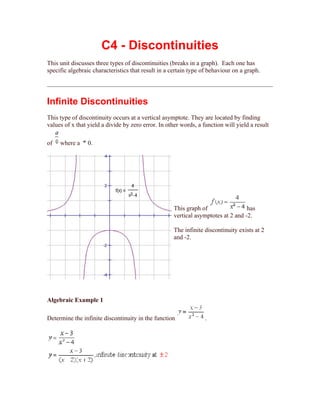
This type of discontinuity occurs at a vertical asymptote. They are located by finding
values of x that yield a divide by zero error. In other words, a function will yield a result

of   where a     0.


                                                     This graph of                 has
                                                     vertical asymptotes at 2 and -2.

                                                     The infinite discontinuity exists at 2
                                                     and -2.


Algebraic Example 1

Determine the infinite discontinuity in the function              .
Algebraic Example 2

Determine the infinite discontinuity in the function                 .


Jump Discontinuities
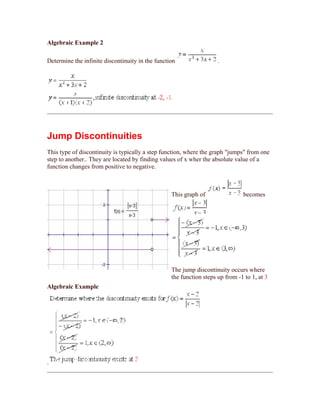
This type of discontinuity is typically a step function, where the graph "jumps" from one
step to another.. They are located by finding values of x wher the absolute value of a
function changes from positive to negative.


                                                  This graph of                becomes


                                                  The jump discontinuity occurs where
                                                  the function steps up from -1 to 1, at 3
Algebraic Example


.
Removable Discontinuities
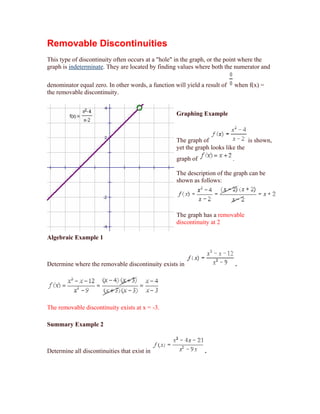
This type of discontinuity often occurs at a "hole" in the graph, or the point where the
graph is indeterminate. They are located by finding values where both the numerator and

denominator equal zero. In other words, a function will yield a result of   when f(x) =
the removable discontinuity.


                                                    Graphing Example


                                                    The graph of                 is shown,
                                                    yet the graph looks like the
                                                    graph of                .

                                                    The description of the graph can be
                                                    shown as follows:


                                                    The graph has a removable
                                                    discontinuity at 2

Algebraic Example 1


Determine where the removable discontinuity exists in                           .


The removable discontinuity exists at x = -3.

Summary Example 2


Determine all discontinuities that exist in                     .
A removable discontinuity exists at x = -3.
An infinite discontinuity exists at x = 0 and x = 3.

C4 discontinuities

  • 1.
    C4 - Discontinuities Thisunit discusses three types of discontinuities (breaks in a graph). Each one has specific algebraic characteristics that result in a certain type of behaviour on a graph. Infinite Discontinuities This type of discontinuity occurs at a vertical asymptote. They are located by finding values of x that yield a divide by zero error. In other words, a function will yield a result of where a 0. This graph of has vertical asymptotes at 2 and -2. The infinite discontinuity exists at 2 and -2. Algebraic Example 1 Determine the infinite discontinuity in the function .
  • 2.
    Algebraic Example 2 Determinethe infinite discontinuity in the function . Jump Discontinuities This type of discontinuity is typically a step function, where the graph "jumps" from one step to another.. They are located by finding values of x wher the absolute value of a function changes from positive to negative. This graph of becomes The jump discontinuity occurs where the function steps up from -1 to 1, at 3 Algebraic Example .
  • 3.
    Removable Discontinuities This typeof discontinuity often occurs at a "hole" in the graph, or the point where the graph is indeterminate. They are located by finding values where both the numerator and denominator equal zero. In other words, a function will yield a result of when f(x) = the removable discontinuity. Graphing Example The graph of is shown, yet the graph looks like the graph of . The description of the graph can be shown as follows: The graph has a removable discontinuity at 2 Algebraic Example 1 Determine where the removable discontinuity exists in . The removable discontinuity exists at x = -3. Summary Example 2 Determine all discontinuities that exist in .
  • 4.
    A removable discontinuityexists at x = -3. An infinite discontinuity exists at x = 0 and x = 3.