Lesson 10.1 Using the periodic table
• Trace the development of the periodic table.
• Identify key features of the periodic table.
atomic number: the number of protons in an atom
The periodic table evolved over
time as scientists discovered more
useful ways to compare and
organize the elements.
Development of the Periodic Table
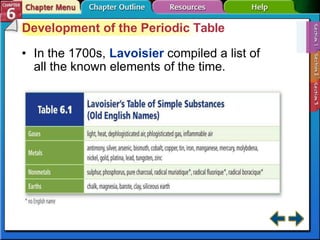
• In the 1700s, Lavoisier compiled a list of
all the known elements of the time.
Development of the Periodic Table (cont.)
• The 1800s brought large amounts of
information and scientists needed a way to
organize knowledge about elements.
• Dimitri Mendeleev was working a way to
classify elements
• At that time 60 elements had been
discovered.
• He arranged the elements in a list using their
atomic masses
• He noticed that the properties of the elements
seemed to repeat in a pattern
Development of the Periodic Table (cont.)
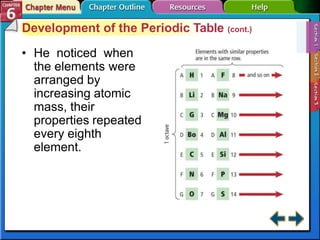
• He noticed when
the elements were
arranged by
increasing atomic
mass, their
properties repeated
every eighth
element.
Development of the Periodic Table (cont.)
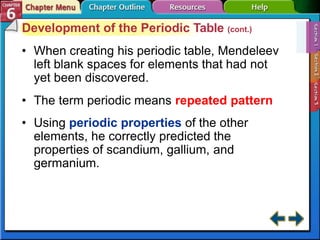
• When creating his periodic table, Mendeleev
left blank spaces for elements that had not
yet been discovered.
• The term periodic means repeated pattern
• Using periodic properties of the other
elements, he correctly predicted the
properties of scandium, gallium, and
germanium.
• Moseley rearranged the table by
increasing atomic number, and resulted
in a clear periodic pattern – our modern
periodic table.
• Periodic repetition of chemical and
physical properties of the elements when
they are arranged by increasing atomic
number is called periodic law.
Development of the Periodic Table (cont.)
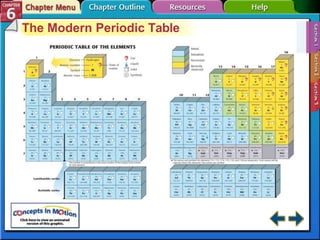
The Modern Periodic Table
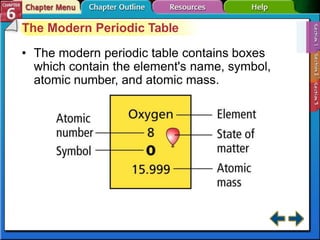
• The modern periodic table contains boxes
which contain the element's name, symbol,
atomic number, and atomic mass.
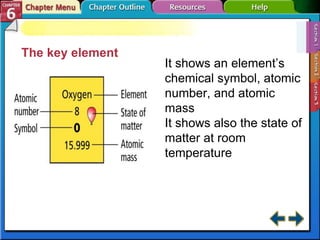
The key element
It shows an element’s
chemical symbol, atomic
number, and atomic
mass
It shows also the state of
matter at room
temperature
The Modern Periodic Table (cont.)
• Groups:
• Columns of elements in the periodic table .
• Elements in the same group have similar
chemical properties and react with other
elements in similar ways.
• periods.
• The rows in the periodic table
• The number of each elements increases by
one as you move left to right across a period
The Modern Periodic Table (cont.)
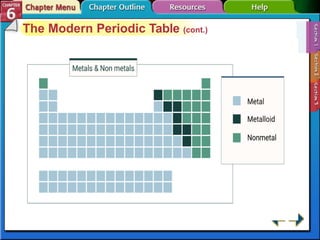
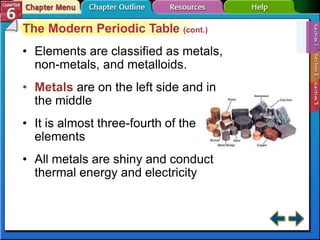
• Elements are classified as metals,
non-metals, and metalloids.
• Metals are on the left side and in
the middle
• It is almost three-fourth of the
elements
• All metals are shiny and conduct
thermal energy and electricity
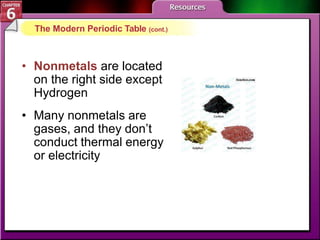
• Nonmetals are located
on the right side except
Hydrogen
• Many nonmetals are
gases, and they don’t
conduct thermal energy
or electricity
The Modern Periodic Table (cont.)
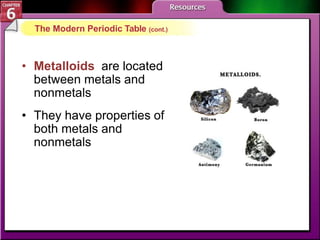
• Metalloids are located
between metals and
nonmetals
• They have properties of
both metals and
nonmetals
The Modern Periodic Table (cont.)
The Modern Periodic Table
Lesson 10.2 Metals
• Trace What elements are metals?
• Identify the properties of metals.
Metals : is an element that is generally shiny
Luster : describes the ability of a metal to reflect light
The periodic table evolved over time
as scientists discovered more useful
ways to compare and organize the
elements.
Metals
• Metals are elements that are generally shiny
when smooth and clean, solid at room
temperature, good conductors of heat and
electricity, malleable, and ductile.
• Physical properties of metals:
 Luster and conductivity
 Ductility and malleability
 Others
Luster and conductivity
• Luster : describes the ability of a metal to
reflect light
Gold is an expensive metal and is used for its
luster
• Conductivity : ability to conduct heat and
electricity
Cupper used in electrical wire not gold
because it is cheap
Ductility and malleability
• Ductility : is the ability to be pulled into thin
wires
Gold is the most ductile and malleable metal
• Malleability : is the ability of a substance
to be hammered or rolled into sheets
Other physical properties
 Density
 Strength
 Boiling point
 Melting point
All are greater for metals than those of other
elements
Chemical properties of metal
 It is the ability or inability of a substance to
change into one or more new substances
 Metals in the same group usually have
similar properties
Group 1: Alkali metals
• are all the elements in group 1 except
hydrogen, and are very reactive.
• They have similar chemical properties
• Silvery appearance , soft , the lowest density
they could float on water
Group 2: Alkaline Earth metals
• are all the elements in group , react quickly
with other elements
• Always combine with other elements
• They have similar chemical properties
• Silvery appearance , soft , the lowest density
but greater than alkali metals
Groups 3-12 Transition elements
• The transition elements are divided into
two blocks
 transition metals in the center of the
table
 inner transition metals includes two
rows in the bottom
• The two sets of inner transition metals are
called :
Lanthanide series - Actinide series.
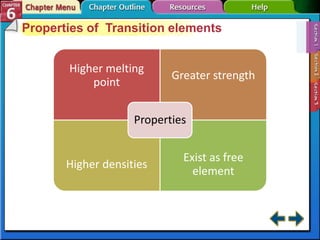
Properties of Transition elements
Higher melting
point
Greater strength
Higher densities
Exist as free
element
Properties
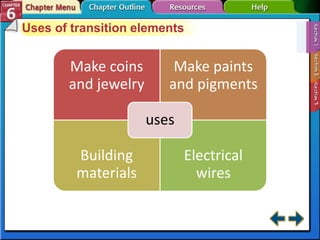
Uses of transition elements
Make coins
and jewelry
Make paints
and pigments
Building
materials
Electrical
wires
uses
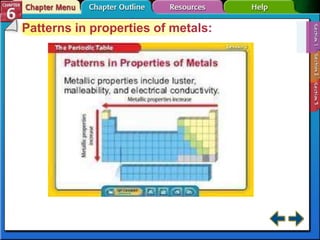
Patterns in properties of metals:
Lesson 10.3 : Nonmetals and metalloids
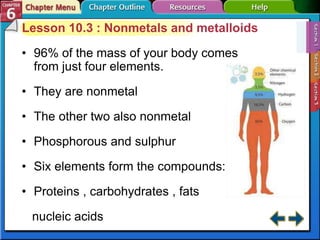
• 96% of the mass of your body comes
from just four elements.
• They are nonmetal
• The other two also nonmetal
• Phosphorous and sulphur
• Six elements form the compounds:
• Proteins , carbohydrates , fats
nucleic acids
Lesson 10.3 : Nonmetals and metalloids
• Non-metals are elements that have no
metallic properties
• Non-metals are elements that are
generally gases at room temperature
• Those that are solid are brittle, dull-
looking solids, and poor conductors of
heat and electricity.
• They are used as insulators
Lesson 10.3 : Nonmetals and metalloids
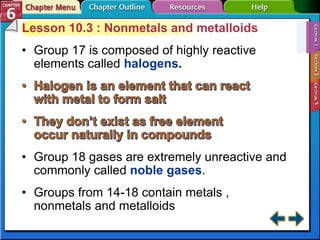
• Group 17 is composed of highly reactive
elements called halogens.
• Group 18 gases are extremely unreactive and
commonly called noble gases.
• Groups from 14-18 contain metals ,
nonmetals and metalloids
Lesson 10.3 : Nonmetals and metalloids
• Group 18 is called the Noble gases.
• Group 18 includes
 Helium
 Neon
 Argon
 Krypton
Lesson 10.3 : Nonmetals and metalloids
• Hydrogen gas
• Has the smallest atomic mass
• It is the most common element in the
universe
• It is classified nonmetal but it has some
properties similar to group 1 alkali metals
• In its liquid form it conducts electricity just like
metal
• On earth it behaves like nonmetal
Metalloids
• Metalloids are elements that has
physical and chemical properties of both
metals and nonmetals
• Silicon is the most abundant metalloid in
the universe
• Most sand is made of a compound
containing silicon
• Used in many products
Semiconductors
• A property of metalloids is the ability to act as a
semiconductor.
• A semiconductor conducts electricity at high
temperatures, but not at low temperatures.
• At high temperatures, metalloids act like
metals and conduct electricity. But at lower
temperatures, metalloids act like nonmetals
and stop electricity from flowing.
• This property is useful in electronic devices
such as computers, televisions, and solar
cells..

Ch.10 L 1 using the periodic table.pptx

  • 2.
    Lesson 10.1 Usingthe periodic table • Trace the development of the periodic table. • Identify key features of the periodic table. atomic number: the number of protons in an atom The periodic table evolved over time as scientists discovered more useful ways to compare and organize the elements.
  • 3.
    Development of thePeriodic Table • In the 1700s, Lavoisier compiled a list of all the known elements of the time.
  • 4.
    Development of thePeriodic Table (cont.) • The 1800s brought large amounts of information and scientists needed a way to organize knowledge about elements. • Dimitri Mendeleev was working a way to classify elements • At that time 60 elements had been discovered. • He arranged the elements in a list using their atomic masses • He noticed that the properties of the elements seemed to repeat in a pattern
  • 5.
    Development of thePeriodic Table (cont.) • He noticed when the elements were arranged by increasing atomic mass, their properties repeated every eighth element.
  • 6.
    Development of thePeriodic Table (cont.) • When creating his periodic table, Mendeleev left blank spaces for elements that had not yet been discovered. • The term periodic means repeated pattern • Using periodic properties of the other elements, he correctly predicted the properties of scandium, gallium, and germanium.
  • 7.
    • Moseley rearrangedthe table by increasing atomic number, and resulted in a clear periodic pattern – our modern periodic table. • Periodic repetition of chemical and physical properties of the elements when they are arranged by increasing atomic number is called periodic law. Development of the Periodic Table (cont.)
  • 8.
    The Modern PeriodicTable • The modern periodic table contains boxes which contain the element's name, symbol, atomic number, and atomic mass.
  • 9.
    The key element Itshows an element’s chemical symbol, atomic number, and atomic mass It shows also the state of matter at room temperature
  • 10.
    The Modern PeriodicTable (cont.) • Groups: • Columns of elements in the periodic table . • Elements in the same group have similar chemical properties and react with other elements in similar ways. • periods. • The rows in the periodic table • The number of each elements increases by one as you move left to right across a period
  • 11.
    The Modern PeriodicTable (cont.)
  • 12.
    The Modern PeriodicTable (cont.) • Elements are classified as metals, non-metals, and metalloids. • Metals are on the left side and in the middle • It is almost three-fourth of the elements • All metals are shiny and conduct thermal energy and electricity
  • 13.
    • Nonmetals arelocated on the right side except Hydrogen • Many nonmetals are gases, and they don’t conduct thermal energy or electricity The Modern Periodic Table (cont.)
  • 14.
    • Metalloids arelocated between metals and nonmetals • They have properties of both metals and nonmetals The Modern Periodic Table (cont.)
  • 15.
  • 16.
    Lesson 10.2 Metals •Trace What elements are metals? • Identify the properties of metals. Metals : is an element that is generally shiny Luster : describes the ability of a metal to reflect light The periodic table evolved over time as scientists discovered more useful ways to compare and organize the elements.
  • 17.
    Metals • Metals areelements that are generally shiny when smooth and clean, solid at room temperature, good conductors of heat and electricity, malleable, and ductile. • Physical properties of metals:  Luster and conductivity  Ductility and malleability  Others
  • 18.
    Luster and conductivity •Luster : describes the ability of a metal to reflect light Gold is an expensive metal and is used for its luster • Conductivity : ability to conduct heat and electricity Cupper used in electrical wire not gold because it is cheap
  • 19.
    Ductility and malleability •Ductility : is the ability to be pulled into thin wires Gold is the most ductile and malleable metal • Malleability : is the ability of a substance to be hammered or rolled into sheets
  • 20.
    Other physical properties Density  Strength  Boiling point  Melting point All are greater for metals than those of other elements
  • 21.
    Chemical properties ofmetal  It is the ability or inability of a substance to change into one or more new substances  Metals in the same group usually have similar properties
  • 22.
    Group 1: Alkalimetals • are all the elements in group 1 except hydrogen, and are very reactive. • They have similar chemical properties • Silvery appearance , soft , the lowest density they could float on water
  • 23.
    Group 2: AlkalineEarth metals • are all the elements in group , react quickly with other elements • Always combine with other elements • They have similar chemical properties • Silvery appearance , soft , the lowest density but greater than alkali metals
  • 24.
    Groups 3-12 Transitionelements • The transition elements are divided into two blocks  transition metals in the center of the table  inner transition metals includes two rows in the bottom • The two sets of inner transition metals are called : Lanthanide series - Actinide series.
  • 25.
    Properties of Transitionelements Higher melting point Greater strength Higher densities Exist as free element Properties
  • 26.
    Uses of transitionelements Make coins and jewelry Make paints and pigments Building materials Electrical wires uses
  • 27.
  • 28.
    Lesson 10.3 :Nonmetals and metalloids • 96% of the mass of your body comes from just four elements. • They are nonmetal • The other two also nonmetal • Phosphorous and sulphur • Six elements form the compounds: • Proteins , carbohydrates , fats nucleic acids
  • 29.
    Lesson 10.3 :Nonmetals and metalloids • Non-metals are elements that have no metallic properties • Non-metals are elements that are generally gases at room temperature • Those that are solid are brittle, dull- looking solids, and poor conductors of heat and electricity. • They are used as insulators
  • 30.
    Lesson 10.3 :Nonmetals and metalloids • Group 17 is composed of highly reactive elements called halogens. • Group 18 gases are extremely unreactive and commonly called noble gases. • Groups from 14-18 contain metals , nonmetals and metalloids
  • 31.
    Lesson 10.3 :Nonmetals and metalloids • Group 18 is called the Noble gases. • Group 18 includes  Helium  Neon  Argon  Krypton
  • 32.
    Lesson 10.3 :Nonmetals and metalloids • Hydrogen gas • Has the smallest atomic mass • It is the most common element in the universe • It is classified nonmetal but it has some properties similar to group 1 alkali metals • In its liquid form it conducts electricity just like metal • On earth it behaves like nonmetal
  • 33.
    Metalloids • Metalloids areelements that has physical and chemical properties of both metals and nonmetals • Silicon is the most abundant metalloid in the universe • Most sand is made of a compound containing silicon • Used in many products
  • 34.
    Semiconductors • A propertyof metalloids is the ability to act as a semiconductor. • A semiconductor conducts electricity at high temperatures, but not at low temperatures. • At high temperatures, metalloids act like metals and conduct electricity. But at lower temperatures, metalloids act like nonmetals and stop electricity from flowing. • This property is useful in electronic devices such as computers, televisions, and solar cells..