CHEMICAL PROPERTIES
OF METALS
BY:
RAAHUL.B.S
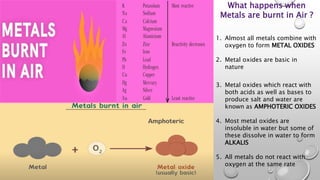
What happens when
Metals are burnt in Air ?
1. Almost all metals combine with
oxygen to form METAL OXIDES
2. Metal oxides are basic in
nature
3. Metal oxides which react with
both acids as well as bases to
produce salt and water are
known as AMPHOTERIC OXIDES
4. Most metal oxides are
insoluble in water but some of
these dissolve in water to form
ALKALIS
5. All metals do not react with
oxygen at the same rate
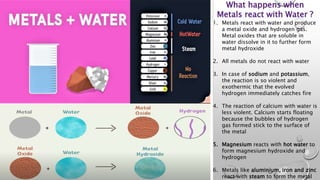
What happens when
Metals react with Water ?
1. Metals react with water and produce
a metal oxide and hydrogen gas.
Metal oxides that are soluble in
water dissolve in it to further form
metal hydroxide
2. All metals do not react with water
3. In case of sodium and potassium,
the reaction is so violent and
exothermic that the evolved
hydrogen immediately catches fire
4. The reaction of calcium with water is
less violent. Calcium starts floating
because the bubbles of hydrogen
gas formed stick to the surface of
the metal
5. Magnesium reacts with hot water to
form magnesium hydroxide and
hydrogen
6. Metals like aluminium, iron and zinc
react with steam to form the metal
What happens when
metals react with acids ?
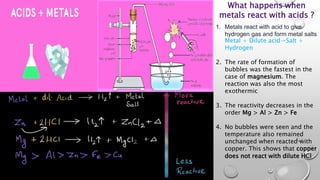
1. Metals react with acid to give
hydrogen gas and form metal salts
Metal + Dilute acid→Salt +
Hydrogen
2. The rate of formation of
bubbles was the fastest in the
case of magnesium. The
reaction was also the most
exothermic
3. The reactivity decreases in the
order Mg > Al > Zn > Fe
4. No bubbles were seen and the
temperature also remained
unchanged when reacted with
copper. This shows that copper
does not react with dilute HCl
METALS + SALT
SOLUTIONS
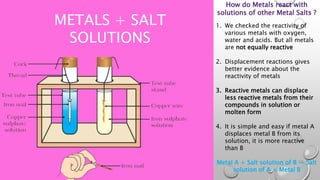
How do Metals react with
solutions of other Metal Salts ?
1. We checked the reactivity of
various metals with oxygen,
water and acids. But all metals
are not equally reactive
2. Displacement reactions gives
better evidence about the
reactivity of metals
3. Reactive metals can displace
less reactive metals from their
compounds in solution or
molten form
4. It is simple and easy if metal A
displaces metal B from its
solution, it is more reactive
than B
Metal A + Salt solution of B → Salt
solution of A + Metal B
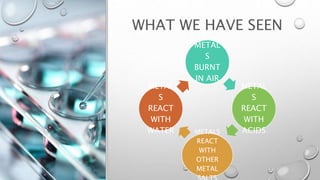
WHAT WE HAVE SEEN
METAL
S
BURNT
IN AIR
METAL
S
REACT
WITH
ACIDS
METALS
REACT
WITH
OTHER
METAL
METAL
S
REACT
WITH
WATER
REACTIVITY
SERIES BY
SIVAPRASA
D
NEXT:

Chemistry-Metals.pptx

  • 1.
  • 2.
    What happens when Metalsare burnt in Air ? 1. Almost all metals combine with oxygen to form METAL OXIDES 2. Metal oxides are basic in nature 3. Metal oxides which react with both acids as well as bases to produce salt and water are known as AMPHOTERIC OXIDES 4. Most metal oxides are insoluble in water but some of these dissolve in water to form ALKALIS 5. All metals do not react with oxygen at the same rate
  • 3.
    What happens when Metalsreact with Water ? 1. Metals react with water and produce a metal oxide and hydrogen gas. Metal oxides that are soluble in water dissolve in it to further form metal hydroxide 2. All metals do not react with water 3. In case of sodium and potassium, the reaction is so violent and exothermic that the evolved hydrogen immediately catches fire 4. The reaction of calcium with water is less violent. Calcium starts floating because the bubbles of hydrogen gas formed stick to the surface of the metal 5. Magnesium reacts with hot water to form magnesium hydroxide and hydrogen 6. Metals like aluminium, iron and zinc react with steam to form the metal
  • 4.
    What happens when metalsreact with acids ? 1. Metals react with acid to give hydrogen gas and form metal salts Metal + Dilute acid→Salt + Hydrogen 2. The rate of formation of bubbles was the fastest in the case of magnesium. The reaction was also the most exothermic 3. The reactivity decreases in the order Mg > Al > Zn > Fe 4. No bubbles were seen and the temperature also remained unchanged when reacted with copper. This shows that copper does not react with dilute HCl
  • 5.
    METALS + SALT SOLUTIONS Howdo Metals react with solutions of other Metal Salts ? 1. We checked the reactivity of various metals with oxygen, water and acids. But all metals are not equally reactive 2. Displacement reactions gives better evidence about the reactivity of metals 3. Reactive metals can displace less reactive metals from their compounds in solution or molten form 4. It is simple and easy if metal A displaces metal B from its solution, it is more reactive than B Metal A + Salt solution of B → Salt solution of A + Metal B
  • 6.
    WHAT WE HAVESEEN METAL S BURNT IN AIR METAL S REACT WITH ACIDS METALS REACT WITH OTHER METAL METAL S REACT WITH WATER
  • 7.